You’ll find Braithwaite four miles west of Bessie in Washita County, where red dirt roads fade into grassland and a lone depot marks where 31 souls once lived. Take State Highway 152 west from Cordell, then venture onto gravel paths requiring patience and 2WD capability. Spring and fall offer the best visiting conditions, when golden hour light transforms the barren landscape into a photographer’s dream. The journey rewards those willing to confront Oklahoma’s most complete emptiness, and there’s much more to discover about this vanished railway town’s story.
Key Takeaways
- Braithwaite is located 4 miles west of Bessie in Washita County, accessible via State Highway 152 west from Cordell.
- Visit during spring or fall for comfortable temperatures, optimal photography lighting, and potential wildlife viewing opportunities.
- The site requires 2WD vehicle access and navigating paved roads that transition to red dirt and gravel surfaces.
- Only lone depot remnants survive in the barren landscape where 31 residents once lived in 1920.
- The schoolhouse foundation and crumbling walls are the primary landmarks remaining from the abandoned 1906 railroad town.
The Rise and Fall of a Railway Town
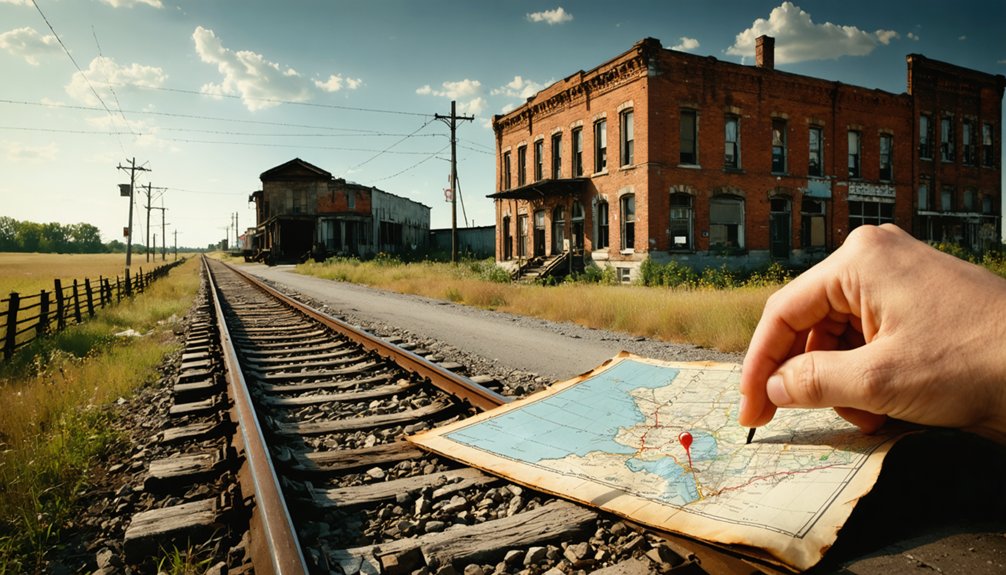
The screech of steel on steel echoed across the prairie in 1906 when construction crews broke ground in Lehigh, Oklahoma, launching what would become the Oklahoma Central Railroad. You’ll find Braithwaite emerged from this railway boom’s original development vision, sprouting alongside tracks meant to haul coal from Lehigh to Chickasha by 1908.
Carter’s Canadian Valley Construction Company carved through unexpected hard rock formations, watching costs spiral beyond estimates. Meanwhile, Dutch financiers discovered his self-dealing scheme and Van Oss cut funding. Construction crews camped west of Blanchard, naming their temporary settlement Middelberg.
Braithwaite couldn’t escape its failed economic expectations. By 1930, it had vanished completely. The Oklahoma Central Railroad itself limped along until 1942 before abandonment claimed the entire line.
What Remains at the Braithwaite Site Today
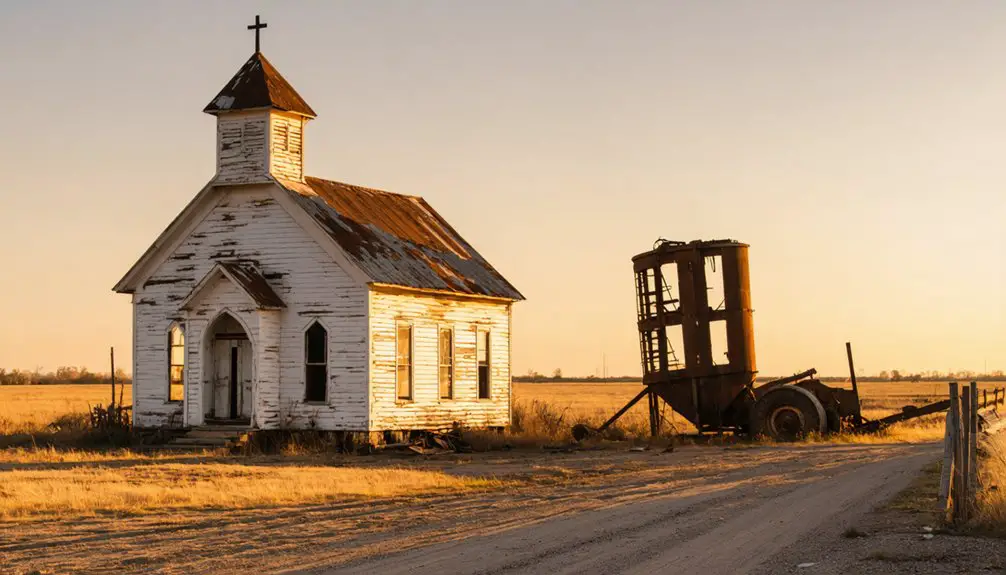
Precious little survives at the Braithwaite site to hint at its brief existence as a railway settlement. You’ll find the lone depot remnants standing as the solitary memorial to this vanished community—no rubble piles, no crumbling foundations, just one weather-beaten structure against the Oklahoma sky.
One weathered depot stands alone—the final witness to Braithwaite’s vanished railway days beneath the Oklahoma sky.
The barren landscape stretches in every direction, making that single building feel even more isolated. Where thirty-one residents once lived in 1920, there’s now only flat grassland and traceable railroad alignments cutting through the prairie.
The minimal present day infrastructure means you’re experiencing pure abandonment here. Spring wildflowers might soften the desolation, but winter reveals the site’s stark reality.
You’ll need 2WD access and a willingness to confront complete emptiness.
Getting to Braithwaite: Directions and Access Routes
You’ll find Braithwaite roughly four miles west of Bessie along Washita County‘s rural roads, where Oklahoma’s red dirt stretches between wheat fields and cattle pastures. The ghost town sits northeast of Cordell at coordinates 35.374, -99.058—a spot you can mark on the Dill City SE quadrangle map before heading out.
While no railway lines cut through this particular location anymore, the old township roads that once connected farming communities still provide your primary access, though you’ll want to verify current conditions since these gravel routes can shift with Oklahoma’s temperamental weather.
Primary Highway Routes In
Since Braithwaite sits tucked away in the western Oklahoma plains, reaching this ghost town requires traversing a patchwork of state highways and weathered county roads that haven’t changed much since the settlement’s heyday.
Your primary highway routes into Braithwaite begin with State Highway 152, running west from Cordell—a straight nine-mile shot through windswept prairie. From Oklahoma City, you’ll take I-40 westbound to US-281 South, though expect seventy miles of open road before turning onto local routes.
The primary highway routes from major cities converge near Cordell and Bessie, where pavement eventually surrenders to gravel. Interstate 40 parallels your journey twenty miles north, while OK-44 offers an alternative approach from Clinton. You’re chasing remnants of forgotten rails here—follow the dust.
Railway Line Landmarks
The ghost of the Chicago, Rock Island and Pacific Railway still haunts this stretch of western Oklahoma, though you won’t find Braithwaite marked on any modern rail map. Your journey to this forgotten settlement means tracking notable rail line infrastructure that once connected prairie towns to the wider world. The tracks have vanished, but remnants remain for those who know where to look.
What You’ll Encounter Along the Old Rail Corridor:
- Weathered railroad grade cuts through red soil hillsides
- Historic train depot remains reduced to concrete foundations
- Abandoned water tower bases marking former stop points
- Overgrown telegraph pole lines paralleling vanished tracks
- Hand-hewn railroad ties scattered in creek beds
These landmarks serve as breadcrumbs leading you toward Braithwaite’s location, where rails once promised prosperity but delivered only memories.
Regional Starting Points
Finding Braithwaite requires patience and a willingness to navigate Oklahoma’s western prairie backcountry, where paved roads eventually yield to red dirt and gravel.
Your journey begins from one of several strategic points. Oklahoma City sits 60 miles northeast—an hour’s drive that shifts from urban sprawl to wide-open rangeland. The neighboring county seat of New Cordell, just 9 miles east, offers the closest civilization and your last chance for supplies.
Clinton, perched along I-40 some 20-30 miles north, provides interstate access before you veer southward on US-183. Accessible rural roads branch westward from these hubs, demanding attention as pavement fragments into washboard surfaces.
You’ll pass through tiny Bessie, 4 miles east of the ghost town, where asphalt finally gives way completely to Oklahoma’s signature red earth.
Best Time to Visit This Washita County Ghost Town
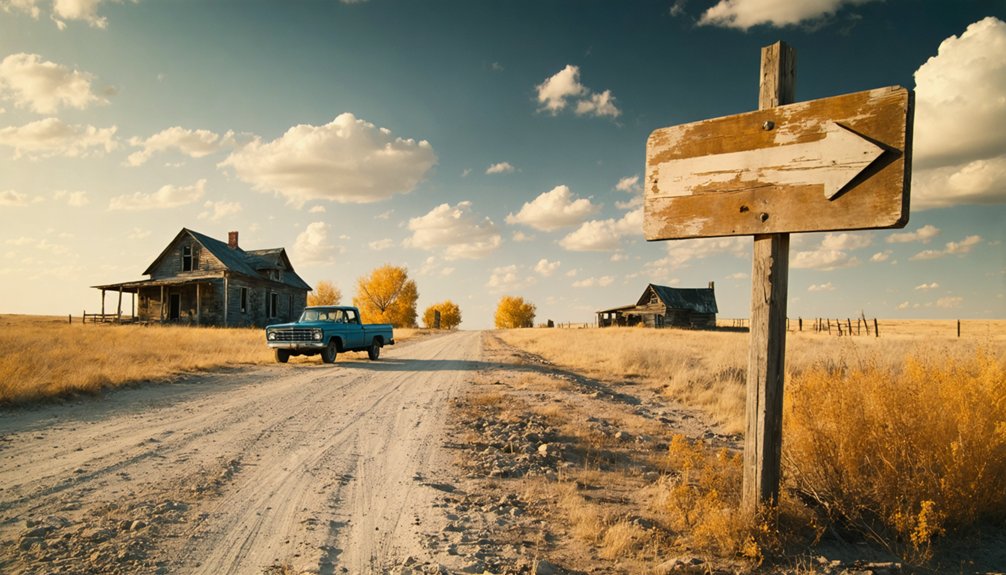
When planning your journey to Braithwaite’s weathered remnants, you’ll find spring and fall offer the sweetest windows for exploration. March through May delivers blooming wildflowers that frame abandoned structures, while September through November paints the ghost town in vivid autumn hues—ideal seasonal conditions for capturing Oklahoma’s forgotten landscapes.
Spring wildflowers and autumn colors create perfect backdrops for photographing Braithwaite’s abandoned structures, making shoulder seasons ideal for ghost town exploration.
Timing Your Visit:
- Peak fall foliage transforms Braithwaite into popular photography locations from late October through early November
- Spring migration brings diverse bird species alongside comfortable temperatures for extended walking tours
- Lower crowds during shoulder seasons grant you solitary encounters with history
- Golden hour lighting in fall creates dramatic shadows across weathered buildings
- Winter solitude offers snow-dusted structures for adventurers seeking complete isolation
Summer’s scorching heat makes midday exploration punishing, while spring and fall temperatures support all-day investigation without extremes.
Exploring the Former School District and Community Landmarks
You’ll find little more than whispers of education when you search for Braithwaite’s schoolhouse, which opened in December 1916 and served local children until the district began fragmenting in 1931.
The community watched its school boundaries shrink through successive cessions to Burns Flat—first in 1931, then 1933, 1938, and 1939—before the final merger erased Braithwaite School District entirely on July 16, 1947.
Today, the rail depot stands as the lone sentinel of this vanished settlement, while the schoolhouse site has disappeared into the landscape, absorbed by the very district that consumed it piece by piece.
Schoolhouse Construction and Timeline
- Original one-room adobe foundation serving pre-1923 education
- Two-acre plot strategically chosen for community access
- July 1923 construction date marking rapid expansion
- Dual-purpose design accommodating church services
- Resident-built walls reflecting self-reliant frontier spirit
- Burns Flat-Dill City Schools at 306 Hwy 44—the 1993 merger headquarters
- Western Technology Center on former Clinton-Sherman Air Force Base grounds
- Burns Flat post office (commissioned February 28, 1936)—Washita County’s last
- One of America’s longest runways, still visible
- Permanent housing structures from the abandoned air base
- Full gas tank plus extra fuel—the nearest station might be 40 miles away
- Paper maps and compass—GPS signals disappear in these flatlands
- Water (one gallon per person)—prairie heat is unforgiving
- First aid kit with snake bite supplies—rattlesnakes inhabit abandoned structures
- Flashlight and spare batteries—exploring decrepit buildings demands proper lighting
These crumbling walls represent something powerful: communities building their own future, classroom by classroom.
District Boundaries Ceded Gradually
As you trace the old boundaries where Braithwaite’s school district once stood, you’re following a slow-motion collapse that unfolded piece by piece over sixteen years. The gradual district annexation began in 1931 when Burns Flat absorbed the first parcels, then continued in 1933, 1938, and 1939—each transfer marking another surrender to reality.
Population decline correlations tell the story: thirty-one residents in 1920 dwindled to twenty-five by 1940. You can still pinpoint where these boundaries shifted at coordinates 35°22′25.18″N 99°3′3.03″W, four miles west of Bessie. By July 16, 1947, Burns Flat claimed the final remnants, erasing what J.S. Braithwaite’s railway stockholder vision had created forty years earlier. Now only the depot remains, testimony to a community that vanished one boundary line at a time.
Burns Flat Merger Legacy
When Burns Flat absorbed Braithwaite’s scattered remnants in 1947, it had already perfected the art of consolidation—the town’s own Consolidated School District Number Seven formed in 1929 by merging three smaller districts into an educational lifeline for western Washita County.
You’ll witness school district consolidation effects firsthand as you explore what remains: a community that’s weathered military base closures and population changes impact that swung from 2,431 residents in 1980 to just 1,948 by 2020.
Legacy landmarks worth seeking:
Nearby Ghost Towns and Historic Sites Worth Visiting
Braithwaite anchors a remarkable concentration of ghost towns scattered across Washita County, transforming a single destination into a weekend explorer’s dream. You’ll find Cloud Chief eight miles southeast of Cordell, where early Oklahoma-era ruins await your camera.
Foss sits twelve miles northwest, offering railroad-era remnants that tell stories of rural economic shifts. Cowden lies seven miles east of Cloud Chief—now a barren site marking agricultural decline. Port, nineteen miles southwest of Cordell, retains minimal structures from its boom-and-bust days. Retrop, ten miles west of Sentinel, completes your ghost town explorations through this fascinating cluster.
These sites connect seamlessly via county routes, letting you craft your own itinerary. Pack water, download offline maps, and embrace the freedom of discovering local county history without tourist crowds or restrictions.
Essential Supplies and Safety Tips for Your Journey
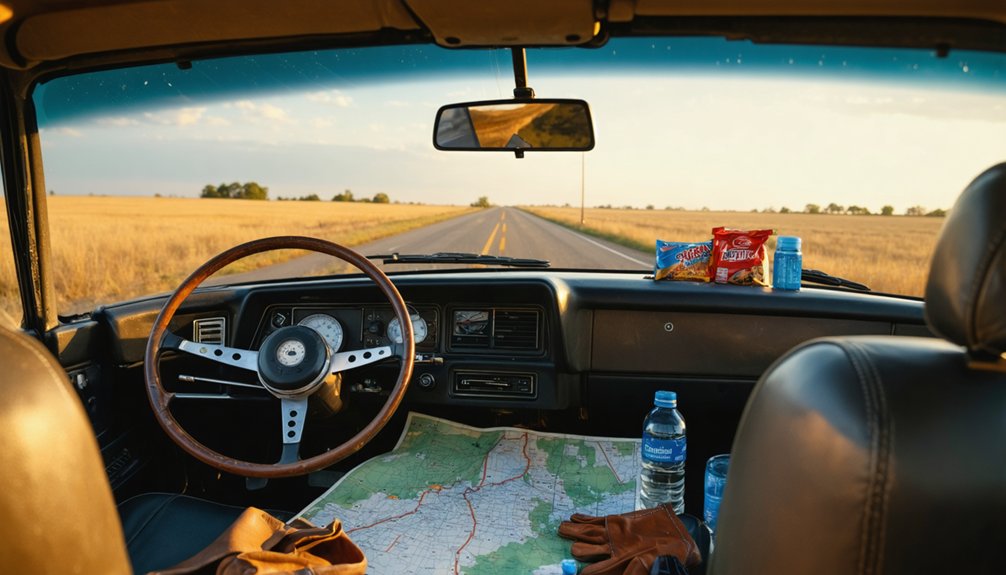
Washita County’s backcountry roads don’t offer gas stations every few miles or cell towers that guarantee five bars of service. You’re venturing into genuine Oklahoma prairie country, where self-reliance isn’t romantic—it’s required.
Before pointing your vehicle toward Braithwaite’s remnants, your pack list items should include:
Smart safety precautions mean telling someone your route and expected return time. Crumbling foundations and rusted metal create hazards that freedom-seekers respect, not ignore.
Capturing the Story: Photography and Documentation Opportunities
Your camera finds its purpose among weathered limestone foundations that jut from prairie grass like broken teeth. Braithwaite’s barren landscape demands patience—you’ll scout closely for stone remnants that mark where neighbors once gathered. The abandoned cemetery offers compelling subjects: gravestones etched with names and dates from 1910-1930 document families who chased Oklahoma’s promise.
Apply photographic composition techniques by framing dangling signs against endless sky, capturing geometric patterns in crumbling foundations where nature reclaims human ambition.
Before arriving, strengthen your documentation through archival research strategies. The Encyclopedia of Oklahoma History and Culture and Morris’s “Ghost Towns of Oklahoma” provide context for what you’ll photograph. Local historical societies hold records of Braithwaite-born residents—some still living—whose stories transform weathered stones into narratives of boom, bust, and resilience.
Frequently Asked Questions
Are There Any Descendants of Original Braithwaite Residents Still Living in the Area?
No verified descendants remain in Braithwaite’s area today. You’ll find the town exists only through local folklore and former residents’ oral histories—whispered memories of a community that vanished, leaving behind dusty questions and abandoned dreams of freedom.
What Happened to the Rail Depot That Still Remains at the Site?
The abandoned rail infrastructure stands weathered but intact, untouched by local preservation efforts. You’ll find the depot’s weathered boards and empty windows telling stories of forgotten journeys, standing alone as Oklahoma’s wind whispers through its sagging frame.
Can Visitors Access Archived Records From the Braithwaite Post Office Years?
You’ll find Braithwaite’s story through National Archives microfilm records, preserved census records from 1920, and archived community newspapers. The original post office documents reveal postmaster names, establishment dates, and the town’s brief existence from 1910-1923.
Why Was J.S. Braithwaite Chosen to Name the Town After Specifically?
No records explain why J.S. Braithwaite earned this honor. You’ll find no documented significant land acquisitions or strategic town planning attributed to him. The naming reason vanished with the town itself—freedom from bureaucracy meant sparse historical recordkeeping.
Were Any Notable Events or Crimes Recorded During Braithwaite’s Active Years?
No high profile disappearances or notorious bootlegging activities were documented during Braithwaite’s brief existence. You’ll find it was a quiet agricultural community that simply faded away economically, leaving behind only memories and barren prairie land.