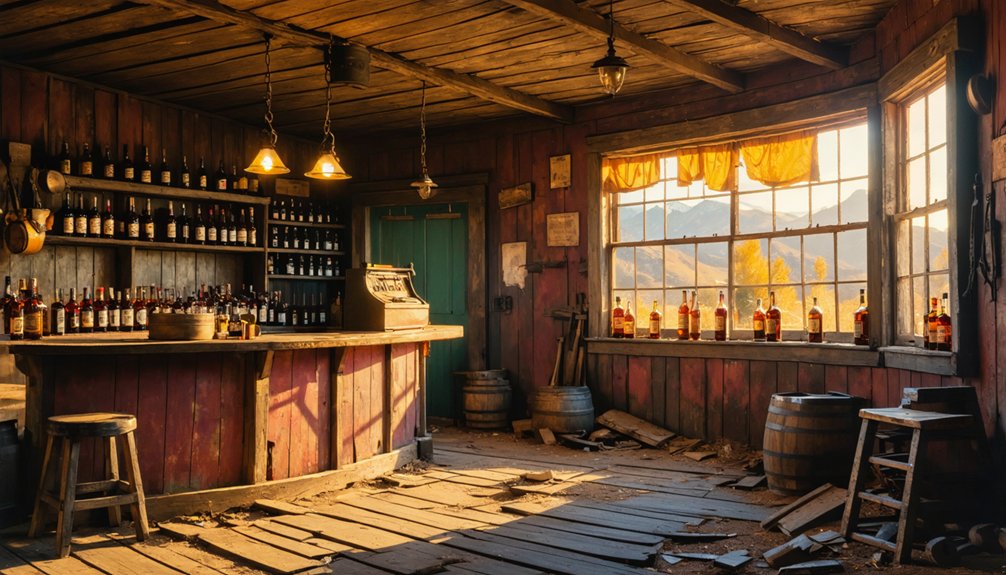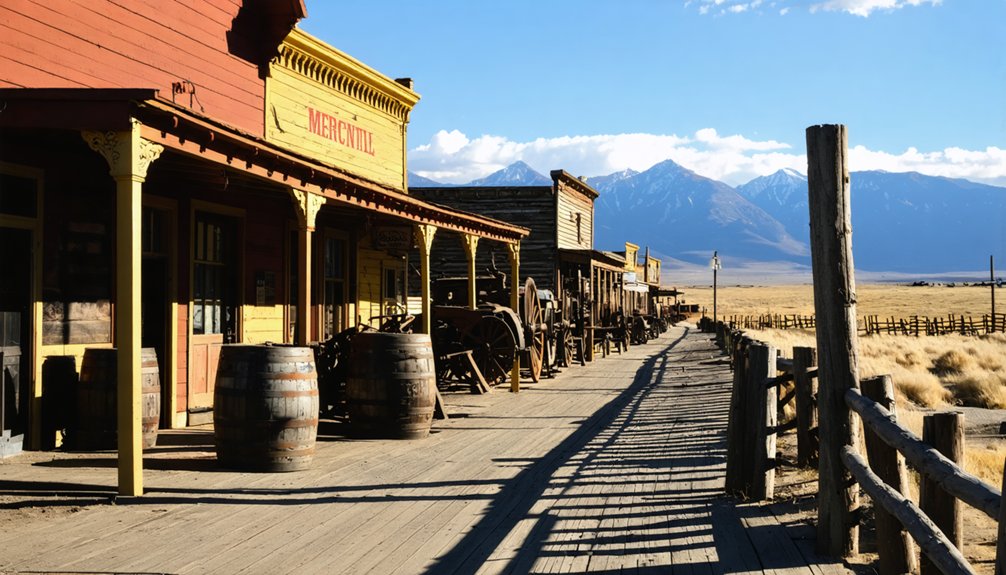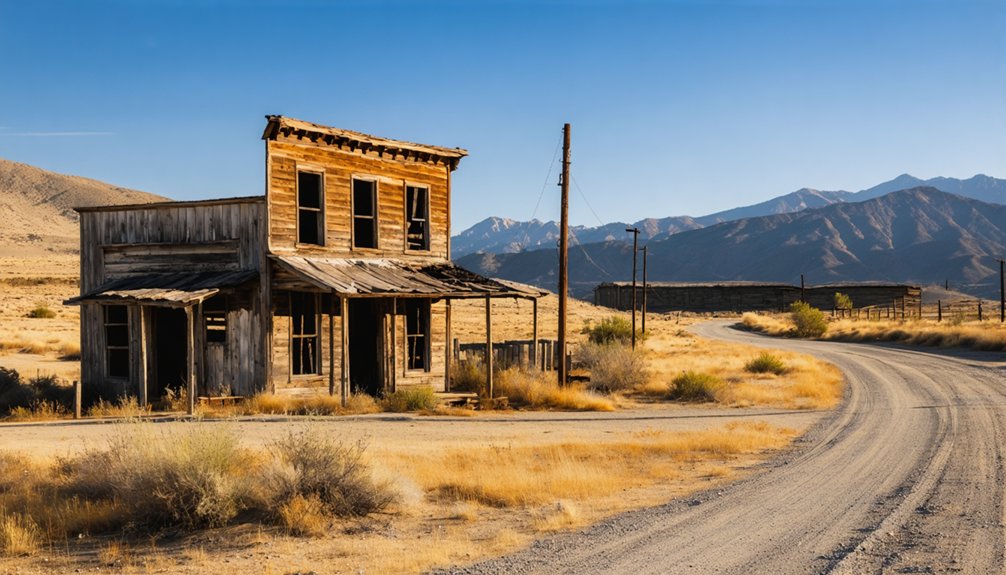
Plan your Branson City ghost town road trip by targeting spring or fall when temperatures range 30-70°F and roads remain passable. You’ll find the abandoned settlement at 33.0780997°N, -116.6172418°W in San Diego County’s backcountry at 3,996 feet elevation. Fewer than 170 deteriorating structures await exploration, including foundation remnants from the 1870 gold rush that produced $2 million before depleting within five years. Pack layered clothing, sturdy boots, and rain gear for this remote site where private property boundaries and seasonal closures require advance route verification.
Key Takeaways
- Branson City sits at 3,996 feet elevation near Julian, California, at coordinates 33.0780997°N, -116.6172418°W with challenging backcountry access.
- Visit spring or fall for optimal conditions (30-70°F), avoiding summer crowds and winter’s 27 inches of snow.
- Explore fewer than 170 decaying structures including roofless ruins, chimneys, hotel foundations, and a historic cemetery.
- Pack layered clothing, sturdy boots, rain gear, sunscreen, and windbreakers for variable mountain weather conditions.
- Verify road conditions and property boundaries beforehand, as access routes remain undocumented and potentially restricted.
The History and Origins of Branson City
When Lewis C. Branson surveyed the rugged terrain west of Julian in August 1870, he recognized opportunity. This lawyer-turned-adventurer staked his claim during California’s gold rush, establishing a settlement that would bear his name. You’ll find Branson City’s remains along Coleman Creek in San Diego County, where water access proved essential for mining operations.
The founder’s background in law positioned him to organize the boomtown rapidly, creating infrastructure that supported the Julian Mining District‘s explosive growth. Economic foundations rested entirely on gold extraction—prospectors flooded the area throughout the 1870s, transforming wilderness into a bustling hub.
Yet when veins depleted, the economy collapsed. Miners abandoned their claims, leaving behind empty structures that now stand as monuments to California’s golden era of unfettered westward expansion.
Getting to Branson City: Routes and Access Points
Although modern maps mark Branson City’s coordinates at 33.0780997°N, -116.6172418°W, the ghost town’s remote location west of Julian presents significant access challenges. At 3,996 feet elevation, backcountry accessibility requires careful planning and preparation.
Key considerations for reaching this historical site:
- Current road conditions and seasonal closures remain undocumented in available records
- Parking options near the abandoned settlement are unverified
- Distance from Julian suggests unpaved roads may dominate the final approach
- Private property boundaries potentially restrict direct access routes
Before attempting this expedition, contact San Diego County authorities and local Julian historical societies for current trail status and legal access points. Your freedom to explore depends on respecting property rights while pursuing this authentic ghost town adventure.
Among the various ghost towns to explore in California, each site offers a unique glimpse into the past and a chance to understand the stories behind them. From the remnants of mining operations to the old saloons that once bustled with activity, these locations are rich with history. Always ensure you follow the latest guidelines to preserve the integrity of these historically significant places.
What Remains: Exploring the Ghost Town Structures
Upon arrival at Branson City’s windswept site, you’ll encounter a landscape where time has claimed most evidence of the 1870s boomtown that once rivaled Julian. You’re free to explore exterior remnants through established walking paths, discovering fewer than 170 investigatable structures in various decay states.
Roofless ruins and standalone chimneys mark where commercial establishments once thrived. Foundation remains of the old hotel and meeting house provide opportunities for architectural excavation and personal discovery. The cemetery offers grounds for historical research, while scattered artifacts throughout the site reward observant visitors.
Unlike Bodie’s preserved condition, Branson City displays advanced deterioration with minimal restoration efforts. This structural documentation reveals decades of climate exposure and water scarcity’s lasting impact, making exploration both compelling and time-sensitive.
Gold Rush Legacy and Mining Heritage
When you stand amid Branson City’s ruins, you’re experiencing a mining district that exploded into existence within days of H. C. Bickers’ February 1870 gold discovery in quartz-bearing rocks above Julian. Over 600 prospectors flooded this area immediately, extracting more than a ton of ore from claims like the George Washington mine and selling it for hundreds of dollars in San Francisco markets.
Branson City served as a hub for these hard-rock mining operations for mere months before Julian’s superior location and access to upstream lode deposits drew miners away, transforming this once-bustling camp into the ghost town you’re exploring today.
Branson’s 1870s Gold Era
A rancher’s keen eye in 1870 transformed San Diego County’s Cuyamaca Mountains into the epicenter of Southern California’s most significant gold rush. Fred Coleman’s discovery in a mountain creek triggered an avalanche of fortune-seekers, with over 600 prospectors arriving within days.
The district’s explosive growth spawned mining rivalries between competing settlements:
- Emily City emerged as the first tent town housing early prospectors
- Julian became the central hub after H.C. Bickers struck gold-bearing quartz on February 20
- Branson City rose as Lewis A. Branson’s competing settlement
- Cuyamaca City sprouted near the lucrative Stonewall Mine
Mining equipment innovations evolved rapidly from simple gold pans to sophisticated operations featuring five-stamp mills and 350-foot incline shafts. Between 1870-1875, these mountains yielded $2 million in gold—your gateway to untamed frontier prosperity.
Mining Operations and Decline
The prosperity that drew hundreds of fortune-seekers to Branson City couldn’t sustain itself against the geographic realities of gold distribution in the Cuyamaca Mountains. While placer mining operations pulled $500,000 from Coleman Creek in 1873, Julian’s proximity to richer lode deposits upstream triggered inevitable population changes.
You’ll find that economic factors accelerated Branson’s demise—the Texas and Pacific Railroad‘s 1873 collapse devastated regional mining investments. Wells Fargo shipments of $20,000 during August-September 1871 represented the settlement’s brief commercial peak. By 1876, most mines had shuttered, and Branson’s infrastructure—its store, saloon, and dance hall—stood abandoned.
The entire Julian-Banner district extracted roughly $2 million between 1870-1875, but Branson’s disadvantageous location and exposure to harsh mountain weather sealed its fate.
Best Time to Visit and What to Bring
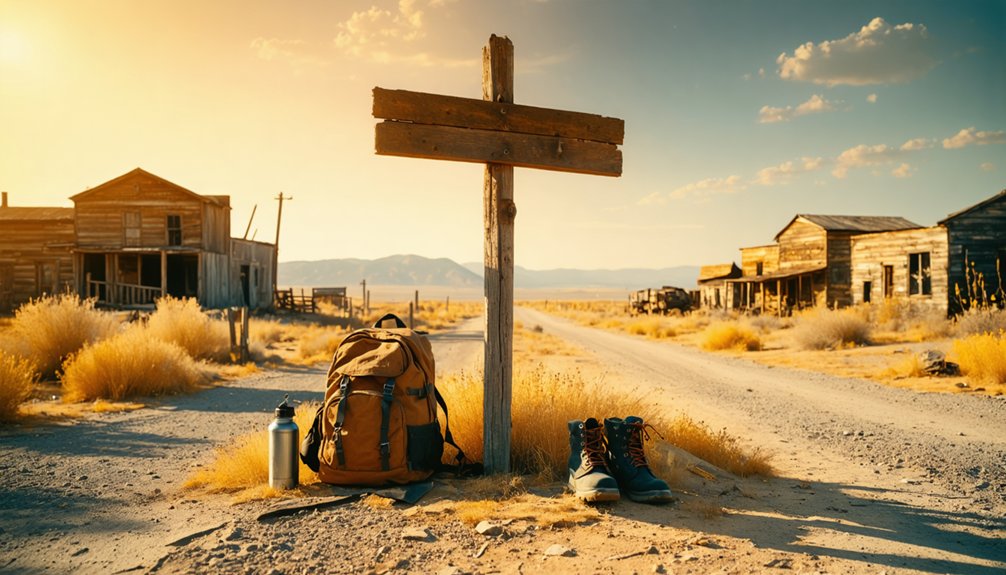
Timing your ghost town road trip to Branson City requires balancing weather extremes against your tolerance for crowds and challenging conditions. Understanding weather patterns helps you navigate 29°F winter lows to 88°F summer highs effectively.
Seasonal considerations for your expedition:
- Spring (30-70°F): Wildflower blooms frame abandoned structures while moderate rainfall (3-4 inches monthly) keeps crowds minimal before peak season arrives.
- Summer (88°F average): Those 249 sunny days and low humidity maximize exploration time during longest daylight hours, though expect company.
- Fall (40-70°F): Clear skies and reduced precipitation create ideal conditions as foliage enhances photographic opportunities.
- Winter (21-29°F): Twenty-seven inches of snow and 91 precipitation days challenge access, but you’ll explore in solitude.
Pack layered clothing, rain gear, sturdy boots, sunscreen, and windbreakers for variable conditions.
Nearby Ghost Towns Worth Adding to Your Journey
Several forgotten settlements dot the desert landscape within reasonable driving distance of Branson City, each offering distinct chapters of California’s mining heritage. Coleman City, your nearest neighbor in San Diego County, operated from 1870 until gold deposits vanished.
Head north to explore Randsburg’s authentic ghost town attractions in Kern County’s Mojave Desert, where 70-100 residents maintain the 1895 settlement’s original buildings. Calico Ghost Town near Yermo provides structured tourism opportunities daily from 9 AM to 5 PM, featuring preserved structures and Maggie Mine tours from its 1881 silver boom.
For absolute solitude, venture to Ballarat’s adobe ruins in Panamint Valley, where 500 prospectors once chased fortune after 1898 gold strikes. Coso in Inyo County rounds out your exploration of Eastern California’s barren mining camps.
Frequently Asked Questions
Are There Any Camping Facilities or Accommodations Near Branson City?
Picture dusty desert horizons meeting rugged mountains—you’ll find Branson’s Motel & RV Park nearby at Parker Dam offers essential hookups and big rig sites. Seasonal lodging options remain limited in this remote ghost town region, so nearby RV parks provide your best freedom-focused basecamp.
Is It Safe to Explore the Remaining Structures in Branson City?
You’ll face real dangers exploring abandoned buildings carefully due to cut railings, exposed elevator shafts, and compromised roofs. Always assess structural integrity before entering any structure—this toxic ghost town offers freedom to explore, but safety’s your responsibility.
Do I Need a Special Permit to Visit Branson City?
You don’t need a special permit to visit Branson City’s public areas along Highway 78. However, you’ll need private property access permission for any remaining structures. Town historical records confirm it’s now an unrestricted abandoned site.
Are There Guided Tours Available for Branson City Ghost Town?
No guided tours exist for “Branson City” ghost town in California—it doesn’t exist. However, you’ll find self-guided tours and audio-guided tours available at authentic California ghost towns like Bodie, where you’re free to explore independently.
What Photography Restrictions Exist at Branson City Historical Sites?
I don’t have specific interior photography restrictions or outdoor photography guidelines for Branson City. However, you’ll typically find flash bans protecting historic interiors and standard non-commercial rules requiring you won’t interfere with other visitors’ experiences.