You’ll need to dedicate a full day to reach Bridgeport, traversing 43 miles of punishing washboard dirt roads that’ll test both your vehicle and resolve. Plan your journey between June and September when high-elevation roads remain passable, and pack a high-clearance 4WD loaded with recovery gear, extra fuel, and offline maps—cell service vanishes completely out here. The twin settlements of Charley Crouse and John Jarvie await patient explorers who understand that uncovering this 1902 ranching outpost‘s secrets requires proper preparation and genuine historical curiosity.
Key Takeaways
- Visit between late May and September when dirt roads are passable; June through August offers the best weather conditions.
- Bring a high-clearance 4WD vehicle with recovery gear, offline maps, extra fuel, water, and spare tires for the journey.
- Drive 43 miles on washboard dirt roads with no cell service or gas stations in remote eastern Daggett County.
- Explore John Jarvie’s preserved farmstead for interpretive context, as Charley Crouse’s original buildings have vanished.
- Allow extra time for challenging terrain including creek crossings, loose shale, and potential navigation difficulties in canyon areas.
Understanding Bridgeport’s Historical Significance and Twin Settlement Legacy
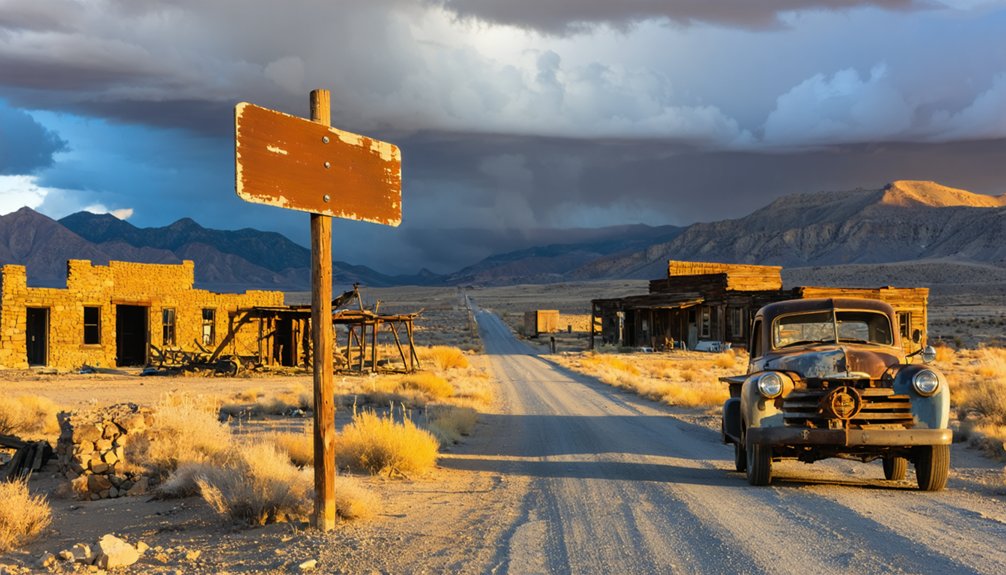
Tucked into the remote reaches of far eastern Daggett County, where Utah’s high desert plateaus surrender to the Colorado border, Bridgeport emerged in 1902 as a dusty outpost that served the scattered ranchers of Browns Park. You’ll find only Charley Crouse’s weathered buildings standing today—silent witnesses to a settlement that thrived when self-reliance wasn’t optional. The architectural design features were purely functional: a store, saloon, and post office clustered on the Green River’s north bank where Jesse Ewing Canyon opens wide.
Two miles upstream, John Jarvie operated a competing establishment, creating an unusual twin-settlement pattern. The social life implications of remoteness shaped everything—these weren’t neighbors by convenience but necessity, bound together by distance from civilization until the post office closed in 1940. Earlier incarnations of Bridgeport clustered around Nathan Packer’s ferry three miles east of Dayton, accommodating freight wagons bound for Montana’s gold fields before the railroad arrived in 1878. Like many Western settlements of this era, the town attracted a diverse workforce including Basque sheep ranchers who brought their distinct cultural traditions to the isolated frontier community.
Geographic Location and Route Planning From Major Access Points
Reaching Bridgeport requires commitment—you’ll navigate forty-three miles of washboard dirt roads where cell service disappeared hours ago and the last gas station feels like a distant memory. Your high-clearance vehicle bounces through Browns Park’s western end, following the Green River’s north bank toward Jesse Ewing Canyon’s mouth at N40.90278, W109.14861.
Forty-three miles of washboard dirt, no cell service, no gas stations—Bridgeport demands commitment before you even arrive.
Site accessibility demands respect for eastern Utah’s unforgiving terrain. Spring runoff transforms benign tracks into impassable mud slicks, while winter snows seal the route entirely. The settlement sits in Daggett County, near the Colorado border, straddling the geographic convergence where territorial boundaries once sparked range wars.
Seasonal considerations dictate summer and fall visits, when dust plumes mark your progress and the BLM-maintained Jarvie farmstead two miles upstream offers interpretive context for Bridgeport’s vanished structures. Multiple approaches exist through rough-graded dirt roads, each testing your vehicle’s capabilities and your navigation skills against the high desert’s isolating expanse.
Pack extra fuel, water, and spare tires—this country doesn’t forgive the unprepared.
Best Times of Year to Visit Eastern Daggett County’s High-Elevation Terrain
The calendar narrows your window dramatically—roughly four months separate viable exploration from wheel-sucking mud or impassable snowdrifts at Bridgeport’s 6,200-foot elevation. You’ll want late May through September, when high-country roads shake off winter’s grip and dry sufficiently for two-wheel-drive access.
June through August delivers clear skies and 70-80°F days—perfect for wandering crumbling foundations without sweat or shivers. Early September capitalizes on shifting fall weather patterns before October storms lock down routes. Those elevation dependent microclimates in sheltered valleys like Browns Park extend your season slightly, but don’t gamble on November access.
Winter’s January lows of 11°F and moderate snowfall transform these windswept badlands into frozen wastelands. Spring’s mud season makes April particularly treacherous. The region sees strong spring winds that can kick up dust and make outdoor exploration uncomfortable during shoulder season months. Check the hourly weather forecast before departure to avoid sudden temperature swings common at this elevation. Plan accordingly—freedom demands respecting mountain weather’s unforgiving temperament.
Gravel crunched beneath my tires as I learned the hard way that optimism doesn’t compensate for ground clearance—my sedan’s oil pan scraping against a limestone outcrop near Bridgeport’s eastern approach taught me more about vehicle requirements than any guidebook could.
You’ll need proper vehicle registration requirements checked before tackling these routes. High clearance matters here—minimum eight inches. Four-wheel drive isn’t optional when traversing washed-out creek crossings and loose shale. Pack recovery gear: tow straps, shovel, extra fluids. Your GPS will ghost in these canyons, so download offline maps beforehand.
Consider guided off road tours if you’re unfamiliar with desert traversal. They’ll show you line selection through boulder fields and identify safe bypass routes. The onX Offroad App with a downloaded Offline Map proves crucial when cell service disappears in the backcountry. Check your rental car agreement beforehand, as many companies restrict driving on unpaved roads and gravel surfaces. Otherwise, air down to 20 PSI for better traction, watch for flash flood channels, and never wheel alone.
What Remains: Identifying Historical Structures and Archaeological Features
After traversing those rutted approaches, you’ll stand at coordinates N40.90278 W109.14861 wondering where Bridgeport actually went. Nature’s completely reclaimed Charley Crouse’s empire—the store, saloon, and post office that anchored this ranching community until 1940. You’ll find scattered stone rubble, maybe fragments of brick foundation, but nothing identifies where pioneers collected mail or bought supplies.
Two miles upstream, John Jarvie’s preserved farmstead tells Bridgeport’s story through intact buildings the BLM maintains. Walk those interpretive trails to understand what you’re missing at Crouse’s barren site.
Search the cattle range remnants for historical markers. Burial plot locations remain largely undocumented here—unmarked graves blend into sagebrush hillsides. Utah’s extensive coal mining past has left many ghost towns scattered across the state, much like the vanished ranching settlements of the northeast. Check the closest city’s court houses and libraries for public records that might reveal more about Bridgeport’s vanished structures and residents. These archaeological ghosts require patience, sharp eyes, and respect for ground that holds more history than structures ever could.
The Rise and Fall of a Freighting Economy Along the Bear River
Long before Charley Crouse sold his last bottle of whiskey, Nathan Williams Packer saw fortune floating across the Bear River‘s muddy current. His rope-guided ferry groaned under 3,000-4,000 tons of freight annually—Montana gold dust flowing south, supplies streaming north. You could’ve smelled the sweat of restless horses at the 1869 stage station, tasted dust from weekly coaches rattling through Bridgeport’s heart.
Then the river won. Packer’s toll bridge washed out twice, rebuilt with log pilings that couldn’t withstand spring floods. The collapse of overland freight came slowly—harsh winters buried sheep routes, Malad River water poisoned cropland, railways bypassed the crossing entirely. The impact on local economy was swift and merciless. By the 1880s, only ghosts rode those freight lines.
Exploring Nearby Ghost Towns: Pine Grove, Belfort, and Masonic
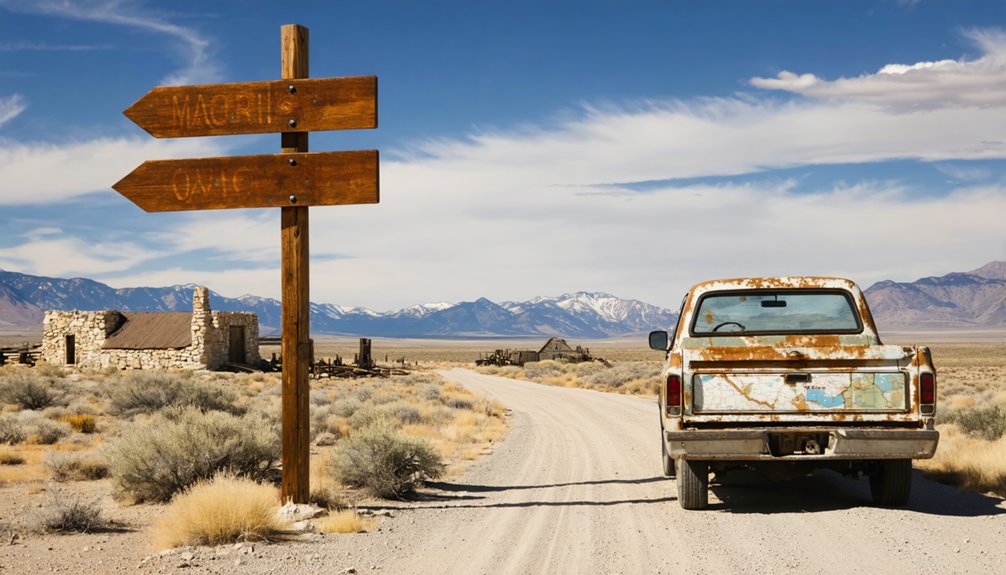
You’ll find Pine Grove’s weathered stamp mill still gripping the canyon floor, its iron flywheel frozen mid-turn after processing $8 million in ore. The five-stamp Joshua Hendy mechanism stands nearly intact among dozens of stone cabins, their walls framing views of sagebrush valleys that once echoed with 600 miners’ voices.
These remote sites demand high-clearance vehicles and careful navigation, but the reward is walking through saloon doorways and peering into doctors’ offices where wooden beams haven’t felt human touch since the 1930s.
Historic Structures Still Standing
Where else can you find dozens of weathered cabins clinging to mountainsides, their century-old timber frames still defying gravity and time? At Pine Grove, you’ll discover structures from the late 1800s with period architectural details that reveal unique carving techniques miners used when wood was their only building material. The saloon ruins sprawl among partially intact cabins, marking what was once the camp’s beating heart.
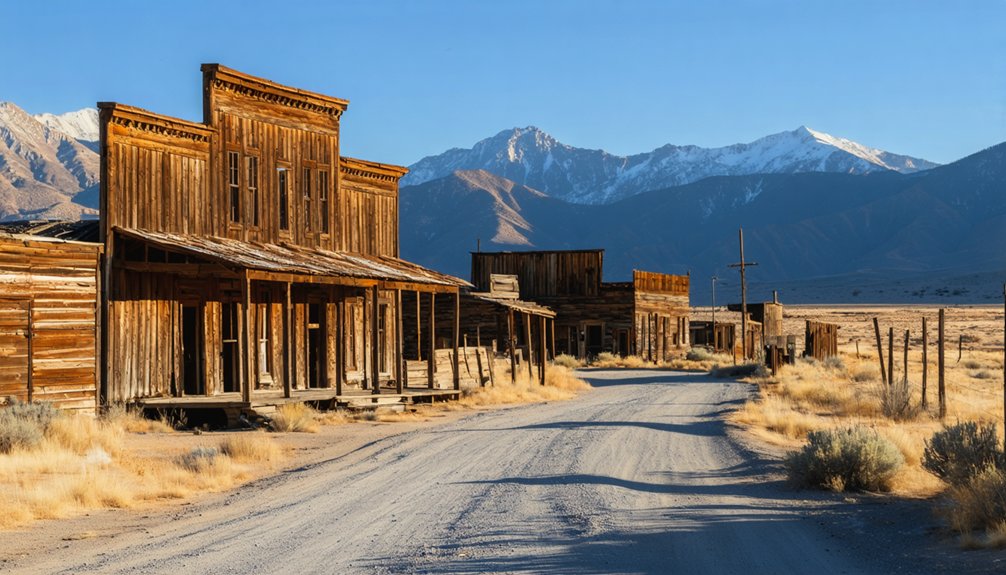
Head to Belfort’s high slopes where cabins stand proud against Sierra winds, their frameworks showcasing arrested decay that’s almost haunting. Stone walls at Masonic outline boundaries settlers carved from this harsh landscape using local materials. These aren’t roped-off museum pieces—you’ll trek remote trails to reach them, touching history without barriers.
Mining Era Stamp Mills
The rhythmic pounding of stamp mills once echoed through these canyons, drowning out birdsong with the industrial symphony of progress. You’ll find Masonic’s milling legacy most intact—the Pittsburg-Liberty Mine’s 10-stamp operation revolutionized local ore processing after 1907, eliminating costly ore shipments.
Stamp mill construction required serious capital; these mechanical beasts cost $12,000 in 1850s dollars, featuring wooden stems dropping 300-500 pound stamps onto ore-bearing rock.
Pine Grove and Belfort left fewer traces. Pine Grove’s miners initially shipped ore elsewhere until twentieth-century infrastructure improvements. Belfort never justified dedicated stamp mill technology, relying instead on Masonic’s shared roads for transport.
Accessing Remote Mountain Sites
Three ghost towns await exploration in these remote mountains, each demanding different levels of commitment from your vehicle and your nerves. Pine Grove splits across a canyon mile east of US-338, accessible via forest roads that wind through Lyon County’s high country. You’ll navigate past open pits and abandoned mine shafts, square nails still visible in weathered rock walls. The Joshua Hendy stamp mill stands sentinel over scattered ruins.
Belfort remains elusive—limited records suggest it’s tucked somewhere in these same ridges, its undiscovered relics waiting for determined explorers. Masonic sits across the state line in California’s Mono County, reached through dirt roads from Bridgeport. Connect these sites using East Walker Road, but prepare for serious elevation and isolation. Your rewards? Complete solitude among genuine frontier remnants.
Safety Considerations for Remote Mountain Ghost Town Exploration
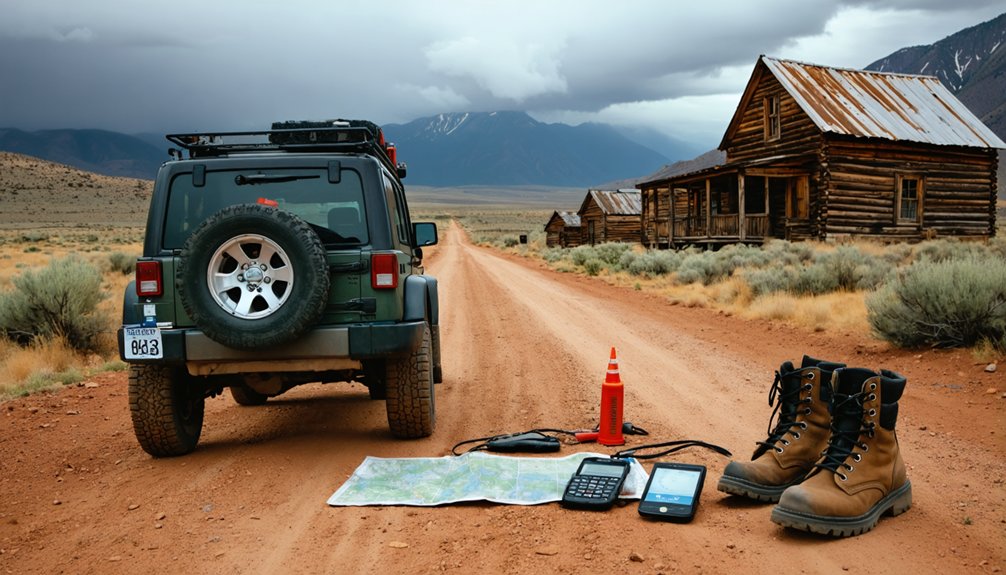
Before you venture into Bridgeport’s weathered remains, understand that these remote mountain ghost towns demand respect and preparation that goes far beyond a casual day trip. You’ll navigate wildlife presence in their natural corridors while evaluating geological formations that’ve shifted dramatically since miners abandoned these slopes.
Pack three days’ worth of water, food, and shelter—weather here pivots violently from blistering 98°F heat to sudden snowfall. Those crumbling structures you’re keen to photograph? Spring floods have eroded their foundations, tilting walls and breaking floors beneath snow’s crushing weight.
Open mine shafts lurk beneath brush—one motorcyclist plunged 700 feet in 2004. Travel with others, carry recovery gear with earth anchors, and check Caltrans QuickMap beforehand. Freedom here isn’t recklessness; it’s intelligent self-reliance.
Photography Opportunities and Documenting Weathered Settlement Remains
You’ll find your best shots during the golden hour when low-angled sunlight ignites the weathered timber framing and stone rubble in warm amber tones, casting dramatic shadows across the sagebrush-dotted terrain.
The roofless cabins at Pine Grove frame the Eastern Sierra mountains perfectly through their collapsed roof beams, while scattered brick foundations create leading lines toward distant peaks.
I’ve captured some of my most compelling images by getting close to the decay—peeling paint on weathered boards, rusted nails holding century-old timber together, and the stark contrast between man-made ruins and the relentless desert reclaiming its space.
Capturing Abandoned Cabin Details
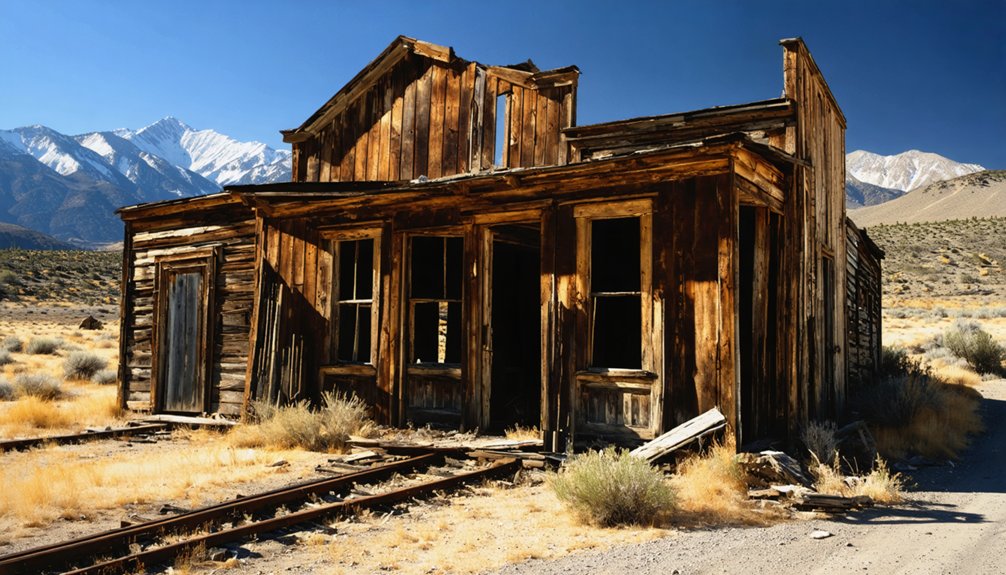
When you approach the weathered cabin remains near Bridgeport’s settlement site, the interplay of light and shadow across splintered logs creates a photographer’s dream. The crumbling cabin architecture tells stories through every gap in the weathered timber, where wind whistles through spaces that once sheltered ranchers and outlaws.
You’ll find the most compelling shot near the natural spring origins, where the BLM-built structure still clings to the hillside at Jesse Ewing Canyon‘s mouth. Early morning light transforms the roofless ruins into something almost ethereal—golden rays piercing through empty window frames. Don’t miss capturing the Green River’s reflective surface behind these skeletal remains. The contrast between flowing water and static decay perfectly embodies Browns Park’s stubborn persistence against time’s relentless march.
Golden Hour Desert Light
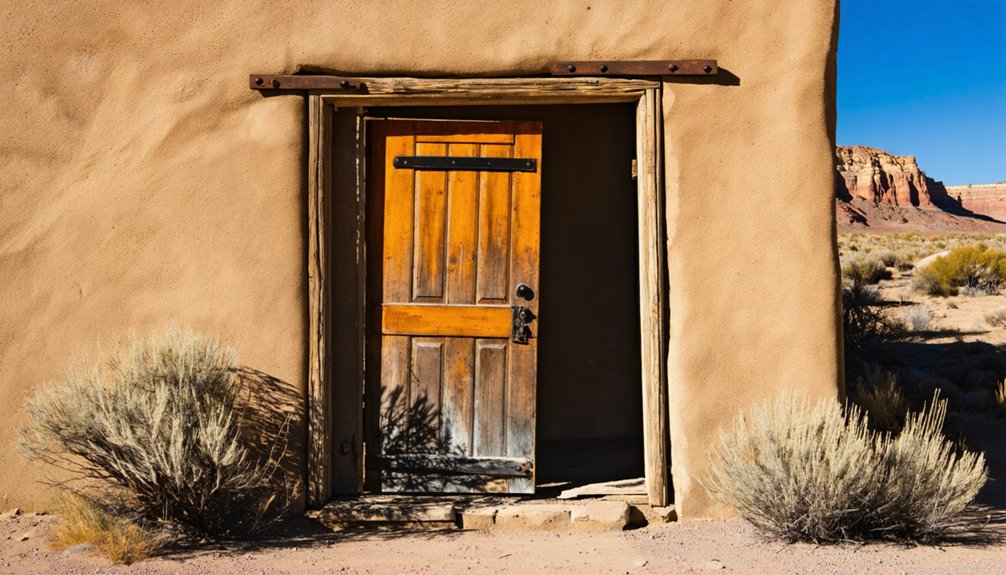
The desert light transforms Bridgeport’s ruins into something magical around sunset, when the low sun rakes across weathered timbers and foundation stones at that perfect 15-degree angle. You’ll find the Jarvie store’s adobe walls glowing amber while dramatic desert shadows carve sharp lines across the dirt.
I’ve watched photographers camp here for hours, waiting as the light shifts across those 1902-era log remnants near the Green River. The 5,436-foot elevation gives you cleaner atmospheric conditions than lower desert sites—your shots won’t have that hazy quality.
Position yourself at the Jesse Ewing Canyon entrance for elevated perspectives, catching low angle golden hour lighting as it illuminates Browns Park’s sprawling emptiness. The weathered textures practically photograph themselves.
Preserving Historical Structure Documentation
Since John Jarvie’s store earned its National Register of Historic Places designation, I’ve returned three times with different cameras to document how its adobe walls resist the high-desert elements. You’ll find photographic evidence of survival two miles upstream, where weathered timber frames still cast shadows across packed earth floors.
Down at Crouse’s original site, nothing stands. You’re hunting foundation stones half-buried in sagebrush, ground depressions where cabins once blocked winter winds. This comparative structure analysis reveals everything about preservation—Jarvie’s buildings survived through institutional protection while Crouse’s settlement returned to dust.
Bring macro lenses for texture details: hand-hewn beam marks, rusted hardware, mortar crumbling between stones. The BLM maintains respectful access, letting you document authentically without barriers compromising your compositions.
Respecting Historical Sites: Leave No Trace Principles for Ghost Town Visitors
Crumbling stone walls and weathered wooden beams tell stories at Bridgeport that future visitors deserve to experience. You’ll safeguard this freedom by following leave no trace trail etiquette—pack out everything you bring, stay on established paths, and resist touching unstable structures. Your footsteps matter less on durable surfaces than fragile archaeological sites surrounding those scattered ruins.
When exploring class 3 ghost towns like Bridgeport, on site preservation considerations mean leaving artifacts exactly where you find them. That rusted horseshoe or pottery shard connects past to present for everyone who follows. You’re free to photograph, explore, and imagine the boomtown’s bustling days, but take only memories. Report vandalism to BLM rangers. Your restraint secures these historic remnants remain untamed and accessible for future adventurers.
Frequently Asked Questions
Are There Any Nearby Accommodations or Campgrounds for Overnight Stays?
You’ll find fabulous freedom at Taylor Flat campground, where wild winds whisper through canyon walls near historic Bridgeport remnants. Though nearby hotels aren’t available locally, local campground options offer authentic wilderness experiences beside the Green River’s remote ranching territory.
Do I Need Special Permits to Explore Bridgeport Ghost Town?
You won’t need special permits for exploring Bridgeport’s weathered streets. Accessibility considerations are minimal—just park where dust meets gravel. Parking requirements? There aren’t formal ones. You’re free to wander these sun-bleached ruins at will.
Is Cell Phone Service Available in the Remote Area?
Cell signal strength fades dramatically once you’re deep in Bridgeport’s wilderness. You’ll want backup remote communication options like satellite messengers—I’ve learned that relying solely on phones means you’re gambling with your safety out there.
Can I Bring My Dog to the Ghost Town Site?
Yes, you’ll love exploring this dog-friendly attraction with your pup! Just follow the on-leash requirements—keeping your furry companion within six feet lets you both safely wander through dusty streets and weathered buildings together.
Are Guided Tours Available for Bridgeport and Surrounding Settlements?
No guided tours exist for Bridgeport itself—you’ll explore independently, discovering its historical significance through weathered structures and preservation efforts. The freedom to wander dusty paths at your own pace creates an authentic, unfiltered ghost town experience.
References
- https://mendonutah.org/history/cv/bridgeport.htm
- https://lifeinmyyears.com/2023/03/05/the-u-s-395-chronicles-bridgeport-and-the-ghost-town/
- https://www.onxmaps.com/offroad/trips/rugged-adventures/ghost-towns-and-mines
- https://www.familysearch.org/en/wiki/Utah_Ghost_Towns
- https://www.atlasobscura.com/places/masonic
- https://www.youtube.com/watch?v=2r8LY_bl_go
- https://kids.kiddle.co/Bridgeport
- https://www.treasurenet.com/threads/bridgeport-utah-ghost-town-1902-1940-in-daggett-county-browns-park.569634/
- http://www.franklincountyhist.org/bridgeport.html
- https://www.geotab.com/ghost-towns/