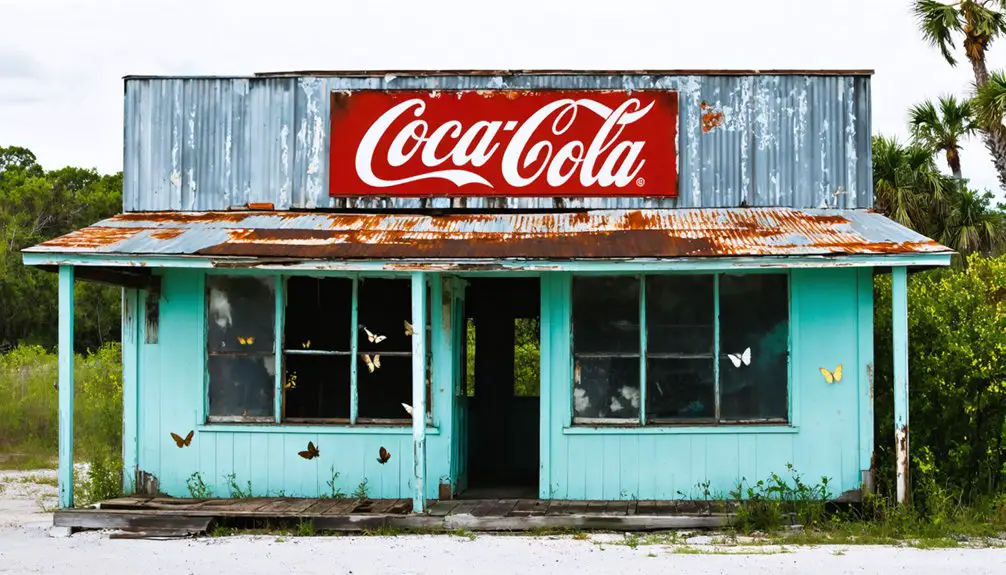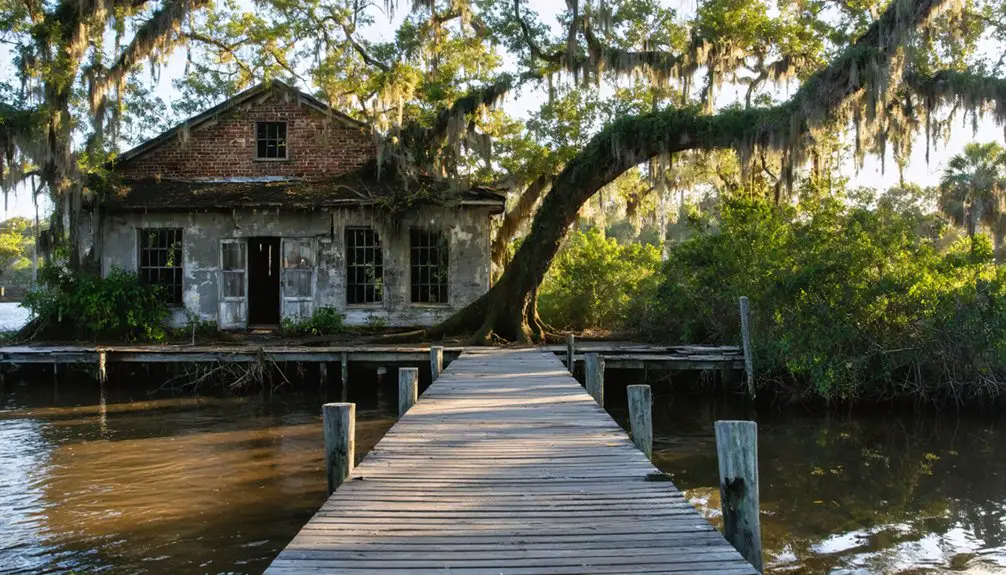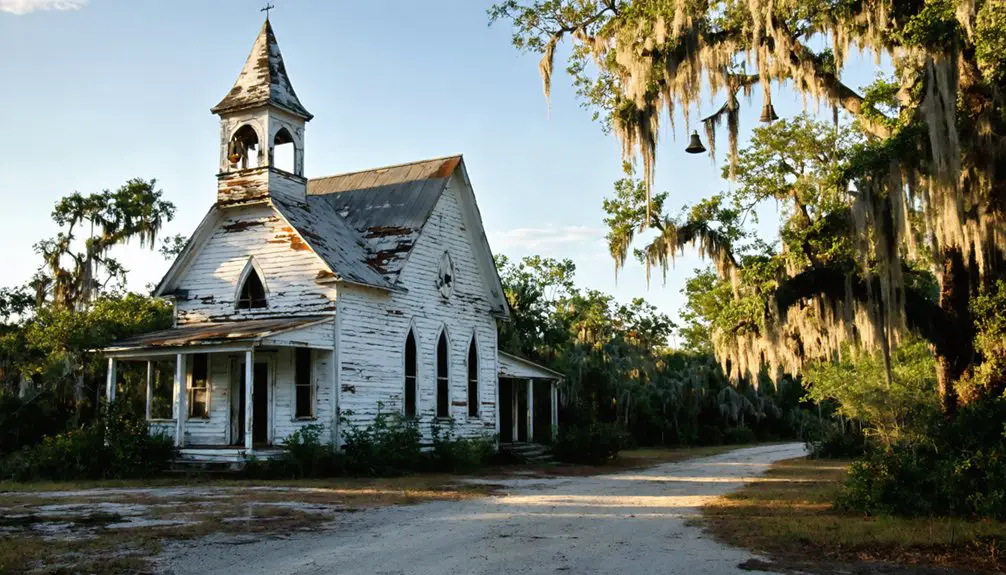
You’ll find Buchanan’s scattered remnants in central Florida’s Hardee County, accessible via simple 2WD roads where nine or ten weathered structures cluster near a towering antenna. Plan your visit during cooler months, bringing sturdy boots, long sleeves, and plenty of water to navigate the overgrown terrain. Scout for scarred longleaf pines bearing “catfaces” from the turpentine era, depressions marking former buildings, and scattered bricks telling stories of labor exploitation. The journey reveals Florida’s darker industrial past while you discover what hidden details these silent witnesses still hold.
Key Takeaways
- Buchanan ghost town is located in Hardee County, central Florida, accessible via 2WD roads with disputed exact coordinates among researchers.
- Prepare by studying topographic maps, informing someone of your plans, and bringing supplies for hot weather and overgrown terrain.
- Look for remnants including nine or ten scattered houses, a towering antenna, depressions, scattered bricks, and weathered fence posts.
- Visit nearby Pioneer Park’s boardwalk and Hardee County Wildlife Refuge to explore Florida’s untamed interior and wildlife habitats.
- Photograph during golden hour using wide-angle lenses for structures and prime lenses for detailed artifacts while keeping horizons level.
The Rise and Fall of Florida Buchanan’s Turpentine Empire
When timber barons turned their attention to Florida’s vast pine forests in the 1870s, they brought with them an industry that had already stripped the Carolinas bare.
You’ll find Buchanan’s story mirrors this pattern of environmental devastation—workers carved “catfaces” into longleaf pines, funneling sap into collection cups. Within a decade, depleted trees became lumber. The operation thrived as Florida’s second-largest industry through 1923, producing turpentine, rosin, and pitch for ships, paints, and medicines. The distillation process created various grades of rosin alongside turpentine spirits for commercial use.
But Buchanan’s prosperity came at a terrible cost. Labor exploitation ran rampant through convict leasing and debt peonage, trapping mostly African American workers in brutal conditions. Workers received payment in company scrip, binding them to settlement stores they could never escape. When steel ships and synthetic chemicals emerged mid-century, the camps vanished. Today, scarred trees stand as silent witnesses to this dark chapter.
How to Find the Florida Buchanan Ghost Town Site
The physical remnants of Buchanan have disappeared into Florida’s reclaimed wilderness, making this one of the state’s most elusive ghost town destinations. You’ll need to channel your inner explorer, as no official markers guide visitors to the site.
Local historians suggest the settlement once occupied land near former turpentine operations, but precise coordinates remain disputed among researchers. Getting there safely requires preparation—study topographic maps, inform someone of your plans, and bring essential supplies including water and guiding tools.
The overgrown terrain demands sturdy boots and long sleeves for protection against brambles and insects. When traversing the site, watch for subtle clues: depressions where buildings once stood, scattered bricks, or weathered fence posts emerging from palmetto scrub. Unlike Old Bluffton in Texas, which resurfaces during droughts, Florida’s Buchanan remains permanently concealed by vegetation. This abandoned ghost town is located in Hardee County, which helps narrow your search area in central Florida.
What Remains Standing in Florida Buchanan Today
Today’s Buchanan landscape offers little drama beyond a single towering antenna that pierces the Florida sky near the Ben Hill Griffin and Sweetwater Road intersection. This steel giant marks where a bustling turpentine town once thrived with over 250 residents.
You’ll find nine or ten scattered houses representing the residential ruins—though none date from the original 1900s boom period. The economic impacts of the turpentine industry’s collapse stripped away everything: businesses, railroad connections, and most settlers. Early pioneer families like the Whidden and Boyette clans established roots here before the town’s eventual decline.
When the Seaboard Airline Railroad discontinued service in 1984, Buchanan’s fate was sealed. You can access this forgotten corner of Hardee County anytime via simple 2WD roads, where hot Florida weather bakes the antenna tower and surrounding structures that stubbornly refuse complete abandonment. Unlike developments such as Parish in Manatee County where giant sandstorms plague ongoing construction, Buchanan’s dust has long since settled into quiet obscurity.
Best Time to Visit Florida’s Forgotten Settlement
Florida’s subtropical climate makes winter your ideal window for exploring Buchanan’s ruins, when temperatures drop from summer’s oppressive highs into comfortable ranges perfect for wandering among scattered houses and circling that towering antenna. You’ll escape the suffocating humidity that blankets Hardee County from May through September, making every step feel like trudging through wet cotton.
Spring and fall offer decent alternatives if winter doesn’t align with your schedule, though central Florida’s weather patterns can still throw unpredictable heat waves your way. Unlike crowded tourism seasons that plague coastal destinations, Buchanan remains blissfully ignored year-round—you won’t fight traffic or jostle with selfie-stick wielding crowds. The forgotten settlement rewards those who venture off-script, regardless of when you arrive, but comfort matters when you’re documenting abandoned dreams. Before visiting, check if you need to download the packet for any site access information or guidelines. While exploring, you’ll find a historical marker that provides information about the site’s history and helps orient visitors to what once stood here.
The Antenna Tower: Florida Buchanan’s Most Visible Landmark
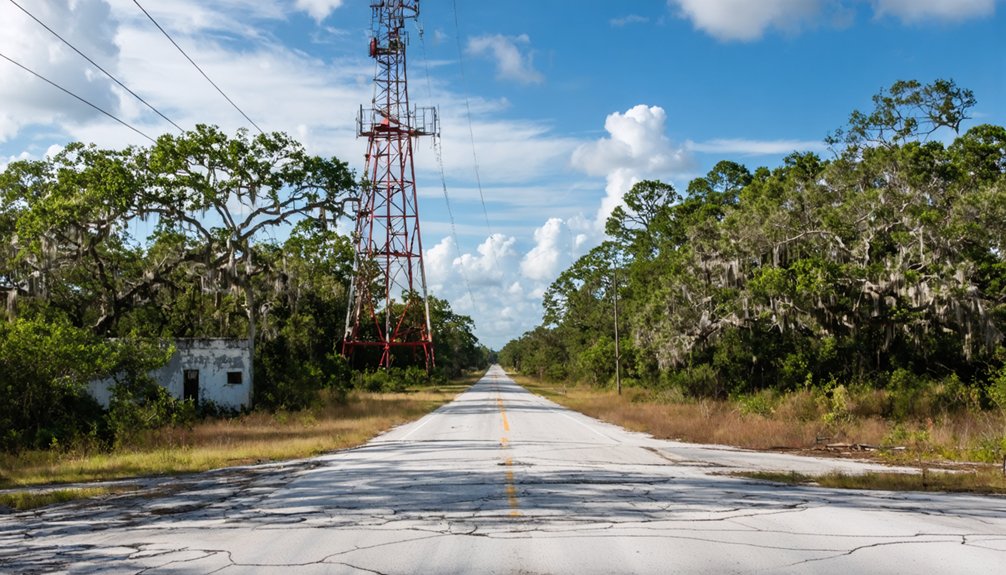
Rising from the flat palmetto scrubland like a steel sentinel, Buchanan’s massive antenna tower pierces the sky just off US17, broadcasting the ghost town’s location to anyone scanning the horizon south of Zolfo Springs. This steel lattice structure dominates the sparse landscape where Buchanan once thrived, serving as your primary navigation aid when hunting this forgotten settlement.
While the tower’s striking design and engineering background remain unclear, its presence transforms an otherwise invisible ghost town into a discoverable destination. You’ll spot it easily from the highway, marking the Ben Hill Griffin/Sweetwater Road intersection where turpentine operations and railroad prosperity once flourished.
Today, amid the nine or ten scattered houses, this solitary tower stands as Buchanan’s unintended monument—a modern landmark preserving a historical footnote. The structure’s design minimizes wind resistance, allowing it to withstand Florida’s intense tropical storms and hurricane-force winds that regularly sweep across the interior flatlands.
Nearby Attractions in Hardee County Worth Exploring
While Buchanan itself offers little beyond its historic emptiness and landmark tower, Hardee County rewards curious travelers with five distinctive attractions that showcase Central Florida’s layered heritage.
Buchanan’s emptiness contrasts with Hardee County’s five distinctive attractions revealing Central Florida’s authentic frontier heritage.
You’ll discover genuine frontier stories at Cracker Trail Museum’s 4,500 artifacts, from Seminole relics to citrus-era memorabilia. Paynes Creek Historic State Park merges nature preserves with pioneer history along the Peace River, where you can paddle and fish. The park includes a visitors center with displays documenting the Seminoles and soldiers who occupied Fort Chokonikla during the 1840s.
Hardee Lakes Park spreads across 1,200 acres with four distinct lakes for exploration. Pioneer Park’s elevated boardwalk winds through wildlife habitats at the Hardee County Wildlife Refuge, housing native and exotic species. For family adventure, Heartland Events Agritourism in Bowling Green delivers year-round rural entertainment.
Each destination operates independently—check seasonal hours before heading out into Florida’s untamed interior.
Photography Tips for Capturing Ghost Town Remnants
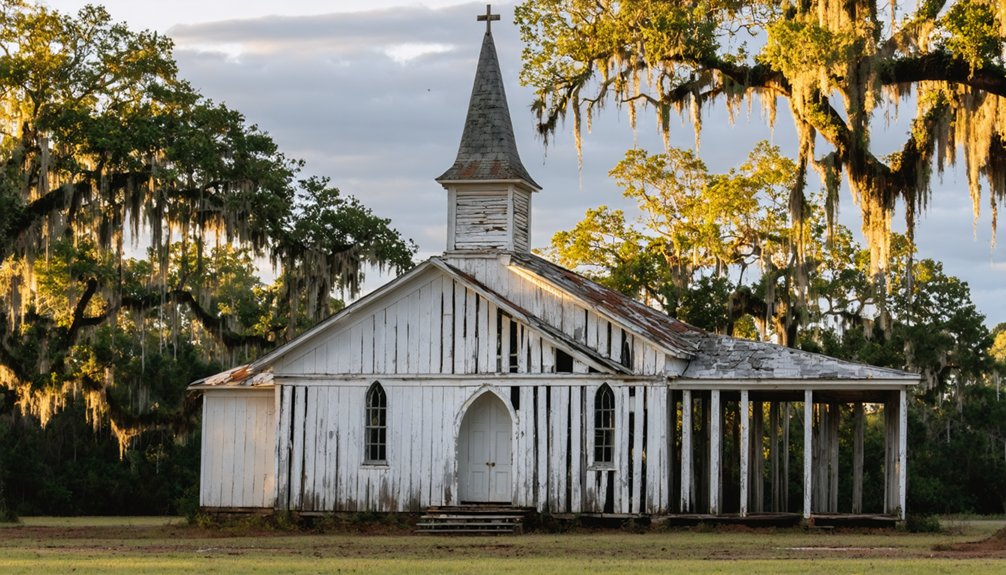
How do you capture the haunting essence of a place that exists between memory and decay? Start by utilizing natural light during golden hour—that magical window after sunrise when abandoned structures transform into storytelling canvases.
Wide-angle lenses reveal Buchanan’s expansive deterioration, while prime lenses excel at capturing detailed artifacts: rusted door handles, weathered signs, forgotten tools that whisper forgotten narratives.
Keep your horizons level to maintain architectural integrity. Seek out key remnants like the old post office, general store, or church—each building holds visual secrets. Notice vegetation creeping through windows; it’s nature’s testimony to abandonment.
Try black and white photography to emphasize texture and contrast, suggesting the weight of time. Don’t follow others’ footsteps—venture where few photographers dare, discovering perspectives that make Buchanan’s story uniquely yours.
Essential Supplies and Safety Precautions for Your Visit
Your camera bag holds tomorrow’s memories, but your backpack must carry today’s survival. Pack water—more than you think you’ll need—sturdy boots, and a first-aid kit before venturing into Buchanan’s forgotten landscape.
The necessary equipment extends beyond photography gear: bring work gloves for probing weathered structures, a charged phone with offline maps, and sun protection for Florida’s relentless heat.
Proper safety protocols require you never explore alone and always inform someone of your route. Watch for unstable flooring, rusty nails, and wildlife reclaiming these abandoned spaces. Test every step in deteriorating buildings.
Respect posted boundaries while satisfying your curiosity—trespassing charges extinguish adventure quickly. Your freedom to roam responsibly maintains these ghostly remnants remain accessible for future explorers seeking their own connection to history.
Combining Your Trip With Other Florida Ghost Towns
Florida’s forgotten settlements cluster along forgotten highways like pearls on a broken strand, and Buchanan’s isolation needn’t limit your exploration to a single destination. Design your route with transportation logistics in mind—grouping abandoned settlements by region maximizes your adventure while minimizing backtracking.
Consider the documented ghost towns scattered across Lake County and St. Johns County, where crumbling foundations whisper stories of timber booms and railroad dreams gone cold. Your budgeting considerations should account for extended fuel costs and overnight camping permissions if you’re chasing multiple sites.
Plot coordinates carefully; many vanished communities exist only as cemetery markers or overgrown clearings now. Pack extra provisions—these forgotten places rarely offer services. The freedom to wander Florida’s lost landscapes rewards those who venture beyond single destinations into interconnected webs of abandonment and memory.
Frequently Asked Questions
Was Florida Buchanan Connected to the Old Bluffton Town Submerged in Texas?
No, they’re unconnected. Picture two separate tombstones marking different graves—Florida’s Buchanan withered from turpentine decline while Texas’s Bluffton drowned beneath dam waters. Despite unclear historical origins and disputed settlement details, you’ll find no linking thread between them.
Did Florida Buchanan Have Any Connection to Railroads or Stagecoach Routes?
You won’t find railroad connections or stagecoach operations linking Buchanan to Florida’s transportation networks. This isolated settlement existed off the grid, bypassed by Henry Flagler’s coastal routes and Atlantic Coast Line’s inland extensions serving Fort Myers.
How Many People Originally Lived in Florida Buchanan During Its Peak?
You’d be amazed—over 250 souls packed this remote turpentine outpost in 1900! The population density thrived when economic factors like railroad access and timber harvesting created prosperity. Then everything vanished when those industries dried up completely.
Are There Any Historical Markers or Plaques at the Florida Buchanan Site?
No historical markers or plaques mark the site today. You’ll find no preserved structures or official recognition of Buchanan’s historical significance. The ghost town exists only through coordinates and memories, leaving you free to imagine its forgotten past.
Can You Camp Overnight Near the Florida Buchanan Ghost Town Location?
Though Buchanan’s remote, you’ll find camping facilities nearby. The Hideaway on Suwannee River offers primitive sites and RV hookups, while nearby lodging options include Carrabelle Beach’s cabins. You’re free to explore this forgotten landscape at your own pace.
References
- https://www.youtube.com/watch?v=x1VRUi_TwoY
- https://www.atlasobscura.com/places/old-bluffton-underwater-ghost-town
- https://www.ghosttowns.com/states/fl/buchanan.html
- https://www.geotab.com/ghost-towns/
- https://en.wikipedia.org/wiki/List_of_ghost_towns_in_Florida
- https://mydigitalpublication.com/article/The+Ghost+Town+I+Live+In/4859751/831858/article.html
- http://www.shrimpnfishflorida.com/forums/threads/lake-county-fl-ghost-towns.5641/
- https://www.hmdb.org/m.asp?m=213513
- https://delandhistoricalsociety.com/blog/the-turpentine-industry-in-florida
- https://dunnhistory.com/the-brutality-of-floridas-turpentine-industry/