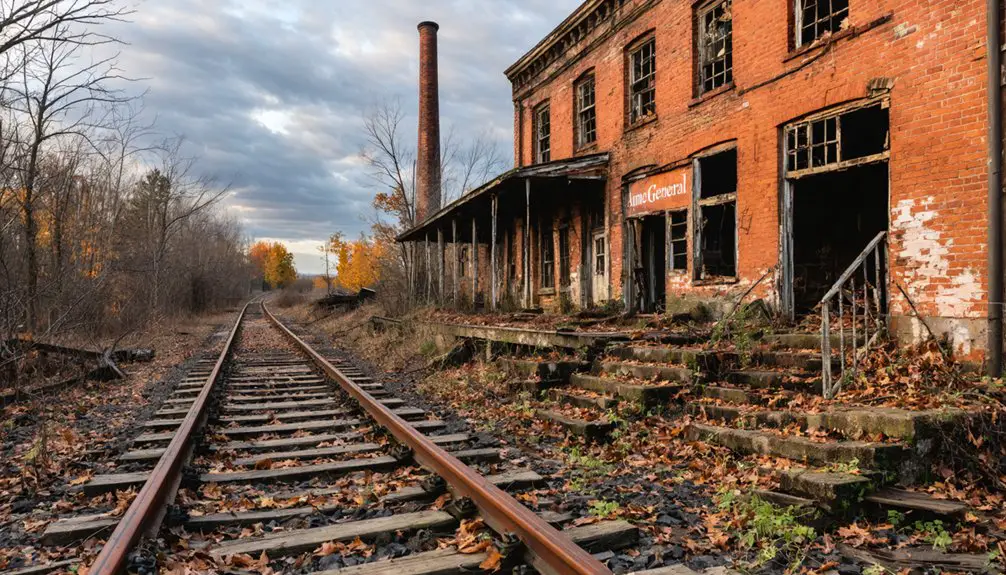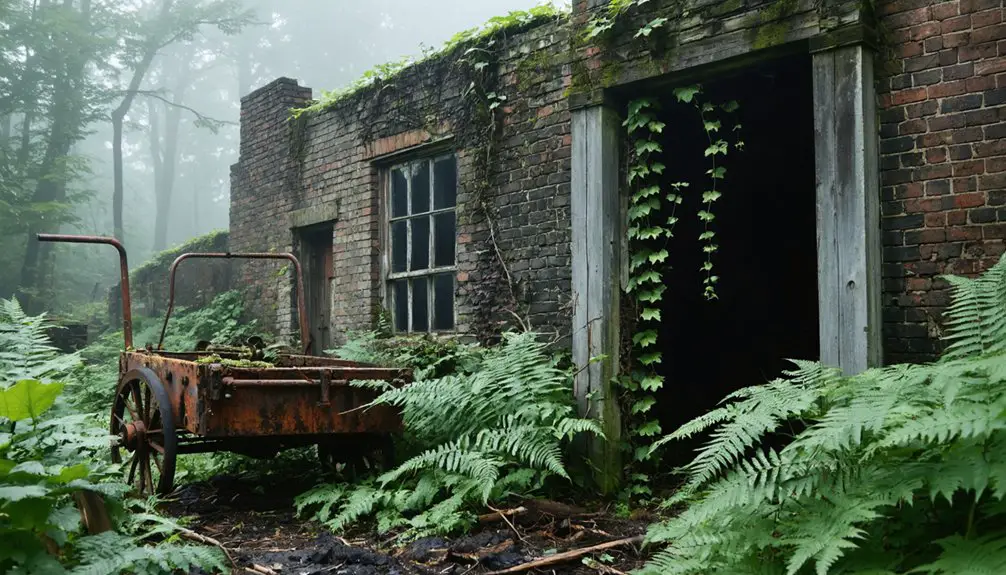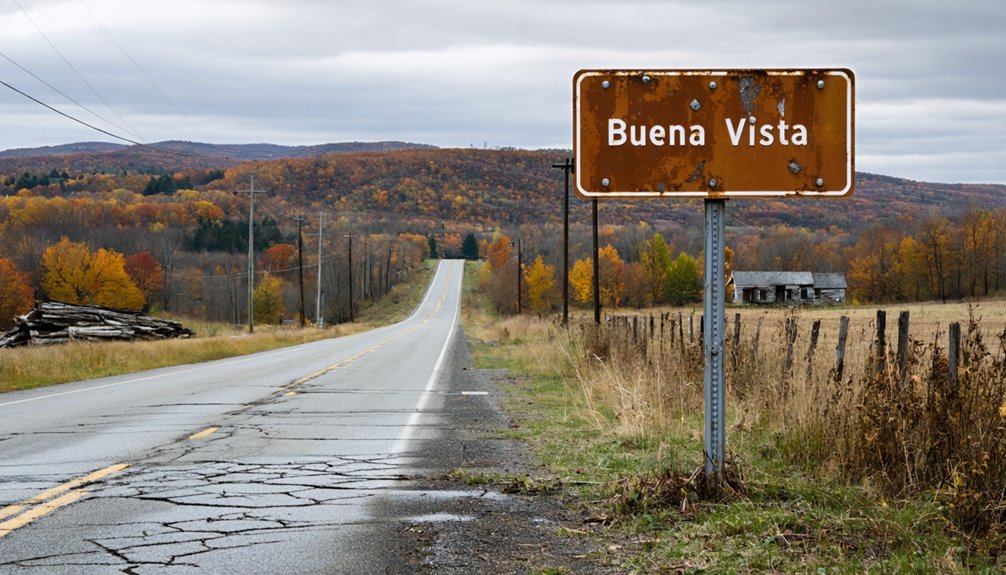
You’ll find Pennsylvania’s best ghost town adventure along the 36-mile Ghost Town Trail in Indiana County, where the 30-foot Buena Vista Furnace stands beside Blacklick Creek. Built in 1847, this iron-making relic once produced 560 tons annually before abandonment. The limestone pathway connects you to Wehrum’s 230-structure ghost town, the pyramid-shaped Eliza Furnace, and scattered coal communities like Claghorn and Bracken. Interpretive markers guide you through collapsed boarding houses and weathered stone walls, revealing the stories behind these wilderness monuments.
Key Takeaways
- The 36-mile Ghost Town Trail in Indiana County connects Buena Vista Furnace with multiple abandoned communities and industrial sites.
- Buena Vista Furnace, a 30-foot stone ruin from 1847, sits beside Blacklick Creek with interpretive markers explaining its history.
- Wehrum, the trail’s crown jewel, once housed 230 structures and offers the most extensive ghost town experience.
- Eliza Furnace in Vintondale is a rare 32-foot hot blast furnace from 1846, listed on the National Register.
- The limestone-packed trail features gentle grades suitable for year-round hiking, biking, and historical exploration.
The Historic Buena Vista Furnace: A 19th Century Iron-Making Marvel
Deep in the Pennsylvania wilderness of 1847, three ambitious entrepreneurs—Henry McClelland, Elias McClelland, and Stephen A. Johnston—built something extraordinary. They named their thirty-foot iron furnace after the Buena Vista battle, celebrating victory and independence. This wasn’t just another industrial site; it was a complete frontier town where sixty-one men and boys forged freedom through labor, producing 400 tons of pig iron annually.
The furnace blazed twenty-four hours daily, its glow visible for miles—a beacon of economic impact transforming raw ore into prosperity. You’ll discover how this cold-blast charcoal operation shaped social history, supporting families through its store, housing, and workshops. At its 1854 peak, workers pushed output to 560 tons, hauling pig iron by wagon to distant markets, proving American ingenuity could thrive anywhere.
Exploring the Ghost Town Trail Through Indiana County
When the Kovalchick Salvage Company donated twelve miles of abandoned railroad corridor to Indiana County in 1991, nobody imagined it would become Pennsylvania’s 2020 Trail of the Year. You’ll discover 36 miles of limestone-packed pathway stretching from Black Lick to Ebensburg, where recreational activities blend seamlessly with history. The trail’s gentle grades (never exceeding 3%) make it perfect for year-round exploration.
From salvaged railroad to state treasure: 36 miles of accessible adventure where Pennsylvania’s industrial past meets outdoor recreation.
What awaits along Indiana County’s section:
- Flora and fauna thriving along Blacklick Creek’s riparian corridors
- Eight ghost towns, including massive Wehrum with its 230 abandoned houses
- Coal-loading tipples and boney dumps marking industrial heritage
- Cross-country skiing and hiking through former railroad passages
- Interpretive sites explaining acid mine drainage impacts
You’ll find freedom pedaling this National Recreation Trail, where nature reclaims forgotten mining communities beneath Pennsylvania’s skies.
Eliza Furnace and Other Abandoned Communities Along the Route
Midway through the Ghost Town Trail, a thirty-two-foot pyramidal tower of unmortared sandstone rises from the forest floor like a monument to Pennsylvania’s industrial ambitions. You’re standing before Eliza Furnace, built in 1846 by David Ritter and Lot Irvin when iron was king.
Its hollow nine-foot bosh once blazed with 800 bushels of charcoal daily, consuming an acre of forest every twenty-four hours. Ninety men and boys worked this beast at its 1848 peak, hauling 1,000 tons of iron by wagon to distant canals.
Operational challenges—outdated technology, brutal transportation costs, rerouted waterways—killed it within three years. Today, charitable preservation efforts maintain one of America’s few remaining hot blast furnaces with original heat exchanger piping intact. The silence here tells stories no highway ever could.
What Remains: Viewing the Furnace Ruins and Historic Structures
The thirty-foot stone sentinel still guards its forest clearing beside Blacklick Creek, though its fire died in 1856. You’ll find the furnace alongside the Ghost Town Trail extension, where limited repair efforts have preserved what floods and time haven’t claimed.
The western facade has collapsed, making the structure unstable—you can’t climb it, but you’re free to explore the grounds and absorb its history through on-site historical signage.
What You’ll Encounter:
- Weathered stone walls that once held 400-600 tons of annual iron production
- Foundation remnants from boarding houses that sheltered 60 workers
- Interpretive markers revealing the furnace’s 1847 origins
- Blacklick Creek’s banks where wagons hauled pig iron toward Johnstown
- Silent testimony to Henry Ford’s failed acquisition attempt
No facilities exist here—just unvarnished history waiting.
Planning Your Visit: Trail Access and Available Amenities
Before you set out to explore the furnace ruins, you’ll need to choose your entry point along the Ghost Town Trail‘s 32-mile main stem or its 17-mile C&I Extension. John P. Saylor Park offers the most complete facilities, while Vintondale provides water and restrooms at Eliza Station. The trail surfaces are crushed limestone throughout, creating accessibility options for various abilities and equipment, including e-bikes meeting trail criteria.
From Saylor Park’s western end, you’ll travel 9.5 miles east to reach Buena Vista furnace. Heshbon provides closer access via US22 and PA259. The grades stay under 3%, climbing eastbound from Blacklick to Nanty Glo—consider this when planning your return journey. Open sunrise to sunset year-round, this National Recreation Trail welcomes hikers, cyclists, and cross-country skiers seeking adventure beyond pavement.
Nearby Ghost Towns Worth Adding to Your Itinerary
Beyond Buena Vista’s crumbling furnace walls, a constellation of vanished coal communities beckons along the Ghost Town Trail’s 32-mile corridor. These forgotten settlements offer a historic overview of coal towns that once thrived through connections to local industry, now reclaimed by Pennsylvania wilderness.
Essential ghost town stops on your route:
- Wehrum – The trail’s crown jewel with 230 former structures, featuring a surviving house, bank vault remnants, and Russian Orthodox cemetery hidden in the woods
- Claghorn – Founded 1903, abandoned after financial collapse, with minimal physical traces remaining
- Eliza Furnace – Vintondale’s National Register-listed hot blast furnace from 1846, remarkably preserved
- Bracken, Armerford, Lackawanna No. 3 – Scattered coal communities marked by tipples and refuse piles
- Historic markers – Trail signage detailing grist mills and company town histories
Frequently Asked Questions
What Was the Unsolved Whiskey Run Murder Case About?
Historical records don’t reveal specific details about Whiskey Run’s murders. You’ll find the cases shrouded in suspicious circumstances, with unsolved investigation files offering no victim names, dates, or motives—just haunting silence from Pennsylvania’s coal-mining past.
How Did Workers React to Being Paid in Goods Instead of Money?
You’ll find no records of worker protests against goods payment at Eliza Furnace, though rapid town abandonments suggest silent resistance. Workers couldn’t demand alternative payment methods—they simply left when better opportunities emerged elsewhere.
Are There Guided Tours Available for the Ghost Town Trail?
No guided tours available—you’ll explore independently along limestone paths shaded by towering trees. Self-guided walking tours let you discover nine ghost towns at your own pace, following historical markers through forgotten coal-mining settlements and iron furnace ruins.
What Caused the 1977 Flood That Damaged Buena Vista Furnace?
The 1977 flood that ravaged Buena Vista Furnace resulted from catastrophic heavy rainfall—up to 12 inches in 24 hours—combined with multiple dam failures. Seven earthen dams burst, releasing over 128 million gallons into the overwhelmed valleys below.
Can You Camp Overnight Near the Furnace Sites?
You’ll find several camping options near the furnace sites, with Gordon Glen Woods just 1.25 miles from the trailhead. These overnight accommodations let you explore the historic furnaces at your own pace, embracing true trail freedom.