Your Bullionville ghost town adventure begins 170 miles northeast of Las Vegas via US-93, continuing through Caliente toward Pioche before heading northwest on unpaved BLM roads. You’ll need a high-clearance vehicle to navigate the gravel terrain to this 4,760-foot elevation site, where weathered foundations, scattered milling equipment, and a windswept cemetery tell the story of Nevada’s 1870s silver boom. Avoid winter visits due to snowpack, and explore nearby Pioche’s Boot Hill and Cathedral Gorge’s volcanic formations to complete your journey through Lincoln County’s mining heritage.
Key Takeaways
- Travel 170 miles northeast from Las Vegas on US-93 through Caliente toward Pioche, then northwest on unpaved BLM roads.
- Use a high-clearance vehicle for gravel terrain and avoid winter travel due to 4,760-foot elevation and potential snowpack.
- Expect unmarked foundations, milling equipment remnants, and a historic cemetery rather than intact wooden buildings at the site.
- Download free topographic maps from TopoZone.com to navigate the unmarked terrain around this remote ghost town.
- Combine your visit with nearby Pioche’s Boot Hill Cemetery, Cathedral Gorge State Park, and the Lincoln County Museum.
Getting to Bullionville: Directions and Best Routes
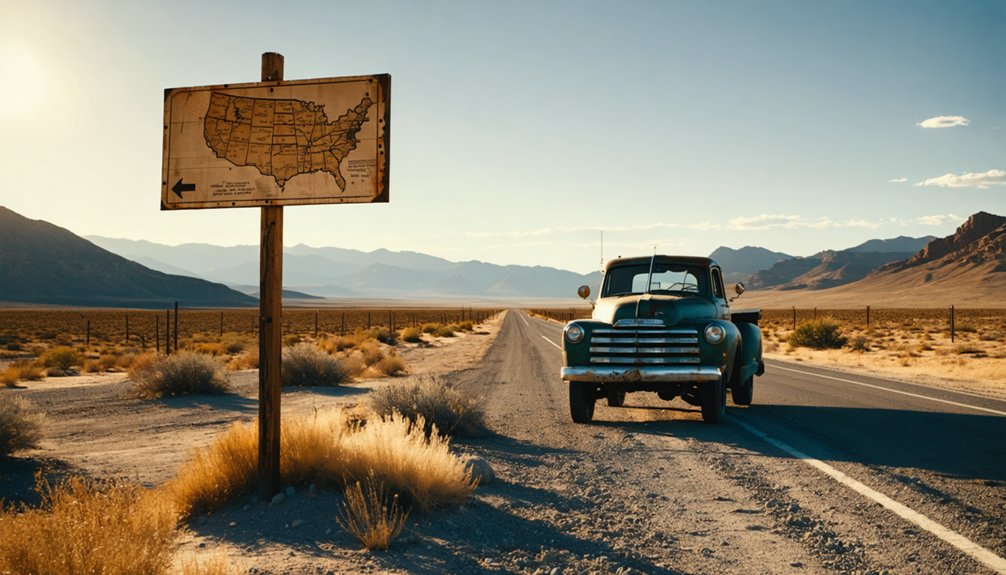
Nestled in the remote high desert of Lincoln County, Nevada, Bullionville sits at 4,760 feet above sea level, roughly 17.6 miles northwest of the historic mining town of Pioche. You’ll reach this forgotten settlement by departing from Las Vegas, traveling 170 miles northeast on US-93, then continuing through Caliente toward Pioche.
From there, head northwest on unpaved BLM roads—your GPS becomes essential as cell signals fade. A high-clearance vehicle handles the gravel and dirt routes best, traversing terrain challenges for visitors including washouts and rocky stretches. Winter travel isn’t recommended due to elevation and potential snowpack.
Parking options at the site remain informal; you’ll find pull-offs near the cemetery and smelting mill coordinates. Before your trip, consider printing the free topographic map available from TopoZone.com to help navigate the unmarked terrain around the ghost town. The town’s name derives from the Anglo-Norman term for melting-house, reflecting its origins as a precious metals refining center during Nevada’s mining boom. The journey rewards those seeking authentic backcountry exploration without crowds or restrictions.
What Remains: Exploring the Historic Bullionville Site
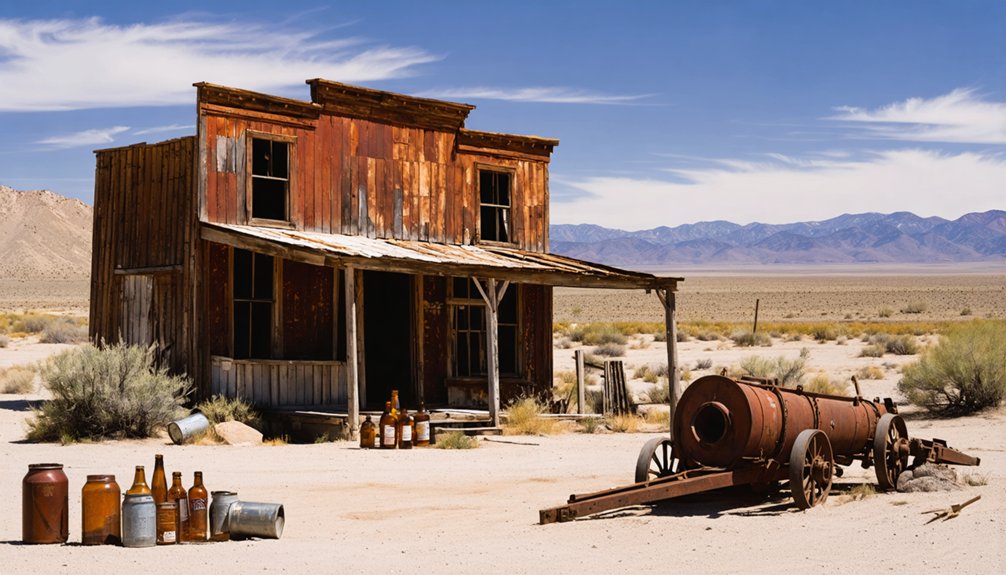
Unlike Nevada’s more famous ghost towns, Bullionville greets visitors with subtle traces of its industrial past rather than dramatic wooden facades. You’ll discover unmarked building foundations scattered across flat terrain where five mills once processed Pioche’s silver ore. Protected iron pipes mark where stores, hotels, and saloons stood during the town’s brief decade of prosperity.
Milling equipment remnants and tailings from processing operations dot the landscape, silent witnesses to 110 stamps that thundered here in 1875. The camp’s strategic location was chosen specifically for its water availability, which made it the preferred site for mills treating ore from Pioche. The PE and Bullionville railroad, built in 1872, transported ore to the mills that sustained this short-lived settlement.
The site’s most poignant feature sits high on a hill within Cathedral Gorge State Park—a small cemetery overlooking the valley. A short hike beyond the historical marker reveals 1870s graves, stark reminders of harsh frontier conditions. These weathered markers represent Bullionville’s most enduring legacy.
Visiting Bullionville Cemetery at Cathedral Gorge State Park
The Bullionville Cemetery crowns a windswept hill within Cathedral Gorge State Park, offering visitors a tangible connection to Lincoln County’s silver boom era. You’ll find this haunting burial ground via a quick uphill trail from the Visitor Center, positioned strategically above where Bullionville’s miners and merchants once lived.
A windswept cemetery connects modern visitors to Lincoln County’s vanished silver boom community through weathered graves and commanding hilltop views.
What You’ll Discover:
- Scattered grave sites where wooden markers weathered away over a century ago
- A couple of preserved headstones, some recently replaced by park historians
- Panoramic views overlooking the former town site and Panaca road
- Evidence of burial rituals distinct from nearby Panaca’s Mormon cemetery and Pioche’s Boot Hill
The cemetery’s hilltop location reflects 1800s settlers’ choices, separating their dead from the valley’s silver processing operations while maintaining proximity to their community. Currently 11 memorials have been documented at the site, with most photographed by volunteers and contributors. This historic site provides a glimpse into the region’s mining heritage and the lives of those who settled this remote corner of Nevada.
Understanding Bullionville’s Role in Nevada’s Silver Mining Boom
When Pioche’s silver veins exploded with prospectors in 1869, the boomtown faced a critical problem—no water for processing ore. You’ll discover Bullionville emerged as the solution, built ten miles south where abundant water transformed raw silver into wealth.
The relationship with Pioche defined everything: five massive stamp mills thundered by 1873, crushing ore hauled down via narrow-gauge railroad. By 1875, 110 stamps processed Pioche’s riches while 500 residents filled saloons and storefronts.
Yet freedom from Pioche’s constraints couldn’t last. The economic decline factors came swiftly—waterworks reached Pioche in 1875, eliminating Bullionville’s advantage. Mills dismantled by the late 1880s, rails pulled up, population crashed to 100. You’re standing where Nevada’s silver rush both built and abandoned a town within two decades. Modern explorers attempting to reach Bullionville may find roads impassable due to wildfire damage in the surrounding Pine Nut Mountains. Today’s explorers might compare this journey to an off-trail hike through Nevada’s remote desert ranges, where history lies scattered across sparse terrain.
Nearby Attractions: Pioche, Panaca, and Cathedral Gorge
Just ten miles north of Bullionville’s ruins, Pioche rises from Nevada’s high desert as one of the West’s most notorious mining camps turned living museum. You’ll discover Western architecture in Pioche through restored landmarks where 72 murders preceded the first natural death. Pioche’s restoration efforts have transformed Thompson’s Opera House into an information center while preserving the Million Dollar Courthouse as record/chronicle/testimony/documentation to boom-era excess.
Your freedom-seeking exploration includes:
- Boot Hill Cemetery, where murderers rest beside their victims
- Self-guided walking tours starting at the 1920s-era Pioche Aerial Tramway
- Cathedral Gorge’s volcanic formations and desert trails twenty miles east
- Lincoln County Museum with docents sharing authentic Wild West accounts
This 1,000-resident community delivers genuine frontier atmosphere without commercialized pretense, positioning you 180 miles from Las Vegas’s constraints. The surrounding high desert terrain offers OHV trails winding through historic mining areas and rugged landscapes for off-road adventurers. Silver ore was discovered in 1864, though commercial mining operations and the town’s official founding didn’t occur until 1869.
Frequently Asked Questions
What Is the Best Time of Year to Visit Bullionville?
You’ll find late spring through early fall ideal for exploring Bullionville’s ruins. Weather patterns stay moderate, roads remain passable, and you’ll have time to discover nearby attractions without winter’s hazards limiting your adventure.
Are There Any Entrance Fees to Access the Ghost Town Site?
You’ll find free access to Bullionville’s forgotten foundations, though challenging terrain tests your determination. Limited parking exists along rugged routes, but fire damage and erosion make reaching this remote ghost town an adventure requiring preparation and persistence.
Is Camping Allowed Near Bullionville or at Cathedral Gorge State Park?
Yes, you’ll find camping at Cathedral Gorge State Park with 24 electric sites, restrooms, and hot showers. Bullionville allows designated-area camping only. You can explore hiking trails and picnic areas while respecting quiet hours and Leave No Trace principles.
What Supplies or Equipment Should I Bring for Ghost Town Exploration?
Over 60% of ghost town injuries involve falls and cuts. You’ll need sturdy footwear, weather-appropriate clothing, work gloves, a headlamp, first-aid kit, water, navigation tools, and a camera to safely explore these forgotten frontiers of freedom.
Are Guided Tours of Bullionville Available or Is It Self-Guided Only?
No guided tours are offered at Bullionville since it’s privately owned property used for cattle ranching. You’ll find self-guided exploration limited to the accessible cemetery trail, while the fenced townsite remains off-limits to visitors.
References
- https://www.youtube.com/watch?v=7B9_9RlPi5o
- https://www.destination4x4.com/bullionville-nevada-lincoln-county-ghost-town/
- http://exploringtheamericanwest.blogspot.com/2013/04/vanishing-communities-1-bullionville.html
- https://nvtami.com/2023/11/13/carman-heights-bullionville/
- https://en.wikipedia.org/wiki/Bullionville
- https://www.nvexpeditions.com/lincoln/bullionville.php
- http://www.onv-dev.duffion.com/articles/bullionville
- https://forgottennevada.org/sites/bullionville.html
- https://en.wikipedia.org/wiki/Bullion
- https://kellycodetectors.com/content/pdf/site_locator_books/NV.pdf