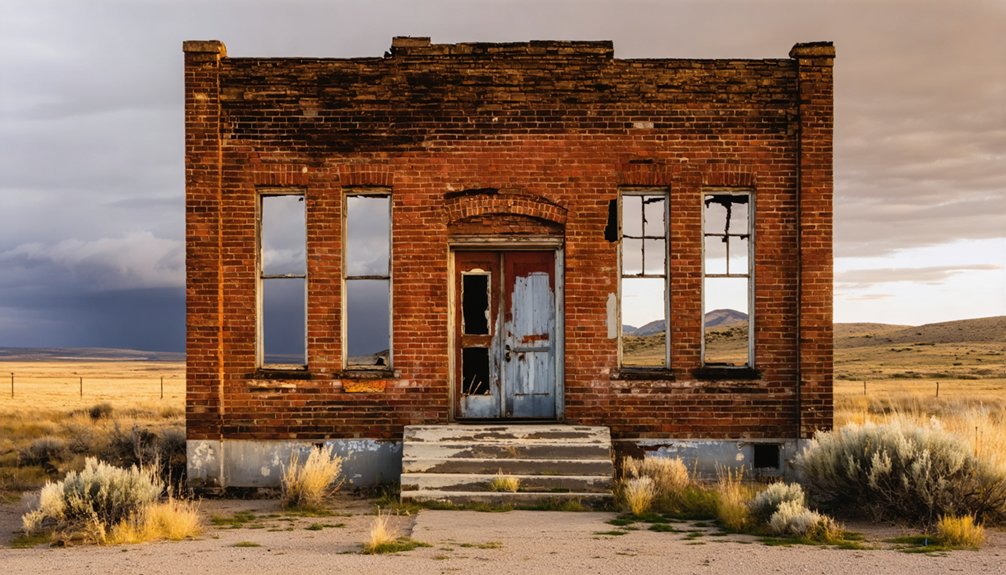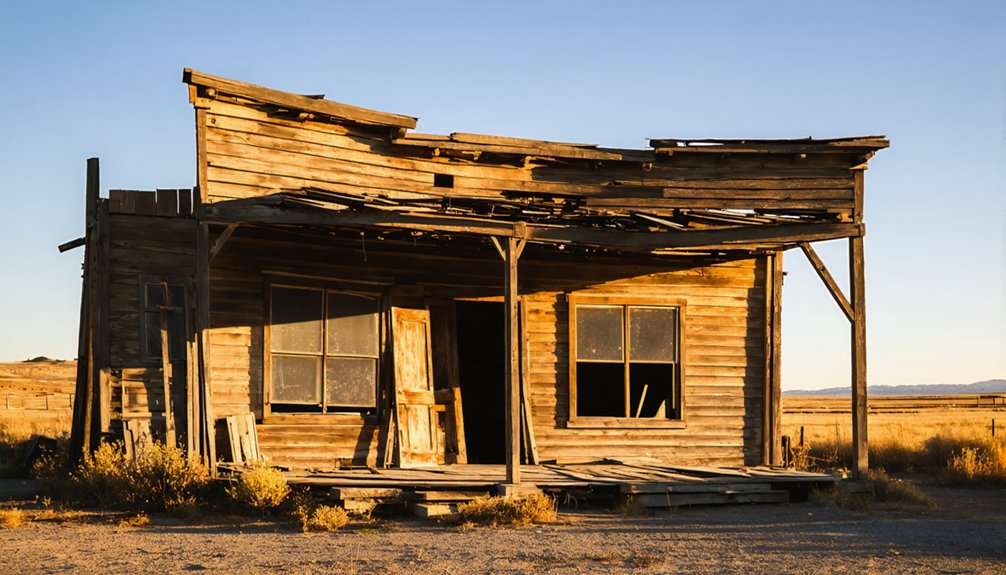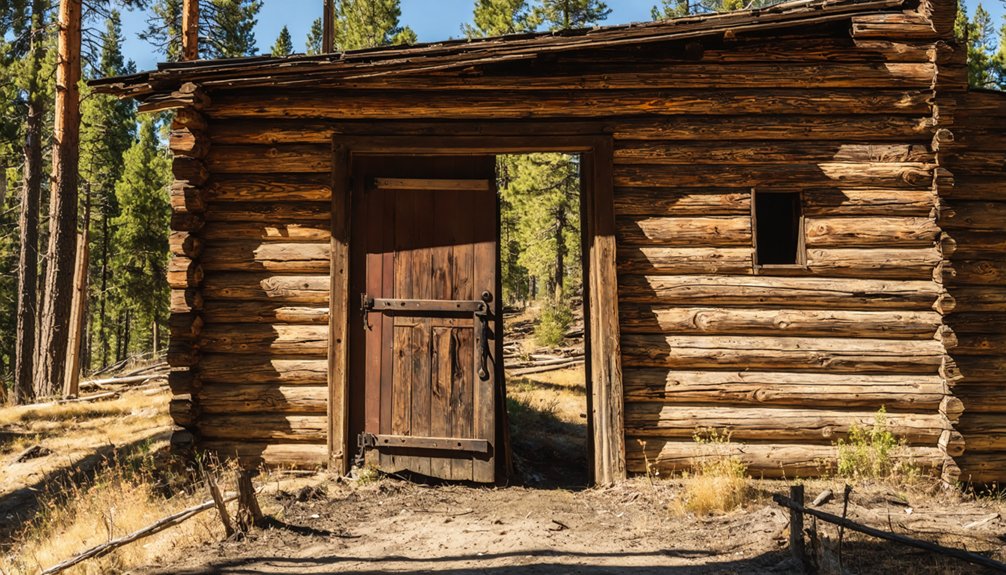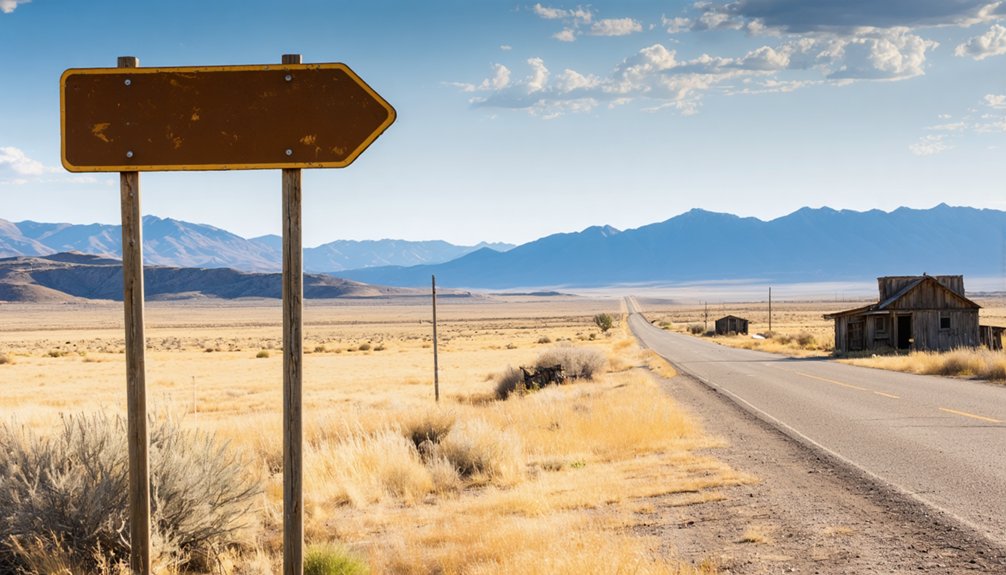
You’ll need a high-clearance vehicle and solid navigation skills to reach Callender’s weathered ruins in central Idaho’s Buffalo Hump Mining District. Plan your visit between July and September—the only window when mountain roads aren’t buried under snowpack. At 4,961 feet elevation, this remote ghost town once housed miners chasing quartz gold strikes in the late 1890s. The crumbling two-story Colgrove Grand Hotel still stands as evidence, proof, or attestation to boom-and-bust frontier life, and the surrounding wilderness holds stories of fortunes won and lost.
Key Takeaways
- Visit only July through September when roads are accessible; November through June snowpack makes routes impassable for standard vehicles.
- Bring a high-clearance vehicle and strong navigation skills to traverse remote mountain roads in central Idaho’s rugged terrain.
- Explore Callender alongside nearby ghost towns Orogrande, Hump Town, and Concord, all part of the historic Buffalo Hump mining district.
- View remnants of the 1899 Colgrove Grand Hotel, which served as Orogrande’s post office during the gold rush era.
- Check Idaho 511 for real-time road conditions before departure to avoid costly search and rescue situations.
Location and How to Reach Callender Mining District
Tucked into Valley County’s rugged central Idaho terrain at 4,961 feet above sea level, the Callender Mining District occupies a remote stretch of high-desert landscape where Montana brushes against Idaho’s border. You’ll find it within the Dillon 1°x2° quadrangle, where accessing through remote roads demands a high-clearance vehicle and solid wayfinding abilities.
State mining district map M-06 helps with guiding through district boundaries, though creek-based routes along Boyle and Williams creeks offer alternative approaches to scattered prospect sites. The Middle Proterozoic quartzite formations underfoot tell ancient geological stories, while Tertiary sediments blanket the surrounding valleys. These ancient rocks share similarities with the Proterozoic Belt Supergroup that hosts the famous silver mines of northern Idaho’s Coeur d’Alene district. The Coeur d’Alene Mining District itself, documented in 1920 historical maps now held by the University of Idaho Library, represents one of the region’s most significant mineral deposits in the state’s northern reaches.
Central Idaho highways bring you close, but you’ll earn your arrival through miles of backcountry trails that wind through mid-mountain terrain where modern conveniences fade and old mining camps whisper their forgotten histories.
Best Time to Visit and Weather Considerations
You’ll find Callender accessible only during a narrow summer window from July through September, when the rugged mountain roads shake off their winter blanket and allow passage to curious explorers.
Outside this brief season, snow buries the ghost town under several feet of white from November through late June, transforming the already-remote mining district into an impassable fortress.
I learned this the hard way during a late-October attempt, turning back three miles from town when my truck started sliding on black ice that appeared without warning as the sun dipped behind the peaks.
The journey requires traveling from Elk City via Orogrande, where you’ll need to prepare for increasingly challenging terrain as you approach the old Buffalo Hump Mining District.
Summer brings temperatures ranging from the 70s to 90s, with long sunny days that maximize your exploration time before the early autumn chill returns to these high-elevation ghost town ruins.
Summer Access Window
Late spring through fall creates the perfect window for exploring Callender and the surrounding ghost towns, though summer truly owns the spotlight here. You’ll find Highway 21’s mountain passes fully open and warm temperatures inviting you to wander freely through weathered mining structures at 6,500 feet elevation.
Plan around closing dates of facilities—Bayhorse Ghost Town locks up October 15, while Challis Hot Springs Campground hangs on until November 1. The Interpretive Center Dump Station shuts down October 10, signaling summer’s end. Budget $7.00 Motor Vehicle Entrance Fee for park access during your visit.
July brings peak seasonal visitor traffic, especially during Custer Days on the second Saturday when thousands descend for tours and reenactments. The Land of the Yankee Fork Historical Association now manages this preserved site, ensuring its mining heritage remains accessible to modern explorers. Yet even at its busiest, these remote mining camps maintain their untamed character. Your 131-mile journey demands flexibility with weather and timing.
Snow Season Restrictions
Winter transforms this high-country landscape into an impenetrable fortress for road-trippers. You’ll find access roads buried under snowpack from December through April, with elevations between 4,000-10,000 feet completely locked down.
While snowmobile trail maintenance opens some backcountry routes during this season, you can’t reach Callender by vehicle—period. Wildlife conservation efforts further restrict movement across winter ranges where deer, elk, and moose seek refuge. Even if limited snowfall makes certain trails appear passable, closures remain enforced to protect vulnerable populations.
Your window for exploration shrinks dramatically once November arrives, as steep mountain grades become impassable and maintenance crews abandon remote forest roads. The Magic Valley doesn’t get much snow, but when it does fall, safety concerns force closures at many key attractions throughout the region. Before you venture into the backcountry, obtain current maps from forest offices or online to stay informed about specific closure areas. Plan your ghost town adventure between late spring and early fall, when freedom to roam returns to these isolated valleys.
Vehicle Requirements and Road Conditions
Before you set out for Callender and the surrounding ghost towns, understanding the dramatic seasonal shifts in road access can mean the difference between a memorable adventure and a life-threatening situation. The county shuts down roads when four to six feet of snow blankets Silver City, and those warning signs aren’t just suggestions—you’ll face search and rescue costs and fines if you ignore them.
Vehicle recommendations for winter driving demand serious consideration:
- Snowmobiles serve as primary transportation once closures begin
- Tracked ATVs navigate deep snow effectively
- Cross-country skis work only for experienced backcountry travelers
- Standard vehicles access routes until fall snowfall hits
Check Idaho 511’s real-time conditions before departure. Monitor traffic updates for your planned route to stay informed of any sudden changes. Last year’s two to three winter rescue operations prove these aren’t empty warnings—responders risk their lives saving unprepared adventurers. The main challenge facing visitors involves tourists unprepared for severe road and weather conditions that can change rapidly in the high country.
The Rise and Fall of Buffalo Hump’s Mining Towns
Following the 1877 Nez Perce War, prospectors pushed into the remote Clearwater Mountains and struck quartz gold in a region that would become known as Buffalo Hump. You’ll find traces of five distinct towns here—Orogrande, Callender, Hump Town, Concord, and Frog Town—each reflecting the explosive mining community growth that followed gold’s discovery.
Frog Town earned its reputation as the liveliest settlement, while Orogrande boasted sophistication with James Henty Colgrove’s Grand Hotel, built in 1899 as both high-toned establishment and official post office. These towns sprouted on lands steeped in Native American histories, where Shoshone and Nez Perce once hunted and fished freely.
The boom couldn’t last forever. By the early 1900s, as veins played out, prospectors abandoned these mountain strongholds, leaving behind weathered foundations and untold stories.
Gold Discovery and Mining Operations
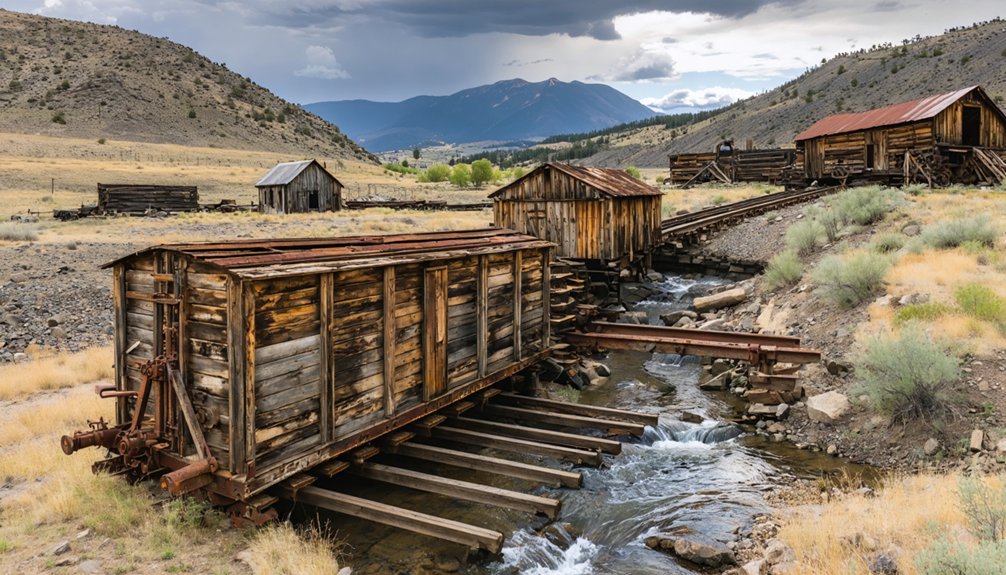
During the summer of 1862, thousands of miners flooded into the Florence camp, their pans and sluices churning through streams that had seen only Nez Perce fishermen for centuries. You’ll find these gold rush discoveries reshaped the landscape dramatically. Captain E.D. Pierce’s 1860 Canal Gulch strike on Nez Perce Reservation land sparked an invasion that forced treaty renegotiations and shrank tribal boundaries.
Gold seekers shattered centuries of Nez Perce stewardship, their 1862 invasion transforming sacred fishing grounds into scarred mining camps virtually overnight.
The region’s mineral wealth emerged in phases:
- 1862 Moose Creek placers – yielding $25 daily per claim
- 1898 Buffalo Hump quartz lodes – finally profitable after decades
- Big Buffalo Mine stake – triggering one last frontier rush
- Charles Sweeney’s 1900 mill – processing ore until 1903 shutdown
Those low-grade ledges early prospectors dismissed eventually powered operations worth exploring today.
Historic Colgrove Grand Hotel and Notable Structures
You’ll spot the remnants of James Henty Colgrove’s ambitious two-story wooden hotel from 1899, perched on a high knoll where it once commanded Orogrande’s skyline. This wasn’t just lodging—the building doubled as the town’s official post office, making it the heartbeat of daily life for miners like the Scottish and Canadian boarders who called it home in 1910.
Today, you’re walking through what the Colgrove family operated until 1913, searching for traces of hand-hewn benches and weathered wood where civilization briefly flourished in these Clearwater Mountains.
Colgrove Hotel’s 1899 Origins
The Colgrove Grand Hotel rose from a high knoll overlooking Orogrande in 1899, its massive two-story frame dominating the raw mining camp like a monument to permanence in a landscape of tent cities and temporary dreams. James Henty Colgrove arrived from Spokane with his wife Maggie and two sons, timing his construction perfectly with the district’s gold boom that began in 1894.
The family’s hotel management created a high-toned establishment—a genuine trade oasis where prospectors struck deals and collected mail.
By 1910, notable hotel residents included:
- Charlie Gee Wong, 42-year-old cook from China
- Goldie G. Harper, 19-year-old Oregon servant
- James Penman, Scottish gold miner, age 47
- James M. McCafferty, Canadian prospector, age 48
The Colgroves operated this outpost until 1913-1914, witnessing $69,598 in gold flow through their doors.
Post Office Operations Inside
While prospectors haggled over claims in the Colgrove’s grand parlor, mail service anchored Callender’s scattered population to civilization through operations far humbler than the hotel’s two-story frame. You’ll find the original post office operated from 1900 to 1904 in Valley County—a brief run typical of mining-era facilities.
Postal establishment efforts required persistence. Mr. Behne and Mrs. Abstein penned letters proving community need, eventually succeeding with a 1905 Yellow Pine office. Before the 1919 road completion, settlers hauled letters via dog sled across frozen wilderness.
The post office relocation landed in a lean-to addition attached to Charlie Ellison’s rough-hewn log building. Homer Levander purchased this modest structure in 1927, where mail sorting continued alongside general store operations—your lifeline when mountain passes trapped you for months.
Current Site Remains
Standing on that windswept knoll where James Henty Colgrove raised his two-story hotel in 1899, you’ll strain to find evidence of Orogrande’s grandest structure. Unconfirmed recent confirmation leaves explorers piecing together what remains from photographs and historical account validity alone.
What survives in documented memory:
- Hand-hewn log bench alongside wooden sidewalks
- Snowdrift images showing staircases buried to second-story doors
- Photographs of miners, saloon girls, and freight wagons with horse teams
- The post office corner where Buffalo Mining Region business transpired
You’re wandering ground Pete Johnson and Hogan prospected for “coarse gold” along Crooked River. The Colgrove family operated this trading camp hub through 1914, serving root beer and dreams. Now silence. Bring old photographs—they’re your only reliable map through vanished streets.
Exploring Nearby Ghost Towns: Orogrande, Concord, and Hump Town
Beyond Callender’s weathered structures, three ghost towns cluster in the Buffalo Hump region, each offering distinct remnants of Idaho’s mining fever.
You’ll find Orogrande eleven miles away, where the 1899 Colgrove Hotel still stands—its two-story frame once housed the post office and served miners who pulled $69,598 in gold from these hills. The run-down cabin and meadow whisper stories of Pete Johnson’s 1894 settlement on heavily placer-mined ground.
Hump Town’s silver mines draw adventurers seeking tales of lawless communities from the early 1900s boom.
Meanwhile, Concord remains shrouded in unverified local lore—you won’t find official records, just local whispers that may confuse it with nearby Dixie or Newsome camps.
All three sites are accessible year-round via 2WD roads, letting you chase freedom through Idaho’s enigmatic mining past.
What Remains: Landmarks and Ruins to Discover
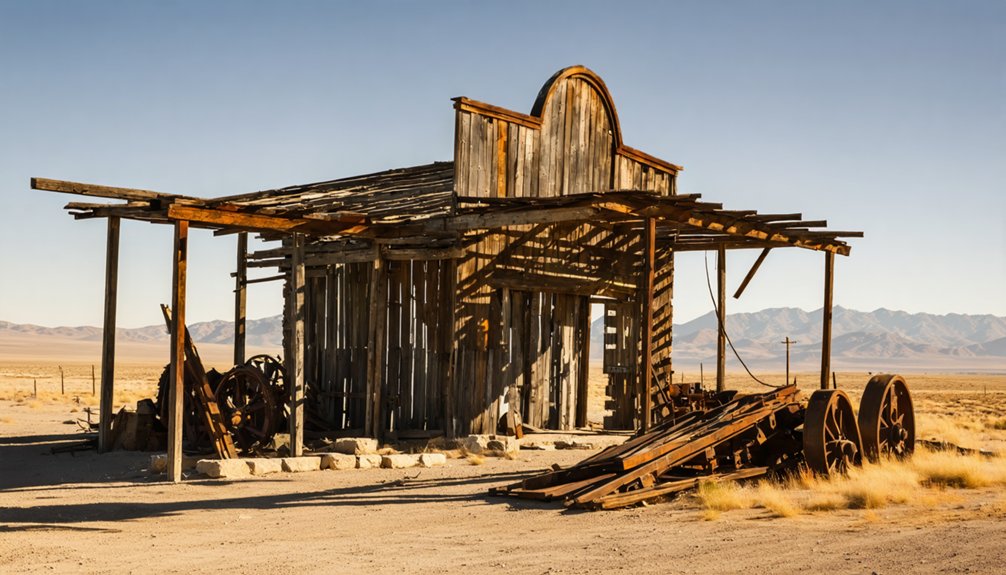
Your journey through Idaho’s ghost towns reveals layers of history written in weathered wood and crumbling stone. Beyond Callender, preserved structures dot the landscape like monuments to frontier resilience.
At Bayhorse, you’ll find exploratory trails leading to an impressive stamp mill clinging to the hillside and a sturdy Wells Fargo building that’s weathered decades. Placerville’s grassy park square showcases historical buildings while its Pioneer Cemetery tells stark truths—only 28 of the first 200 burials resulted from natural causes.
Must-see landmarks include:
- Florence’s Boot Hill Cemetery, where Cherokee Bob’s grave marks outlaw history
- Rocky Bar’s original structures, revealing harsh winter survival
- Gilmore’s preserved sites, protected by the Lemhi County Historical Society
- Bayhorse’s accessible stamp mill and interpretive signs
Each site offers unrestricted exploration through interpretive signs and self-guided tours.
Essential Trip Planning Tips and Resources
Before you load your truck for Callender, understand that reaching this remote ghost town demands serious preparation—this isn’t a paved-road Sunday drive. You’ll navigate roughly 40-50 miles of dirt forest roads from Grangeville, requiring four-wheel drive through high subalpine terrain where weather shifts without warning.
Callender demands respect—pack your 4WD with emergency gear before tackling 40 miles of unforgiving subalpine forest roads.
June through September offers your window; winter snow seals these routes completely.
For visitor resources for exploration, grab Idaho County’s National Register PDF and study Forest Service road maps before departure. The “Code of the West” signs marking Buffalo Hump’s entrance aren’t decorative—they’re warnings about genuine wilderness hazards.
Pack bear spray, emergency supplies, and enough food for primitive overnight stays since Callender offers zero facilities. That burned-down Orogrande Lodge won’t shelter you. Modern Grangeville provides your last civilized stop before pushing into this forgotten mining district.
Frequently Asked Questions
Are There Camping Facilities or Accommodations Near the Callender Mining District?
You’ll find camping at Camp 3 Campground with tent sites and fire pits, plus CampLife’s nearby cabin rentals. PerfectCamp offers 52 RV-friendly sites, while local inn accommodations dot the area. Over 1,000 acres of trails await your exploration.
What Wildlife Should Visitors Expect to Encounter in This Wilderness Area?
You’ll likely spot mule deer bounding across sagebrush flats at dawn. Native mammal populations include elk, coyotes, and mountain lions roaming freely. Migratory bird species like hawks and eagles soar overhead, while smaller songbirds flit through juniper groves seasonally.
Is Cell Phone Service Available in the Buffalo Hump Mining District?
You won’t find cell tower coverage in Buffalo Hump’s remote mining district. Before tackling hiking trail access into this wilderness, download offline maps and tell someone your plans—you’ll be completely off-grid in true backcountry freedom.
Are There Any Safety Concerns or Hazards When Exploring Old Mines?
Yes, you’ll face serious dangers: abandoned mine shafts drop hundreds of feet, loose rock formations collapse unexpectedly, and toxic gases linger in darkness. Fatal falls, drowning in flooded tunnels, and suffocation claim nearly thirty lives yearly—freedom demands respect.
Do I Need Permits to Visit or Explore the Ghost Towns?
You don’t need permits for casual exploration, but respect private property access boundaries and no-trespassing signs. Abandoned structure risks mean you’re exploring at your own risk—freedom comes with personal responsibility for your safety and legal compliance.
References
- https://www.ghosttowns.com/states/id/callender.html
- https://www.youtube.com/watch?v=uqsVJKcyCYw
- https://dustywindshield.wordpress.com/2016/09/10/orogrande-mining/
- https://greenelibrary.bibliocommons.com/v2/record/S981C15279098
- https://wildwestcity.com/old-west-ghost-towns/
- https://pubs.usgs.gov/imap/1803c/report.pdf
- https://www.isu.edu/digitalgeologyidaho/n-idaho-mining/
- https://www.lib.uidaho.edu/digital/historicalmaps/items/spec_hm2.html
- https://hub.arcgis.com/maps/uidaho::map-of-coeur-dalene-mining-district/about
- https://westernmininghistory.com/mine-detail/10266337/