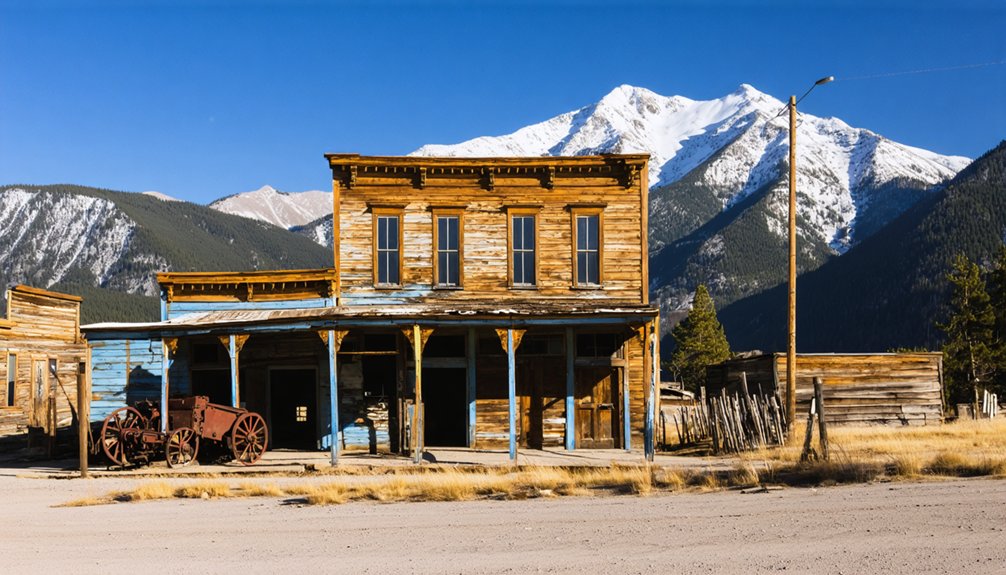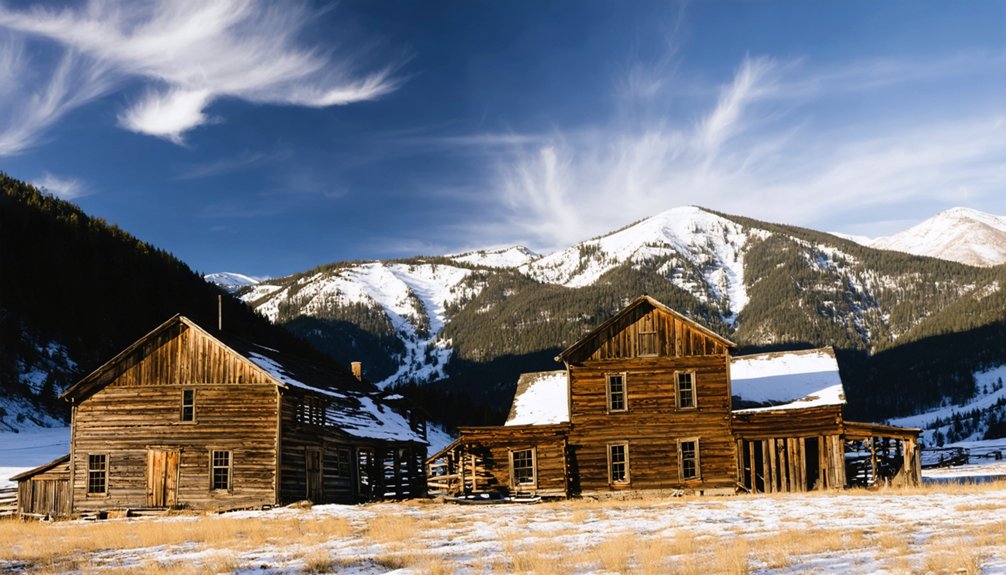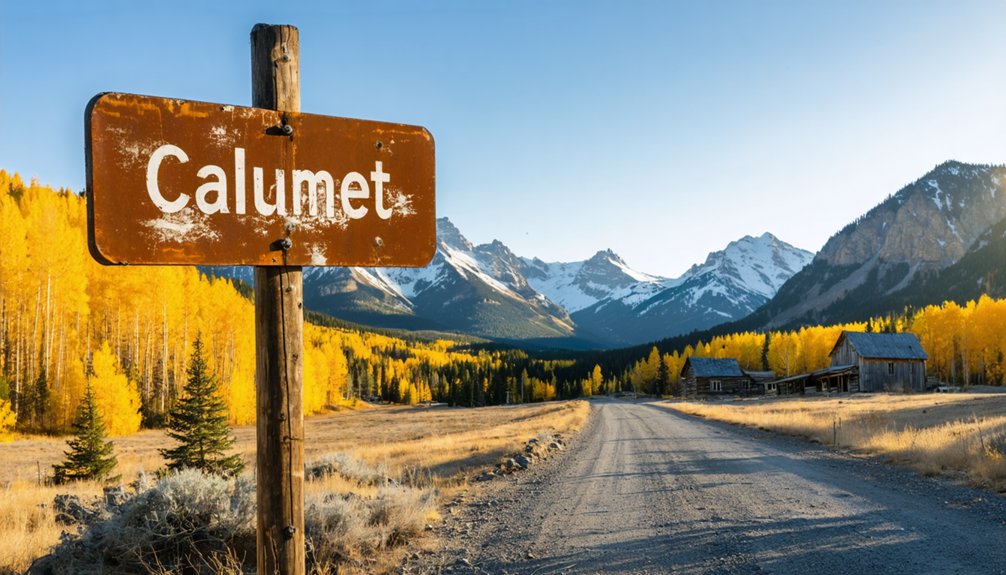
You’ll find Calumet’s haunting remains in Huerfano County at 6,391 feet, accessible via county roads near Farista and Pictou. Plan your visit between late June and early September when temperatures hit 84°F, though you’ll need layers for chilly nights. The 1904 mine office foundation and Hekla mill smokestack still stand among rusted stamps and tailings piles, where you can collect quartz crystals and magnetite. Pack sturdy boots, flashlights, and plenty of water—there’s much more to uncover about this coal town’s explosive history.
Key Takeaways
- Calumet sits at 6,391 feet in Huerfano County, accessible only by county roads near Farista and Pictou.
- Visit late June through early September for comfortable weather, with daytime highs around 84°F and cool nights.
- Bring 4×4 vehicle, sturdy boots, layers for temperature swings, flashlights for exploring, and ample water supplies.
- Explore 1904 mine office foundations, Hekla mill smokestack, rusted stamps, and collect mineral specimens like quartz crystals.
- Early fall offers vibrant colors, mild temperatures, and fewer crowds for those seeking optimal exploration conditions.
Getting to Calumet: Directions and Highway Access
The ghost town of Calumet emerges from Colorado’s high prairie at 6,391 feet elevation, where the earth still whispers stories of coal dust and miners’ boots. You’ll find it northwest of Walsenburg in Huerfano County, coordinates locked at 37.6928°N, -104.8597°W.
The transportation logistics require traversing local county roads—no interstate convenience here. Your GPS will guide you through rugged access roads terrain that wind past Farista and Pictou, both 4½ miles southeast. Set your coordinates to 37° 41′ 34.04″ N, 104° 51′ 34.96″ W and consult the USGS Walsenburg North quadrangle before departing.
Satellite imagery reveals the route’s character: unforgiving backcountry demanding respect. This isn’t a destination for casual Sunday drivers—you’re chasing authentic frontier solitude.
What Remains: Exploring the Mining Ruins
When you crest the final rise into Calumet’s valley, silence greets you first—the kind that settles in your chest after industry dies. Foundation stones mark where the mine office stood since 1904, but the earth has reclaimed almost everything else.
The Hekla mill’s smokestack pierces the skyline above scattered tailings piles, while rusted stamps lie half-buried in sage. You’ll find little machinery intact—Kaiser Steel stripped most equipment before the 1971 abandonment.
For mineral specimen collecting, the real treasure demands hard rock mining into untouched pockets where double-terminated quartz crystals nestle on epidote matrices. Magnetite masses and blue corundum still reward persistent searchers. Artifact preservation isn’t the priority here; discovery is.
The Rise and Fall of a Coal Mining Community
Long before silence claimed these valleys, Colorado Coal & Iron hammered rails toward rich seams that would birth Calumet in the late 1800s. You’ll find traces of an empire that once dominated Las Animas County, where 4,411 miners extracted nearly 2.4 million tons in 1915 alone. Historic mining equipment rusts among foundations where company towns housed workers who fueled railroads and steel mills across the West.
But prosperity demanded blood—1,708 Colorado miners died between 1884 and 1912. Early labor conflicts erupted as deadly conditions met meager wages, culminating in the 1913-1914 Coalfield War when United Mine Workers challenged Rockefeller’s CF&I. Armed strikebreakers and twenty-one-hour sieges scarred these hillsides. By 1899, Calumet’s furnaces went cold, leaving only wind through empty portals.
Best Time to Visit and What to Bring
The sun-bleached bones of Calumet reveal themselves best between late June and early September, when summer warmth transforms the high-altitude ghost town into an accessible time capsule beneath partly cloudy skies.
You’ll need to prepare for temperature swings that can plunge from 84°F afternoons to chilly mountain evenings, so pack layers that’ll keep you comfortable while exploring weathered structures and overgrown pathways. Your vehicle should carry everything from high-SPF sunscreen and sturdy hiking boots to flashlights for peering into darkened mine shafts, plus ample water to counter the dehydrating effects of Colorado’s thin air.
Optimal Visiting Seasons
Timing transforms your Calumet ghost town adventure from merely interesting to utterly unforgettable. At 6,391 feet elevation, you’ll escape the harsh conditions plaguing higher-altitude sites. Summer brings comfortable temperatures for exploration, though you’ll share the landscape with tourist crowds.
As you venture through the remnants of the past, consider checking out the various ghost town attractions in Nevada. Each site is steeped in history, offering a glimpse into the lives of the miners and settlers who once called these places home. Whether you are delving into old saloons or viewing the remains of mining equipment, these experiences promise to enhance your adventure.
#SpringEarlyBlooms paint the surrounding valleys with wildflowers as snow retreats from accessible roads. Early fall stands out as your sweet spot—vibrant autumn colors frame weathered structures while mild temperatures persist and crowds thin dramatically. #FallColorSplendor creates stunning photography opportunities against rustic backdrops.
Winter delivers solitude and snow-dusted charm, with Calumet’s lower elevation ensuring milder conditions than nearby ghost towns. Year-round 4×4 capability opens your options, letting you chase whatever season speaks to your wandering spirit without extreme weather blocking your path.
Essential Road Trip Gear
Your dusty boots crunch across weathered planks while mountain winds whistle through broken windowpanes—but this atmospheric adventure demands serious preparation beyond choosing the perfect season. Essential off road accessories include recovery equipment like high-lift jacks, tire deflators, and air compressors for traversing rutted mountain trails.
Pack emergency tools—jumper cables, tow rope, and extensive repair kits—since cell service vanishes in these forgotten valleys. Camping gear recommendations start with temperature-appropriate sleeping bags and insulated pads, as Colorado nights bite hard at elevation.
Your vehicle becomes your lifeline: stock paper maps, GPS devices, and three days’ emergency supplies. Don’t forget the first aid kit and extra batteries for headlamps when exploring shadowy structures. Freedom means self-sufficiency—pack accordingly.
Kaiser Steel’s Legacy at Calumet No. 2
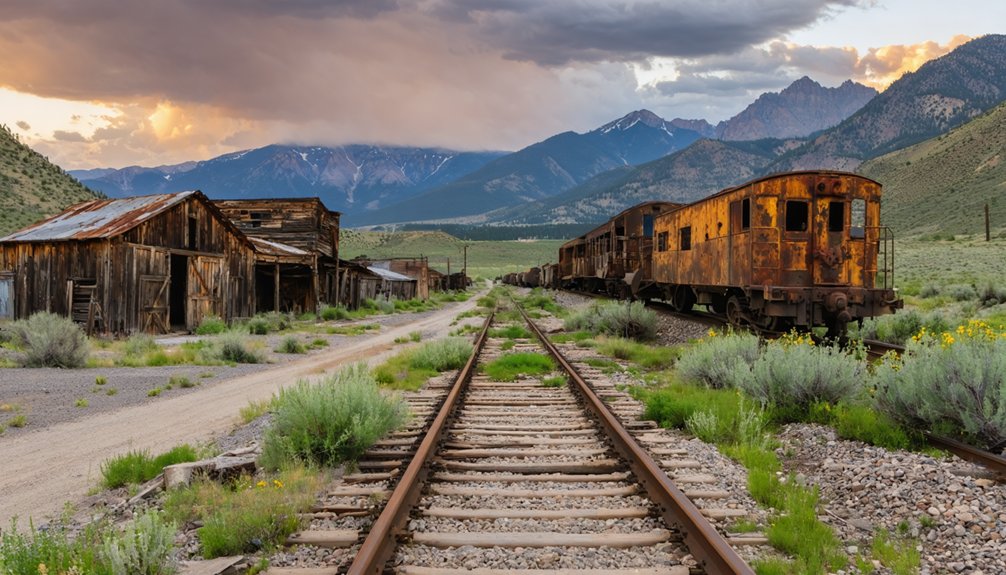
You’ll discover that Kaiser Steel transformed Calumet No. 2 into an industrial powerhouse that rumbled with round-the-clock operations for nearly fifty years.
The mine hit its stride in 1961, when conveyor belts groaned under record-breaking tonnage that crowned it the county’s top coal producer. Standing among the weathered ruins today, you can still sense the echoes of that peak era—when black gold poured from these tunnels and fueled the steel mills of distant California.
Nearly Five Decades Operating
For over four decades, Kaiser Steel Corporation‘s massive industrial complex in Fontana, California, churned out the steel that built America’s West Coast—from Liberty ships that crossed the Pacific to pipelines that crisscrossed deserts.
From 1942 to 1983, this inland fortress employed over 100,000 workers whose labor force composition shaped entire communities. You’ll find echoes of this empire in places like Calumet, where Kaiser’s Utah coal mines fed the hungry blast furnaces named “Big Bess.”
When economic reality forced closure in 1983, the post closure industrial landscape told a familiar story—debt-laden buyouts, scattered remnants, and the slow transformation of industrial might into memory. Today’s California Steel Industries rose from those rolling mill ashes, but the ghost towns remain as testimony to an empire’s reach.
Peak Production in 1961
The steel empire’s hungering blast furnaces demanded constant feeding, and Kaiser’s Colorado coal operations answered that call with mechanical precision throughout the early 1960s. You’ll find 1961 marked the apex—Kaiser Steel shattered eighteen production records while Calumet’s mines hummed beneath the Rockies, extracting coal that would journey westward to fuel unprecedented output.
The tinplate mill’s 200,000-ton capacity roared at full throttle, processing sheets into products destined for markets beyond America’s borders. This record breaking output positioned Kaiser for international expansion, as Western dominance alone couldn’t satisfy corporate ambitions.
While Somerset operations moved 57,234 tons and Oliver #2 contributed its share, you’re witnessing the final glory days before decline—when Calumet’s underground labyrinth still mattered to California’s industrial heartbeat.
County’s Top Coal Producer
When Kaiser Steel claimed ownership of Calumet No. 2 in 1924, few could’ve predicted this modest underground operation would dominate Huerfano County’s coal landscape by 1961. You’re standing where Henry J. Kaiser’s vision transformed a small-scale mine into the county’s reigning champion of coal production leadership. The mountain air still carries whispers of that pivotal year when Calumet’s underground tunnels outproduced every competitor across Huerfano’s rugged terrain.
Kaiser Steel’s management proved that scale doesn’t determine success—efficiency does. This unassuming operation achieved significant regional impact through nearly five decades of calculated extraction, demonstrating how strategic ownership could elevate a modest enterprise beyond its physical limitations. The mine’s triumph represented Colorado’s industrial independence, where determination carved prosperity from solid rock.
Red Dawn’s Hollywood Connection
Although fictional Calumet, Colorado never existed beyond the script, Las Vegas, New Mexico transformed itself into America’s most iconic invaded town during the summer of 1983. You’ll find Red Dawn’s filming locations scattered throughout this rugged landscape, where Johnson’s Mesa hosted the haunting execution scene and Hermit Peak loomed over roadblock confrontations.
The production facts reveal an abandoned Safeway became the Wolverines’ secret hideout, while locals painted murals and Russian banners along Main Street. That distinctive “Calumet says Howdy” sign still greets visitors today. Directors chose this terrain deliberately—its vague landmarks could represent any American township worth defending.
From Talus Natural Arches to Ojo Caliente’s convoy ambush site, these locations embody the spirit of resistance that resonates with freedom-loving travelers.
Nearby Ghost Towns Worth Adding to Your Route
Beyond Red Dawn’s filming locations, Colorado’s high country conceals dozens of authentic ghost towns where wooden storefronts sag against mountain winds and abandoned dreams rust in alpine meadows.
St. Elmo stands twenty miles southwest of Buena Vista, its forty-three buildings frozen in 1950s abandonment. You’ll wander past saloons and jailhouses where 2,000 souls once carved lives from stone. The architectural highlights include telegraph offices and hotels that whisper tales of boom-town excess.
Tin Cup’s cemetery reveals the historical significance of its lawless past—short-lived sheriffs rest beneath weathered markers. Meanwhile, Carson’s machinery litters the Continental Divide Trail near Lake City, rusting relics from gold fever dreams.
Alta claims National Register status near Telluride, its cabins and boarding houses perched in high-alpine splendor where freedom-seekers once chased mineral fortunes through brutal winters.
Safety Tips and Legal Considerations for Exploration
The romance of weathered storefronts and mountain-wind whispers fades when your vehicle breaks down thirty miles from cell service, or when a property owner confronts you with a shotgun. Before you roll toward Calumet’s ruins, verify your oil, fluids, and tire pressure—carry recovery gear and share your route plan with someone reliable.
Most ghost towns sit on private land; trespassing earns prosecution, not adventure. Respect posted boundaries and secure permission beforehand. Inside crumbling structures, rattlesnakes coil in shadows while unstable timbers threaten collapse. Mine shafts shelter mountain lions practicing wildlife conservation in their adopted refuges. Federal law protects artifacts—leave them untouched for natural resource protection.
Check local codes, heed warnings from veterans, and remember: true freedom requires responsibility, not recklessness.
Frequently Asked Questions
Are There Any Local Accommodations Near Calumet for Overnight Stays?
Craving adventure under starlit skies? You’ll find nearby bed and breakfasts in Crested Butte offering cozy refuge, while local campgrounds let you sleep beneath mountain peaks. Both options put you minutes from Calumet’s haunting, abandoned streets.
Can I Find Guided Tours of Calumet’s Mining Ruins?
While Calumet itself lacks formal mining tours available, you’ll discover guided hikes offered at nearby Old Hundred Gold Mine in Silverton. You’ll venture deep underground, touch cold volcanic rock, and pan shimmering gold—keeping whatever treasures you find.
What Photography Equipment Works Best for Capturing Ghost Town Remnants?
You’ll want a mirrorless or DSLR camera with wide-angle lenses for capturing vast, decaying structures. Camera tripods stabilize low-light shots inside crumbling buildings, while high dynamic range photography reveals haunting details hidden in shadows and brilliant sunlight simultaneously.
Are There Restaurants or Gas Stations Close to the Site?
You’ll find limited nearby dining options in remote Calumet, so pack provisions before departing. Availability of fuel supplies requires planning—fill up in larger towns like Leadville or Buena Vista. Your freedom means embracing self-sufficiency on this backcountry adventure.
Did Any Notable Historical Figures Live in Calumet During Mining Operations?
The background information discusses Calumet, Michigan’s mining operations and notable residents, but you’re asking about Calumet, Colorado. Unfortunately, there’s no documented evidence of prominent historical figures living in Colorado’s Calumet during its brief mining operations era.