Your ghost town road trip to Camp Whiteside begins 7.3 miles southwest of Junction City, where dirt roads wind through Geary County’s open prairie toward crumbling limestone foundations and eroded earthworks. You’ll need a government-issued photo ID to access this forgotten 1850s military outpost on Fort Riley land, plus a four-wheel drive vehicle for unpredictable terrain. Nearby ghost towns like Bala, Dunlap, and Cedar Point offer additional stops where deteriorating churches and abandoned bank buildings whisper stories of Kansas’s frontier past, revealing deeper connections between military expansion and prairie settlements.
Key Takeaways
- Camp Whiteside sits 7.3 miles southwest of Junction City, accessible via dirt roads requiring four-wheel drive vehicles through open prairie.
- Military installation access requires government-issued photo ID; apply online at Visitor Control Center to reduce wait times at entry.
- Nearby ghost towns include Bala’s Presbyterian Church, Dunlap’s preserved structures, and Cedar Point’s abandoned 1920s bank forming exploration routes.
- Fort Riley’s limestone buildings date to 1853, offering historical context where peacekeeping confronted Bleeding Kansas slavery conflicts.
- Combine your trip with White Cloud’s Chief Ma-Hush-Kah memorial and Lewis and Clark Scenic Overlook along the Missouri River.
Historical Background of Camp Whiteside and Fort Riley
Where the Smoky Hill and Republican Rivers converge in the Kansas prairie, soldiers of the U.S. Army established their post in 1853. You’ll discover Fort Riley was built from native limestone, named for Maj. Gen. Bennett C. Riley who’d blazed the Santa Fe Trail in 1829. This frontier outpost became your gateway to Camp Whiteside, where Kansas’s first territorial legislature gathered in July 1855.
You’re standing where history turned volatile. Debates on slavery echoed through these grounds as the nation teetered toward war. Fort Riley’s peacekeeping role during Bleeding Kansas wasn’t just about protecting westward settlers—it meant confronting the raw conflict between freedom and bondage. Ironically, slavery existed within the garrison itself, reflecting America’s fractured soul during the 1850s.
Understanding Access Requirements for Military Installation Sites
The gravel crunches beneath your tires as you approach Fort Riley’s gates, where uniformed guards await your credentials with practiced efficiency. You’ll need government-issued photo ID—your REAL ID-compliant driver’s license, passport, or CAC card opens these gates to historical exploration. Expired documents won’t cut it here.
Navigating screening procedures becomes smoother when you’ve applied online at the Visitor Control Center beforehand, trimming wait times to under ten minutes. Your sponsor must hold DoD credentials and be eighteen-plus, verifying sponsorship through proper channels. Vehicle registration and insurance documentation stay within reach as you roll forward.
For repeat visits to Camp Whiteside’s remnants, consider the Locally Approved Credential. Commercial vehicles detour through 12th Street’s dedicated screening point, keeping traffic flowing toward Kansas’s hidden historical treasures.
Route Planning From Junction City to Camp Whiteside
Credentials secured, you’ll chart your course southwest from Junction City’s main streets toward this 7.3-mile journey into Kansas military history. MapQuest and Google Maps become your digital companions, revealing dirt roads that wind through Geary County’s open prairie.
Remote site accessibility demands preparation—satellite imagery shows the terrain you’ll traverse, where pavement surrenders to gravel and grassland. Among suggested transportation options, four-wheel drive vehicles handle unpredictable conditions best, though Dollar Rent A Car in Junction City can outfit you adequately.
The route passes within view of active Fort Riley installations before veering toward abandoned Camp Whiteside. You’ll navigate by landmarks rather than street signs, watching Rolling Hills give way to forgotten military grounds where Kansas wind whistles through skeletal structures standing sentinel over their vanished purpose.
Connecting Your Journey With Nearby Kansas Ghost Towns
After exploring Camp Whiteside’s weathered remnants, you’ll discover this journey positions you perfectly within Kansas’s ghost town corridor, where military abandonment parallels the railroad’s broken promises across the prairie.
Just thirty minutes west, Bala’s deteriorating Presbyterian Church stands against Fort Riley’s expansion, a symbol of community pride fighting inevitable change.
Head south to Morris County where Dunlap’s population crashed from 400 to 30, yet local preservation efforts keep history breathing through original storefronts.
Chase County rewards your wanderlust with a one-day circuit—Cedar Point’s 1920s bank, Clements’ stone arch bridge, and Elmdale form a triangle of abandonment. Each crumbling foundation whispers stories of railroads that never came and dreams that couldn’t survive the prairie’s harsh economics.
You’re free to chart your own path through Kansas’s forgotten landscapes.
White Cloud and the Legacy of Chief Ma-Hush-Kah
You’ll find Chief Ma-Hush-Kah’s burial site beneath a towering tree overlooking the Missouri River near Iowa Point, where the respected Ioway leader was laid to rest in 1854 after falling in battle against the Pawnee.
The same river bluffs that witnessed the chief’s life now offer you sweeping views from the Lewis and Clark Scenic Overlook, where the famous expedition passed through in 1804.
Stand at this convergence of Native American heritage and pioneer exploration, where the waters below have carried centuries of history through Kansas Territory.
Chief Ma-Hush-Kah’s Historic Burial
When you stand in White Cloud, Kansas today, you’re walking ground hallowed by tragedy and transformation. This town bears the name of Chief Ma-Hush-Kah, whose journey from warrior leadership to peacemaker defined an era of tribal governance caught between two worlds.
The chief’s final resting place tells a haunting story:
- Shot in the back by his own tribesman in 1834 while sitting peacefully at his campfire
- Buried along the Nodaway River in what’s now Cass County, Iowa
- Commemorated by a full-sized sculpture displayed in 1909 before 12,000 spectators
Ma-Hush-Kah’s death embodied bitter irony—killed during his mission for peace, after renouncing the very violence that once defined him. His legacy lives on in White Cloud’s name, honoring a leader who chose transformation over revenge.
Lewis and Clark Viewpoint
From a hilltop platform 16 feet by 24 feet, you’ll command views across four states where Lewis and Clark once charted America’s unknown frontier. The Missouri River winds below, tracing the same route the expedition followed in 1804 and 1806 through Kaw tribal territory.
A stone marker stands as bicentennial commemoration of their passage, while an interpretive pavilion documents their journey through these northern reaches.
This wheelchair-accessible overlook reveals Kansas, Missouri, Nebraska, and Iowa stretching to distant horizons—one of Kansas’s Eight Wonders of Geography. You’ll understand why White Cloud thrived as a steamboat landing, its river transportation history written in the valley’s curves below.
The same waters that carried explorers into wilderness later brought settlers, transforming Chief White Cloud II’s hunting grounds into bustling frontier commerce.
Trading Post and Historic River Settlements Worth Exploring
Along the Marais des Cygnes River, where shallow waters once carried French fur traders’ canoes, the weathered foundations of Cyprian Chouteau’s 1825 trading post still mark Kansas’s oldest white settlement site. You’ll discover the role of fur trade through pack-horse trails that wound through untamed woodlands, connecting frontier merchants with Native tribes long before roads scarred this landscape.
Where French voyageurs paddled through wilderness, Chouteau’s crumbling stones whisper tales of Kansas’s first white foothold along ancient trading routes.
The impact of border ruffians transformed this peaceful trading ground into Kansas’s bloodiest crossroads:
- The 1858 Marais des Cygnes Massacre, where Charles Hamilton executed five Free-Staters
- Union fortifications from 1861-1865 overlooking strategic river crossings
- Button factories harvesting mussel shells from riverbeds
Explore upstream to find Kickapoo Post’s bluff-top ruins and Bill Williams’ confluence settlement, where independent traders carved freedom from wilderness before government surveyors arrived.
Complete Multi-Day Itinerary for Kansas Ghost Town Enthusiasts
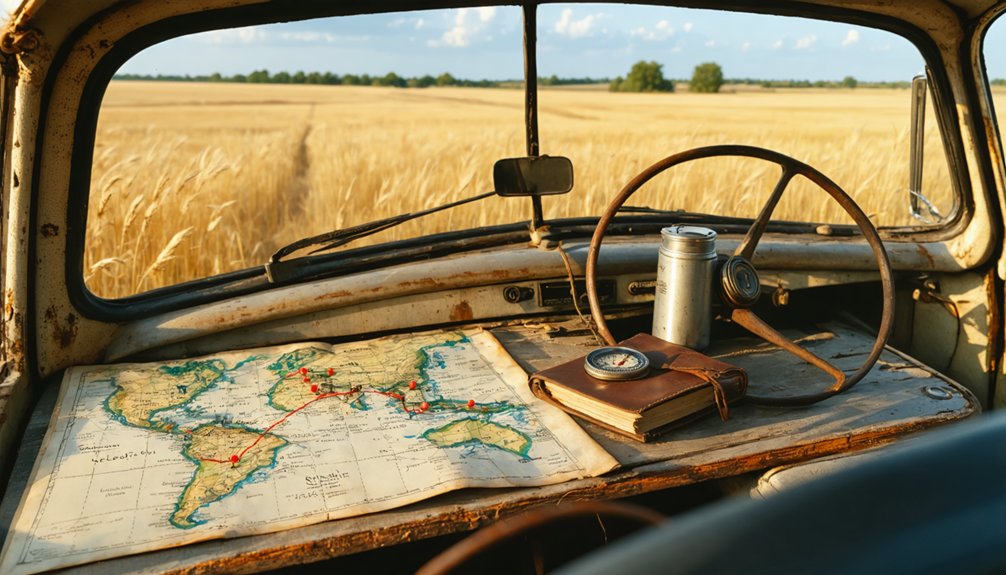
Your Kansas ghost town expedition demands strategic planning across three distinct regions, each requiring a full day to absorb the haunted textures of prairie ruins and mining scars.
Day one explores Fort Riley’s Camp Whiteside and White Cloud’s riverfront remnants, where Ma-Hush-Kah’s burial grounds overlook the Missouri. Secure lodging accommodations in Atchison, thirty miles south.
Day two tackles Empire City’s lead-poisoned streets near Galena, followed by Centennial City’s coal-weighing foundations. The Galena Mining Museum contextualizes both sites through nearby museum exhibits documenting extraction’s brutal economics.
Day three sweeps through Sumner County’s railroad ghosts—Hunnewell’s stockyards, Perth’s flood-ravaged foundations, Rome’s scattered stones. Each stop reveals how cattle drives, Cherokee land runs, and steel rails dictated prosperity’s fleeting geography across these windswept plains.
Essential Photography Tips and Respectful Exploration Guidelines
Camp Whiteside’s crumbling concrete foundations and weathered military structures offer haunting photographic opportunities, but you’ll need to balance your creative vision with stringent access restrictions. The abandoned base sits on private property with portions still under military jurisdiction, so you must secure explicit permission before setting foot on site.
Your wide-angle lens will capture the stark beauty of decaying barracks and overgrown parade grounds, but remember that respecting boundaries preserves these fragile historical remnants for future documentation.
Capturing Historical Military Remnants
The windswept Kansas prairie reveals its secrets slowly at these coordinates—39.08472°N, 96.77139°W—where artillery batteries once thundered across 0.7 square miles of training ground. You’ll find remnants of General Whitside’s legacy scattered across this abandoned military landscape, perfect for highlighting lost artillery placements from the 1930s.
Your camera becomes a time machine when capturing abandoned barracks structures against the flat terrain. Channel those archival black-and-white prints by photographing:
- Battery positions where the 161st Field Artillery trained in August 1933
- Cavalry command structures from the 114th Regiment’s 1926 encampments
- Infantry training sites used by the 137th during Kansas National Guard exercises
Golden hour transforms these ghost town remnants into dramatic silhouettes. Wide-angle lenses capture the full expanse where soldiers once drilled under vast prairie skies.
Respecting Restricted Base Access
Before you pack your camera gear for Camp Whiteside, understand this pivotal reality: you’re approaching an active military installation where unauthorized photography isn’t just discouraged—it’s illegal. Your exploration requires sponsorship requirements from a DoD ID holder, plus background clearance through Fort Riley’s Visitor Control Center. Bring your REAL ID-compliant license and legitimate documentation proving your historical research purpose.
Visitor etiquette demands strict adherence to posted restrictions. Keep cameras holstered near operational areas, security checkpoints, and restricted zones. Your sponsor remains accountable for your actions, so respect speed limits and signage. Gates like Four Corners operate 24/7, but expect vehicle inspections requiring registration and insurance. Violations don’t just end your visit—they’ll bar future access to all military installations. Freedom here means operating within clearly defined boundaries.
Frequently Asked Questions
What Camping Facilities Are Available Near Camp Whiteside for Overnight Stays?
You’ll find Ellis City Lake Campground nearby, offering primitive campsites for $15 nightly and RV hookup sites from $20-25. Picture yourself beneath towering cottonwoods along Big Creek, where electrical connections meet wilderness freedom and hot showers await your dusty adventures.
Are Guided Tours of Fort Riley’s Historical Sites Offered to Civilians?
You’ll find limited public access to Fort Riley’s historical sites, with self-guided tours available through brochures at the U.S. Cavalry Museum. Custer House offers guided experiences by appointment, letting you explore frontier military heritage independently.
What Cell Phone Coverage Can Visitors Expect in Rural Kansas Areas?
Cell coverage becomes a patchwork quilt across rural Kansas—you’ll find local cellular network reliability strongest with Verizon and AT&T, though emergency communication options like satellite services prove essential when exploring remote ghost towns beyond traditional towers.
Which Restaurants in Junction City Serve Authentic Kansas Cuisine?
You’ll find authentic Kansas flavors at local barbecue joints like Bobo’s Drive-In and Hot Rodz BBQ, serving slow-smoked meats with tangy sauce. Pair your meal with finds from seasonal produce markets for a true taste of heartland freedom.
What Weather Conditions Should Road Trippers Prepare for Year-Round?
Kansas weather shifts like a wild mustang—untamed and unpredictable. You’ll face seasonal temperature swings from 20°F winters to 93°F summers, plus potential for severe storms. Pack layers, rain gear, and embrace the adventure of changing conditions daily.