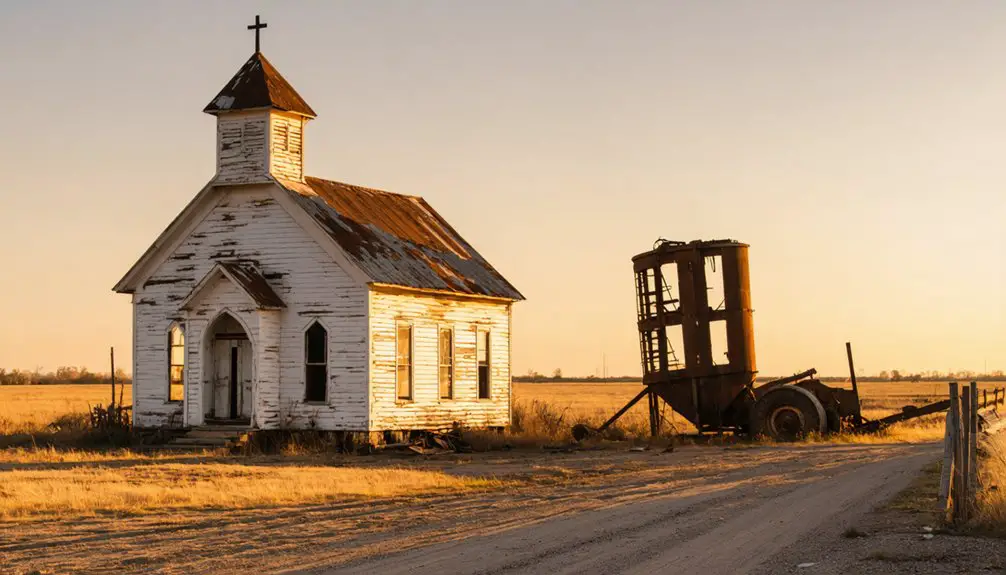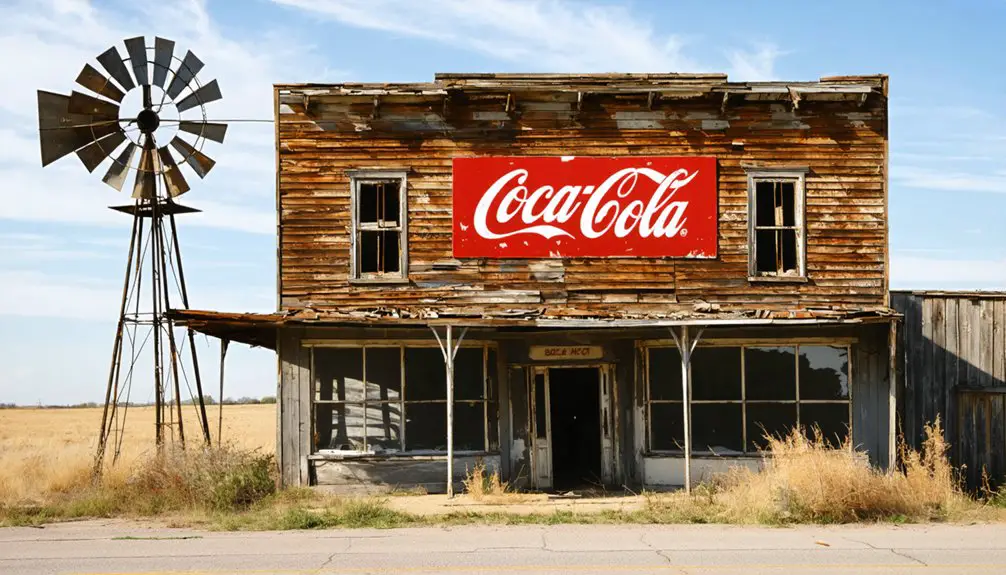
You’ll find Carpenter eight miles north of Elk City, where toxic mining dust still coats the barren landscape and subsurface shafts threaten to swallow what’s left. This ghost town offers little dramatic ruins—just haunting emptiness—but Carpenter’s Bluff Bridge stands as the most accessible remnant of its boom-town past. Visit during shoulder seasons (April-June or September-October) when temperatures cooperate, pack GPS for off-grid navigation, and prepare for self-sufficiency since no services exist. The surrounding region holds surprising discoveries worth exploring.
Key Takeaways
- Carpenter lies eight miles north of Elk City at the intersection of Roger Mills and Custer counties; GPS is essential for navigation.
- Visit during April-June or September-October for ideal weather; avoid oppressive July-August heat and winter’s unpredictable conditions.
- The abandoned mining town offers sparse ruins compared to Picher, but Carpenter’s Bluff Bridge provides accessible historical exploration.
- No services exist in the unincorporated settlement; pack supplies and plan for complete self-sufficiency during your visit.
- Nearby Stroud offers Route 66 lodging, dining, and attractions like the Joseph Carpenter House and Stroud Lake recreational areas.
The History and Mystery of Carpenter’s Abandoned Streets
When George Oermann’s geological survey struck pay dirt in 1913 on Harry Crawfish’s property, nobody imagined the boom town of Carpenter would someday vanish into Oklahoma’s red earth. You’ll find abandoned streets where lead and zinc miners once flooded in, building a thriving community that served the Tri-State district through two World Wars. Walk carefully—subsurface shafts still threaten cave-ins beneath crumbling foundations.
The toxic legacy lurks in massive chat piles dotting the landscape, their metal-contaminated dust a silent warning. By the 1990s, sinkholes swallowed yards and buildings whole, driving out families who’d stayed despite the dangers. Criminal activity, including unsolved murders, added darkness to Carpenter’s final years. Today, you’ll encounter a ghost town where freedom comes at nature’s harsh price.
What Remains: Buildings and Landmarks to Explore
Unlike its notorious neighbor Picher, Carpenter offers little for urban explorers seeking dramatic ruins—you’ll find mostly rubble piles and vacant lots where buildings once stood. The site’s barren landscape creates a haunting atmosphere that speaks louder than preserved structures ever could.
While Picher showcases toxic mining remnants and standing buildings, Carpenter’s deterioration is nearly complete. You won’t discover chat piles or exposed foundations like Cardin’s Superfund site, but the absence itself tells a story.
Your best bet? Head to the nearby Carpenter’s Bluff Bridge spanning the Red River between Oklahoma and Texas. This iron truss landmark—one of the region’s highest crossings—offers tangible history you can actually touch. It’s where locals once gathered, making it Carpenter’s most accessible remnant worth your detour.
Getting There: Routes and Accessibility Information
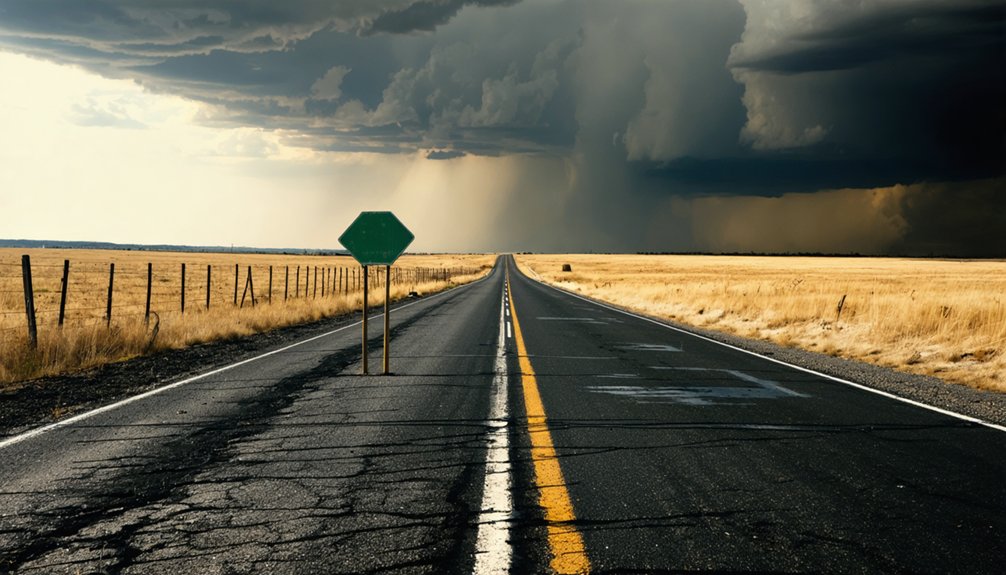
Reaching Carpenter requires traversing eight miles north of Elk City along rural county roads that slice through Oklahoma’s western plains. You’ll navigate routes that Benjamin Carpenter himself likely traveled in 1898, when population dynamics favored scattered ranching communities over clustered towns.
The unincorporated settlement straddles Roger Mills and Custer counties at coordinates 35°31′49″N 99°22′18″W—GPS essential for this off-grid adventure.
State highways connecting through Elk City provide your gateway, though expect unpaved stretches as you approach the ghost town. Interactive Google maps plot Carpenter alongside 240+ Oklahoma ghost towns, helping you chart your course.
This agricultural history hotspot once supported enough residents to warrant a post office from 1901, but today’s barren landscape demands self-sufficiency: bring water, charged devices, and backup navigation.
Best Times to Visit and Weather Considerations
The vast Oklahoma plains surrounding Carpenter transform dramatically across seasons, dictating whether you’ll wander through a frozen tableau or swelter under merciless prairie sun. I’ve discovered that shoulder season experiences from April to June and September to October deliver ideal conditions—temperatures hovering between 60°F and 80°F let you explore without extremes.
Off peak travel advantages shine brightest January through March, when you’ll encounter virtually no crowds and budget-friendly accommodations near Beavers Bend. Winter temps dip to 29°F, but rarely bring snow, just crisp air perfect for solitary trail walks.
Skip July and August entirely; that oppressive heat and holiday crowds suffocate the ghost town’s eerie solitude. Pack layers for unpredictable weather, and you’ll claim this forgotten corner as your own.
Nearby Attractions and Places to Stay
Carpenter’s desolation gains context when you venture into Stroud, just seven miles east along Route 66, where the Joseph Carpenter House at 204 W 6th Street stands as the town’s oldest preserved prairie-style residence—a tangible connection to the ghost town’s namesake family.
You’ll find local accommodations at the historic Skyliner Motel (717 N Main Street), Graham Hotel, or Hotel Lincoln—all authentic Route 66 structures that’ve sheltered travelers for decades.
While Carpenter offers no on-site dining options, Stroud’s Main Street delivers genuine roadside fare. Extend your exploration north to Stroud Lake’s campgrounds, three miles up Highway 99, where you’ll discover boat ramps and riding trails.
The annual Route 66 Wine and Food Festival and Sac & Fox pow-wow provide cultural depth to your ghost town pilgrimage.
Frequently Asked Questions
Is It Legal to Enter and Explore the Abandoned Buildings in Carpenter?
No, you can’t legally explore Carpenter without permission due to private property concerns. The site’s likely on privately-owned land, and trespassing carries potential legal risks including criminal charges. Always seek landowner consent before venturing onto abandoned properties.
Are There Any Safety Hazards or Dangers Visitors Should Know About?
You’ll face hazardous structures with rotting floors and collapsing roofs that could give way beneath you. Watch for wildlife concerns like snakes, spiders, and raccoons nesting in abandoned buildings. Wear sturdy boots and stay alert constantly.
Can I Camp Overnight in or Near the Ghost Town?
You can’t camp directly in Carpenter’s ghost town, but you’ll find nearby campgrounds available at Cookson Bend and Tenkiller Lake. Camping permits required at designated sites, though public lands offer 14-day boondocking freedom.
What Photography Equipment Works Best for Capturing Abandoned Buildings?
You’ll want a camera that handles high ISO for low light, like the Sony A7 III. Consider wide-angle lenses (16-35mm) to capture natural light streaming through broken windows, plus a sturdy tripod for long exposures in those hauntingly dark interiors.
Are There Guided Tours Available or Must I Explore Independently?
You’ll explore Carpenter independently—no guided tours availability exists for this forgotten settlement. However, self-guided exploration options abound through PocketSights’ GPS app, leading you through Creek County’s abandoned ruins where freedom meets eerie solitude.