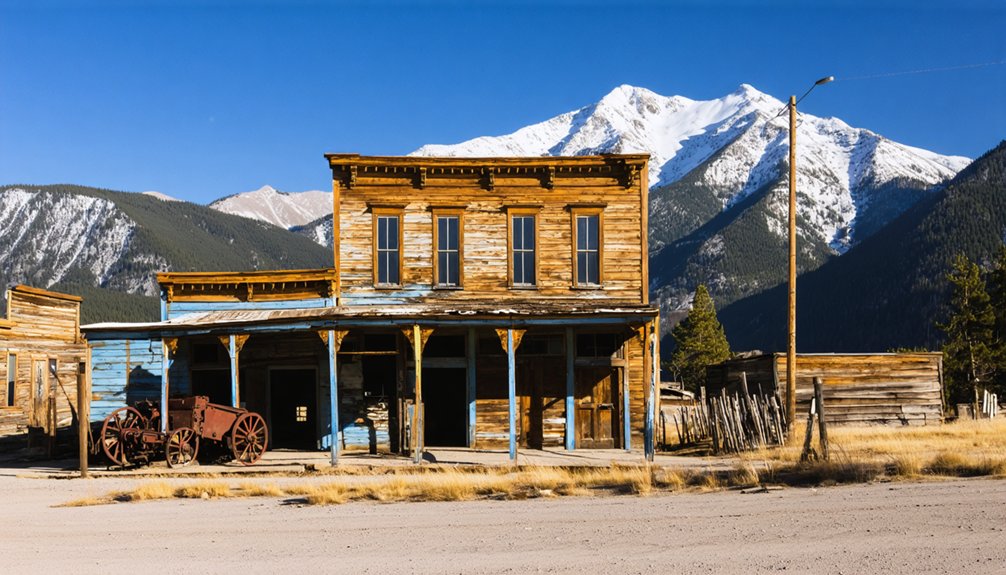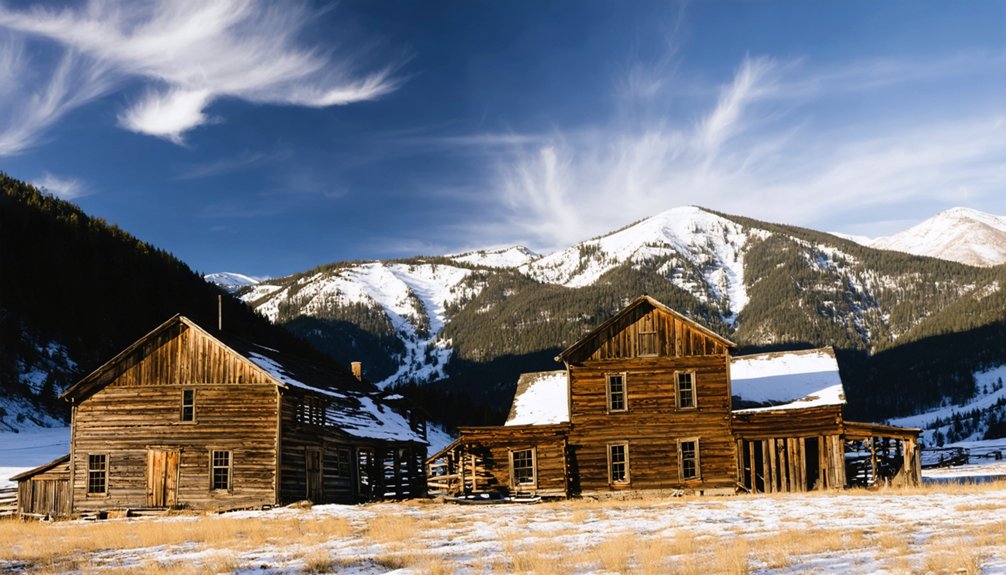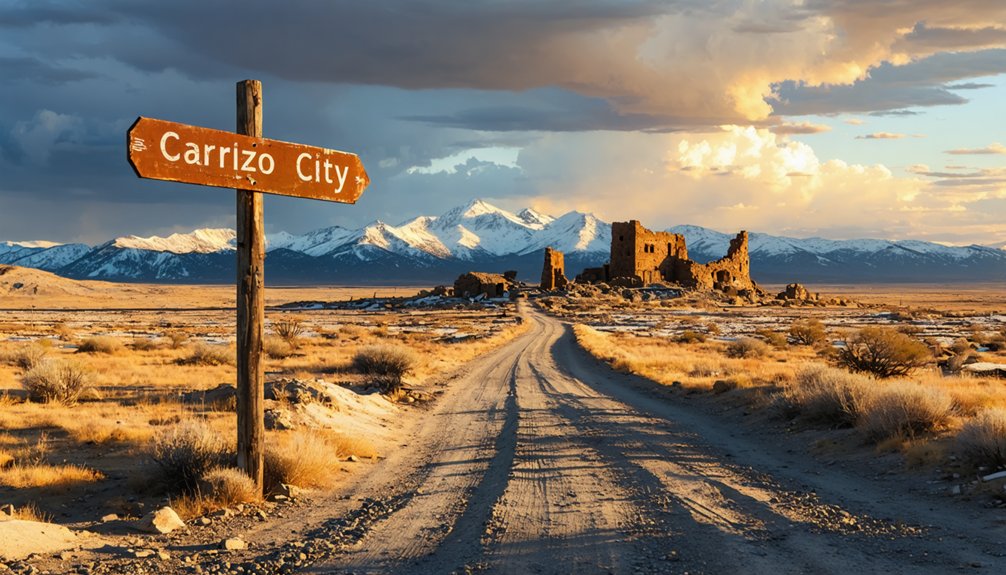
You’ll find Carrizo City’s haunting stone foundations scattered across a windswept bench above East Carrizo Creek in remote Baca County, where rows of rock rubble still trace Main Street from this 1880s settlement. The site features weathered building foundations, debris from the Bear Canyon Copper Company, and a small hillside cemetery with seven graves marking the families who once called this desolate prairie home. Access requires crossing private property, and historical knowledge helps identify the scattered remnants that blend seamlessly with natural stone after more than a century of abandonment—though the stories behind these ruins reveal far more than crumbling walls suggest.
Key Takeaways
- Carrizo Springs, established in 1887, features stone foundations along Main Street and a small cemetery with seven graves.
- The townsite sits on an elevated bench above East Carrizo Creek in the Colorado prairie.
- Key remnants include rock foundations, weathered rubble, and debris from the Bear Canyon Copper Company operations.
- The site is now on private property, restricting visitor access to this archaeological ghost town.
- Best viewing requires historical knowledge to identify scattered structural remnants beyond the downtown core.
The Rise and Fall of a Colorado Ranching Town
When homesteaders, prospectors, and cowboys converged on the southeastern Colorado plains in December 1887, they established Carrizo Springs along a creek lined with the reed grass that gave the settlement its Spanish name. You’ll find that this frontier outpost exploded during 1888-1889, spawning four saloons, two cafes, a general store, and the Carrizo Current newspaper.
The commodious La Mesa Hotel welcomed travelers while the Bear Canyon Copper Company employed seventy miners nearby. Town buildings constructed from locally quarried stone housed merchants and ranchers who seriously considered making this their county seat. But prosperity proved fleeting. By the 1890s, economic decline had already begun, and this once-promising settlement faded into obscurity—another casualty of harsh plains reality and shifting frontier economics.
What Remains at the Townsite Today
Standing on the bench above East Carrizo Creek, you’ll find rows of stone foundations tracing what was once Main Street, their weathered rocks scattered across the prairie grass.
A small cemetery holds seven graves—silent markers of the families who called this windswept corner of Baca County home. The rubble demands close inspection to distinguish human construction from natural stone, as a century of abandonment has nearly reclaimed the townsite.
Stone Foundations and Rubble
Today, a couple of rows of rock foundations mark what was once Main Street at Carrizo City, scattered across the Colorado prairie like a stone skeleton. You’ll spot these remnants from the bench above East Carrizo Creek, where rubble scattering patterns reveal the town’s quarter-mile footprint. The stone construction techniques employed local creek-side materials, forming durable bases that outlasted their wooden counterparts.
Multiple foundations extend beyond the downtown core, though you’ll need knowledge of the historical layout to distinguish random rubble piles from former buildings. Some debris likely originated from nearby Bear Canyon Copper Company operations, where 60-70 miners once worked. These enduring rocks tell stories of late 1800s ambition, though private property status now restricts access to this windswept archaeological site.
Cemetery With Seven Graves
Beyond the scattered stone foundations, a small rise near Potato Butte Mesa holds the settlement’s most poignant remnants—seven graves that mark Carrizo Springs‘ brief existence from 1887 to 1890. You’ll find five burials encased in stacked flagstone, laboriously hauled from the nearby town quarry to protect bodies from varmints. Two smaller graves lie level with the earth—the Veer girls, covered but not built up.
Ghost town rumors swirl around these windswept plots. One holds George Brenton, the JJ Ranch cowboy whose 1891 funeral became famous through a Cowboy Hall of Fame photograph. Another contains EC Cabler or possibly an old man who poisoned himself—the stories blur. Despite unmarked headstones on several graves, you can still trace the desperate, hardscrabble lives of those who dared settle this unforgiving Colorado prairie.
East Carrizo Creek Bench
At the base of Tater Butte Mesa in southwest Baca County, the townsite of Carrizo Springs still clings to its elevated bench above East Carrizo Creek—a scatter of stone foundations marking what locals once called Main Street. The bench’s strategic location offered protection from flooding while maintaining access to the creek’s riparian ecosystem of reed grass below.
When you explore the quarter-mile radius, you’ll discover:
- Multiple rows of stone rubble defining the original downtown core
- Rock foundations positioned along the elevated bench’s natural terrace
- Scattered structural remnants requiring trained eyes to identify
- Creek-facing orientation capitalizing on water access and defensive positioning
You’ll need familiarity with frontier settlement patterns to distinguish these ruins from natural stone formations across the windswept landscape.
Stories From the Cemetery: Seven Graves Tell the Tale
Among the windswept sagebrush, seven stone graves hold the frontier’s darkest moments.
Harry Teal’s story ended in a cafe kitchen in 1888, shot dead after a night of drinking when he drunkenly demanded breakfast at gunpoint—his killer, Dick Robertson, fled south and never returned.
George Brenton met a different fate that same rough year, the Reynolds Cattle Company cowboy drowning where the east and west forks of Carrizo Creek merge during fall cattle work.
Harry Teal’s Fatal Night
When darkness settled over Carrizo Springs on that fateful night, Harry Teal stumbled into the local cafe with whiskey on his breath and violence in his eyes. Despite having no teal’s criminal history on record, his belligerent demands for breakfast quickly escalated into threats against the owner.
The fatal confrontation unfolded through these critical moments:
- Teal burst through the cafe door demanding food
- The owner issued multiple warnings to leave
- Threats intensified as Teal refused to back down
- A single gunshot ended the standoff permanently
You’ll find Teal’s grave among the seven notable burials in Carrizo Springs Cemetery, its elevated rock enclosure standing as a stark reminder of frontier justice. This shooting became part of the town’s legendary history, documented in Canyon Journeys and local accounts.
George Brenton’s Drowning Tragedy
The noonday sun beat down mercilessly on August 9, 1891, as George Brenton guided his horse toward the swimming hole where his fellow cowboys had already plunged into the cool waters of Carrizo Creek. What happened next remains disputed—his horse either stumbled or Brenton chose his fate deliberately, troubles with his wife weighing heavy. Either way, horse and rider vanished beneath the surface. Only the horse emerged.
The cowboys couldn’t swim well enough to help. They found Brenton’s body by feeling with their feet, dragging it up with rocks tied to rope. These tragic death details would cement his posthumous legacy as Carrizo Springs Cemetery’s most famous resident. The Cowboy Hall of Fame now recognizes his grave, forever marked by the haunting photograph captured moments before disaster struck.
The Shooting of Harry Teal at Mrs. Robertson’s Café
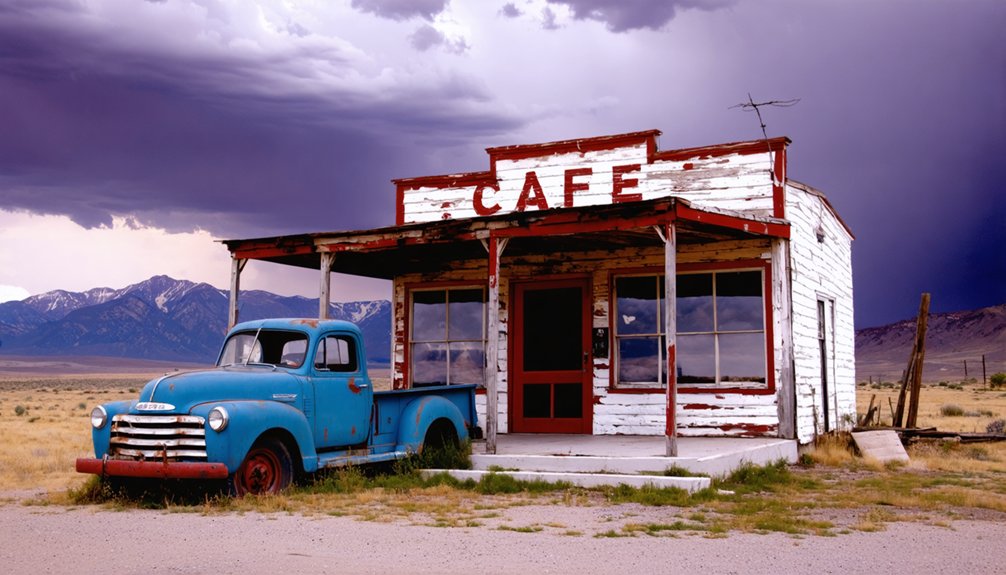
Carrizo Springs earned its place in Colorado frontier lore through violence that erupted one morning in 1888 or 1889, when a drunken cowboy pushed civility too far. Harry Teal, a JJ Ranch hand from Higbee, staggered into Mrs. Robertson’s café demanding breakfast. He’d blown his wages drinking all night and arrived belligerent, pistol-waving, cursing loud enough to shake the rafters.
A drunken cowboy’s violent breakfast demand at a Colorado frontier café would spark bloodshed that became legend.
The town history took a violent turn when:
- Mrs. Robertson sent her teenage son Dick to intercept the drunk cowboy
- Dick retreated to the kitchen, returning with a shotgun instead of food
- One blast removed the top of Teal’s head, ending the confrontation instantly
- Doc Ruggles assured Dick he’d face no prosecution for defending the business
Despite this reaction to the shooting, Dick fled south into the cedars, never returning.
George Brenton: A Cowboy Hall of Fame Legacy
Unlike Harry Teal’s violent end in Mrs. Robertson’s café, George Brenton’s death came quietly beneath the waters where East and West Carrizo creeks meet. You’ll find his story woven through local ranch histories—a Bar7L hand working Reynolds Cattle Company’s 1891 roundup when his horse stumbled in a swimming hole four miles south of Carrizo Springs.
Twenty cowboys witnessed Brenton’s cowboy lifestyle end that hot afternoon, then buried him right there on the open range. No preacher. No women. Just hands from Colorado, Kansas, New Mexico, Oklahoma Territory, and Texas standing hat-in-hand before a fresh grave. A photographer captured that stark moment—creating an iconic image of frontier justice and brotherhood. They etched the Bar7L brand into history, then mounted up and continued working cattle across hard country.
How to Find and Explore the Ruins
Finding these wind-scoured foundations requires patience and a high-clearance vehicle willing to tackle Baca County’s unpaved back roads. You’ll navigate the bench above East Carrizo Creek, where geological features carved by centuries of water flow guide you toward remnants of Main Street’s rock foundations.
Patience and proper clearance bring determined explorers to weathered stone foundations marking where Main Street once stood above the creek.
Scout the quarter-mile radius systematically:
- Follow creek-adjacent terrain where carrizo reed grass (the town’s namesake flora) still marks ancient pathways
- Locate foundation rows amid stone rubble and scattered ruins
- Watch for wildlife corridors through the fauna-rich canyons leading toward No Man’s Land
- Map mesa escape routes once used by frontier roughs
The townsite rewards those who understand its 1887 layout, revealing homestead markers and ranch boundaries against Colorado’s vast open range.
Best Time to Visit Baca County Ghost Towns
Responsible visitation recommendations favor fall’s low humidity, which preserves fragile adobe remnants better than spring’s erosive winds or winter’s destabilizing freezes.
Avoid April’s unpredictable weather—late snows and rain transform high plains roads into impassable quagmires.
Winter promises solitude for the adventurous, but ice-closed rural routes often block access entirely.
Choose freedom over frustration: visit when nature cooperates.
What to Bring for Your Exploration
Before you venture onto the windswept plains where Carrizo City once thrived, you’ll need to pack strategically for an environment that forgives nothing. The importance of detailed planning becomes clear when you’re miles from civilization with potential safety concerns like rattlesnakes, extreme temperature swings, and zero cell service.
Miles from civilization, Carrizo City’s plains demand meticulous preparation—rattlesnakes, temperature extremes, and zero connectivity leave no room for error.
Your essential gear includes:
- Navigation arsenal: GPS device, topographic maps, and compass for when technology fails in remote Baca County
- Desert survival kit: Four liters of water per person, electrolyte packets, and emergency blanket
- Protection gear: Sturdy boots, wide-brim hat, long sleeves, and gloves for handling jagged rock foundations
- Documentation tools: Camera, notebook, and binoculars to capture Main Street’s remnants
Pack a first-aid kit, multi-tool, and bear spray. This isolated hunting ground demands self-reliance.
Nearby Attractions and Other Abandoned Sites to Explore
Beyond Carrizo City’s scattered foundations, southeastern Colorado conceals a constellation of ghost towns that’ll transform your single-site visit into a multi-day odyssey through frontier collapse.
The Carrizo Springs Cemetery, established during the town’s 1887-1889 heyday, holds seven graves including rock-built structures from local quarries—George Brenton’s resting place recognized by the Cowboy Hall of Fame among them. These abandoned settlements dot Baca County’s unforgiving terrain, each whisper telling stories of ranchers, outlaws, and dreamers who couldn’t outlast the elements.
While nearby historic mines scatter across Colorado’s higher elevations—Independence Ghost Town at 10,913 feet and Carson Ghost Town at 11,574 feet—they’ll require serious 4×4 capability and altitude preparation. String together multiple sites for the ultimate escape into forgotten Western history.
Frequently Asked Questions
Is Overnight Camping Permitted Near the Carrizo City Townsite?
You’ll find overnight camping isn’t a straightforward treasure hunt near Carrizo—public access restrictions and environmental preservation complicate matters. You’d need valid hunting or fishing licenses for state trust lands, though BLM options exist nearby with fourteen-day limits.
Are There Guided Tours Available for Carrizo City?
No guided tours are offered seasonally at Carrizo City—you’ll explore independently among the stone foundations. For guided tour group options, consider nearby Independence Ghost Town’s scheduled walks, though Carrizo remains wonderfully unstructured and yours to discover alone.
Is the Cemetery Still Accessible to Visitors Year-Round?
You’ll find the cemetery accessible year-round, its haunting ambiance preserved beneath Colorado’s open skies. The historical significance remains untouched by seasons, letting you explore freely whenever wanderlust calls. Just respect the grounds during your independent adventure.
Do I Need a 4WD Vehicle to Reach the Ruins?
You won’t need 4WD to reach Carrizo Springs’ haunting foundations. The bench above East Carrizo Creek presents manageable terrain conditions without serious access difficulty, unlike Colorado’s high-altitude ghost towns where rugged trails demand serious off-road capability.
Are There Any Entrance Fees or Permits Required?
Your wallet can rest easy—Carrizo City requires no entrance fees or permits. You’ll find unrestricted accessibility information and no posted entrance hours at this abandoned settlement, offering pure freedom to explore Colorado’s weathered ruins whenever wanderlust strikes.