You’ll find Carwye at coordinates 43.8° N, 103.3° W, though this ghost town has vanished so completely you’ll question its existence. Take Highway 16 East from Rapid City, where pavement surrenders to gravel roads tracing abandoned railroad beds. Summer’s 85°F heat offers pristine passage, while winter blizzards seal routes entirely—check SD 511 obsessively before departing. The Homestake Mining Company’s narrow gauge railroad sparked Carwye’s brief life before complete abandonment left only windswept prairie and haunting memories. What remains below reveals the full story of this enigmatic disappearance.
Key Takeaways
- From Rapid City, take Highway 16 East through the Black Hills, then follow gravel roads along the abandoned railroad bed.
- Visit during summer for optimal conditions with 85°F temperatures and clear passage on gravel roads.
- Check SD 511 before departure, as spring snowmelt and winter blizzards can make roads impassable.
- Bring a high-clearance vehicle to navigate gravel roads and Deadman Creek’s drainage crossings safely.
- Explore remaining structures including the 1904 church’s weathered timber frames and the historic bank vault.
What Makes Carwye a Genuine South Dakota Ghost Town
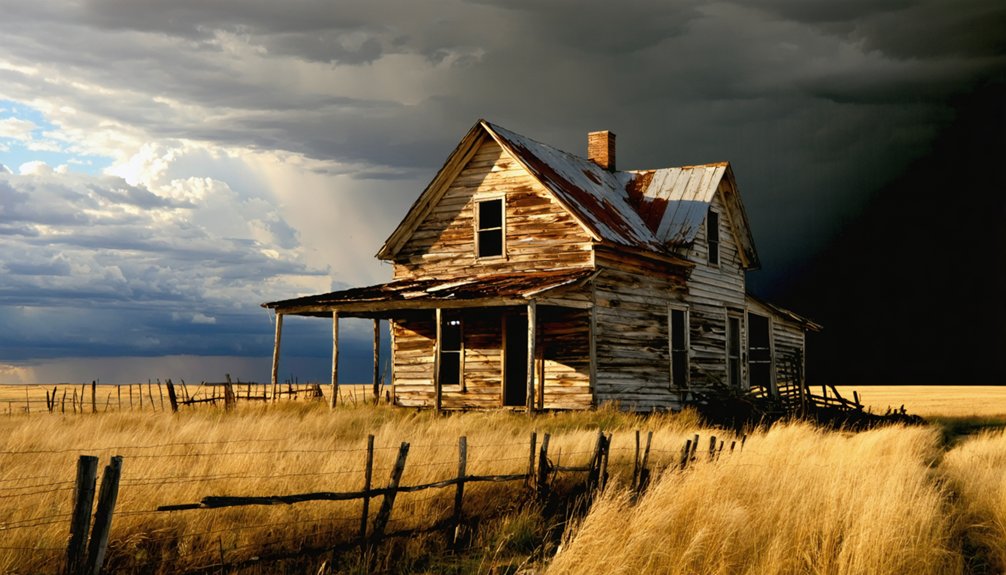
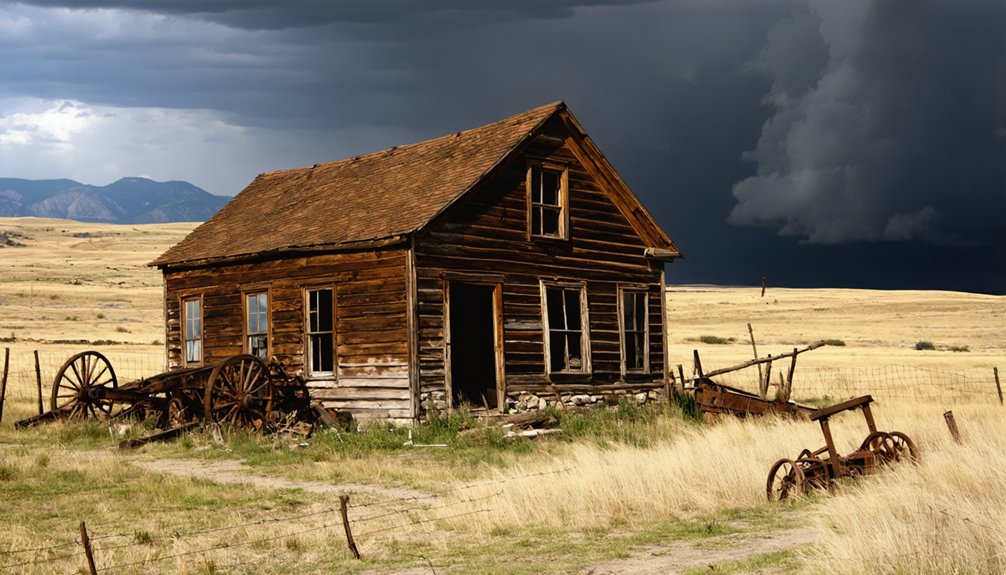
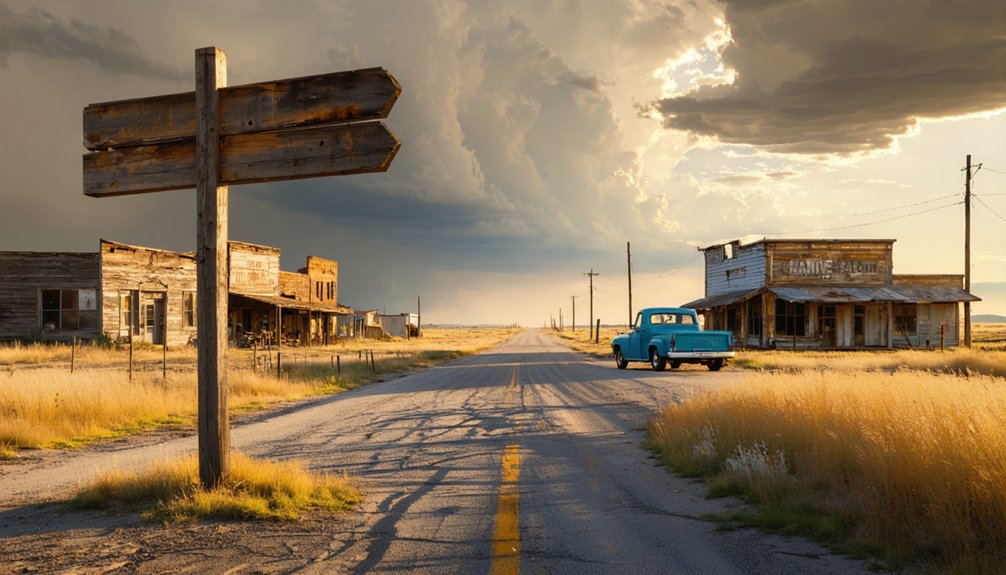
The gravel crunches beneath your tires as you roll into what remains of Carwye, where weathered wooden frames lean against the prairie wind like old men too stubborn to fall. You’ll find yourself drawn to the unique architectural features of abandoned buildings—false-fronted storefronts that once promised prosperity, now exposing skeletal beams to endless sky.
The mysterious circumstances surrounding Carwye’s demise whisper through broken windows and doorless thresholds. No historical markers guide you here; this place exists beyond official records, preserved only in fading memories and stubborn structures that refuse erasure. Walk freely among the ruins where prairie grass reclaims floorboards and rusted hinges guard secrets nobody bothered documenting. This is ghost town authenticity—raw, unrestored, uncompromising.
Getting to Carwye: Routes and Road Conditions From Rapid City
You’ll leave Rapid City’s urban edge behind on Highway 16 East, where ponderosa pines frame your windshield as the pavement cuts through the Black Hills’ southeastern reaches.
After roughly thirty miles, the asphalt yields to gravel roads that trace the abandoned railroad bed—your compass to Carwye’s forgotten coordinates. Spring snowmelt and summer thunderstorms transform these final approaches into muddy gauntlets, so you’ll want dry conditions and a vehicle that won’t flinch at washboard ruts.
Highway 16 East Route
Since US Highway 16 serves as your primary artery from Rapid City into the eastern Black Hills, you’ll traverse over 16 miles of evolving landscape where urban sprawl gradually surrenders to pine-studded ridges. Your eastbound journey launches from Cathedral Drive, threading past Rockerville where pavement meets possibility.
Summer’s tourism surge brings crowds you’ll want to navigate strategically—unfamiliar motorists clog scenic overlooks along route, stretching what should be liberating miles into patience tests. Regional tourism impacts have triggered multi-year reconstructions: expect intersection modifications through 2026, reduced-conflict upgrades by 2030, and full corridor reconstruction before 2032.
The reward? Keystone Wye marks your gateway deeper into forgotten territories, where blacktop ends and true exploration begins. SD511 provides real-time conditions when winter storms threaten your escape.
Gravel Road Final Approach
Beyond Keystone’s last gas station, pavement crumbles into washboard memory. You’ll navigate gravel road conditions that shift with every season—spring runoff carves fresh ruts, summer dust billows behind your wheels, autumn hardens the surface into corrugated ridges.
Remote road access demands respect here. County maintenance ends miles before Carwye’s coordinates at 44.222208, -103.421298, where the Homestake Mining Company’s narrow gauge once terminated.
Oak Draw Road and North Lame Johnny Road offer alternative approaches through ranch country, but none guarantee smooth passage. Your vehicle becomes your commitment. Four-wheel drive isn’t mandatory, but clearance matters when crossing Deadman Creek’s drainage.
The final miles strip away comfort, replacing it with the raw solitude you’ve been chasing—exactly what disappeared when they pulled those railroad ties from history’s grasp.
Seasonal Weather Travel Considerations
When temperatures swing sixty degrees between Rapid City’s June afternoons and December predawn hours, your journey to Carwye transforms with the calendar.
Summer unveils pristine passage—Highway 385 slices through 85°F heat with minimal closures, while I-90 hums reliably westward. You’ll navigate freely through fall’s 70°F days, though October frosts glaze elevated passes after dark.
Late spring thaw impacts reshape your route entirely: melting snowpack floods Vanocker Canyon approaches, forcing reliance on stable I-90 corridors while secondary roads battle washouts.
Winter imposes the ultimate seasonal accessibility challenges—blizzards seal Highway 385 beneath 100+ inches of accumulation, chains clatter on icy interstates, and whiteouts erase visibility completely. Check SD 511 obsessively. Plan summer escapes. Respect winter’s iron grip on these ghost-haunted highlands.
The Rise and Fall of Carwye’s Population
The Homestake Mining Company‘s decision to extend its narrow gauge railroad into the Black Hills sparked Carwye’s existence in the late 1800s, transforming an empty stretch of Meade County prairie into a bustling hub of commerce and activity. You’d have witnessed remarkable population dynamics as workers flooded in—lumber men, railroad crews, and mine suppliers building homes, boarding houses, stores, and saloons around that essential Y-shaped track terminus. The town thrived while serving Homestake’s insatiable appetite for lumber and supplies.
Then came the dramatic demographic shifts. When the company tore up its rails, Carwye vanished overnight. No gradual decline, no slow exodus—just complete abandonment. The infrastructure disappeared as quickly as it arrived, leaving behind only coordinates and the haunting legacy of Black Hills boom-and-bust cycles.
Remaining Buildings and Structures to Explore
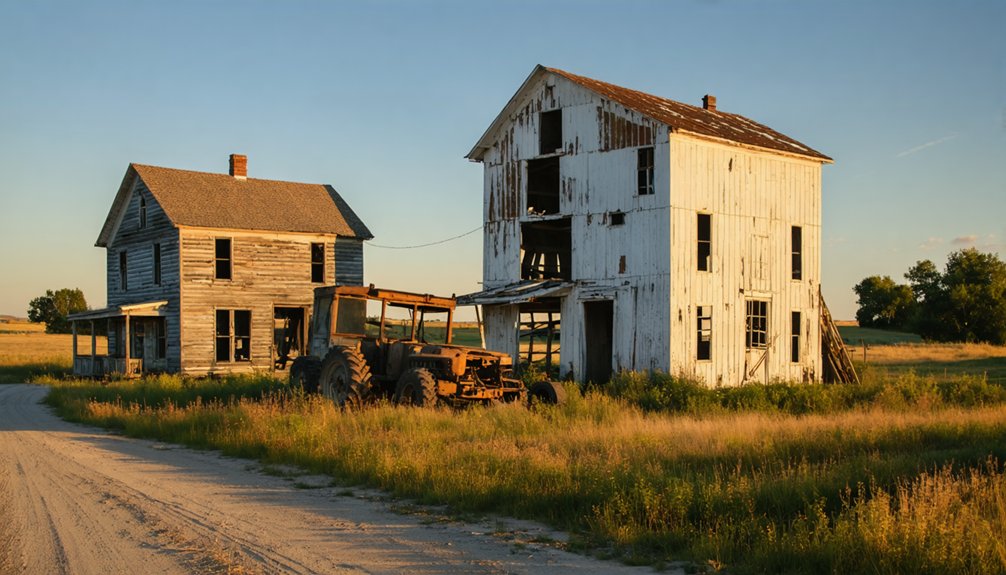
You’ll find nothing but windswept prairie where Carwye once thrived—the town vanished so completely that even foundation stones have surrendered to time and tall grass.
When the Homestake Mining Company ripped out the railroad tracks, the settlement died with brutal efficiency, leaving behind only the barren coordinates 44.222208, -103.421298 to mark where lumber men and railroad workers once lived.
Unlike other Black Hills ghost towns that cling to their skeletal remains, Carwye offers only absence, a place where roofless walls that might’ve stood elsewhere never survived past the railroad’s departure.
Historic Town Hall Bank
Standing at the intersection of civic duty and frontier commerce, Carwye’s historic town hall bank rises from the prairie grass like a weathered monument to South Dakota’s banking boom. You’ll discover bank architectural significance in every crumbling brick—the dual-purpose design that merged municipal governance with financial security speaks to resourcefulness born from isolation.
Step inside where sunlight pierces broken windows, illuminating the iron-clad vault that once safeguarded settlers’ dreams. The bank vault features remain remarkably intact: thick steel doors, combination locks frozen in time, concrete reinforcement that outlasted the community itself.
Run your fingers along the teller counter’s worn wood, imagining transactions conducted when Alpena’s dirt roads teemed with optimism. This structure embodies the lasting prairie banking roots that eventually grew into modern institutions—proof that permanence was always the goal, even when impermanence claimed the town.
Collapsing 1904 Church Structure
Beyond the town hall’s iron vault, weathered timber frames reach skyward in a desperate architectural prayer. The 1904 church structure leans against South Dakota’s relentless wind, its skeletal remains telling stories of Sunday gatherings long abandoned. You’ll find crumbling foundation stones where congregations once assembled, their community significance evident in the building’s prominent hilltop position overlooking the ghost town.
The architectural features reveal craftsmen’s ambitions—Gothic-inspired window frames now hollow, hand-hewn beams exposed to prairie elements. Shingles scatter like memories across overgrown grass. This isn’t preserved history behind velvet ropes; it’s raw decay you can witness firsthand. The structure’s collapse progresses with each passing season, creating urgency for explorers seeking authentic remnants before nature reclaims what pioneers built. You’re witnessing freedom from restoration’s sanitizing touch.
Abandoned Grain Elevator Standing
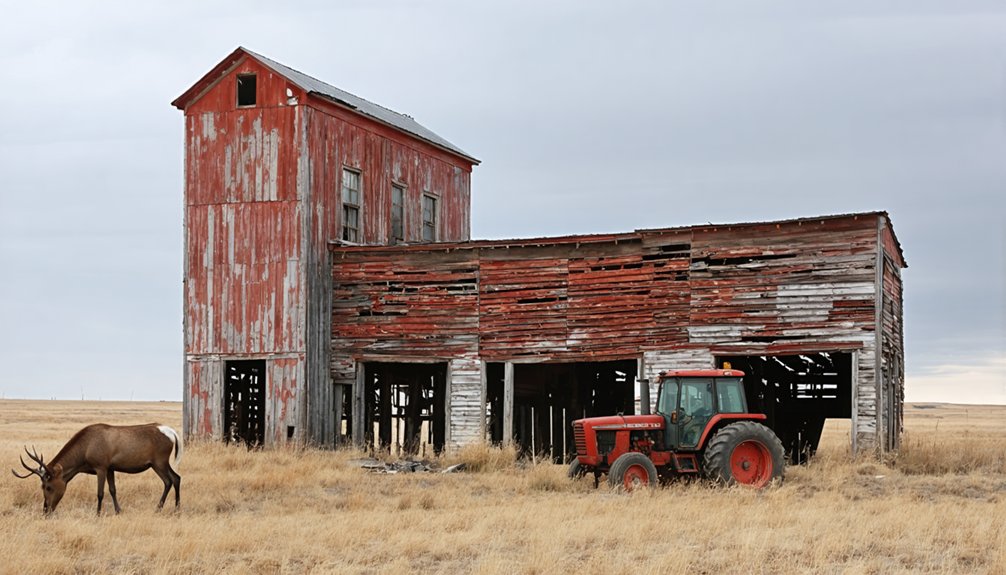
While church spires crumble into prairie dust, Carwye’s grain elevator refuses to surrender. This century-old sentinel showcases architectural ingenuity that’s outlasted demolition attempts and Dakota’s brutal seasons.
The crib-style construction—wood slats absorbing moisture to protect stored grain—stands as embodiment to turn-of-the-century engineering genius.
You’ll discover why these structures dominate ghost town landscapes:
- Built railroad-adjacent for farmers escaping long hauls to distant markets
- Wood construction proves superior to metal for grain storage
- Solid cribbing design thwarts nature’s assault and human demolition
This abandoned giant represents community preservation through sheer stubbornness. While neighboring towns like Esmond and Sitka claim similar survivors, Carwye’s elevator stands defiant—proof that freedom-seeking pioneers built structures matching their unbreakable spirit.
Railroad History and the Milwaukee Road Connection
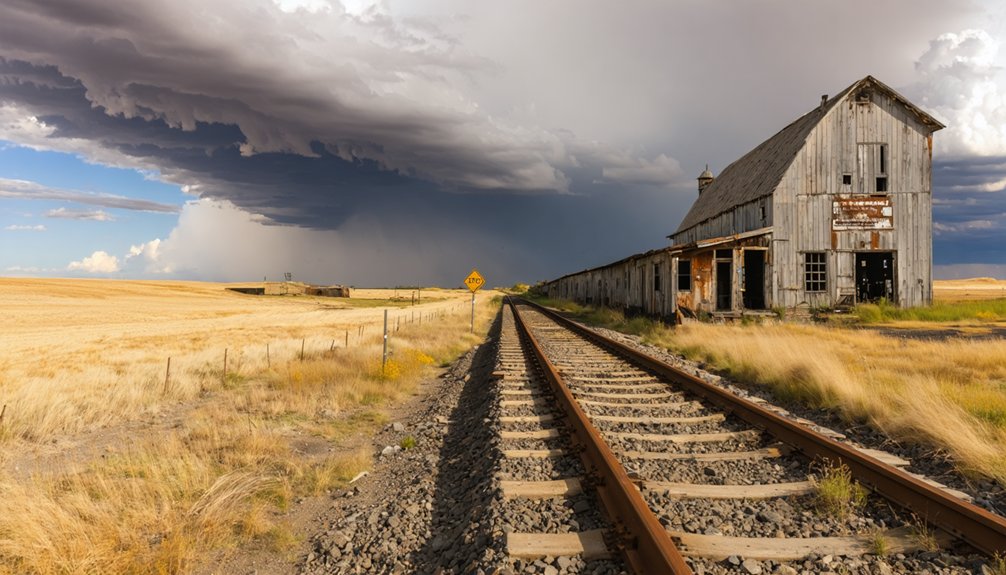
The rails that connected Carwye to the wider world trace their lineage back to 1847, when ambitious Milwaukee businessmen chartered the Milwaukee and Waukesha Railroad. By 1906, this enterprise had evolved into a transcontinental giant pushing westward across the prairies.
When construction crews reached this area in 1906, Carwye sprang up overnight—a statement to Milwaukee Road’s impact on South Dakota settlement patterns. The line terminated at Rapid City, establishing that city’s role as regional transportation hub for the western territories.
Branch lines spider-webbed across Walworth County’s grasslands, connecting isolated homesteads to distant markets. Though the Olympian Hiawatha once thundered through these parts bound for Puget Sound, those glory days ended with bankruptcy. Today, silence reclaims the abandoned right-of-way.
Respecting Private Property During Your Visit
Railroad corridors transformed this landscape from open prairie to settled townships, but those same paths now present temptations for modern visitors drawn to abandoned structures and forgotten spaces. You’ll discover Carwye’s remnants while respecting owner property rights, preserving your freedom to explore without legal entanglements. Understanding boundaries protects both you and current titleholders from complications like avoiding adverse possession claims.
Explore abandoned spaces thoughtfully—respecting property boundaries preserves access for future wanderers while protecting owners and preventing legal complications.
Follow these essential guidelines:
- Photograph from public roadways – Capture weathered buildings and prairie vistas without crossing property lines
- Honor no-trespassing signage – These markers define legitimate boundaries, not restrictions on your spirit
- Report concerns to the sheriff – If you notice suspicious occupation, proper authorities handle property matters
Even seemingly forgotten places have owners. Your conscious awareness maintains access for future adventurers while honoring the legal framework that paradoxically enables your wandering spirit.
Best Times to Photograph Carwye’s Abandoned Landmarks
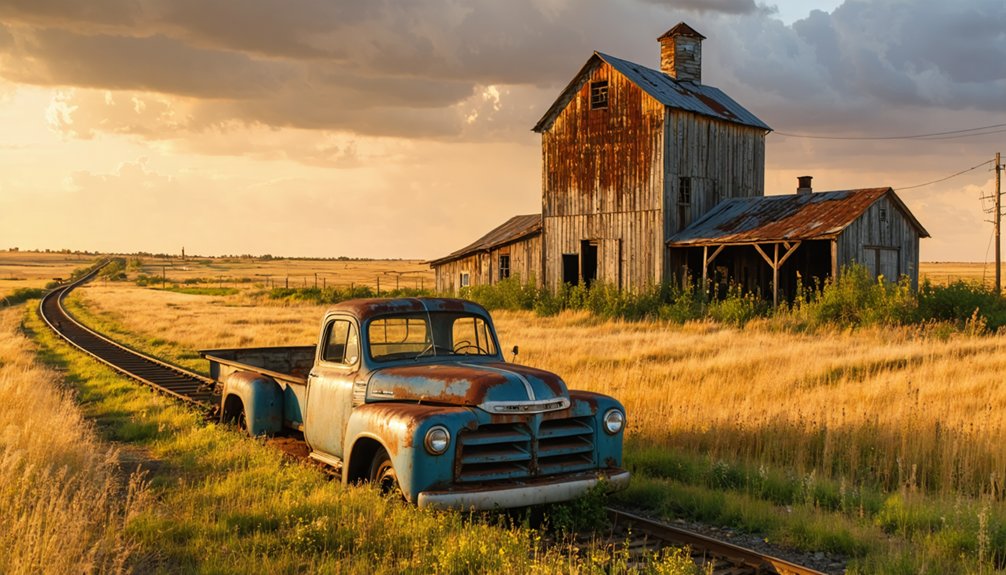
Carwye’s weathered structures reveal their deepest character when light slants across the prairie at extreme angles, transforming skeletal frames and collapsed rooflines into subjects worthy of your lens. You’ll find ideal lighting conditions during spring’s golden hours when 60°F temperatures minimize haze, letting you capture crisp decay details.
October mornings deliver dew-kissed rust and vibrant foliage backdrops, while winter’s low sun accentuates the Y-railway terminus contours against fresh snow. Summer grants you fifteen-hour days to explore Homestake remnants, though evening shoots around 8 PM dodge harsh midday flatness.
Avoid hazardous weather patterns—July’s thunderstorms threaten flash floods, spring winds kick dust across your shots, and April’s mud compromises tripod stability. Time your visit when nature conspires with abandonment.
Nearby Ghost Towns to Add to Your Itinerary
Beyond Carwye’s crumbling foundations, South Dakota’s prairie conceals a constellation of abandoned settlements where you’ll trace the arc of frontier ambition through weathered doorframes and silent main streets.
Three Ghost Towns Worth Your Freedom-Seeking Journey:
- Mystic – Once bustling with prospectors, this 1876 mining camp welcomed President Calvin Coolidge before vanishing entirely. Population: zero. You’ll hike the old railroad grade to reach nearby historic gravesite locations.
- Galena – Eight miles from Deadwood, explore ruins where saloons like Sudden Death once roared. Visit the restored cemetery documenting Civil War veterans among notable resident legends.
- Diamond City – Lawrence County’s phantom settlement existed briefly around 1880. Though 1967 demolition erased its stamp mill and dozen homes, Silver Creek’s banks still whisper prospector dreams.
Each stop reveals humanity’s relentless westward push.
Essential Supplies for Your Southwest South Dakota Adventure
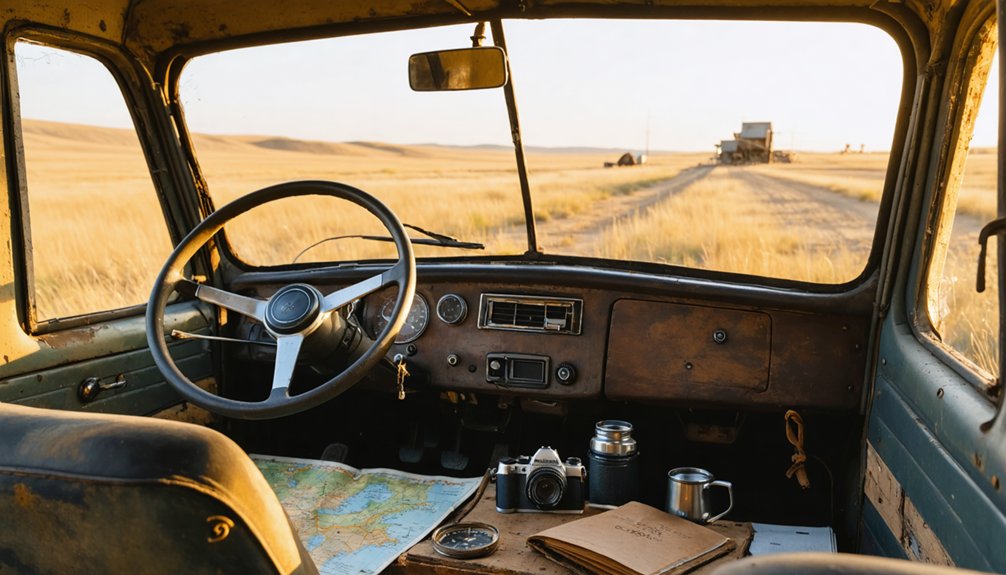
Your vehicle kicks up dust clouds on washboard roads leading to Carwye’s skeleton, but romance fades fast when your radiator overheats twenty miles from the nearest gas station. Pack redundancy into every corner—spare tires, tools, and jumper cables become lifelines when civilization vanishes behind Black Hills ridgelines.
When pavement ends and cell service dies, your spare tire matters more than your sense of adventure.
Master off road driving techniques before tackling Vanocker Canyon’s ruts, where skid plates shield your undercarriage from unforgiving rock. Stash gallons of water per person, electrolyte packets, and purification tablets for when adventure stretches longer than planned.
Remote campsite planning demands offline GPS maps, topographic charts, and printed coordinates—cell towers don’t exist where railroads died. Layer clothing for forty-degree dawns transforming into ninety-degree infernos.
Snake bite kits, bear spray, and first aid supplies aren’t paranoia; they’re passport stamps for territory reclaimed by rattlesnakes and forgotten dreams.
Frequently Asked Questions
Are There Any Lodging Options Near Carwye for Overnight Stays?
You won’t find lodging in Carwye itself—it’s an abandoned ghost town. However, you’ll discover rustic cabins available in nearby Custer and Hill City, plus basic campgrounds nearby throughout Black Hills National Forest for your wild, untethered adventure.
What Wildlife Might I Encounter Around the Abandoned Carwye Townsite?
You’ll encounter mule deer, coyotes, and black-tailed prairie dogs thriving amid Carwye’s ruins. With fifty-one waterfowl species migrating through, you’ll spot pronghorn antelope sightings and rare bird species like golden eagles soaring above these wild, untamed grasslands.
Can I Legally Enter the Buildings in Carwye to Explore?
You can’t legally enter Carwye’s buildings—ownership restrictions still apply despite abandonment. Beyond trespassing laws, potential safety hazards like rotting floors and collapsing roofs make interior exploration dangerous. Respect boundaries and admire these weathered sentinels from outside.
Is Cell Phone Service Available in the Carwye Area?
You’ll likely face limited connectivity options in Carwye’s remote terrain. Reliable cellular coverage isn’t guaranteed across this forgotten landscape, so you’d better download maps beforehand. The wilderness here doesn’t bend easily to modern technology’s reach.
Are There Any Guided Tours of Carwye and Surrounding Ghost Towns?
No guided tours exist—you’ll forge your own path through Carwye’s windswept ruins. Self-guided tours let you wander freely among whispers of the past, though historical markers are scarce in this forgotten prairie outpost awaiting your discovery.