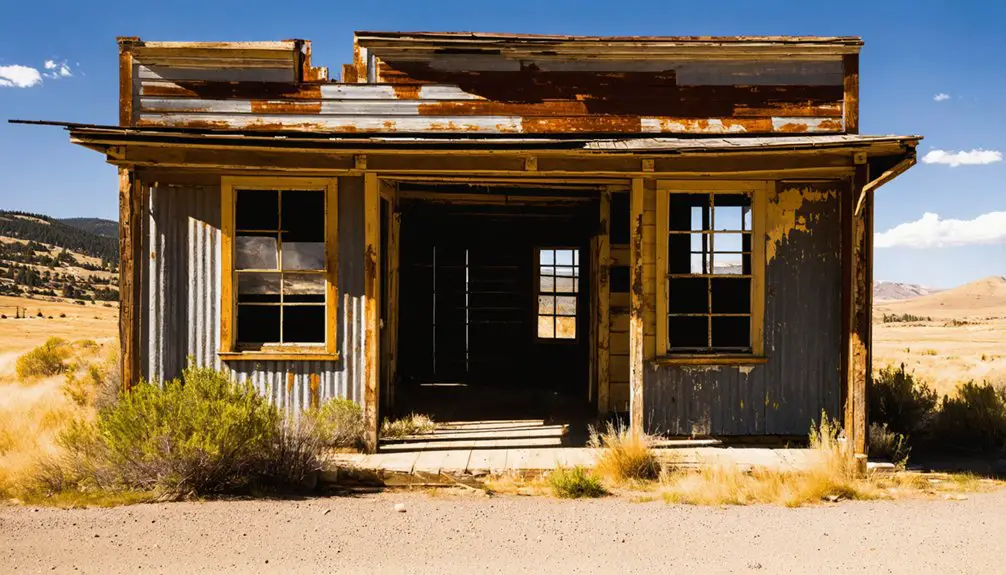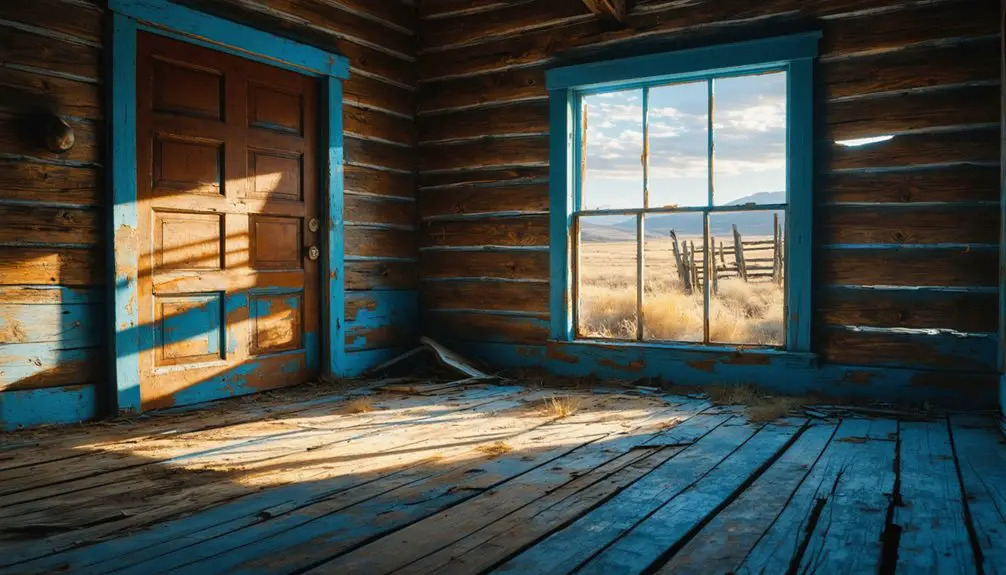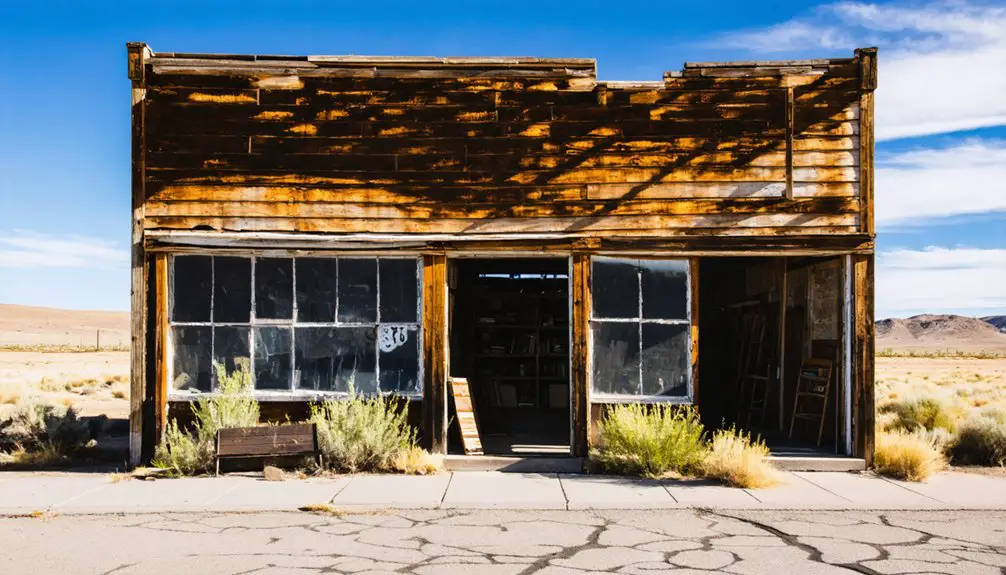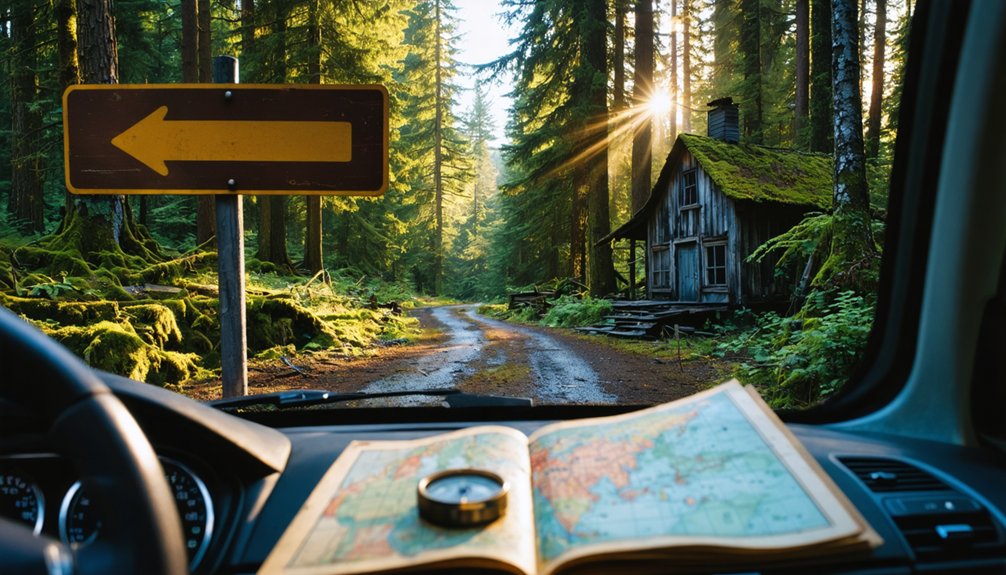
You’ll find Cascadia 12 miles east of Sweet Home, where Short Bridge Ghost Towne‘s weathered storefronts and donated period structures recreate Oregon’s vanished logging past without admission fees. The South Santiam River flows steps away, offering swimming holes after you’ve explored the frontier settlement. Stock supplies before departure, as cell service fades and Forest Service roads demand high-clearance vehicles on washboard gravel. Pack layers, paper maps, and emergency gear—the 300-mile journey from Portland rewards committed travelers who venture beyond typical tourist routes.
Key Takeaways
- Cascadia is not mentioned in Oregon ghost town records; verify the destination exists before planning your route.
- Consider visiting Short Bridge Ghost Towne, 12 miles east of Sweet Home, as a free roadside attraction alternative.
- Southern Oregon mining towns like Buncom and Golden offer authentic 1850s structures with interpretive trails and Chinese mining heritage.
- Essential stops include Shaniko, Sumpter with its massive gold dredge, and Sparta’s 1877 Methodist church in the Blue Mountains.
- Pack paper maps, emergency gear, spare fuel, and 4WD vehicle; expect no cell service or fuel stations for 90-mile stretches.
Understanding Oregon’s Rich Ghost Town Heritage
Oregon’s high desert plateaus and misty mountain valleys harbor far more ghost towns than most travelers realize. While you’ll often hear estimates of 60 to 80 abandoned settlements, historical post office records reveal a staggering 1,600 locations that once thrived between 1847 and 1985. These towns vanished when gold veins dried up, railroads chose different routes, or timber mills exhausted their forests.
Modern exploration means preserving oral histories from descendants who remember these places and leveraging archaeological digs to uncover forgotten communities like Maxville’s integrated logging town. You’ll find remnants ranging from Auburn’s 6,000-person gold rush metropolis to coastal Bayocean, which literally eroded into the Pacific. Each site tells stories of pioneers, dreamers, and risk-takers who chased opportunity across unforgiving landscapes.
What Makes Cascadia’s Short Bridge Ghost Towne Attraction Special
Unlike authentic ghost towns that crumbled through neglect, Short Bridge Ghost Towne emerges as a deliberate labor of love—a roadside attraction 12 miles east of Sweet Home where volunteers have recreated the area’s vanished past through weathered storefronts and period structures.
A volunteer-built tribute to Oregon’s logging heritage, where weathered facades and pioneer stories come alive without the admission price.
You’ll discover this one of a kind roadside attraction preserving Cascadia’s logging heritage alongside the historic 1945 covered bridge spanning the South Santiam River. The collection grows continuously through donations, with new buildings expanding the settlement each season.
What sets this experience apart is its accessibility—you can explore freely without admission fees, wandering between structures while vibrant local history displays tell stories of mid-1880s pioneers and turn-of-the-century timber camps.
The South Santiam flows steps away, offering swimming holes and rockhounding opportunities after you’ve absorbed the area’s frontier legacy.
Southern Oregon’s Best-Preserved Mining Ghost Towns
You’ll find Southern Oregon’s mining ghost towns clustered in the rugged hills between Grants Pass and Jacksonville, where 19th-century Chinese miners first struck gold along Sterling Creek.
Buncom stands out with three original buildings—a bunkhouse, post office, and cookhouse—that have survived since 1851, preserving a rare glimpse into the Chinese mining community that founded the settlement.
Just north near Grants Pass, Golden’s four remaining structures sit in peaceful woodlands, including a weathered church and combination store-post office that once served over 150 residents during the 1890s boom.
Buncom’s Well-Preserved Chinese Mining Heritage
Deep in the Little Applegate Valley, where Sterling Creek tumbles down to meet the river at 1,783 feet, you’ll find what remains of a gold rush settlement that tells a story most mining camps have long forgotten.
Buncom showcases long standing chinese cultural legacies through infrastructure that still marks the landscape. Mining boss Gin Lin purchased these claims in 1864, transforming the valley with remarkable hydraulic mining techniques that carved new waterways into existence.
What You’ll Discover:
- The Gin Lin Ditch – Five miles of hand-built irrigation channels paralleling the river, memorial to engineering vision that rerouted Yale Creek
- Chinese Wall at Palmer Creek – 300 feet of stacked stone rising 12-15 feet high
- Three preserved structures – Bunkhouse, cookhouse, and post office protected by the Buncom Historical Society
You’re standing where freedom-seeking miners built their own empire.
Golden’s Historic Structures Near Grants Pass
Where Coyote Creek cuts through the hills three miles east of Wolf Creek, Golden’s weathered church steeple rises above the pines like a compass needle pointing to Oregon’s spiritual mining past. You’ll find four original buildings clustered along the creek—the 1892 Golden Church, Rev. Ruble’s family home, Bennett’s general store with its intact post office counter, and a carriage house that’s defied gravity for 120 years.
Interpretive signs guide you through the miners’ stories without the usual bureaucratic droning. The hiking trails wind past those fake “Gunsmoke” grave markers and down to Golden Coyote Wetlands, where beavers now occupy ground that hydraulic mining devastated. Unlike sanitized historical parks, this Oregon Heritage Site lets you wander freely, touching history on your terms.
Essential Stops: Shaniko, Sumpter, and Sparta
While modern highways whisk travelers past at seventy miles per hour, these three ghost towns demand you slow down and step back into Oregon’s rough-and-tumble frontier days.
- Shaniko – The “Wool Capital of the World” peaked at 600 residents before rail redirected commerce elsewhere. You’ll explore the 1900 Shaniko Hotel’s 18-inch brick walls and preserved wool sheds marking this frontier industry decline.
- Sumpter – Baker County’s gold magnet once supported 87 saloons serving 2,000 miners. The massive Sumpter Dredge extracted $4 million in gold and now anchors heritage tourism impact through thousands of annual visitors.
- Sparta – Twenty-eight saloons served 1,200 fortune-seekers in this Blue Mountains outpost. Access requires traversing Forest Road 17, rewarding adventurous souls with weathered ruins and an 1877 Methodist church standing sentinel over canyon solitude.
Defining True Ghost Towns: What to Expect When You Arrive
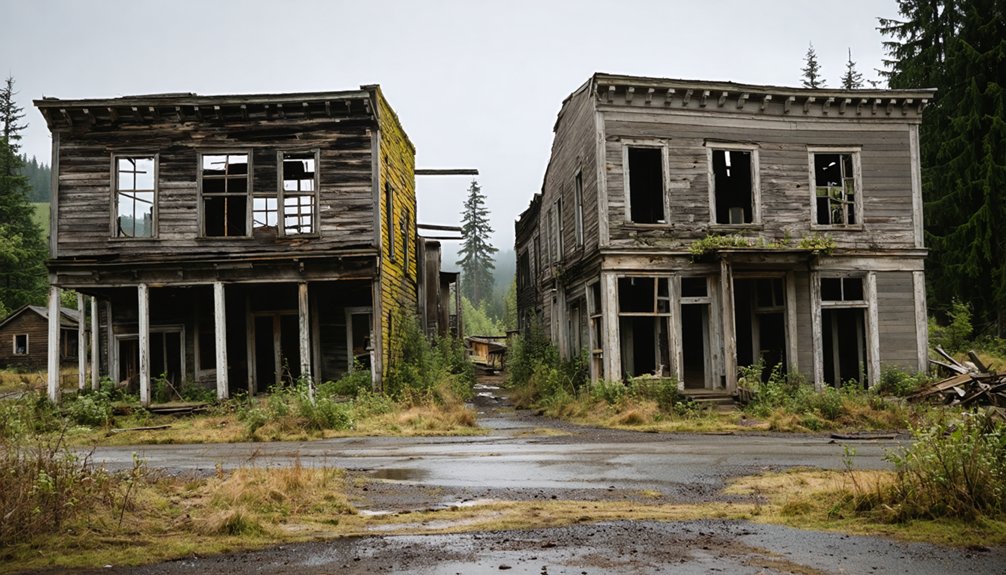
When you pull into a true ghost town, you’ll notice weathered storefronts lining dusty main streets—structures still standing but hollowed out, windows dark and doorways empty. The old schoolhouse, jail, or mercantile might remain surprisingly intact, their wood siding silvered by decades of sun and wind, while other buildings have collapsed into skeletal frameworks of beams and brick.
Some Oregon ghost towns maintain their eerie authenticity through pure neglect, whereas others like Shaniko have been partially restored for tourists, creating a tension between genuine decay and curated history.
Buildings Without Current Residents
The hollow windows of Cascadia’s abandoned buildings stare back at visitors like empty eye sockets, their weathered frames offering glimpses into Oregon’s mining and logging past. You’ll discover structures ranging from completely intact schools and post offices to skeletal remains barely distinguishable from surrounding debris. The building aesthetics vary dramatically across Oregon’s 250+ documented ghost towns, creating exceptional opportunities for ruin photography.
Classification by structural condition:
- Class A sites – No visible buildings remain, sometimes marked only by cemeteries
- Class B locations – Dilapidated structures with scattered rubble and debris fields
- Class C towns – Mostly intact buildings maintained by caretakers
You’ll find rusted mining equipment, peeling paint on abandoned vehicles, and weathered wood providing endless abstract compositions. Some residents have repurposed these structures for storage or converted them into contemporary living spaces.
Historic Public Facilities Present
Among Oregon’s ghost towns, historic public facilities serve as the most reliable markers separating authentic abandoned settlements from fabricated tourist attractions. You’ll find genuine weathered architecture at Shaniko’s operational schoolhouse and depot, where wool-era remnants stand alongside preserved commercial buildings.
Golden offers seven structures including a minister-built church accessible through state park land near Grants Pass. Weatherby’s 1884 railway station fragments reveal Baker County’s transport legacy, while Pinehurst maintains an active school despite its 1878 origins and remote backroad location.
Millican represents the opposite extreme—its abandoned gas station and deteriorated general store form tourism infrastructure for zero inhabitants. These scattered relics on private land demonstrate what happens when communities completely collapse rather than preserve their past for visitors seeking authentic frontier history.
Preservation Versus Full Abandonment
Oregon’s 200 ghost towns present a bewildering spectrum when you arrive—some offer pristine 19th-century buildings with interpretive signage, while others deliver nothing but foundation holes and scattered debris. Understanding these classifications helps set realistic expectations for your adventure.
What you’ll encounter:
- Class C preserved sites like Buncom feature viewable structures behind locked doors, protecting their structural frailty while offering exterior photography opportunities
- Class D hybrid towns maintain period buildings alongside sparse populations—you’re exploring living history, not complete abandonment
- Class A vanished settlements such as Valsetz leave zero traces; only cemetery markers prove communities existed
Recent abandonments in British Columbia showcase intact interiors, while Oregon’s 1880s mining camps crumble into Pacific Northwest soil. You’ll find everything from tourist-friendly heritage sites to genuinely forgotten ruins demanding respectful exploration.
Mapping Your Route: From Portland to Remote Mining Sites

Before dawn breaks over Portland’s Willamette River bridges, you’ll want your tank filled and your route memorized—because the 300-mile journey to Oregon’s eastern ghost towns demands commitment. I-84 carves through the Columbia Gorge, delivering you to Baker City in six hours if conditions cooperate.
From there, OR-7 peels north toward Granite’s weathered structures, where heritage preservation practices meet nature’s reclamation efforts. You’ll navigate challenging infrastructure conditions on Forest Service roads accessing Cornucopia and Cracker Creek—gravel switchbacks climbing 5,000 feet toward abandoned mine shafts.
Stock supplies in The Dalles; cell service vanishes past Baker County. May through October offers your window before snowpack seals these routes. Golden, 280 miles southwest via I-5, demands separate expedition planning. These aren’t paved tourist loops—they’re earned discoveries.
Accessing Backroads and Historic Districts Safely
When gravel crunches beneath your tires and the pavement ends 40 miles past civilization, you’re finally approaching Oregon’s authentic ghost towns—but only if you’ve prepared correctly.
To truly appreciate the history and stories behind these abandoned places, take the time to explore ghost towns near Millican. Each town offers a glimpse into the past with its unique architecture and remnants of life that once thrived there. Remember to bring your camera along; you’ll want to capture the haunting beauty that envelops these forgotten landscapes.
Essential protocols for backroad access:
- Check seasonal road closures through ODOT before departing—winter snow blocks high desert routes, stranding unprepared travelers
- Navigate private property restrictions like the Skinner toll road near Arock; GPS won’t warn you about locked gates
- Pack paper maps and emergency gear—cell signals vanish east of Mt. Hood, leaving you dependent on traditional navigation
Your high-clearance 4WD becomes pivotal on washboard roads to Shaniko. Respect no-trespassing signs at abandoned sites. Between Burns Junction and Hampton, fuel stations disappear for 90 miles. Freedom means self-reliance: water reserves, tire chains, satellite communicators. Dawn departures prevent nocturnal livestock encounters.
Packing and Preparing for Your Ghost Town Adventure

Between crumbling foundations and weathered timber frames lies the difference between memorable exploration and emergency evacuation—and that difference sits in your vehicle before you even shift into drive. You’ll need layers for seasonal weather considerations that shift dramatically in Oregon’s mountains, where fall’s golden comfort transforms into winter’s impassable snows.
Pack spare tires, extra fuel, and paper maps—cell service vanishes quickly beyond Baker City. Your first-aid kit isn’t optional when remote terrain challenges place you hours from help. Load ample water and snacks for extended backcountry wandering.
Remember: mining tunnels stay closed for good reason, and those fragile structures won’t support your weight. Check tide tables for coastal ghost forests, verify road conditions, and fuel up completely before venturing into service-free zones.
Frequently Asked Questions
Are There Camping Facilities Near Cascadia’s Ghost Town Sites?
You’ll find excellent camping near Cascadia’s ghost town, with 35 total sites offering river access and hiking trails to waterfalls. Don’t miss the scenic viewpoints along Soda Creek—they’re stunning at sunrise when mist rolls through the canyon.
What Cell Phone Coverage Exists in Remote Ghost Town Areas?
Ghost town areas offer spotty coverage—you’ll find AT&T works at Glass Buttes, but Greenhorn’s completely off-grid. Check location-based cell signal mapping before departing, and consider satellite connectivity for true freedom when exploring Oregon’s abandoned outposts.
Are Ghost Town Buildings Safe to Enter or Explore Inside?
No, ghost town buildings aren’t safe to explore inside. Oregon’s pre-1974 structures lack earthquake reinforcement, compromising structural integrity. For your personal safety, admire these weathered relics from outside—their crumbling facades tell stories without risking your freedom through injury.
Do Any Ghost Towns Charge Admission or Entrance Fees?
Yes, some ghost towns charge admission—Bodie State Historic Park costs $8 for adults. However, you’ll find countless free Oregon sites with guided tours available. Proximity to nearby towns often determines fee structures, giving you freedom to explore affordably.
What Time of Year Offers the Best Weather for Visiting?
Last September, I explored Cascadia’s abandoned buildings under clear skies—perfect conditions. You’ll find late summer through early fall offers mild temperatures around 74°F and dry climate ideal for wandering freely through Oregon’s forgotten landscapes.