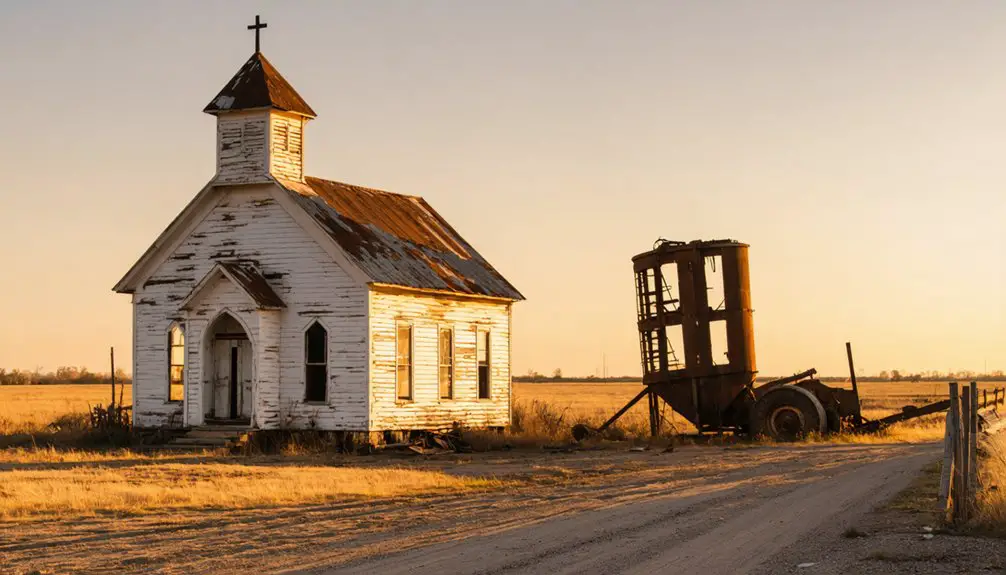
You’ll find Cayuga along winding Oklahoma backroads where a gray limestone church rises from the prairie like a frontier ghost. Park along the property’s edge and explore the weathered mission where founder Matthias Splitlog once envisioned an Ozark metropolis. The 1,600-pound Belgian bell still rests on these grounds, while hand-carved woodwork whispers stories inside. Wander the adjacent cemetery where Splitlog and pioneering families sleep beneath windswept stones, and you’ll discover there’s considerably more to this abandoned dream than meets the eye.
Key Takeaways
- Cayuga is an unincorporated Oklahoma community accessible by winding roads with informal parking along the historic church property edge.
- The 1884 gray limestone mission church remains visible from a mile away and hosts Sunday services at 8:30 a.m.
- Explore the weathered church featuring carved woodwork, a 1,600-pound Belgian bronze bell, and damaged stained glass windows.
- Visit the adjoining cemetery containing founder Matthias Splitlog’s grave and burial sites of frontier families and indigenous heritage.
- Once envisioned as the Ozarks’ greatest town, only the church and cemetery remain from Splitlog’s industrial center.
Getting to the Historic Cayuga Mission Church Site
Tucked between the Grand River and Cowskin River in the unincorporated community of Cayuga, this gray limestone church rises from Oklahoma’s green hills like a sentinel from another era. You’ll find it at 26211 S 670 Rd, near Grove—just watch for the steeple visible from a mile out. The winding roads feel like discovering secrets the state’s been keeping.
There aren’t formal parking options, but you can pull off along the property’s edge. Don’t expect gift shop offerings here; this isn’t a commercialized attraction. It’s real, raw history where you’re free to wander the cemetery dating to the mid-1880s, explore the grounds, or attend Sunday services at 8:30 a.m. Deer and raccoons share the space, unbothered by visitors seeking something authentic.
What Remains of the Original 1884 Settlement
As you stand on this windswept prairie nine miles northeast of Grove, you’ll find only two silent witnesses to Cayuga’s vanished glory—the stately limestone mission church and its adjoining cemetery.
The white board fences and gingerbread-trimmed buildings that once housed seven or eight hundred Cayuga tribe members have completely disappeared, leaving the 1896 church standing in lonely vigil beside a little-used road.
Within the cemetery’s grounds, marble headstones mark where Matthias and Eliza Splitlog rest, their graves now the primary remnants of the settlement Matthias founded in 1874.
The Historic Mission Church
The limestone church rises from the Oklahoma prairie like a monument to enduring love, its Romanesque arches catching the morning light just as they did in 1896. You’ll find Mathias Splitlog’s tribute to his wife Eliza standing unchanged since its dedication, each hewn stone hand-selected from local quarries.
The arched doorway displays fifteen stones carved with Indian symbols—a cultural bridge between two worlds. Inside, eye catching stained glass windows cast colored patterns across the hand carved wooden altarpiece, evidence of the craftsmanship Mathias demanded. He never saw the finished sanctuary; pneumonia claimed him weeks after dedication. Yet his vision persists.
Every Sunday at 8:30 a.m., the church welcomes travelers seeking connection to Oklahoma’s frontier past, no appointment necessary.
Cemetery and Burial Grounds
Beyond the church’s sanctuary walls, weathered headstones mark where Cayuga’s founding families now rest. You’ll find Matthias Splitlog’s grave here, the town founder who died from pneumonia in 1896. His wife Eliza’s marble tombstone bears an unusual inscription—she passed before the church’s 1893 completion, her funeral held among improvised seats in the unfinished sanctuary.
These three acres of historic church interments tell stories the highway won’t. Hundreds gathered for Matthias’s Requiem Mass in 1897, yet today you’ll likely walk these grounds alone. The cemetery symbolizes what remains of the original 1884 settlement, though undiscovered burial plots likely exist beyond marked stones. While the parish dissolved and Catholic artifacts scattered to distant churches, this sacred ground still holds Cayuga’s pioneers.
The Story of Matthias Splitlog and His Vision
Born into the Huron/Wyandotte tribe somewhere between 1812 and 1818 along Canada’s Detroit River, Matthias Splitlog would become one of the most remarkable Indigenous entrepreneurs of the nineteenth century. You’ll discover how he transformed forced relocations into opportunity, building gristmills, steamboats, and eventually a $3 million railroad.
After government treaties pushed him from Canada to Kansas, then Oklahoma by 1874, he refused to accept displacement as defeat. Instead, his wealth and influence funded Cayuga Springs—a self-contained industrial center with wagon factories, stores, and homes. His multigenerational community planning created something revolutionary: a settlement designed to resist future forced removals through economic independence.
As elected Tribal Chief in 1890, he’d declare Cayuga would become the Ozarks’ greatest town—a bold vision backed by entrepreneurial action.
Exploring the Church Architecture and Interior Details
As you approach the weathered limestone façade, you’ll spot the name “Splitlog” carved letter by letter above each arched window, wrapping from the right front all the way around to the left side.
The massive 1,600-pound Belgian bronze bell—once audible for 12 miles—now rests on the church grounds after spending years at St. Catherine’s in Nowata.
Through the broken stained-glass windows, you can glimpse the hand-carved imported woodwork inside, including an ornate piano that’s sat silent since the church’s abandonment.
Original Bell Tower Legacy
Rising from the Oklahoma prairie like a sentinel of faith, the bell tower of Splitlog Church commands your attention long before you reach its limestone walls. That massive 726-kilogram Belgian bronze bell once carried deep, resonant tones twelve miles across the landscape—imagine hearing those beautiful sounds echoing through valleys you’re now free to explore.
The bell tower restoration preserves the native limestone and reinforced wood framework that’s stood since 1896, though the blessed bell itself departed in 1930 for St. Catherine’s parish in Nowata. The musical acoustics were designed to reach distant homesteads, calling worshippers across vast expanses.
Today’s silence speaks volumes about Cayuga’s transformation from thriving community to peaceful ghost town you can wander at your own pace.
Damaged Stained Glass Windows
When you step through the weathered doorway of Splitlog Church, imagine sunlight once streaming through $19,000 worth of imported stained glass—that’s $706,500 in today’s money—illuminating the carved surname “Splitlog” above each arched window. Vandals dynamited the church in 1925, hunting for legendary hidden gold, shattering these irreplaceable treasures depicting Christ’s life, death, and resurrection. Rain poured through the broken frames for decades, accelerating the church’s decline.
You’ll find empty stone arches now, spelling out the founder’s name around the nave—a ghost of extravagant beauty funded by Native American parishioners. The cost of restoration would be astronomical, but the cultural significance remains undeniable. Stand where those windows once blazed with color, and you’re witnessing both artistic ambition and the brutal reality of abandonment.
Catholic Furnishings and Stonework
The native limestone that forms Splitlog Church‘s 50-by-30-foot frame came from the Boone Formation beneath Oklahoma soil—the same ancient stone that surfaces in bluffs and creek beds across Delaware County. Mathias Splitlog hauled each block himself in 1896, building something meant to last.
Inside, you’ll find fifteen stones embedded with Indian symbols—tribal motifs woven directly into Catholic architecture. The ornate altar furnishings departed after the parish closed, relocated by the diocese to active congregations. What remains are the preserved woodwork carvings—hand-carved embellishments that wrap around doorframes and fixtures, showcasing 1890s craftsmanship.
Above the entrance, that tall steeple still holds the 1,600-pound Belgian bronze bell Henry Splitlog dragged twenty-four miles from Neosho. The stonework hasn’t buckled in 125 years.
The Cemetery and Its Notable Burials
Nestled among weathered headstones and native grasses, Cayuga Cemetery—also known as Cayuga Splitlog Mission Church Cemetery—stands as a quiet memorial to the families who shaped this Delaware County community. You’ll discover interment records spanning the late 19th through 20th centuries, each stone telling stories of frontier resilience.
The Evans family claims considerable ground here—Alfred Gould Evans (1889-1952), Curtle Evans (1894-1979), and Esther Spicer Evans (1892-1973) rest among their kin. Young George Austin Downing‘s brief life (1895-1898) marks the harsh realities pioneers faced.
Nearby, the Seneca-Cayuga Tribal Cemetery honors indigenous heritage with six memorial records. Together, these burial grounds preserve the complex cultural tapestry that defined Cayuga’s identity. You’re walking through authentic history—no sanitized tourist version, just raw Oklahoma truth.
Tales of Hidden Treasure and Mysterious Events

Greed and mystery cling to Cayuga’s ruins like morning fog on the Illinois River. You’ll find legends of buried treasure woven through every crumbling foundation, sparked when vandals dynamited the church in four places hunting Chief Splitlog’s rumored gold stash. The explosions scarred the interior, yet treasure hunters found nothing but rubble and broken dreams.
Walk the church grounds and you’ll notice large steam pipes connecting the old engine house. Locals spun these into rumors of tunnels and escape routes—elaborate stories about priests fleeing hostile Indians through underground passages. The native residents found this hilarious, knowing full well the pipes simply carried steam.
Then there’s that mysterious telegram sent to the Splitlog family by a well-dressed stranger nobody recognized. He vanished before anyone discovered his identity or purpose.
Sunday Services and Visiting the Active Church
Beyond the treasure hunters and their explosive fantasies, life continues at Cayuga Mission Church every Sunday morning at 8:30 AM. You’ll find the white clapboard building at 26211 S 670 Rd, where hymns echo through rooms that’ve witnessed a century of Sundays. The hour-long service runs traditional—familiar favorites sung by voices that know every verse.
Call 918-314-4987 to arrange a group tour, though you’re welcome to simply show up. While this mission church maintains its quiet rhythm, it lacks the young adult programming and extensive volunteering opportunities you’d find at larger congregations. For those seeking contemporary worship or midweek connection groups, you’ll need to look beyond Cayuga’s borders. But there’s something honest about a church that’s exactly what it appears to be.
Best Times to Visit and What to Bring

The rhythm of seasons dictates your Cayuga experience more than any guidebook ever could. Spring brings eclipse-chasing adventurers and thunderstorms that transform dirt paths into muddy chronicles of Oklahoma’s temperament.
You’ll find freedom from seasonal crowds during fall’s September-through-November window—when museum hours shorten to 10am-5pm but vibrant foliage paints the cemetery in amber light. Pack layered clothing for temperature swings between 30-95°F, sturdy boots for uneven terrain around Splitlog Church, and rain gear for those unpredictable weather predictions. Don’t forget your flashlight for dim church interiors and bug spray for riverside mosquitoes.
Winter offers solitude but demands warm coats for evening explorations. Summer’s humidity reaches oppressive levels—bring extra water bottles and embrace early morning visits before heat consumes your wanderlust.
Frequently Asked Questions
Are There Any Hotels or Campgrounds Near the Cayuga Ghost Town Site?
You’ll find civilization’s comforts scarce near Cayuga’s forgotten streets. Nearby RV parks and local accommodations cluster around Durant, about 30 miles south, where you’ll discover freedom-friendly lodging options before your adventure into Oklahoma’s haunting, abandoned past.
Is Photography Allowed Inside the Church and Cemetery?
Photography policies restrict interior church access during worship, but you’ll find freedom capturing the exterior’s Gothic stonework and cemetery’s weathered markers. Church accessibility requires permission from Delaware County officials—respect this sacred space while documenting your ghost town adventure.
What Other Ghost Towns Are Within Driving Distance of Cayuga?
You’ll find several nearby ghost town destinations within easy reach. Centralia and Alluwe offer potential side trips from Cayuga, while Ketchum’s crumbling structures beckon explorers. Each abandoned settlement promises authentic freedom to wander Oklahoma’s forgotten landscapes at your own pace.
Do I Need Permission to Visit the Church on Non-Service Days?
No permission needed—you’re free to explore this limestone sanctuary during church access hours on non-service days. Local regulations regarding visiting are welcoming; just call ahead for groups. The weathered steps and symbol-carved arch await your discovery.
Are There Restaurants or Gas Stations Between Grove and Cayuga?
Like a ribbon through empty prairie, the route offers minimal stops—you’ll find sparse convenience shops and no grocery stores between Grove and Cayuga. Fuel up beforehand; this quiet stretch rewards adventurers who embrace solitude over services.