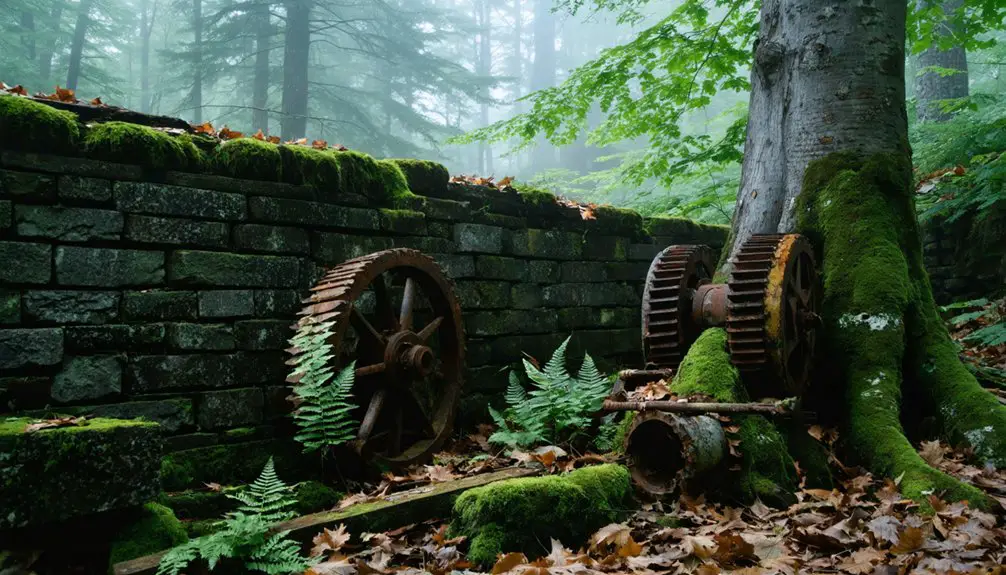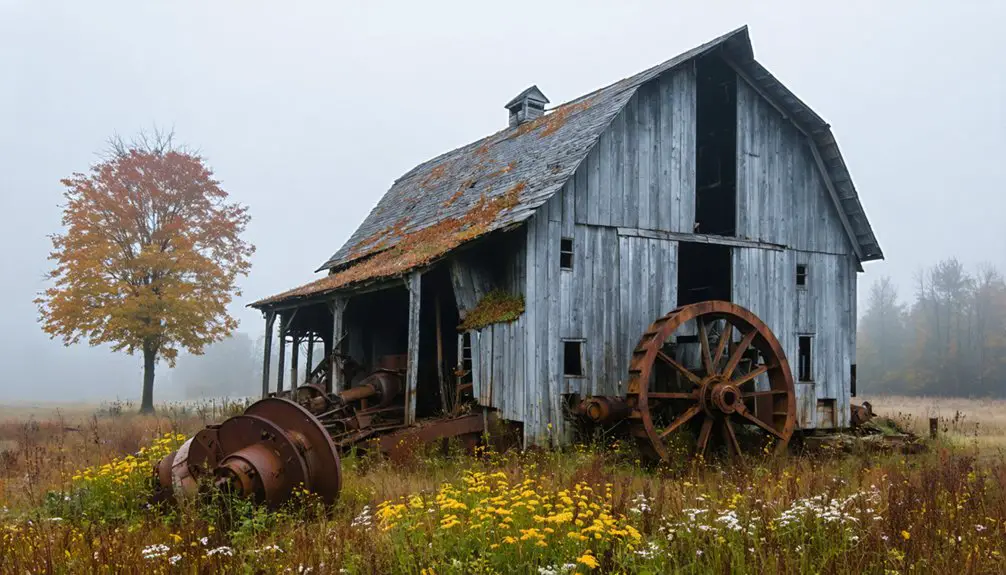
Your Vermont ghost town road trip begins at South Glastenbury, where twelve brick charcoal kilns still stand among the ruins of an 1880s logging settlement that housed 241 residents before economic collapse led to its 1937 disincorporation. You’ll traverse the mysterious Bennington Triangle, site of five unexplained disappearances between 1945 and 1950, before reaching Cedar Beach on Lake Champlain’s shores, where legends claim Revolutionary War-era pirates buried gold beneath the sand. The route reveals how Vermont’s wilderness reclaimed these once-thriving communities and why their stories continue to captivate explorers.
Key Takeaways
- Cedar Beach features Revolutionary War-era legends of gold hidden beneath its sandy shores, connecting to Lake Champlain’s pirate history.
- Visit nearby Glastenbury, Vermont’s famous ghost town, which thrived as a logging center until economic collapse and disincorporation in 1937.
- Explore twelve historic brick charcoal kilns remaining from Glastenbury’s industrial boom powered by immigrant labor in the 1880s.
- The Bennington Triangle area saw five mysterious disappearances between 1945 and 1950, adding intrigue to the wilderness region.
- Mysterious stone chambers dating to 492 AD dot Vermont’s hillsides, with treasure legends at Mount Ascutney and Worcester Mountain nearby.
The Rise and Fall of South Glastenbury: From Logging Hub to Abandoned Settlement
When Bennington business interests discovered Glastenbury’s vast timber resources in the 1870s, they transformed a remote wilderness into one of Vermont’s most productive logging centers. You’ll find this story reflects classic Exploitative Business Practices—outsiders extracting wealth while local communities bore the consequences.
Resource extraction capitalism at its finest: distant investors harvesting wealth while abandoning communities once the land gave nothing more.
The population swelled to 241 by 1880 as two sawmills and dozens of charcoal kilns emerged at South Glastenbury, supplying iron production across the region.
Evolving Railroad Infrastructure shaped the town’s destiny. The Bennington & Glastenbury Railroad climbed steep grades along Bolles Brook starting in 1873, enabling intensive timber harvest. After just 22 years, mature trees were depleted and the railroad ceased operations in 1889.
A brief trolley revival and failed resort attempt couldn’t save the settlement. By 1937, only seven residents remained.
Mysteries of the Bennington Triangle: Unexplained Disappearances and Strange Phenomena
The quiet forests surrounding Glastenbury Mountain became the scene of Vermont’s most perplexing mystery when five people vanished without a trace between 1945 and 1950. These strange disappearances began with experienced guide Middie Rivers in November 1945, followed by Bennington College student Paula Welden in 1946.
The pattern continued with eight-year-old Paul Jepson and veteran James Tedford, both in 1950. Frieda Langer‘s case proved most haunting—she disappeared near Somerset Reservoir in October 1950, only to have searchers discover her body seven months later in previously combed terrain. Despite massive search efforts involving thousands of volunteers and military personnel, investigators found virtually nothing. The missing bodies and lack of evidence transformed this region into what locals call the Bennington Triangle, cementing Glastenbury’s reputation as Vermont’s most enigmatic wilderness.
The Wild Man of 1867: Glastenbury’s Earliest Monster Encounters
Long before the Bennington Triangle gained its notorious reputation, Glastenbury’s wilderness spawned tales of a different kind of terror. In 1867, residents reported encounters with a “wild man” who’d emerge from forest caves to terrorize communities. This disheveled figure, wearing only a coat, would expose himself to women before brandishing a revolver and vanishing into the mountains.
Unlike typical mountain hermits seeking peaceful solitude, this individual’s erratic behavior convinced locals the wilderness had driven him mad. The community eventually chased him from the region, but his legacy endures as Glastenbury’s supernatural lore’s earliest documented monster. These accounts predate the area’s later disappearances by decades, establishing a pattern of unexplained phenomena that would define this isolated Vermont territory for generations to come.
Industrial Boom to Ghost Town: Charcoal Kilns, Quarries, and Economic Collapse
South Glastenbury’s transformation from thriving industrial hub to abandoned ghost town reveals Vermont’s boom-and-bust extractive economy. You’ll find evidence of this prosperity in the twelve brick charcoal kilns that once lined the hillsides, where Irish, Italian, and Slavic immigrants labored in slate quarries and processing mills.
The 1898 flood that destroyed the railroad tracks—combined with earlier murders and dwindling resources—triggered the economic collapse that led to the town’s 1937 disincorporation.
Charcoal Operations and Logging
From colonial times through the early 20th century, Vermont’s forests fueled an industrial empire built on charcoal. You’ll find evidence of this operation throughout Cedar Beach’s landscape, where skilled colliers transformed hardwoods into fuel through carefully controlled burns in earthen kilns and mound pits.
The fuel consumption estimates reveal staggering demands:
- Single furnace operations required 210,160 bushels annually to produce 1,602 tons of pig iron
- Each gross ton consumed 120 bushels of charcoal, hauled an average five miles to ironworks
- Vermont suppliers shipped charcoal across state lines to furnaces in New York and Massachusetts
The environmental impact of logging was severe—entire hillsides stripped bare by winter woodcutters seeking off-season wages. These independent operations sustained local economies while methodically depleting the region’s forests.
Immigrant Labor in Quarries
Welsh slate workers’ recruitment brought 300 experienced craftsmen to Slate Valley in 1891 alone, filling supervisory roles. Irish laborers handled the dangerous unskilled work, while Slavic workers arrived after 1900.
Floods and Economic Decline
During its industrial peak, Glastenbury’s economy thrived on charcoal production, with twelve brick kilns lining the cleared hillsides of South Glastenbury. The Forks location optimized transport routes while supporting a massive loggers’ boardinghouse and company store. Yet prosperity proved fragile when environmental forces struck.
The 1898 flood devastated the region’s infrastructure, creating cascading failures:
- Transportation challenges emerged as floodwaters washed out railroad tracks beyond repair, ending the trolley resort after just one season
- Labor pool shifts accelerated as workers abandoned West Castleton’s slate quarries and mining operations
- Weather vulnerabilities compounded problems, with sixteen-foot snow depths blocking narrow canyon access
The Enchanted Stone and Other Mountain Legends
Scattered across Vermont’s forested hillsides, mysterious stone chambers have sparked debate among historians, archaeologists, and amateur researchers for generations. You’ll find these ancient stone chambers throughout the state, with radiocarbon dating from Putney revealing construction around 492 AD—centuries before colonial settlement. While Vermont’s Historic Preservation Division dismissed most as root cellars in 1977, independent researchers argue otherwise, pointing to astronomical alignments and ceremonial features.
At Lone Rock Point on Lake Champlain, stone structures survived 19th-century quarrying that destroyed what indigenous traditions considered sacred ground. Mount Ascutney and Worcester Mountain hold undocumented chambers alongside legends of hidden treasures, including Old Indian Joe’s elusive gold mine that captivated 1800s townsfolk. These enigmatic sites represent Vermont’s untamed past, waiting for you to explore and draw your own conclusions about their mysterious origins.
Cedar Beach and Lake Champlain’s Pirate Gold Legend

Lake Champlain’s murky depths and secluded shorelines have concealed treasure legends for over two centuries, with Cedar Beach standing as ground zero for one of Vermont’s most enduring tales of buried gold.
Cedar Beach guards Vermont’s oldest mystery: Revolutionary-era gold still hidden beneath its sandy shores after 250 years.
The surviving soldiers never relocated their fortune, leaving Charlotte’s shoreline ripe for colonial era artifact discovery.
Beyond Cedar Beach, Lake Champlain’s pirate legacy centers on Captain Mallett, who established his Revolutionary War-era stronghold at Malletts Head:
- Coates Island remains the focal point for ongoing treasure searches
- Antique artifacts including brass buttons surface regularly around Malletts Bay
- Historical accounts verify Mallett’s tavern hosted smugglers and spies from both sides
These legends continue drawing seekers to Vermont’s waterfront.
Your hidden treasure hunt begins with the 1773 British soldiers’ cache—$75,000 in gold coins hastily buried during an Indian attack.
Champ Sightings: Vermont’s Own Lake Monster Mystery
Beyond the glittering promises of buried pirate gold, Cedar Beach harbors an even older mystery—one that predates colonial treasure hunters by thousands of years. The Abenaki called it Gitaskog—”great serpent”—warning French explorers not to disturb these waters. You’re standing where Captain Crum witnessed a 187-foot creature rear from the depths in 1819, its head fifteen feet above the waves.
Indigenous beliefs about Champ aren’t mere folklore. By 1992, 600 witnesses documented 180 sightings across Lake Champlain. In 1984, sixty passengers aboard the *Spirit of Ethan Allen* watched a thirty-foot creature surface near Burlington. That famous 1977 photograph sparked modern day Champ tourism, transforming this ancient legend into Vermont’s most enduring mystery. The lake keeps its secrets, inviting you to discover them yourself.
Planning Your Route: Key Sites Between Glastenbury and Cedar Beach

Your journey from Glastenbury’s abandoned logging settlements to Cedar Beach along Lake Champlain connects two distinct chapters of Vermont’s frontier history.
Begin at the Fayville ruins off Route 9, then head northwest through Bennington to explore the region’s colonial-era fortifications and trading posts that once defended against lake pirates.
This route traces Vermont’s transformation from isolated mountain communities to its strategic waterfront settlements, where smugglers and privateers operated during the War of 1812.
Historic Glastenbury Town Stops
While Cedar Beach serves as your final destination, the ghost town sites of historic Glastenbury offer essential stops that reveal Vermont’s forgotten industrial past. You’ll discover state park heritage sites that preserve remnants of Vermont’s logging era, when this mountain community thrived for over a century before its 1937 disincorporation.
Essential Glastenbury stops include:
- Fayville Settlement Ruins – Explore abandoned mill infrastructure near Bennington, accessible via the Long Trail. These structures mark where Vermont’s lumber industry once dominated the landscape.
- South Glastenbury Resort Site – Locate the former trolley-equipped resort area, where 1898 floods destroyed railroad tracks and dreams of tourism prosperity.
- Fire Road 325 – Drive this historic route through Woodford, following the original paths that carried charcoal and lumber to Bennington’s markets.
Lake Champlain Pirate Landmarks
Between Glastenbury’s mountain ruins and Cedar Beach’s shoreline, Lake Champlain’s pirate landmarks transform your ghost town expedition into a maritime treasure hunt. You’ll discover Captain Mallett’s tavern history in Colchester, where the French pirate established his log cabin retreat for spies and smugglers during Revolutionary times. His legacy persists through Mallett’s Bay, Coates Island, and local schools bearing his name.
Navigate dirt roads to Panton’s Adams Ferry Road, where Benedict Arnold’s sunken fleet remains visible from the Revolutionary War battle. At Lake Champlain Maritime Museum in Ferrisburgh, you’ll find the *Aladdin* pirate ship model alongside exhibits documenting Lake Champlain pirate shipwrecks. These maritime stops connect Vermont’s mountain ghost towns with coastal pirate history, revealing the state’s diverse freedom-seeking past.
Safety Tips and What to Bring on Your Ghost Town Adventure
Exploring abandoned settlements like Cedar Beach demands thorough preparation that extends far beyond simply pointing your vehicle north. Vehicle maintenance forms your foundation—check oil, fluids, tire pressure, and tread depth before departure. Vermont’s remote roads won’t forgive mechanical failures, so verify your lights, signals, and spare tire function properly.
Emergency preparedness separates confident explorers from stranded travelers:
- Recovery gear: Pack winch, earth anchors, and straps for self-extraction on isolated terrain
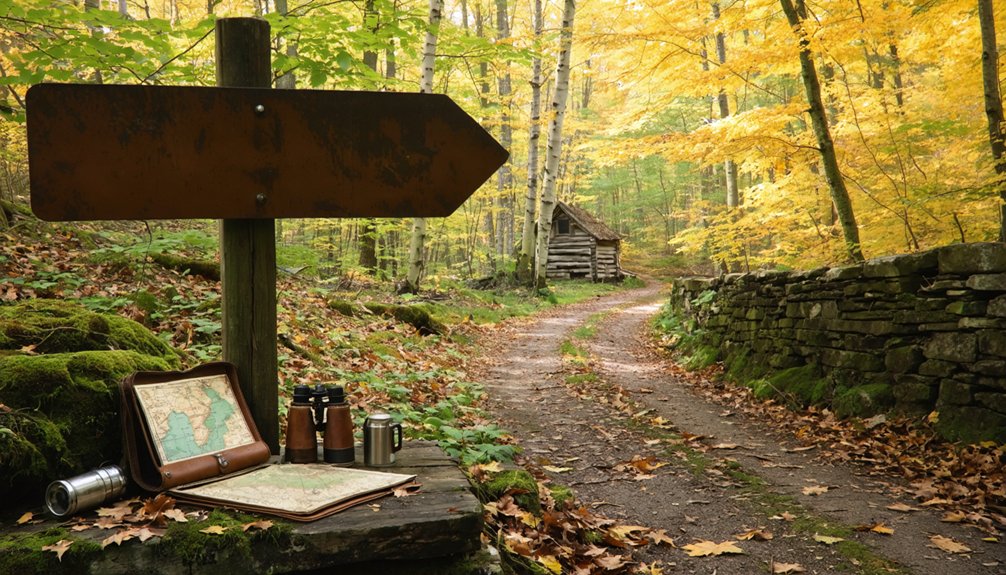
- Navigation tools: Carry GPS, atlas, and compass since cell coverage disappears near ghost towns
- Survival essentials: Include first aid kit, water, food, blanket, flashlight, and fire-starting materials
Share your route and expected return time with trusted contacts. Lake Champlain’s abandoned communities reward the prepared while punishing the reckless.
Frequently Asked Questions
Are There Any Guided Tours Available for Glastenbury Ghost Town?
No official guided tours availability exists for Glastenbury Ghost Town currently. You’ll need to explore independently, respecting the historical significance of Glastenbury while hiking the Long Trail. Always practice leave-no-trace principles to preserve this mysterious Vermont wilderness for future adventurers.
What Permits or Permissions Are Needed to Explore These Abandoned Areas?
Traversing abandoned sites requires respecting boundaries—you’ll need private property access permission from current landowners to avoid potential trespassing risks. Vermont’s historic sites deserve community stewardship, so always secure written consent before exploring these cultural treasures independently.
Is Camping Allowed Near Cedar Beach or Glastenbury Mountain?
Yes, camping’s allowed at both locations. Cedar Beach offers developed campsites with amenities, while Glastenbury Mountain provides dispersed camping with higher seclusion levels and wildlife presence. You’ll find different experiences matching your desired freedom and comfort preferences.
What Is the Best Season to Visit These Ghost Town Locations?
Fall paints Vermont’s ghost towns in spectacular fashion—you’ll find autumn foliage framing abandoned structures while crisp temperatures create an eerie atmosphere perfect for exploration. Dry trails and fewer crowds let you roam freely through history.
Are There Nearby Accommodations or Must You Camp During the Trip?
You’ll find nearby inns in Burlington and Charlotte, though private campgrounds offer closer access to Cedar Beach. State parks provide developed sites, while backcountry camping lets you explore freely. Reserve ahead during peak seasons for guaranteed spots.