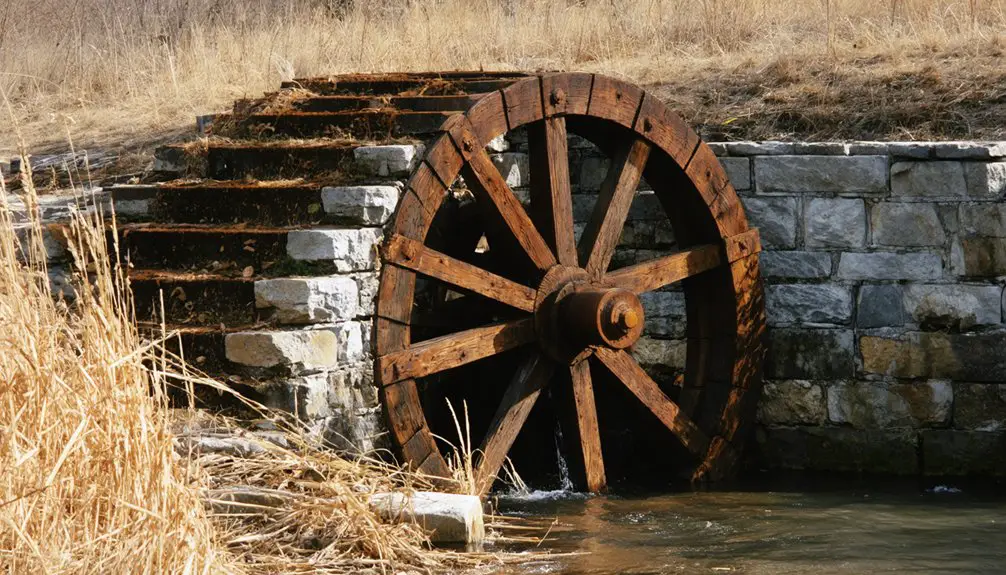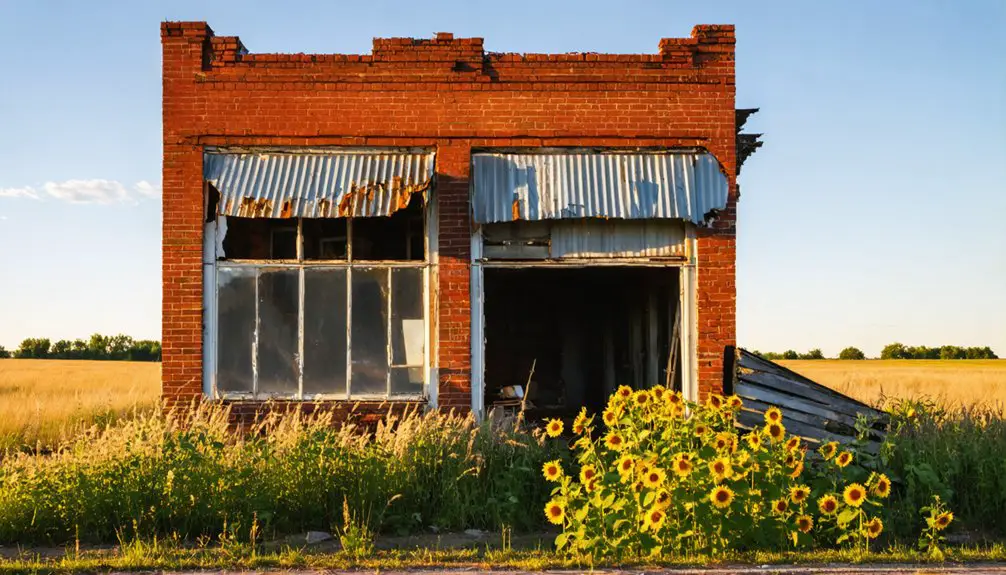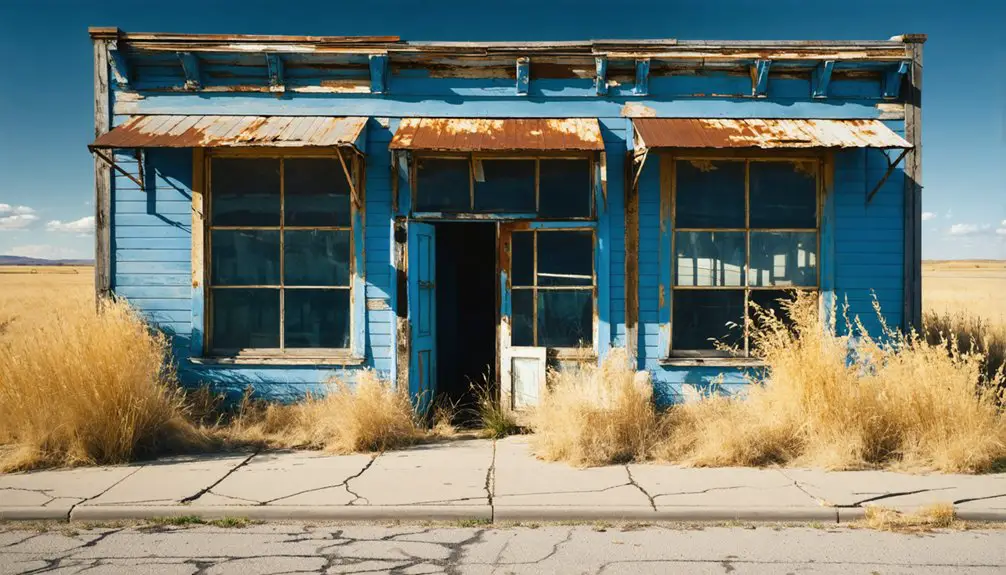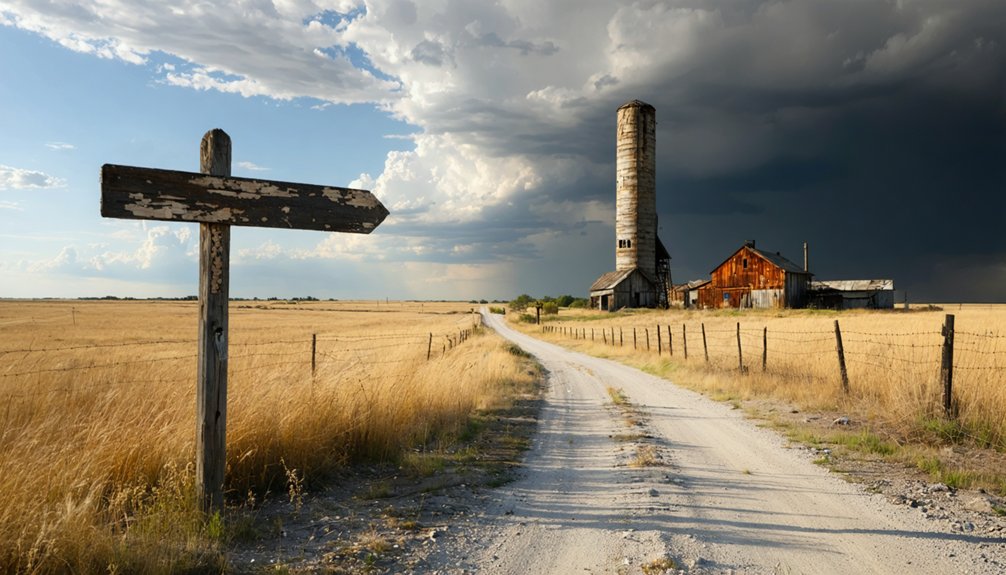
Your ghost town adventure to Centerview starts with traversing Franklin County’s maze of unmarked rural roads, where you’ll discover a 1918 brick schoolhouse with its roof collapsed and limestone walls now sheltering farm equipment instead of students. Pack essentials like offline GPS, sturdy boots, and emergency supplies since amenities don’t exist out here. From Topeka, wind through Overbrook before plunging into true backroad territory, where weathered cemetery markers guard pioneers’ final resting places and summer’s extended daylight reveals Kansas’s haunting prairie secrets.
Key Takeaways
- From Topeka, travel through Overbrook on unmarked rural roads; from Wichita, take Highway 56 eastward for 200 miles.
- Pack emergency supplies, sturdy boots, layered clothing, offline GPS, and maps as cell coverage is limited and amenities nonexist.
- Visit the 1918 brick schoolhouse, limestone schoolhouse with farm equipment, weathered cemetery markers, and crumbling Freeport School building.
- Extend your trip to nearby ghost towns: Waterloo (10 miles north), Diamond Springs, Galatia, and LeHunt’s abandoned cement plant.
- Plan for October ghost-hunting opportunities or summer’s extended daylight for photographing ruins with wide-angle lenses at sunset.
History and Origins of Centerview
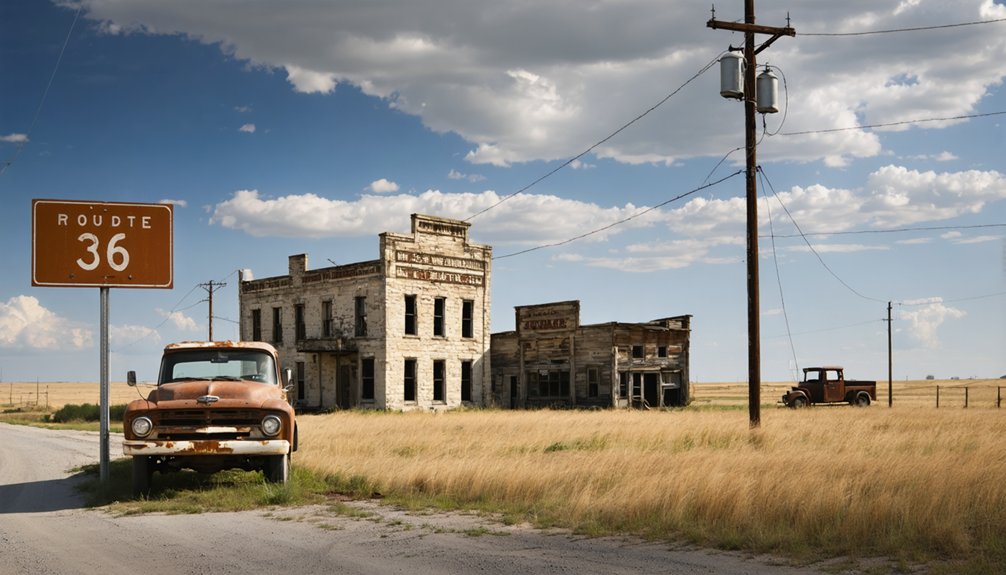
The dirt roads northwest of Ottawa wind through farmland that once bustled with pioneer ambition when settlers first claimed this stretch of Johnson County in March 1856.
You’re tracing the footsteps of pioneers who built Centerview into a community of nearly 100 souls by 1921, their livelihoods rooted in agriculture diversification across these fertile plains. The post office operated from 1854 to 1930, connecting isolated families to the wider world through county road networks.
Yet railroad isolation sealed Centerview’s fate—tracks bypassed the town, funneling commerce elsewhere while you’d have watched neighbors slowly drift away. The Dust Bowl’s choking winds of the 1930s delivered the final blow, leaving only scattered farmsteads where churches and trading posts once anchored community life.
What Remains Standing Today
When you arrive in Centerview today, you’ll find a landscape where crumbling schoolhouse walls stand sentinel over wheat fields that’ve swallowed most traces of the town’s 1880s grid.
The cemetery on the edge of what was once Main Street holds weathered limestone markers—some leaning, some fallen—that tell stories of families who never imagined their bustling community would fade to farmland within a generation.
Scattered concrete foundations poke through the prairie grass like broken teeth, marking where the general store, blacksmith shop, and dozens of homes once anchored a town of 250 hopeful souls.
Deteriorating Buildings and Structures
Among the windswept prairie grass, Centerview’s skeletal remains tell a story of abandonment through crumbling mortar and weathered stone. You’ll find the 1918 brick schoolhouse with its collapsed roof, where nature’s reclaiming what education left behind in 1970. The limestone schoolhouse survives nearby, its immovable walls now sheltering farm equipment rather than students.
Look closely at the crumbling stone structures—erosion’s rounded those once-sharp edges that builders chiseled square. Scavengers stripped the window bars decades ago, ignoring artistic preservation techniques that might’ve saved these fragments. The Freeport School building teeters between standing and collapse, its weathered frame enduring testament to community gatherings long past.
Without heritage conservation efforts, you’re witnessing Centerview’s final chapter. These structures won’t wait forever.
Cemetery Markers and Graves
Scattered across Centerview’s windswept grasslands, weathered limestone markers lean at precarious angles—silent sentinels guarding the town’s final residents. You’ll find pioneer stones barely legible, their inscriptions worn smooth by decades of Kansas winds. Some markers have toppled completely, half-buried in prairie soil that’s reclaimed its own.
The cemetery tells stories of cholera outbreaks and hard frontier lives cut short. Many graves remain unmarked, their locations lost to time and overgrown vegetation. Local preservation efforts have been minimal—this isn’t a manicured memorial park but raw history left to the elements.
If you visit at dusk, you might understand why locals whisper about unexplained phenomena. There’s something unsettling about standing among these forgotten graves, where the boundary between past and present feels remarkably thin.
Historical Foundation Remnants
Standing against the relentless prairie winds, Centerview’s century-old church remains the town’s most defiant survivor. You’ll find it alongside the 1870s schoolhouse—the only two structures still claiming their ground. The building sizes tell stories of modest frontier ambition: practical dimensions that served essential needs without pretense.
Walk the main street and you’ll trace foundations marking where businesses once thrived. Material compositions reveal construction methods—original stone bases replaced by frame structures after a cyclone swept through.
Near the old farmhouse, a barn and scattered outbuildings paint pictures of agricultural life. That collapsed garage near Shang’s memorial shows how quickly nature reclaims abandoned places.
The foundations along side streets create a ghost grid you can explore freely, connecting you to settlers who built lives here without asking permission.
Getting There: Routes and Road Conditions
The journey to Centerview’s ghostly remains demands patience with Franklin County’s maze of unmarked rural roads. You’ll navigate approximately 10 miles northwest from Ottawa on narrow county routes where asphalt gives way to gravel without warning.
From Topeka, your 40-mile trek winds through Overbrook before plunging into true backroad territory—no GPS guarantees here. Wichita explorers face a 200-mile odyssey along Highway 56, where ghost towns like Delivan mark your eastward progress.
The roads stay passable year-round for standard vehicles, though spring rains transform some sections into muddy challenges. Don’t expect parking options beyond roadside pull-offs near vacant lots, and visitor amenities simply don’t exist—pack everything you’ll need. Weather-dependent conditions rule these forgotten routes where freedom means self-reliance.
Best Time to Visit

You’ll find the sweetest window for exploring Centerview’s weathered storefronts and crumbling homesteads between April and June or September through November, when temperatures hover comfortably in the 50s to 70s and calm winds won’t buffet your car on those long prairie stretches.
I’ve watched spring wildflowers push through abandoned foundations in May, then returned in October to photograph the same structures framed by golden cottonwoods—both seasons offered clear skies perfect for those dusty back roads leading to forgotten settlements.
Beyond weather, you’re also timing your trip around seasonal festivals in nearby towns and the practical reality that summer’s scorching 90-degree days make metal-roofed ruins feel like ovens.
Optimal Season Selection
When planning your ghost town road trip to Centerview, Kansas, timing can transform your experience from merely adequate to extraordinary. Spring and fall emerge as your golden windows—moderate temperatures in the 50s-70s range create perfect conditions for exploring abandoned structures without battling oppressive heat or bitter cold. These seasons offer significant seasonal pricing considerations, with accommodations priced between budget winter rates and premium summer costs.
Weather pattern variations during March through June and September through November provide reliable conditions for rural exploration, though you’ll want flexibility built into your itinerary. Summer delivers the longest daylight hours and lowest prices but brings scorching temperatures. Winter offers rock-bottom rates and total solitude, yet demands serious cold-weather preparation. Choose your season based on your tolerance for crowds, temperature extremes, and budget constraints.
Weather and Road Conditions
Planning around Centerview’s weather patterns demands attention to Kansas’s notorious temperature swings and unpredictable conditions. You’ll face summer heat topping 90°F in July, while January plunges to brutal 17°F lows—pack layers accordingly. The road trip’s success hinges on understanding precipitation patterns, with May dumping nearly 5 inches of rain that can turn dirt roads into muddy traps. I’ve learned this lesson twice, spinning wheels outside abandoned farmhouses.
Spring and early summer offer your sweet spot—65°F temperatures and manageable conditions. Winter brings snow-packed routes and bone-chilling wind gusts that’ll buffet your vehicle mercilessly. Kansas’s strong winds persist year-round, so secure any loose gear. Check local forecasts obsessively; weather shifts faster than your GPS can recalculate, potentially stranding you miles from civilization.
Special Events and Activities
October transforms Centerview’s desolate landscape into prime ghost-hunting territory, coinciding with Kansas’s concentrated paranormal activity calendar. You’ll find authenticity here that commercialized haunts can’t replicate—abandoned buildings don’t perform on schedule.
As you delve into the haunting tales, take some time to explore the history of Richmond Kansas, a town rich with stories of its past. From early settlers to ghostly encounters, the area offers a deep connection to the lives once lived here. Each corner of Richmond reveals echoes of history that add to the local lore, making it a fascinating destination for both history buffs and thrill-seekers alike.
Event highlights within driving distance:
- Belvoir Winery’s paranormal investigations let you explore genuine phenomena until midnight ($66)
- Vaile Mansion’s macabre tours run nightly through late October, blending Victorian architecture with documented hauntings ($35)
- Haunted Speakeasy in Leavenworth combines tarot readings, prohibition-era atmosphere, and nacho bars—because ghost hunting requires sustenance ($20)
Summer offers extended daylight for photographing Centerview’s crumbling structures, though you’ll sacrifice festive activities.
Spring brings wildflowers softening decay’s harsh edges.
Winter’s isolation amplifies the town’s abandonment, attracting serious paranormal researchers over casual tourists.
Your independence determines timing—crowds or solitude, comfort or atmosphere.
Photography Opportunities and Landmarks
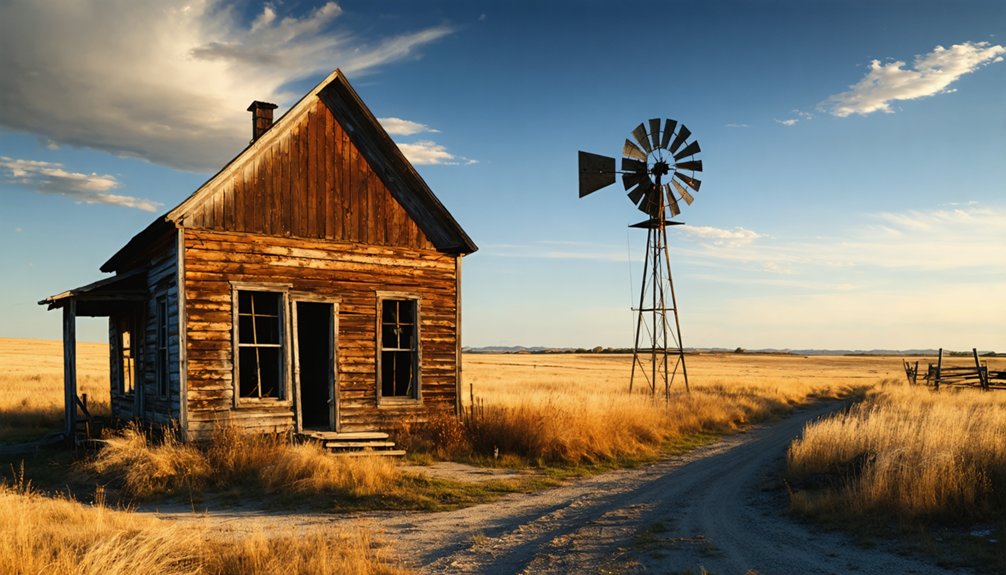
The Flint Hills stretch endlessly before you as you climb toward Teter Rock, where a 16-foot monument of native Kansas stone rises from the hilltop like a sentinel over the prairie. You’ll capture cinematic skylines here at sunset, when the stone glows against orange horizons. The gravel road marked “PROCEED AT YOUR OWN RISK” sets the perfect tone—this isn’t sanitized tourism.
Wide-angle lenses work best for the endless vistas, while atmospheric rural elements like grazing cows and fenceless roads add authenticity to your shots. Diamond Springs’ ruins along the Santa Fe Trail offer close-up perspectives of settlement remnants. Don’t miss Homewood’s restored 1906 schoolhouse and LeHunt’s abandoned cement plant, where workers encased their deceased colleague’s tools in concrete—a haunting memorial you’ll photograph reverently.
Nearby Ghost Towns to Explore
Branch out from Centerview and you’ll discover a constellation of abandoned settlements scattered across Kansas’s rural counties, each preserving fragments of prairie settlement dreams that didn’t quite take hold. Within Kingman County, Waterloo sits just ten miles north via rural roads off US-54—perfect for spontaneous detours where you’ll find weathered foundations marking where families once fought regional agricultural challenges.
These weathered foundations and forgotten crossroads stand as monuments to prairie dreams that couldn’t survive Kansas’s harsh realities.
Consider these evocative stops:
- Galatia (Barton County) – Population dropped to 36 by 2020, embodying slow-motion local community decline
- Diamond Springs (Morris County) – Santa Fe Trail oasis from 1825, where wagon trains once watered
- Le Hunt (Montgomery County) – Failed cement company town abandoned within a decade
Each location whispers stories of resilience and defeat across Kansas’s unforgiving plains, offering you authentic glimpses into America’s vanishing rural heritage.
Essential Supplies and Safety Preparations

Exploring these forsaken settlements demands more than wanderlust and a full tank—you’ll need preparation that matches the unforgiving character of Kansas’s backcountry. Pack your DeLorme Atlas for unmarked routes where cell signals vanish, and stash a gallon of water per person—dehydration hits hard when you’re photographing crumbling grain elevators under relentless prairie sun.
Your proper footwear selections matter: sturdy boots grip uneven terrain at cemetery sites and foundation ruins where twisted metal lurks. Suitable outerwear options include layered clothing for Kansas’s mercurial weather—I’ve watched blue skies blacken in minutes on Highway 56.
Load your first aid kit, spare tire, and emergency flares. Keep that GPS offline-capable. When you’re twenty miles from civilization, self-reliance isn’t optional—it’s survival.
Where to Stay During Your Visit
Where should you rest your head after photographing Centerview’s skeletal storefronts and wind-scraped foundations? Your ghost story research deserves accommodations with character. Based on accommodation reviews, these Flint Hills options deliver:
- Beaumont Hotel Cafe — Sleep where pioneers and cattle buyers once bargained, in an 1879 stagecoach stop that’s survived three centuries in semi-ghost town Beaumont
- Brandt House in Alma — Seven boutique rooms ($150-$225) with Comphy sheets and smart TVs, perfect for processing your day’s discoveries
- Weaver Hotel in Waterville — This 1905 railroad hotel offers authentic period atmosphere, though guests report moving cords and mysterious tub draining
Each location positions you near forgotten Kansas settlements while providing modern comfort. You’ll appreciate having a genuine historic base rather than generic chain lodging.
Local Legends and Stories
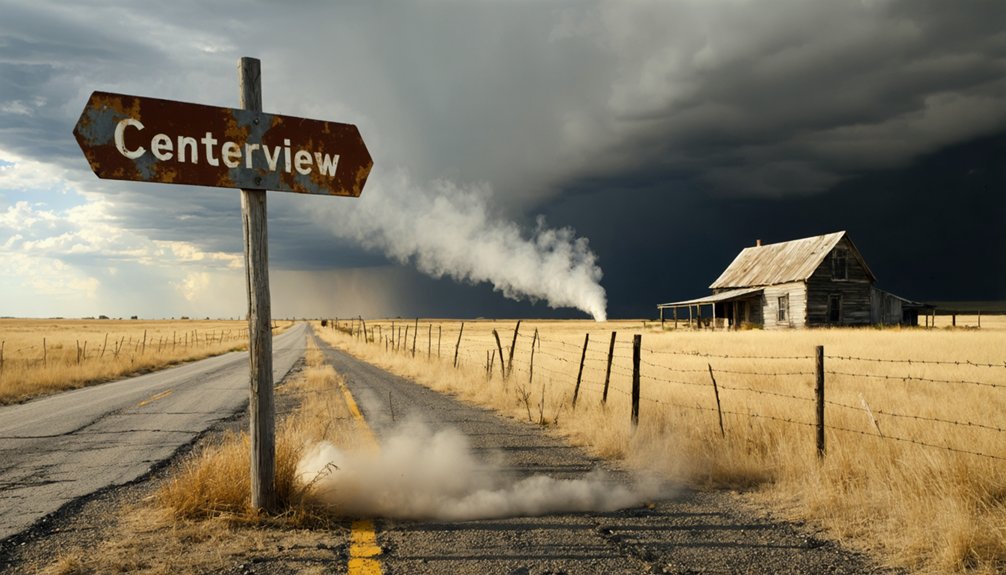
Every abandoned Kansas townsite whispers its own violent or bitter past, and the Flint Hills region holds stories fiercer than you’d expect from these quiet prairies.
You’ll find towns with mythical origins rooted in Osage Nation villages, led by chiefs who walked these lands before settlers arrived. Civil War flames consumed entire communities—Union soldiers torched towns to ashes, halting development for years.
Uncovering hidden details reveals bitter feuds: rival newspapers fueled vicious competition over depot placements, with entire populations relocating overnight based on railroad decisions. Cemetery stones at places like Oakill preserve names from these violent chapters.
Pro-slavery squatters clashed with abolitionists, creating tension that lingered decades. These weren’t peaceful failures—they were battlegrounds where ambition, ideology, and survival collided head-on.
Frequently Asked Questions
Are There Any Admission Fees or Permits Required to Visit Centerview?
You won’t pay a dime to explore Centerview—no parking fees or admission charges exist. While 100% of the ghost town remains free to roam, guided tours in nearby Kansas locations cost $30-$150 if you’re craving structured paranormal adventures.
Can I Bring My Dog or Other Pets to the Ghost Town?
You can bring your dog to explore Centerview’s abandoned buildings! While there aren’t official pet-friendly accommodations or leashed pet policy signs in this ghost town, keeping your companion leashed guarantees safety around crumbling structures and wildlife.
Is Cell Phone Service Available in and Around Centerview?
Cell phone signal coverage around Centerview is spotty at best. You’ll find limited network availability in this remote area, so download maps beforehand. Embrace the digital detox—it’s liberating to disconnect and explore Kansas’s forgotten places unplugged.
Are Drone Flights Permitted for Aerial Photography of the Site?
Drone regulations demand deliberate preparation: you’ll need Part 107 certification since blog photography qualifies as commercial use. Secure property owner permission before flying, follow photography guidelines, and respect Kansas’s privacy laws protecting dwellings—freedom requires responsibility.
What Dining Options Exist Within Reasonable Driving Distance of Centerview?
You’ll find varied cuisine options nearby, from Spin! Pizza’s 4.7-star vegetarian fare to The Go-Go Bean’s exceptional 4.9 rating. Venture to Council Grove’s historic Hays House for locally sourced ingredients and authentic frontier dining experiences worth the drive.