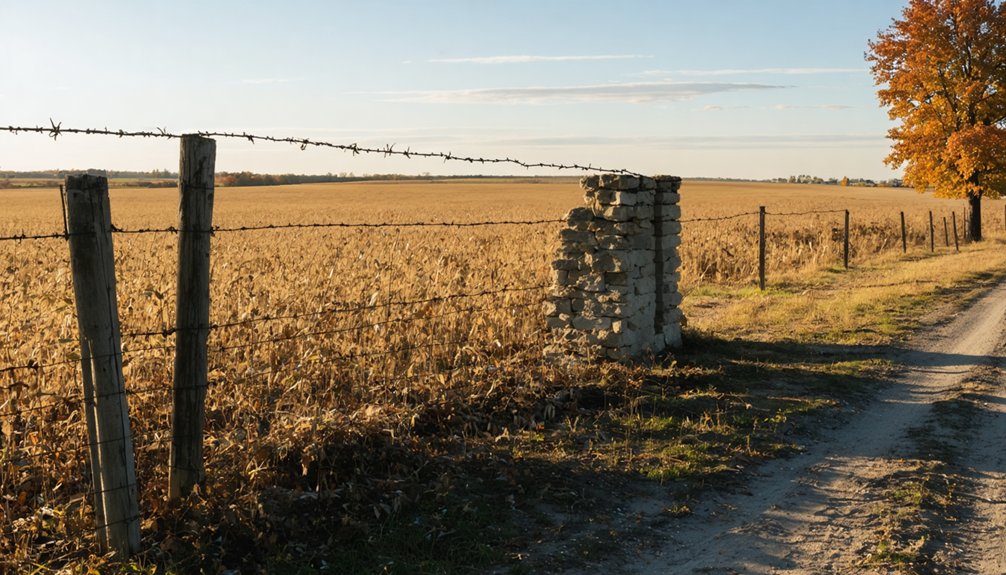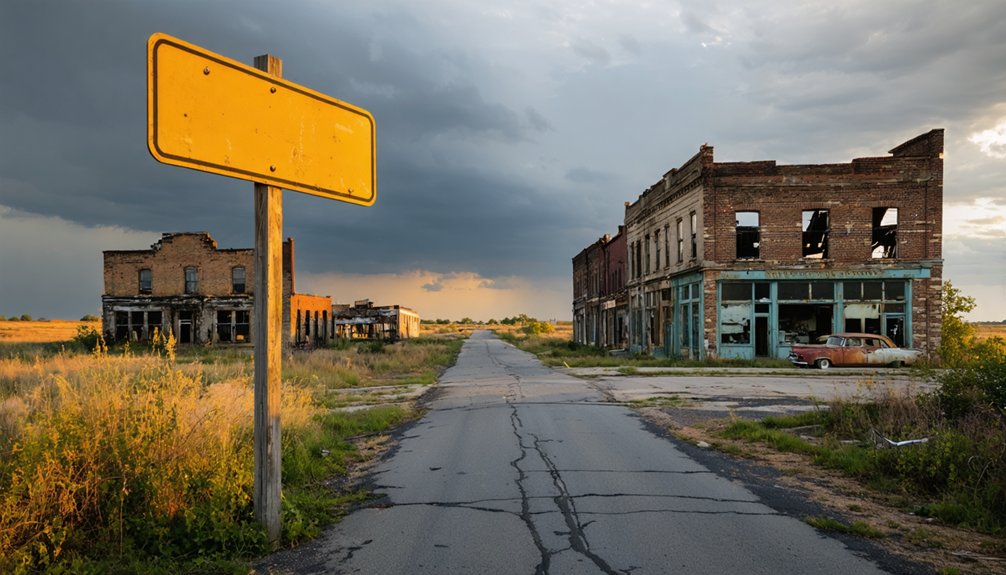
Your ghost town road trip to Clifford Eight begins in northwestern Williamson County, where you’ll find remnants of a coal mining boomtown that housed 2,000 residents by 1918. You’ll navigate county roads to discover the Clifford Hills waste piles, mine pond, and company store foundation on private property. Within a 90-mile radius, you can extend your journey to include Totten’s Old Cemetery, Tuscumbia near Bernadotte, Civer between Canton and Cuba, and Sugarville—all sharing similar boom-and-bust patterns that shaped Illinois’s industrial heritage.
Key Takeaways
- Clifford Eight is in northwestern Williamson County, approximately 320 km from Energy and 297 km from Christopher, accessible via county roads.
- Visit Clifford Hills waste piles, mine pond, railroad right-of-way, and company store foundation, though many sites are on private property.
- Explore nearby ghost towns within 90 miles: Totten, Tuscumbia near Bernadotte, Civer between Canton and Cuba, and Sugarville in Fulton County.
- Peak remnants include mining artifacts like rail hardware and telegraph insulators where 400 houses once housed 2,000 residents by 1918.
- Plan for a self-guided rural exploration as Clifford Eight has no interstate access and limited infrastructure at this former coal mining boomtown.
Location and How to Get There

Clifford Eight sits at coordinates 37°49′25″N 89°04′38″W (37.82361°N, 89.07722°W) in the northwestern sector of Williamson County, Illinois. You’ll navigate approximately 320 km from Energy and 297 km from Christopher to reach this former unincorporated community.
The site’s geographic isolation defines its ghost town character—no interstate highways provide direct access, and you’ll rely on county roads threading through southern Illinois’s rural network.
Transportation challenges begin with absent signage marking the abandoned settlement. Program your GPS with the decimal coordinates (37.82361°N, 89.07722°W) for accurate navigation. The Central Time Zone (CST UTC-06:00) governs your schedule.
Verify current road conditions with Williamson County authorities before departure, as local routes may deteriorate seasonally. This location rewards travelers seeking authentic backcountry exploration.
The Rise of a Coal Mining Boomtown
The coordinates that guide you to this remote location mark what was once a thriving industrial settlement born from the ambitions of the Big Muddy Coal and Iron Company. After striking coal on November 27, 1903, the company rapidly transformed sections 14 and 15 of Blairsville Township into a bustling community.
From coal strike to company town: Big Muddy Coal and Iron Company forged an entire industrial settlement from Blairsville Township wilderness in 1903.
Clifford’s explosive growth created:
- Over 2,000 residents during the World War I era, representing significant regional economic impact
- Standardized four-room company houses forming a complete mining camp by 1905
- Essential infrastructure including a post office (1905) and large school facility
- Labor union activism demonstrated when miners challenged inflated company store prices by financing their independent store
The company’s response—blocking road access and converting the structure into a segregated school—revealed the power dynamics governing this frontier boomtown.
Life at Its Peak: What Clifford Eight Once Was

By 1918, over two thousand residents called this unincorporated settlement home, making it one of Williamson County’s most populous mining camps during the Great War. You’d have found four hundred houses clustered around Mine Number Eight, including fourteen modest two-room World Fair houses.
The brick company store, managed by George Otey, anchored community commerce alongside a confectionary and post office run by Patrick H. Carroll. Two doctors—Galver and Evans—served as prominent citizens, with the company physician maintaining private practice rights.
Recreational services included a poolroom and barbershop where miners gathered after shifts. The Methodist Church provided spiritual guidance, while superintendent D. L. McConnighi championed educational initiatives and backed the Boy Scouts program, creating a self-sufficient village that thrived independently of outside interference.
The Decline and Fall of the Mining Community
Prosperity proved fleeting for Clifford Eight’s thriving community. When Consolidated Coal Company acquired the property in 1920, they declared Mine Number 8 idle. By 1923, complete closure arrived, driven by resource exhaustion and economic and labor pressures that plagued Illinois mining operations.
Within three years, Consolidated Coal Company’s acquisition transformed Clifford Eight from a prosperous mining community into an abandoned industrial relic.
Key factors in Clifford Eight’s demise:
- Resource depletion – Mining efforts exhausted coal nearest the surface, making extraction increasingly difficult and unprofitable
- Industry collapse – Depressed coal markets shut down small operators unable to meet stringent reclamation and safety standards
- Labor conflicts – Violent strikes over wage cuts and working conditions destabilized operations throughout the region
- Population exodus – From 2,000 residents at WWI peak, only 300 remained by 1958
You’ll find nature has reclaimed this once-bustling settlement, where residents moved their houses elsewhere or sold structures for salvage.
What You Can Still See Today
Beyond the prominent Clifford Hills waste piles, you’ll find scattered evidence of the mining infrastructure that once sustained 2,000 residents. Cracked foundations and collapsed brick fragments mark former building sites, though systematic house removal by 1958 left minimal structural traces.
The old railroad right-of-way remains discernible through vegetation patterns, while mine ponds formed from subsidence create water-filled depressions across the reclaimed farmland.
Mine Pond and Foundations
Although nature has reclaimed most of Clifford Eight since its 1923 closure, two significant features still mark where 2,000 residents once lived and worked.
What survives as equipment remnants and mining operations artifacts:
- Mine pond – The original coal hoisting pond remains visible on private property, accessible by driving through the former town area one mile north of Colp
- Company store foundation – Brick foundation where manager George Otey operated the store that miners once rebelled against for high prices
- Location markers – Sections 14 and 15 of Blairsville Township along Big Muddy River, reachable via 2WD roads year-round
- Rural transformation – Former 400-house village now returned to farmland with scattered new homes, population collapsed from 2,000 to 300 by 1958
Railroad Right-of-Way Evidence
While the coal mines and company buildings of Clifford Eight have vanished into farmland, the Illinois Central Railroad infrastructure that connected this ghost town to the broader mining economy left more durable marks on the landscape. You’ll trace faded rail bed outlines through overgrown corridors where graded earthworks reveal cut-and-fill sections from circa 1910 construction.
Erosion patterns expose ballast stone concentrations and occasional spikes surfacing after spring plowing. Aerial imagery analysis clarifies what ground-level vegetation obscures—linear depressions cutting through fields, fence lines following original right-of-way boundaries, and bridge abutments standing at creek crossings. County records map these abandoned corridors precisely.
Metal detecting along accessible paths yields rail hardware fragments, ceramic telegraph insulators, and tie remnants documenting the transportation network that once sustained Clifford Eight’s mining operations.
Best Time to Visit and What to Expect
Since Clifford Eight sits on accessible 2WD roads in Williamson County’s moderate climate, you can visit year-round without significant seasonal barriers. Understanding seasonal weather considerations helps optimize your experience at this former coal town site.
Optimal visiting conditions:
- Spring (March-May): Blooming landscapes and comfortable temperatures of 50-70°F make roadside observation pleasant
- Fall (September-November): Cooler weather and reduced insect activity provide ideal driving conditions
- Summer: Avoid prolonged stops during peak heat with 85-90°F highs and high humidity
- Winter: Year round accessibility continues, though check for potential rural road icing around 25°F lows
Expect nothing beyond driving through—the town’s completely gone. Only the old mine pond and company store foundation remain visible from roads, surrounded by private homesteads offering no pedestrian access.
Nearby Ghost Towns to Add to Your Route
Expanding your Clifford Eight expedition into a proper ghost town route requires heading north to Fulton County, where several vanished settlements cluster within a 90-mile radius. Cameron, established in 1824 by Thomas Cameron near Totten in section 28, represents one of Illinois’s earliest pioneer communities—now reduced to historical records and the nearby Old Totten Cemetery on private land.
Tuscumbia offers a similarly fleeting experience around Bernadotte, where a roadside sign off Bernadotte Blacktop marks the location of this settlement abandoned by 1855. Civer, positioned between Canton and Cuba, provides another designated marker for what’s become a completely vanished townsite. These abandoned settlements share common community history patterns—brief flourishing periods followed by economic decline, leaving only roadside markers documenting their existence.
Sugarville rounds out Fulton County’s ghost town inventory for thorough exploration.
Frequently Asked Questions
Are There Any Safety Concerns When Exploring the Former Mine Site?
Yes, you’ll face significant dangers. Unstable mine structures risk collapse without warning, and hazardous materials left behind include unexploded ordnance and deteriorated explosives. You should avoid entering abandoned shafts and always maintain extreme caution when exploring independently.
Can You Take Photographs on the Private Property Where Clifford Eight Stood?
You’ll need the landowner’s permission before photographing on this private homestead. Legal restrictions prohibit trespassing, though photographic opportunities exist from public roads where the old mine pond and foundation remnants remain visible without entering the property.
What Happened to the Residents Who Lived in the Company Houses?
Residents gradually relocated after the 1923 mine closure, with no formal relocation efforts. You’ll find they independently moved or sold their houses during the 1930s Depression. Abandoned housing conditions worsened until structures were removed post-1958, leaving nothing today.
Are There Any Local Museums With Artifacts From Clifford Eight?
No museums currently house Clifford Eight artifacts, though you’ll find the Williamson County Historical Society references the town’s mining heritage. Unfortunately, preservation efforts never materialized before residents relocated their possessions, leaving no public exhibits for exploration-minded visitors.
Why Was the Mine Called “Number Eight” Specifically?
The mine received “Number Eight” from Big Muddy Coal and Iron Company’s sequential mining shaft numbering system. Historical mining operations designated it eighth in their sequence after Mine Number Seven’s abandonment, making it part of their systematic development pattern.