You’ll find Clifton along Route 3 Kennedy Parkway within Canaveral National Seashore, where Butler Campbell’s 1872 settlement still whispers through weathered cemetery stones and a restored schoolhouse. The drive requires standard vehicles and GPS, but check access restrictions beforehand since you’re entering federal territory. Three cemeteries hold Campbell and Jackson family markers, while coquina foundations outline vanished homes from this formerly enslaved community. Pack water and wear sturdy shoes—the site’s archaeological significance and ongoing preservation efforts reveal layers of Florida’s complex post-Civil War history.
Key Takeaways
- Clifton is located on Route 3 Kennedy Parkway between Allenhurst and Shiloh, accessible via standard 2-wheel drive vehicles.
- Check current access restrictions before visiting, as Clifton sits within federally controlled Canaveral National Seashore territory.
- Key sites include a restored one-room schoolhouse, three historic cemeteries, and coquina foundations from former structures.
- The Main Clifton Cemetery dates to 1841 and contains graves of founding families including Campbell and Jackson.
- Use GPS or internet maps to navigate, and look for the historic marker identifying Clifton’s boundaries.
Historical Roots of Butler Campbell’s Settlement on Merritt Island
In the transformative years following the Civil War, Butler Campbell made a bold journey from South Carolina to Florida’s frontier, carrying with him the determination that defined countless formerly enslaved people seeking independence. By 1872, he’d established his homestead north of Old Haulover Canal along Mosquito Lagoon‘s edge, where population demographics remained sparse and opportunities abundant.
Despite land acquisition challenges, Campbell secured 118 acres in May 1875 through Florida’s Internal Improvement Fund, paying just 75 cents per acre. This wasn’t merely property—it was sovereignty. His settlement became Haulover’s foundation, later renamed Clifton in 1889.
You’ll find it remarkable that Campbell built this community when Merritt Island barely existed beyond Indianola, lacking even basic infrastructure until 1917’s first bridge connected it to mainland Florida.
Getting to Clifton: Routes and Access Points
Reaching Clifton requires traversing Route 3 Kennedy Parkway on north Merritt Island, where the ghost town’s coordinates (28°45.0’N 80°46.2’W) place it between the abandoned settlements of Allenhurst and Shiloh. You’ll find the road conditions accommodate standard 2-wheel drive vehicles, making navigation straightforward with GPS devices or internet maps.
However, NASA’s ownership through Canaveral National Seashore means you’re entering federally controlled territory. The site’s protected natural status demands you verify current access policies before departure—government restrictions can change without notice.
Look for the historic marker identifying Clifton’s boundaries, then explore three cemeteries and the partially intact schoolhouse discovered in 2004. Spring and fall offer ideal exploration conditions, though determined travelers can visit year-round with proper hydration during summer’s intense heat.
What Remains: The Clifton Schoolhouse and Historic Structures
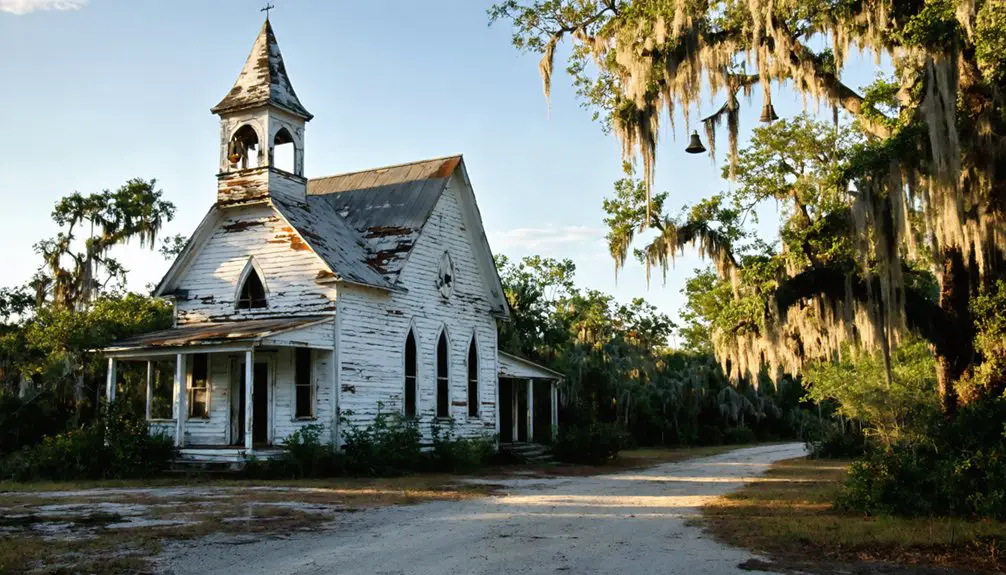
You’ll find Clifton’s most significant remnant standing quietly among the palmettos—the restored one-room schoolhouse, its heart pine walls and coquina foundation defying more than a century of Florida’s harsh elements.
Scattered throughout the surrounding scrubland, weathered cemetery markers emerge from the underbrush, marking the final resting places of the Campbell and Jackson families who once cultivated this land.
If you search carefully through the dense vegetation, you can still trace the coquina block foundations where homes and outbuildings once stood, their geometric patterns revealing the footprint of a vanished community.
Discovery of the Schoolhouse
When federal authorities seized north Merritt Island in the 1960s to expand NASA’s operations, they systematically demolished nearly every trace of Clifton’s existence. Yet somehow, the tiny schoolhouse escaped destruction.
Hidden beneath decades of overgrowth in the remote wilderness near Mosquito Lagoon, it stood silently until 2004—94 years after classes ended.
When researchers finally stumbled upon the structure, they found it barely standing but miraculously intact. The hand-cut coquina foundation still held. The heart pine walls remained. Here was tangible proof that Clifton’s residents had built something lasting, something the government couldn’t completely erase.
Today, ongoing restoration efforts and archeological excavations continue uncovering the community’s story. You’ll find a historic marker on State Road 3, acknowledging what once thrived here before progress demanded its removal.
Cemetery Markers and Foundations
Beyond the schoolhouse, three weathered cemeteries stand as Clifton’s most enduring monuments to the families who carved lives from this unforgiving landscape. You’ll find these family burial grounds scattered along Route 3 Kennedy Parkway, marking the final resting places of Griffiths, Doyles, and Sammis families who settled here between 1875-1910.
Grave marker conditions reveal the toll of time and neglect. The Sammis headstones—commemorating Emile at 21 and Martha at 28—have toppled within the past decade. Young Julia’s monument bears incomplete engravings. Red cedars planted as property markers still frame the burial grounds, though environmental exposure has rendered many inscriptions illegible.
The Baxter family monument maintains dual-sided inscriptions, while historic fence lines and cable assemblies hint at forgotten burial mechanisms from another era.
Exploring the Three Cemeteries of Clifton
Three historic burial grounds stand as silent witnesses to Clifton’s vanished community, each revealing distinct chapters of this forgotten settlement’s past. You’ll discover the main Clifton Cemetery, established in 1841 as the Sammis family’s private burial ground before evolving into the community’s final resting place. Spanish moss drapes ancient oaks sheltering weathered headstones marking the Kingsley, Sammis, and Baxter lineages.
The generational impacts on cemetery preservation are evident—some monuments stand proud while others succumb to time’s relentless advance. Preservation challenges over time threaten these fragile historical markers, yet they persist as tangible connections to Florida’s complex antebellum heritage. Each cemetery offers genealogical treasures and stories of Arlington’s free Black community, waiting for you to uncover their secrets beyond downtown Jacksonville’s modern sprawl.
Notable Figures and Families Who Shaped the Community
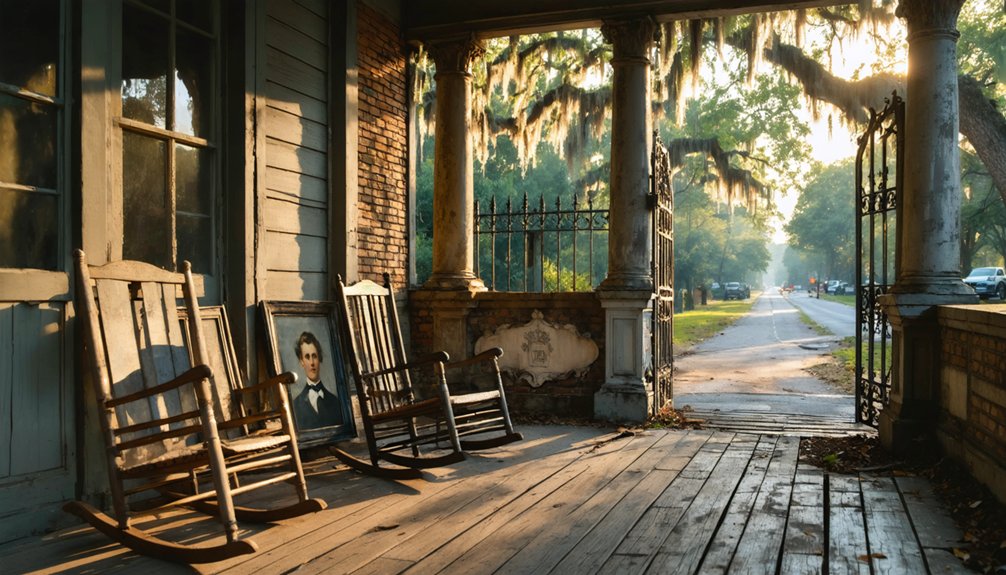
You’ll discover that Clifton’s heart beats through the stories of visionaries who transformed wilderness into community. Butler Campbell stands tallest among them—a formerly enslaved man who purchased nearly 200 acres on north Merritt Island in 1875, establishing not just a settlement but a record, chronicle, or account of Black entrepreneurship during post-Reconstruction.
Working alongside Andrew Jackson, Campbell cultivated citrus groves and vegetable fields while co-building the Clifton Colored School in 1890-91, creating both economic opportunity and educational access for generations to come.
Butler Campbell’s Founding Legacy
In the late 19th century, Butler Campbell transformed a vision of educational opportunity into reality through sheer determination and strategic community building. As an African American homesteader on north Merritt Island, Campbell’s entrepreneurial vision drove him to partner with Andrew Jackson in establishing the region’s first formal schoolhouse for Black children.
His community leadership manifested through:
- Securing Resources: Negotiated a one-acre land donation from neighbor Wade Holmes and coordinated sailboat delivery of heart pine lumber from Titusville
- Building Infrastructure: Constructed a 12 x 16-foot schoolhouse meeting Brevard County’s official requirements
- Establishing Curriculum: Recruited professor Mahaffey to teach reading, mathematics, geography, science, and U.S. history
Campbell’s legacy represents self-determination during an era of severe restrictions, proving that autonomous community action could create lasting change.
Educational Pioneers and Builders
Beyond Butler Campbell’s founding vision, a constellation of dedicated individuals transformed Clifton’s educational aspirations into brick-and-mortar reality. Andrew Jackson and Campbell erected the one-room Clifton Colored School in 1890-91, establishing multigenerational educational legacies that would echo through decades.
Early settlers like Wade Holmes helped forge the community agricultural foundations—citrus groves, onion fields, and vegetable farms—that generated the economic stability necessary for sustaining a schoolhouse. You’ll discover how their agricultural prosperity didn’t just feed families; it funded futures.
The school operated until 1910, serving children who’d return as educated adults. Eugenia Campbell exemplified this cycle, attending as a student before returning in 1924. Their collective efforts created more than a building—they built pathways to freedom through literacy and learning.
Best Times to Visit and What to Expect
Timing your visit to Clifton’s abandoned cemetery requires balancing Florida’s notorious climate with your tolerance for heat and humidity. Fall through spring offers the most comfortable exploration conditions, while summer’s scorching temperatures can quickly drain your energy during extended outdoor wandering.
Seasonal considerations and local transportation options:
- Getting There: You’ll need a rental car or taxi from Nassau, as local bus services don’t reach this remote western coastal area. Southwest Road provides your main access route.
- What You’ll Find: Three historic cemeteries dating to 1852 wind through forgotten orange groves and overgrown pastures along State Road 11.
- Time Investment: Plan however long curiosity guides you—photography opportunities and peaceful atmosphere reward those who linger beyond the crowds.
NASA Property Restrictions and Preservation Efforts
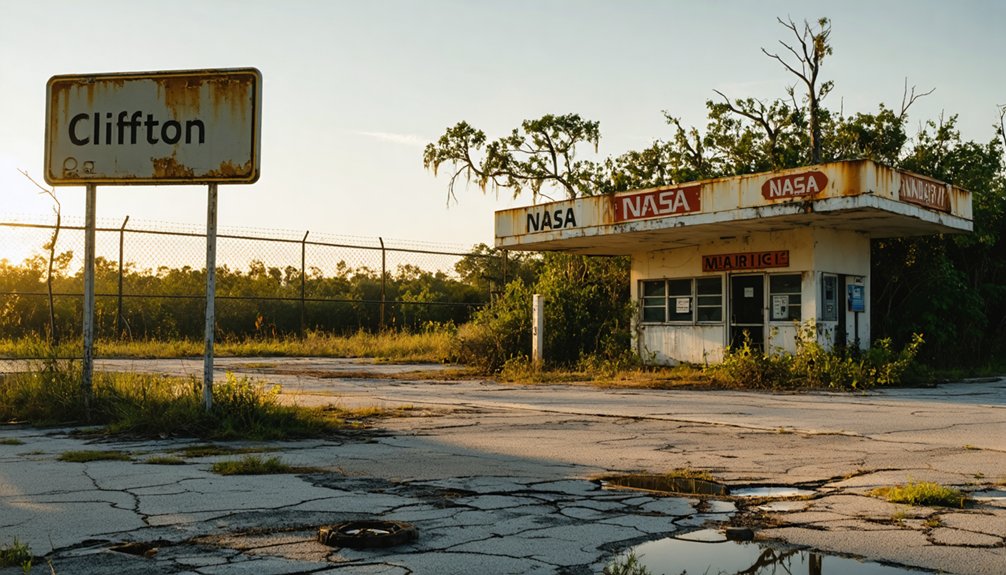
While Clifton’s weathered headstones tell stories of Florida’s pioneering past, modern space-age boundaries now complicate access to this ghost town. NASA-KSC maintains strict control over ingress and egress throughout Kennedy Space Center properties, where Clifton’s remnants rest. You’ll find gates and traffic regulation mechanisms blocking spontaneous exploration—access restrictions intensify during extraordinary circumstances or security concerns.
NASA’s space-age security protocols have transformed Clifton’s historic grounds into a restricted zone requiring authorized access rather than casual exploration.
Cultural resource preservation activities protect Clifton through mandated Phase I Archaeological Surveys and Section 106 compliance reviews. These protocols identify and evaluate historical significance before any ground disturbance occurs.
Environmental regulations enforcement adds another layer, requiring assessments under federal guidelines and Florida state law.
Understanding these restrictions helps you navigate legitimate viewing opportunities. Space Florida’s lease agreements and commercial partnerships occasionally permit controlled access, though you’ll need advance coordination rather than impromptu wandering.
Frequently Asked Questions
Are Guided Tours Available for Exploring the Clifton Ghost Town Site?
Guided tours aren’t offered at Clifton’s abandoned streets, but that’s part of its wild appeal. You’ll find self-guided exploration recommended here, letting you wander freely through weathered ruins and discover forgotten stories at your own pace.
Can Visitors Take Photographs of the Structures and Cemeteries at Clifton?
Photography policies aren’t publicly documented for Clifton’s abandoned structures. You’ll want to respect private property boundaries while pursuing photographic preservation. Historical documentation through your lens captures freedom’s essence, but always verify current access permissions before exploring these hauntingly beautiful ruins.
What Safety Precautions Should Visitors Take When Exploring the Abandoned Schoolhouse?
You’ll need to avoid unsafe structures with weakened floors and collapsed roofing. Maintain situational awareness of your surroundings, watch for debris, and never explore alone. Wear sturdy boots and bring a flashlight for darker interior spaces.
Are There Nearby Accommodations or Camping Facilities for Overnight Visitors?
Since Clifton’s a remote ghost town, you’ll find limited options nearby. Your best bet’s exploring pet friendly campgrounds in Brevard County or booking historic bed & breakfasts in surrounding towns, offering authentic Florida charm and adventure-ready access.
Is Permission Required From NASA Before Visiting the Clifton Ghost Town?
Yes, you’ll need NASA’s permission before visiting Clifton. The site sits on federal property with strict private property access controls. Without authorization, you’d face serious trespassing concerns and potential legal consequences on this restricted Kennedy Space Center land.