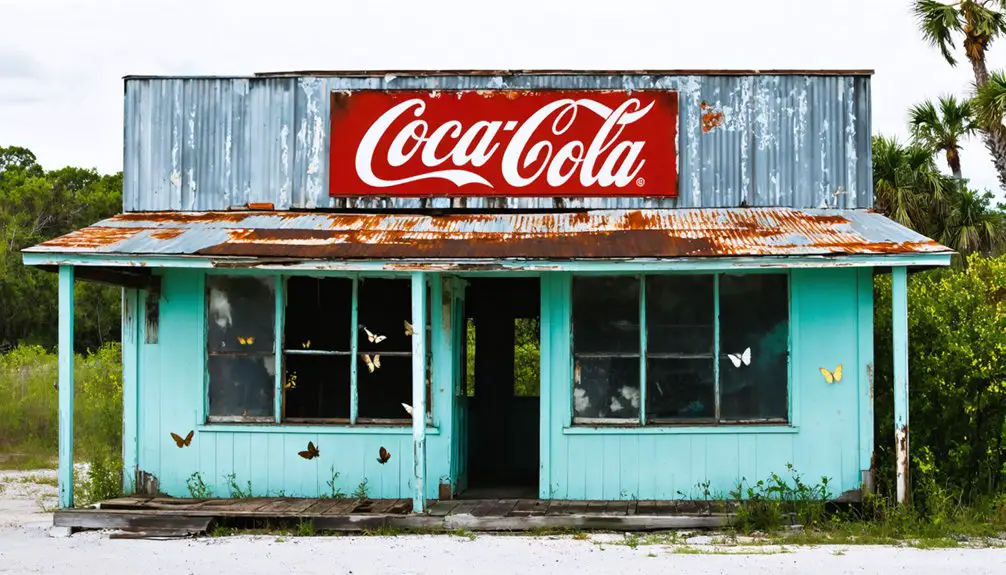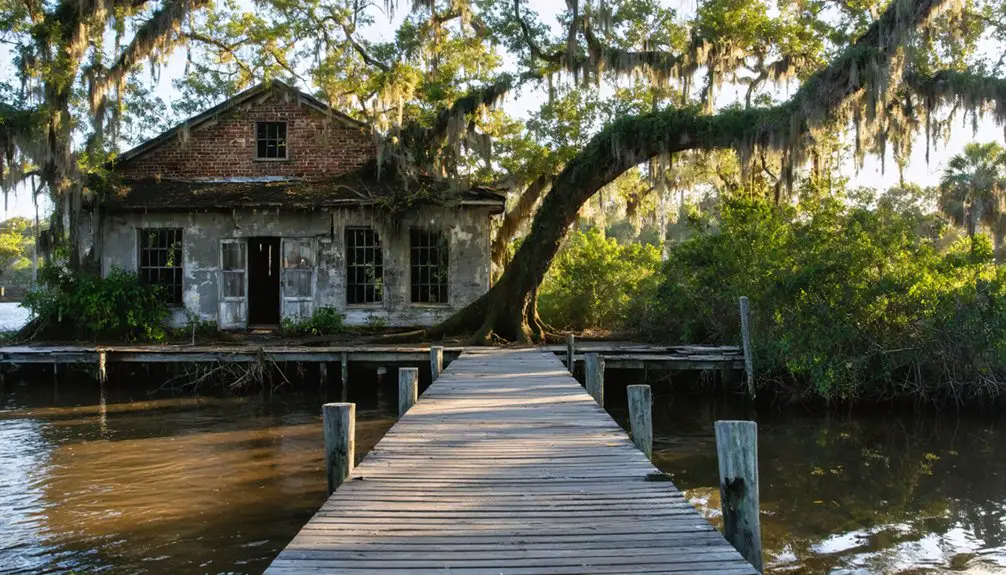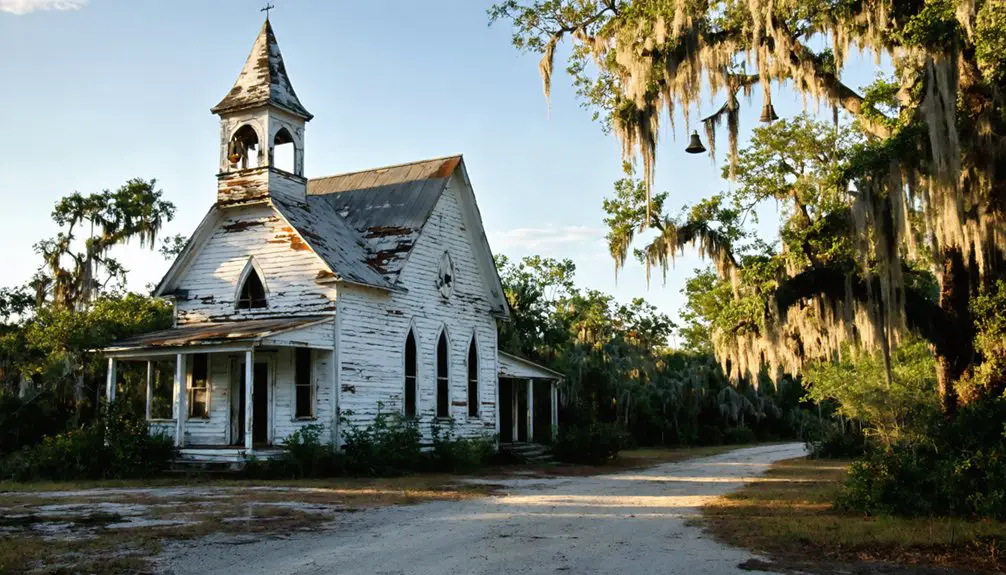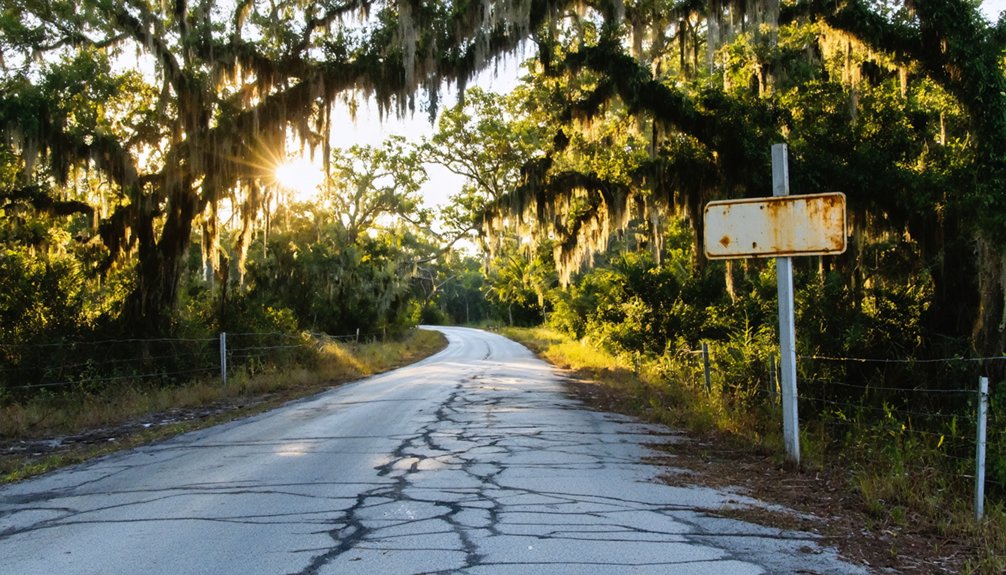
Planning a ghost town road trip to Conant, Florida means embracing the art of historical imagination. You won’t find crumbling ruins or weathered storefronts — nature and suburban development have erased nearly everything. Head to Griffin Road in Lady Lake, where this once-thriving 1884 luxury frontier town stood before the catastrophic Big Freeze of 1894-95 destroyed its citrus economy forever. Visit between October and April for the best experience, and keep exploring to uncover the fascinating full story of Conant’s dramatic rise and disappearance.
Key Takeaways
- Conant, founded in 1884, was devastated by the Big Freeze of 1894-95, destroying citrus crops and triggering a population collapse and eventual abandonment by 1919.
- No original structures remain; modern subdivisions and The Villages development have replaced the former townsite, leaving Griffin Road as the only geographic connection to the past.
- Visitors should expect no ruins, historical markers, or preserved ghost town legends, requiring imagination to envision Conant’s former existence within its suburban surroundings.
- The best time to visit is October through April, offering comfortable humidity, clear skies, and a reflective atmosphere suited to exploring Griffin Road.
- Nearby ghost towns Bamboo and Centralia offer additional exploration opportunities, sharing similar histories of economic collapse and natural disaster across Florida’s abandoned settlements.
How Conant, Florida Went From Luxury Frontier Town to Ghost Town
When wealthy English settlers founded Conant in 1884, they didn’t just build a town — they built a statement. Named after Florida Southern Railway financier Major Sherman Conant, this community stretched from Lady Lake north into Marion County, offering luxury amenities that felt wildly out of place on the Florida frontier.
A towering three-story hotel catered exclusively to the upper class, earning Conant a reputation for pretentiousness that locals never forgot.
But the frontier lifestyle has a way of humbling even the proudest ambitions. The devastating Big Freeze of 1894–95 wiped out the citrus crops that sustained the town.
Wildfires followed. By 1919, the population had collapsed to nearly nothing, the post office shuttered, and Conant quietly disappeared from the map entirely.
Conant’s Rise and Fall as a Frontier Boom Town
When wealthy English settlers founded Conant in 1884, they built a three-story luxury hotel and established a frontier enclave so refined it earned a reputation for pretentiousness among Florida’s early settlers.
Named after Major Sherman Conant, a Florida Southern Railway financier, the town stretched from Lady Lake north to the Marion County line, thriving on citrus wealth and upper-class ambition.
Then the Big Freeze of 1894-95 hit hard, destroying the citrus crops that sustained the town and reducing its population to a mere 100 survivors, setting Conant on an irreversible path toward abandonment.
Wealthy English Settlers Arrive
Back in 1884, wealthy English settlers descended on the wilds of central Florida, carving out a town they called Conant along the Florida Southern Railway line stretching from Lady Lake north to the Marion County line.
These wealthy settlers named their settlement after Major Sherman Conant, the railway’s financier, and wasted no time establishing an air of superiority in the untamed wilderness.
They erected a grand three-story luxury hotel, signaling their refusal to fully embrace the rugged frontier lifestyle surrounding them.
Locals quickly noticed their reluctance to get their hands dirty, earning them a reputation for pretentiousness that clashed sharply with the raw, hardworking spirit of the Florida frontier.
You can almost picture the culture clash playing out beneath those towering Southern pines.
Freezes Doom The Town
The Big Freeze of 1894-95 hit Conant like a death sentence, wiping out the citrus crops that had lured those proud English settlers to central Florida in the first place. The freeze impact on the citrus industry was catastrophic, stripping away the town’s entire economic foundation overnight.
Those who’d built their lives around orange groves suddenly had nothing left to harvest, sell, or hope for. You’d have watched the population collapse from a thriving community to barely 100 souls.
Wildfires followed, burning through what the cold had already broken. By 1919, the post office closed, mail service moved to Lady Lake, and Conant simply ceased to exist.
What frontier pride couldn’t protect, nature destroyed without hesitation.
What Killed Conant Almost Overnight?
Conant’s downfall came swiftly and without mercy. The catastrophic Big Freeze of 1894-95 didn’t just destroy the citrus crops — it obliterated the town’s entire economic impact overnight.
Those elegant groves that once promised wealth and independence simply vanished beneath killing frost.
You’d think community resilience might’ve saved Conant, but the proud English settlers who’d built this frontier showpiece had no appetite for rebuilding from scratch.
They’d come for easy prosperity, not hardship. Wildfires swept through afterward, accelerating what the freezes had already started.
What’s Left of Conant Today?
Where a three-story luxury hotel and elegant citrus groves once stood, you’ll find nothing but modern subdivisions and repaved roads.
Conant history has been almost entirely erased from the landscape. No original structures survived the freezes, wildfires, and decades of neglect that followed.
The road once called Conant Road was renamed Griffin Road in the 1950s, quietly burying another layer of ghost town legends beneath fresh asphalt.
Conant Road became Griffin Road in the 1950s, its original name paved over along with the ghost town it once served.
The Water Oak Country Club Estates now sits on land the Worcester family once farmed. The Villages development has absorbed much of the surrounding area.
Your best resource for piecing together what existed here is the Lady Lake Historical Society Museum on SR 441.
It’s the closest thing to a time machine you’ll find in this part of Florida.
Nearby Lake County Ghost Towns on the Same Route
While you’re exploring the Conant area, you can extend your road trip to other vanished Lake County communities that share the same tragic story.
Head toward Bamboo, where the post office once served a thriving community before relocating to Orange Home in 1890, leaving behind little more than a name on old maps.
If you’re willing to venture further, Centralia in nearby Hernando County offers another ghost town experience that echoes Conant’s rise and disappearance.
Centralia Ghost Town Stop
Though Conant isn’t the only ghost town worth tracking down in the region, Centralia in neighboring Hernando County makes a compelling addition to your route if you’re already venturing through Lake County’s forgotten past.
Centralia history mirrors much of what you’ll find throughout this corridor — communities that briefly thrived, then quietly surrendered to economic collapse and natural disaster.
Adding Hernando County to your ghost town tours lets you connect the broader story of Florida’s abandoned settlements into one meaningful journey.
You’re not just driving through empty land; you’re retracing the lives of people who built something real and watched it disappear.
Centralia sits close enough to make the detour worthwhile, giving your road trip a deeper narrative beyond any single forgotten town.
Bamboo’s Vanished Post Office
Bamboo, another Lake County community swallowed by time, once had its own post office before losing it to Orange Home in 1890.
You’ll find Bamboo‘s history woven into the same freeze-ravaged story that doomed Conant and countless other Florida settlements. The Goethe sawmill near SR 44 and CR 468 marks one of the few tangible reminders that real people once built lives here.
When you roll through this area, you’re tracing the ghost of a community that simply couldn’t survive economic collapse and geographic irrelevance.
The post office closure signaled Bamboo’s surrender, stripping away the institutional identity that kept small towns alive.
Add it to your route alongside Conant, and you’ll understand how quickly Florida’s frontier erased its own ambitious beginnings.
What Should You Know Before You Go?
Visiting Conant today requires almost no special preparation, but knowing a few details will make your trip more rewarding. Standard 2WD vehicles handle the roads fine, so you won’t need anything rugged. Florida’s summers run brutally hot, but you can visit year-round without real restrictions.
Don’t expect ghost town legends preserved behind velvet ropes or historic preservation markers pointing the way. Conant left almost no physical trace — no structures, no signs, nothing beyond the landscape itself. The former townsite now blends into Lady Lake and The Villages’ modern sprawl.
Stop by the Lady Lake Historical Society Museum on SR 441 before exploring. Staff there can sharpen your sense of exactly where Conant once stood, transforming an otherwise ordinary drive into something genuinely meaningful.
How To Find the Conant Site
Finding Conant today means tracing a ghost through modern suburbia. The former townsite sits absorbed into Lady Lake and The Villages, where manicured streets replaced frontier ambitions long ago.
You won’t find original structures — none survived the freezes, wildfires, and decades of abandonment.
Start your search along Griffin Road, once called Conant Road until the 1950s renamed it. That subtle change itself carries ghost town legends worth pondering.
The Water Oak Country Club Estates now occupies land the Worcester family once farmed. Stop by the Lady Lake Historical Society Museum on SR 441 to gather context about the site’s historical significance before exploring.
Roads here are 2WD-friendly, so any vehicle handles the trip comfortably.
You’re fundamentally reading landscape like a faded map.
What Will You Actually See When You Get There?
What greets you at Conant isn’t ruins or roadside markers — it’s the quiet irony of a thriving suburb where a failed aristocratic enclave once stood.
The Villages and Water Oak Country Club Estates now occupy land where English settlers once dismissed frontier lifestyle as beneath them. You won’t find a single original structure. No hotel foundations, no platform remnants, nothing anchoring the ghost town history to the present landscape.
Subdivisions and golf courses now blanket land where English settlers once refused to rough it.
Griffin Road — formerly Conant Road — cuts through the area, offering your only geographic connection to the past.
What you’re really seeing is erasure: nature, wildfire, abandonment, and suburban development conspired to wipe every trace clean.
Come prepared to use your imagination, because that’s your primary tool for experiencing what Conant once was.
Best Time To Visit Conant
Florida’s brutal summers give you one good reason to time your visit carefully, though Conant’s former site — now absorbed into Lady Lake and The Villages — stays accessible year-round.
The best season runs from October through April, when ideal weather keeps temperatures comfortable and humidity manageable. You’ll want clear skies and mild air when you’re driving Griffin Road — once called Conant Road — imagining the three-story luxury hotel that once stood there.
Summer visits aren’t impossible; roads here handle standard 2WD vehicles easily. But the heat saps your focus, and ghost town exploration deserves your full attention.
Come during cooler months, when the quiet landscape better reflects the melancholy of a town that froze, literally and figuratively, into history.
Frequently Asked Questions
Was Conant Ever Considered for Incorporation as an Official Florida City?
Like a wildflower never taking root, Conant history shows no record of incorporation challenges being pursued. You’ll find it bloomed briefly as a settlement, then vanished before official cityhood could ever take hold.
Did Any English Settler Families From Conant Relocate Together After Abandonment?
The records don’t confirm whether English settler families coordinated their settler migration together. You’d imagine family reunions happened elsewhere, as these proud, once-prosperous colonists scattered after the devastating freezes shattered their cherished, pretentious frontier dream forever.
Are There Any Photographs or Paintings of Conant’s Three-Story Luxury Hotel?
You won’t find any confirmed photographs or paintings capturing Conant’s historic imagery or luxury architecture. That magnificent three-story hotel vanished alongside the town itself, leaving you only imagination to reconstruct its forgotten, frost-silenced grandeur.
Did Sherman Conant Ever Personally Visit the Town Named After Him?
Like a ghost drifting through history, the records don’t confirm Sherman Conant’s visit. You’ll find his legacy lives through Conant’s historical significance — he financed the railway that shaped the town, dying in Palatka in 1890.
Were Any Artifacts From Conant Ever Recovered or Preserved in Museums?
No recovered artifacts from Conant’s historical significance are documented. You won’t find artifact preservation efforts in museums, but you can explore the Lady Lake Historical Society Museum on SR 441, where you’ll uncover Conant’s nostalgic, freedom-calling frontier story.
References
- https://www.ocalastyle.com/ghost-towns-of-lake-sumter/
- https://www.ghosttowns.com/states/fl/conant.html
- https://www.littletonhistoricalsociety.org/research/genealogy/conant-sherman/
- https://floridatrailblazer.com/tag/ghost-towns/