Your ghost town road trip to Coronado starts three miles east of Leoti, where prairie grass has swallowed every trace of this once-hopeful settlement. You’ll find no buildings, markers, or welcome signs—just windswept farmland where Swedish settlers once dreamed of prosperity before the brutal 1887 county seat war drove them away. Search the scattered wooded patches for faint foundation traces, then continue to Coronado Heights near Lindsborg, where a WPA-built sandstone castle marks the explorer’s farthest reach into Kansas, and discover the archaeological treasures that sparked this settlement’s short-lived existence.
Key Takeaways
- Coronado ghost town site is three miles east of Leoti with no standing structures, only prairie grass reclaiming former settlement areas.
- Visit WPA-built Dakota sandstone castle at Coronado Heights near Lindsborg, marking the expedition’s farthest point into Quivira territory.
- Trace Coronado’s 1541 route crossing the Arkansas River between Larned and Kinsley through the Smoky Hill River valley.
- El Cuartelejo Museum in Scott City displays Spanish artifacts including chain mail fragments, copper bells, and pottery sherds.
- Explore archaeological sites near Salina and Wichita where Quivira civilization remnants and Spanish colonial trade evidence remain.
The Rise and Fall of Coronado: A Brief History of Wichita County’s Lost Town
The dusty windswept prairies of Kansas hold countless stories of forgotten towns, but few carry a name as legendary as Coronado. You’ll find this ghost town in Wichita County, where Spanish conquistador Francisco Vásquez de Coronado supposedly searched for gold in 1541.
The discovery of chain mail, Spanish coins, and bridle fragments near Sharps Creek sparked alternative theories of Coronado’s route through Kansas. While historians place his northern reach at Great Bend, interpretations of the archaeological evidence keep the debate alive.
Swedish settlers arrived in 1869, establishing their community at the bluff’s base before relocating to modern Lindsborg. Today, you can explore the WPA-built Dakota sandstone castle atop Coronado Heights, where views stretch endlessly across terrain once traversed by gold-seeking explorers.
The County Seat War: When Rivalry Turned Deadly
When you explore this vanished settlement’s history, you’ll discover how voter intimidation poisoned the March 10, 1887 election. Leoti supporters hovered menacingly over voting booths while Coronado residents feared their lives weren’t worth casting a ballot.
Despite Coronado’s legal challenges, Leoti secured the county seat through threats and manipulation. The conflict escalated into what locals called the “Great County Seat War“—violence rivaling Dodge City’s legendary lawlessness, with feuds persisting another eighteen months.
What Remains Today: Visiting the Coronado Ghost Town Site
Today’s Coronado site sits three miles east of Leoti, where prairie grass and wheat stubble have reclaimed every trace of the town that once challenged its rival. You won’t find standing structures or welcome signs—just open farmland stretching toward the horizon. The location accessibility makes it easy to explore by vehicle from Leoti, though there’s little to mark where businesses and homes once stood.
If you venture into scattered wooded patches, you might spot foundations or collapsed features hiding beneath decades of growth. The recreational activities here lean toward solitary exploration and photography rather than structured tours. Bring your camera and curiosity, but don’t expect amenities or crowds. This is Kansas ghost hunting at its rawest—unfiltered, unmarked, and utterly yours to discover.
Following Francisco Vázquez De Coronado’s 1541 Kansas Expedition
Long before Kansas became a state or Coronado the ghost town earned its name, Spanish conquistador Francisco Vázquez de Coronado led an expedition through these very plains in 1541, chasing rumors of golden cities that proved as ephemeral as prairie mirages.
Coronado’s golden dreams dissolved into Kansas grasslands, leaving only dusty footprints and the bitter taste of conquistador disappointment.
You can trace the Coronado expedition route across central Kansas today:
- Cross the Arkansas River between Larned and Kinsley, where Coronado’s army first encountered Quivira Indians
- Visit Coronado Heights near Lindsborg, marking his farthest penetration into Quivira territory
- Explore the Smoky Hill River valley where grass-house villages once stood
- Follow Highway 270 near Liberal, retracing his return path southward
The Quivira civilization remains consist mainly of archaeological sites near Salina and Wichita—no gold, just agricultural communities that shattered Spanish dreams of conquest.
Archaeological Treasures: Spanish Artifacts Found Across Kansas
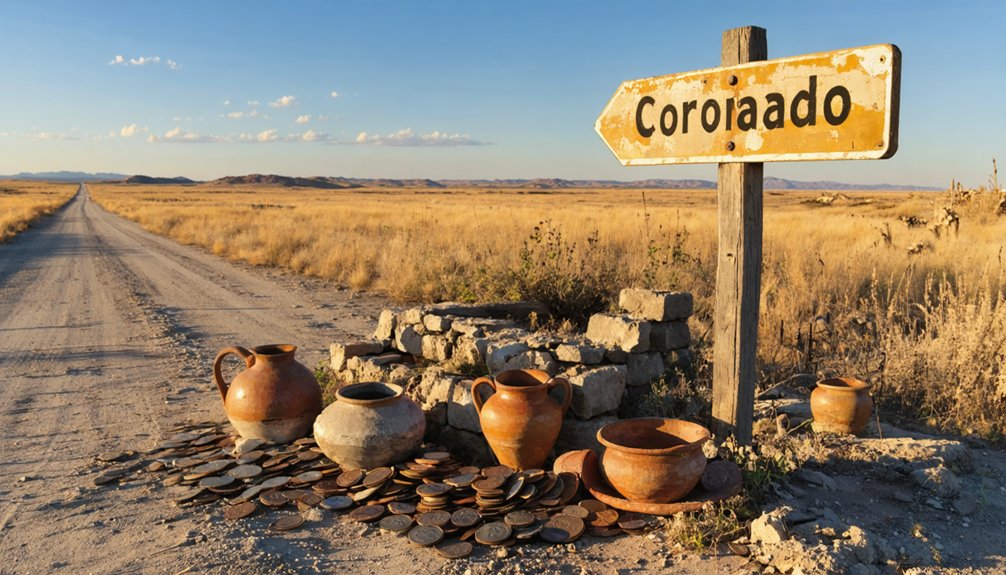
Beneath Kansas soil lie scattered remnants of Spanish ambition—iron chain mail fragments, copper bells, pottery sherds bearing Southwestern pueblo designs—each artifact a breadcrumb from expeditions that ventured into these grasslands centuries ago. You’ll find evidence of Spanish colonial trade routes at Etzanoa, where drone imaging revealed a horseshoe-shaped council circle beneath rangeland.
The 1594 Umana-Leyba expedition and Oñate’s 1601 battle left tangible proof—thousands of artifacts surfaced during 1994 road construction. At El Cuartelejo, stone and bone tools document indigenous cultural interactions between Plains Apache and Pueblo refugees fleeing Spanish rule. The El Quartelejo Museum in Scott City displays these recovered treasures, while the reconstructed pueblo foundation in Scott State Park lets you walk where cultures collided and merged.
Frequently Asked Questions
What Is the Best Time of Year to Visit Coronado?
You’ll find Coronado’s tumbleweeds photogenic year-round, but fall’s your golden ticket. Seasonal weather patterns stay mild, crowds vanish like the town’s former residents, and recreational activities won’t melt you alive—unlike summer’s oppressive heat.
Are There Any Nearby Accommodations or Camping Facilities for Visitors?
You’ll find comfortable nearby hotels and the Coronado Motel right in Lindsborg, just minutes from your ghost town adventure. Local RV campgrounds offer full hookups with spacious sites, giving you the freedom to explore Kansas’s forgotten landscapes at your own pace.
How Far Is Coronado From Major Kansas Highways or Cities?
You’ll find Coronado isolated in northwest Kansas farmland, requiring several hours’ travel time from major cities. Accessibility by major highways isn’t direct—you’ll navigate rural roads from distant routes, making this ghost town truly off the beaten path.
Is the Ghost Town Site on Private Property or Public Land?
The ghost town sits on private property owned by E.S.E. Alcohol Corporation. You’ll face accessibility concerns visiting this old farmyard site. Respect ownership status and seek permission before exploring—trespassing charges aren’t worth the adventure, friend.
What Other Ghost Towns Are Within Driving Distance of Coronado?
You’ll find Farmer City just miles from Coronado, sharing nearby ghost town history in Wichita County. Both offer photogenic abandoned structures and dusty remnants of frontier rivalry. The open prairie beckons explorers seeking authentic Kansas ghost town adventures without restrictions.
as you delve into exploring mildred ghost town history, you will uncover tales of its former inhabitants and the challenges they faced. The remnants of buildings tell stories of a bygone era, inviting visitors to imagine life in this once-thriving community. A visit here provides a unique glimpse into the past, making it a perfect addition to any journey through Kansas.