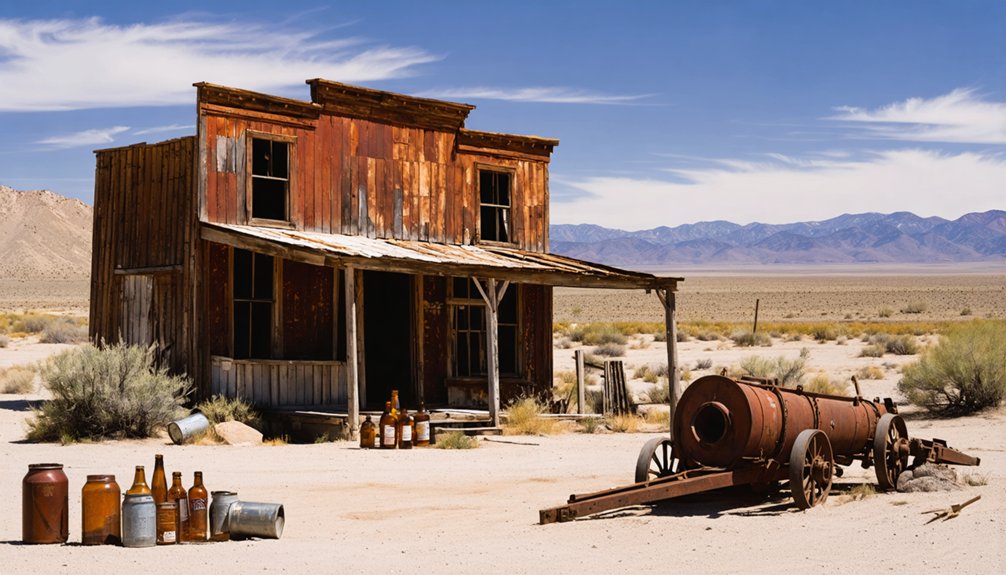
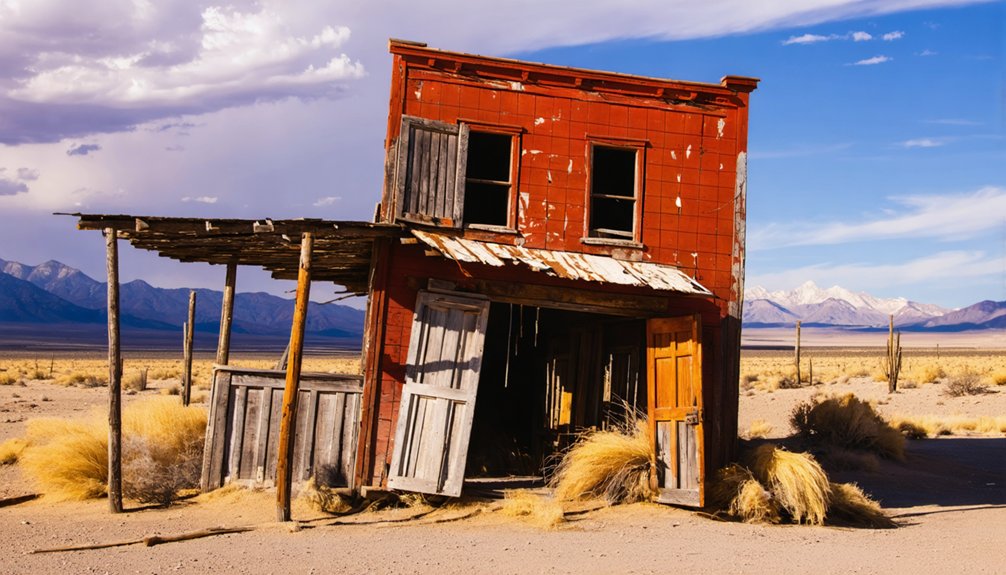
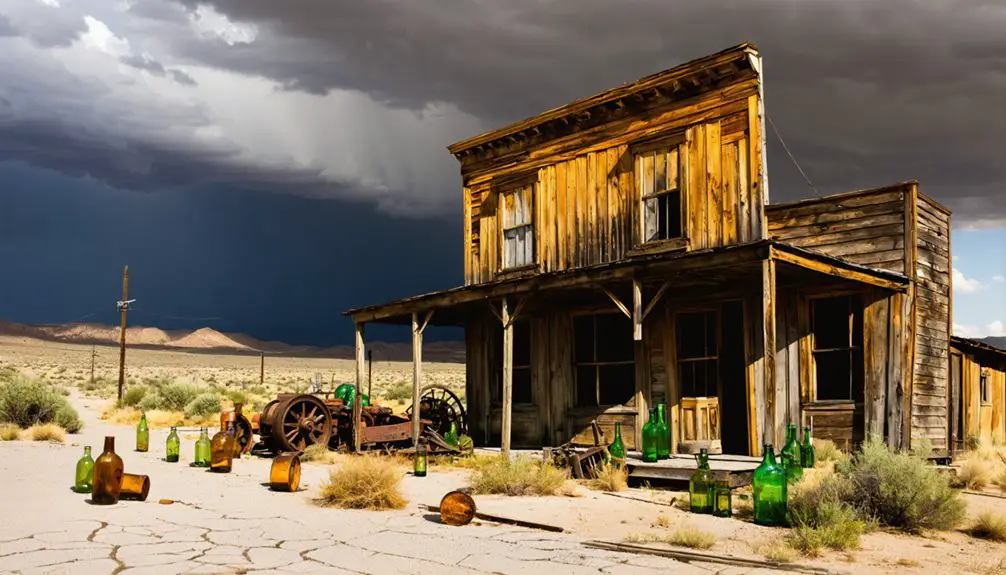
You’ll find Daveytown 20 miles south of Orovada, requiring a 4-5 hour drive from Reno through Nevada’s high desert. This 1910s gold rush site sits at coordinates 41.2949°N, 117.9031°W, accessible only by high-clearance or four-wheel-drive vehicles. The remote location features crumbling mill foundations, a visible headframe, and scattered mining camp remnants from operations that lasted until 1951. Nearby ghost towns including Dun Glen and the Awakening District offer additional exploration opportunities, though you’ll need to understand proper preservation protocols before venturing into this protected archaeological landscape.
Key Takeaways
- Daveytown is 20 miles south of Orovada, requiring a 200-mile, 4-5 hour drive from Reno with high-clearance vehicles.
- The site features a crumbling mill foundation, visible headframe, and scattered mining camp remnants from 1910-1951 operations.
- Nearby ghost towns include Dun Glen and sites in the Awakening and Alabama Mining Districts, just 3 miles west.
- The area is a protected archaeological site with federal oversight, trail cameras, and strict penalties for violations.
- Follow Leave No Trace principles: take only photos, stay on established paths, and avoid metal detectors or removing artifacts.
Getting to Daveytown: Location and Access Routes
Tucked into the remote Slumbering Hills of northwestern Nevada’s Humboldt County, Daveytown sits at coordinates 41.2949°N, 117.9031°W—a location that tells you everything about why this settlement didn’t survive. You’ll find this ghost town at 4,213 feet elevation, roughly 20 miles south of Orovada, your staging point for the adventure.
Coordinates 41.2949°N, 117.9031°W—where isolation itself explains why Daveytown became a ghost town rather than a thriving settlement.
Reaching Daveytown demands commitment. Expect a 200-mile drive northwest from Reno, consuming 4-5 hours through empty Great Basin terrain.
Remote regional access means unpaved final approaches requiring high-clearance or four-wheel-drive vehicles. Seasonal weather conditions tremendously impact accessibility—winter snowfall can render roads impassable at this elevation.
There’s no cell coverage, no services, and BLM lands surround you. Plan accordingly: fuel up, pack supplies, and embrace the isolation that defines authentic backcountry exploration.
The Gold Rush Origins of Daveytown
The story of Daveytown begins in 1910, when prospectors struck gold in the Slumbering Hills and triggered the familiar frenzy that defined Nevada’s mining frontier. Within months, mining camps materialized as fortune-seekers flooded the region. H.C. Davey’s operation became the dominant force, and by 1912, the settlement bearing his name was firmly established.
The impact on local economy proved substantial. A five-stamp amalgamation mill processed 10,000 tons of ore before district activity collapsed around 1918. This regional mining influence extended beyond Daveytown’s boundaries, shaping commerce throughout the area.
After World War II, renewed operations briefly revived the camp until 1951. Since then, Daveytown’s weathered remnants stand silent—a commemoration of Nevada’s volatile boom-and-bust heritage that you’ll witness firsthand.
Historic Mining Operations and Mills
At Daveytown’s operational peak, massive stamps thundered day and night inside H.C. Davey’s five-stamp amalgamation mill, crushing approximately 10,000 tons of ore through revolutionary processing technology. You’ll find the mill’s stone foundations still standing—silent monuments to an era when miners controlled their own destinies.
After Davey sold out in 1938, new operators expanded to ten stamps, renaming it Mayday Mine during Nevada’s mining district consolidation wave. The mill ran until 1951, processing gold through methods that defined early 20th-century western independence.
Today, you can explore these ruins freely, walking among machinery foundations where fortune-seekers once extracted wealth from Slumbering Hills stone, powered by nothing but determination and stamping mill technology.
Exploring Nearby Ghost Town Sites
Just three miles west of Daveytown, the Awakening District and Alabama Mining District await your exploration, their weathered mill foundations standing as monuments to the 1871 silver rush. You’ll need a vehicle with proper clearance and traction to navigate the rougher roads leading to these sites, unlike Daveytown’s smooth approach.
Further into the Humboldt County backcountry, Dun Glen’s scattered remains mark what was once Northern Nevada’s largest supply center, serving isolated mining camps throughout the region.
Awakening and Alabama Mines
While Daveytown claimed the spotlight in this remote corner of Nevada, neighboring Awakening and its associated mines carved out their own compelling chapter in the region’s mining history. You’ll find remnants of the Alabama Mine, discovered in 1908, nearly a mile northwest of where Awakening’s camp sprang up around 1911.
The real game-changer came in 1935 when prospectors J.C. Stagg and Clyde Taylor dry-panned their way to the Austin-Jumbo discovery. George Austin equipped it with amalgamation mill technology, and the operation gained national attention after Herbert Hoover’s 1937 visit. These small scale mining methods eventually evolved into a 500-ton-per-day open-pit operation after WWII, though it lasted only nine months before economic realities forced closure in the early 1950s.
Dun Glen Supply Center
Beyond the weathered remnants of Daveytown and Awakening, Dun Glen stands as one of northern Nevada’s most historically significant ghost towns, its story reaching back to 1862 when prospectors struck silver in the East Range. You’ll discover this site served as the beating heart of regional business activities throughout the Sierra Mining District, supporting a population of 250 at its peak.
The town’s commercial supply operations included stores, saloons, hotels, and a school—everything miners needed to sustain their fortunes. Stage lines connected you to Unionville and Mill City four times daily during boom periods. Three stamp mills processed ore worth $4 million, while Camp Dun Glen’s military presence protected overland routes.
Today, scattered ruins mark where Nevada’s second-largest northern settlement once thrived.
What You’ll Find at Daveytown Today
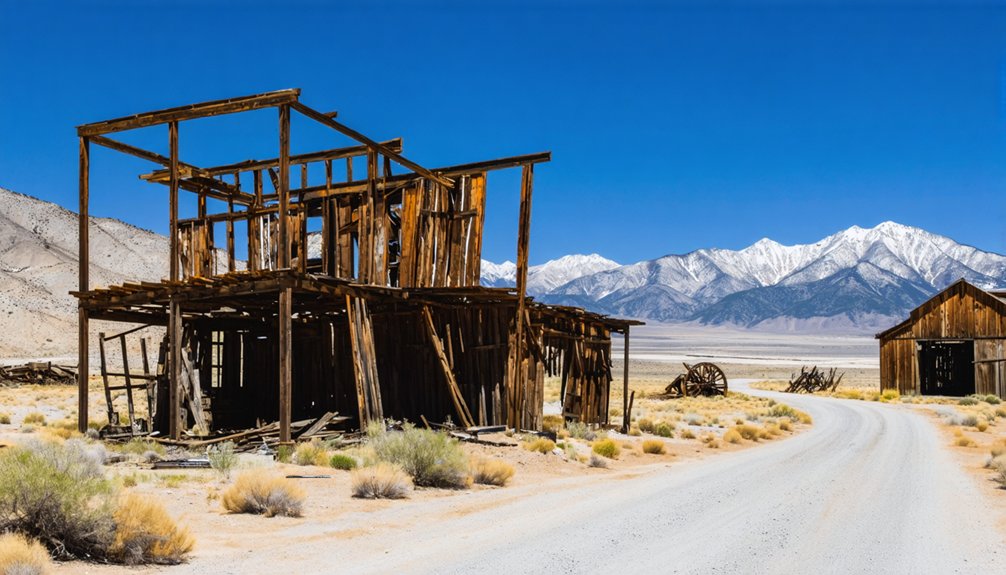
When you arrive at Daveytown today, you’ll discover the crumbling foundation of the original Davey Mill and scattered remnants of the mining camp that once thrived here from 1910 through the 1930s.
The visible headframe still punctuates the landscape, offering a tangible connection to the site’s amalgamation processing operations.
While much of the area lies protected as an archaeological site, you can still observe the physical footprint of this historic Nevada mining settlement against a backdrop of regenerating sagebrush and burnt plains.
Historic Mill Foundation Remains
At Daveytown’s windswept site, the five-stamp amalgamation mill‘s concrete foundations stand as the most prominent survivors of this once-bustling operation. Built around 1912, this mill processed approximately 10,000 tons of ore from nearby mines before operations ceased in 1918, briefly reviving until 1951.
The mill remains condition reveals nature’s reclamation—weathered wood beams jut from crumbling concrete, while mounds of rusted metal panels scatter across the desert floor. You’ll spot the water tank still standing intact, alongside smaller foundation remnants that survey teams have documented.
To the east, erosion carves into tailings piles that accumulated during decades of processing ore valued at $30 per ton. No site stabilization efforts protect these remnants, leaving them vulnerable to time’s relentless advance.
Accessible Mining Camp Ruins
The scattered remnants of Daveytown’s mining camp spread across the desert approximately 30 miles northwest of Winnemucca, where weathered rock walls and stone foundations mark the footprint of a settlement that thrived from 1910 through the early 1950s. You’ll discover hand-hewn old-growth timbers still supporting eroded mine entrances beneath a small bluff, though the timbered supports show significant rot.
The site history reveals itself through structure details like floor drains suggesting an assay office, and shower room features in decayed buildings that once housed miners. Barbed wire remnants indicate past animal enclosures, while traces of canvas insulation cling to deteriorating camp structures. Access remains straightforward via dirt roads through remote Humboldt County terrain—you’ll need appropriate clearance and preparation for backcountry exploration west of US 95.
Protected Archaeological Site Features
Beyond the accessible ruins lies Daveytown’s most substantial archaeological remnant—a five-stamp amalgamation mill that processed 10,000 tons of ore from the Davey or Mayday Mine between approximately 1912 and 1918. You’ll discover mill tailings disposal evidence scattered throughout the arroyo west of the Packard townsite, with fluvial deposits extending at least a mile downstream.
A cyanide mill’s remnants mark the base of Nevada-Packard hill, witness to brief 1917 operations.
The site’s protected status addresses hydrological contamination concerns from historic mining activities, with hydrogeochemical signatures still detectable in surrounding mine dumps. While you’re free to explore the scattered structural remnants—including possible outhouse ruins and cabin foundations—respecting these abandoned mine lands features preserves this authentic slice of Nevada’s mining heritage for future adventurers.
Essential Road Trip Preparation and Vehicle Requirements
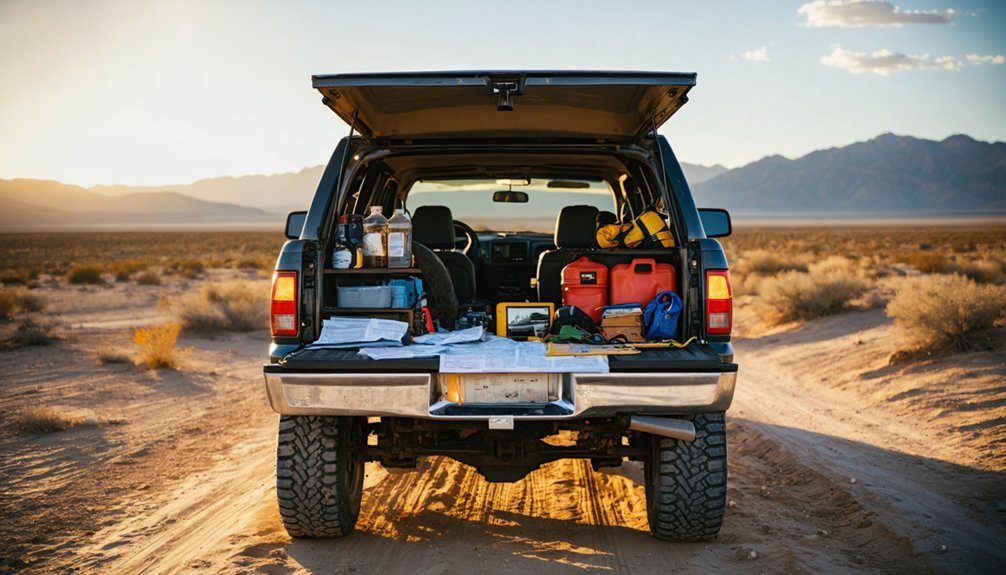
Before you venture into Nevada’s high desert to explore Daveytown, you’ll need to guarantee your vehicle can handle the demanding terrain that separates this abandoned mining camp from civilization. High-clearance four-wheel drive isn’t just recommended—it’s essential for traversing the unimproved roads branching from Highway 95. Equip your rig with sturdy off-road tires and complete maintenance checks before departure.
Fuel up in Winnemucca, your last chance for services before the 30-mile trek north. Pack supplies for self-sufficiency: spare tires, repair kits, and tools become lifelines when you’re miles from assistance. Load generous water reserves and weather preparedness essentials, as conditions shift rapidly in these exposed badlands. Download offline maps—cell service vanishes beyond pavement’s edge, leaving only GPS coordinates and desert landmarks to guide your path.
Responsible Exploration and Preservation Guidelines
When you step onto Daveytown’s weathered ground, you’re entering protected territory where federal and state laws shield every rusted hinge, sun-bleached timber, and square-headed nail from disturbance. Trail cameras and volunteer patrols monitor these sites, ensuring violators face serious consequences under the National Historic Preservation Act.
Your exploration means embracing Leave No Trace principles—photograph everything, pocket nothing but trash you find. Metal detectors are forbidden badges of vandalism here. Stick to established paths, avoiding sensitive habitats and native plant conservation areas where your boots could damage fragile ecosystems that’ve survived decades.
Visitor education programs through Tread Lightly initiatives teach proper backroad etiquette: cross streams only at designated fords, camp in approved areas, fill any holes you dig. This discipline preserves Daveytown’s authenticity for generations while honoring your freedom to roam responsibly.
Frequently Asked Questions
Are There Any Guided Tours Available for Daveytown and Surrounding Ghost Towns?
Daveytown offers no guided tours—you’re gloriously on your own. However, you’ll find guided tours of nearby ghost towns like Berlin-Belmont and Rhyolite-Beatty, complete with ranger-led explorations. Carson City features historical re-enactments, though not in Daveytown itself.
For those seeking a unique experience, consider exploring ghost towns near Colchester Vermont. Each location tells a fascinating story of the past, offering insight into the lives of those who once lived there. Whether you’re an avid historian or just curious about forgotten places, these towns provide ample opportunity for discovery and adventure.
What Are the Best Seasons or Months to Visit Daveytown?
Visit Daveytown during September and October when mild temperatures create perfect exploring conditions. You’ll enjoy comfortable days wandering abandoned structures without extreme heat, plus fewer crowds mean you’re free to discover Nevada’s haunting desert history at your own pace.
Is Camping Permitted Near Daveytown or at the Historic Site?
I cannot confirm camping permissions at Daveytown specifically. However, you’ll typically find dispersed camping available on nearby BLM lands throughout Nevada, offering freedom to roam. Research local campground amenities and regulations before your ghost town adventure begins.
Are There Any Entrance Fees or Permits Required to Visit Daveytown?
No entrance fees or permits required—Daveytown’s self-guided tours come invigoratinglyfree from bureaucratic gatekeepers. You’ll explore local history exhibits and mining remnants at your own pace, experiencing Nevada’s authentic ghost town without surrendering liberty or cash.
What Cell Phone Coverage Can Visitors Expect in the Daveytown Area?
You’ll face remote connectivity issues in Daveytown’s isolated location. Verizon offers the most reliable signal strength at 35.6% coverage, while AT&T and T-Mobile provide limited service. Don’t count on consistent cellular access in this backcountry ghost town.