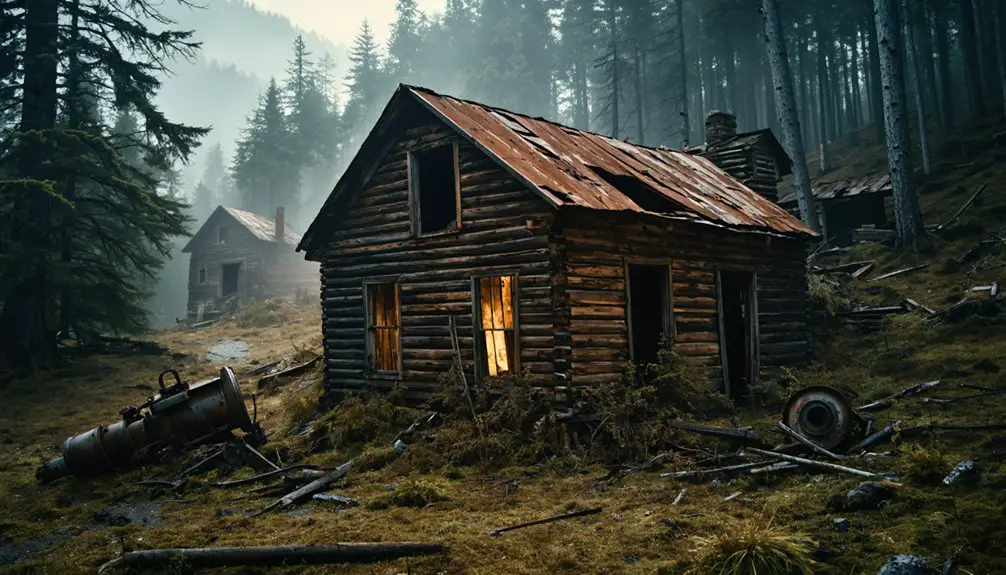
Your ghost town adventure to Davis, Maryland starts fifteen miles northwest of Baltimore along the Seneca Greenway Trail, where Civil War-era stone mill walls and Gothic church ruins hide in dense woodland. You’ll discover rough-cut granite foundations, crumbling residential remains, and the restored gristmill base that once powered Confederate uniform production. Plan for a morning exploration, then head to Ellicott City’s antique shops and riverside cafés fifteen minutes east. The complete story of Davis’s rise, tragedy, and the intimate human histories buried in archive boxes awaits your discovery.
Key Takeaways
- Access Davis ruins via Seneca Greenway Trail to view granite mill walls, masonry dam, and Gothic church remains scattered through woodland.
- Visit restored mill foundations showcasing the water-powered grist mill base and 19th-century stone mill building remnants.
- Explore nearby Ellicott City, fifteen minutes east, for antique shops, riverside cafés, and dining in renovated historic buildings.
- Research family history through archive records documenting women’s property rights, dairy operations, and colonial-era settlement from 1617.
- Note that a 1940 fire destroyed remaining structures, leaving only stone ruins and fragments of this former self-sufficient community.
The Rise and Fall of a Mill Town
While the Civil War raged across America, a stone mill rose in Davis, Maryland in 1864—the first of its kind in the area to house a carding machine. You’ll discover this wasn’t just another enterprise—it prepared wool for Confederate uniforms while damming local waters for power.
The population changes over time reflected the mill’s transformation: sawmill in 1866, gristmill by 1871 with French burr stones and a Leffel waterwheel grinding flour for neighbors.
The operator’s generosity—free milling for widows—earned him a seat on Salado College’s board in 1882. But economic shifts in region proved unforgiving. Factory closures and suburbanization brought ready-made goods that rendered local milling obsolete. Fire claimed what remained in 1940, leaving only stories of self-sufficiency lost.
How Davis Got Its Name
The surname Davis carries centuries of meaning—”son of David” from the Hebrew “beloved”—but pinpointing exactly which Davis lent his name to this Maryland mill town requires detective work through fragmentary records.
Davis’ Welsh etymology traces back through “ap Dafydd,” connecting common folk to ancient lineages. Davis’ association with Welsh nobility runs deep, linking bearers to David ap Gryffydd, North Wales’ last prince, and even Saint David himself.
When you’re exploring the town’s origins, you’ll find local historians debate whether the namesake descended from Maryland’s colonial Davises who patented Severn River land in 1672, or later arrivals like William Davis in 1805. The truth likely vanished with the mills’ ledgers, leaving only the name carved into mountain hollows.
Where to Find Davis Ghost Town
Looking for Davis on modern maps proves futile—this ghost town doesn’t exist in Maryland’s historical record. You’re chasing a phantom location that never was. Before visiting ghost town remoteness in Maryland, redirect your adventure to actual abandoned settlements.
Real Maryland Ghost Towns Worth Exploring:
- Daniels – Straddling the Patapsco River between Baltimore and Howard counties, east of Woodstock
- Kempton – Southwest Maryland’s coal mining relic, abandoned since 1950
- Old Ellicott City – Historic district near Daniels with accessible ruins
- Woodstock area – Gateway to authentic Patapsco Valley ghost sites
Davis ghost town accessibility isn’t an issue—it simply doesn’t exist. Instead, you’ll find Daniels and Kempton offering genuine exploration opportunities. Pack your GPS with corrected coordinates, and you’ll discover Maryland’s true forgotten settlements waiting along forgotten trails.
What Remains of the Mill Village
You’ll spot the most dramatic remnants along the Seneca Greenway Trail, where rough-cut granite walls with ashlar quoins rise from the 1783 mill foundation like silent sentinels of Davis’s industrial past.
The masonry dam still spans the waterway, its stone abutments gripping the banks while head and tail races carved into the northern hillside trace the water’s journey to power wheels long gone.
French burr millstones, fragments of circular saws, and rubble piles mark where buildings once hummed with gristmill activity and lumber production, now cleared by preservation volunteers who’ve made these 240-year-old ruins accessible again.
Stone Ruins and Structures
Scattered through dense woodland, Davis’s stone ruins tell stories of a thriving mill village that nature has slowly reclaimed. You’ll discover intriguing architectural elements everywhere—from crumbling residential foundations along old Alberton Road to gothic style stone structures like St. Stanislaus Kostka’s haunting remains.
The 1878 church, designed by John Stark, burned in 1927 but its stone skeleton still stands defiantly.
Key ruins worth exploring:
- Low stone walls marking 118 former row house sites
- Three-and-a-half-story mill foundations near the Patapsco River
- Pentecostal Holiness Church, strangled by vines since 1972’s tropical storm
- Small graveyard with toppled stones dating 1853-1939
Graffiti mars some sites, but these weathered stones represent genuine freedom—a town that escaped corporate demolition only to surrender gracefully to nature’s reclamation.
Abandoned Artifacts and Foundations
The Davis Mill’s crumbling stone foundations rise from the forest floor like ancient monuments, their weathered surfaces telling a story that spans from 1783 to a devastating 1940 fire. You’ll discover restored mill foundations thanks to volunteers from the Coalition for Seneca Greenway and Goshen Historic Preservation Society who’ve cleared decades of overgrowth.
The original water-powered grist mill‘s stone base remains visible, alongside ruins from the later 19th-century stone mill building. Look for discarded industrial equipment scattered among the undergrowth—remnants of machinery that once ground wheat and corn for local farmers. Frame dam abutments still stand near Seneca Creek, and if you’re observant, you’ll spot impressions of the old mill pond on Watkins Mill Road bridge’s north side.
Exploring the Abandoned Churches
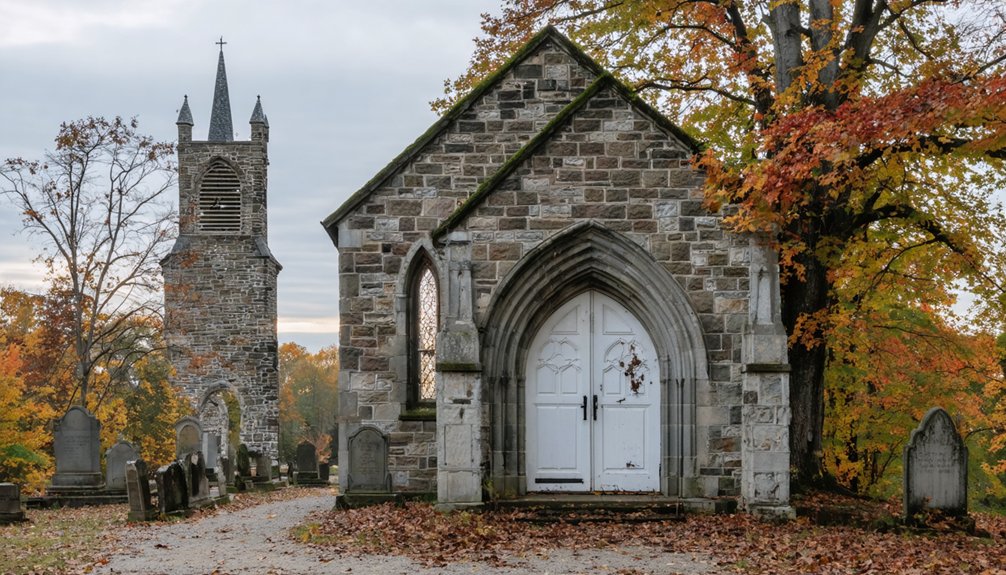
Three historic churches stand silent among the overgrowth in Daniels, Maryland, each telling a different chapter of this ghost town’s spiritual past.
Three abandoned houses of worship bear witness to a community’s vanished faith, now reclaimed by nature’s silent congregation.
Saint Stanislaus Kostka Catholic Church, built mid-1800s, was struck by lightning in 1926. You’ll find hidden gravestones directly behind its charred remains. The Pentecostal Holiness Church sits half a mile away, covered in graffiti but still intact. St. Alban’s Episcopal Chapel rounds out the trio, with records preserved at Baltimore’s Archdiocese.
What you’ll discover exploring these sites:
- Unexplored cellars beneath crumbling foundations
- Overgrown cemeteries with burials dating to town’s heyday
- Lightning-scorched walls from the 1926 fire
- Vandalized interiors showing decades of abandonment
These three churches once served 90 families before the 1968 evacuation notice sealed Daniels’ fate.
Getting to the Trailhead Safely
After exploring these spiritual relics, you’ll need to navigate a maze of rural roads to reach them. The Alberton Road trailhead‘s notoriously hard to find—I’ve learned Google Maps is your best friend here. Route signage gets sparse once you leave Route 40 or US 29, so download Maryland DNR’s trail map beforehand.
You’ll spot the entrance where Dogwood meets Alberton Road. Parking availability’s limited to a small lot, but it’s usually sufficient for this off-the-beaten-path destination. Lock your doors—this isn’t paranoia, just smart practice. The gate’s marked “Patapsco State Park,” your signal you’ve arrived.
From here, Alberton Road transforms into a rustic footpath. Woods flank one side, flowing water the other. Keep sharp eyes for unmarked side trails leading to Davis’s haunting church and graveyard ruins.
Best Time to Visit the Ruins

Four distinct seasons transform Daniels’s ruins into completely different experiences, and I’ve witnessed each one’s unique character. Understanding ideal visiting seasons helps you avoid crowds and hazardous conditions while maximizing your exploration freedom.
Weather considerations for each season:
- Spring (April-May) – Moderate temperatures, lush greenery, but muddy trails after rain
- Summer (June-August) – Best visibility through lighter foliage, though humidity peaks and parking fills quickly
- Fall (September-October) – Prime time with comfortable temps, stunning foliage, and stable trail conditions
- Winter (December-February) – Bare trees reveal hidden structures, but icy paths require traction devices
I’ve found early mornings during weekdays offer the most solitude. Check recent weather reports before heading out—flash floods can make the Patapsco River crossing treacherous.
Nearby Attractions and Dining Options
Your ghost town exploration doesn’t end at the ruins—Ellicott City, just fifteen minutes east, transforms your day trip into a complete adventure with its labyrinth of antique shops, riverside cafés, and its own haunted history.
Main Street’s historic district offers unique dining experiences at spots like The Little Market Café, where you’ll refuel with artisan coffee and house-made sweets after hours on the trail. Browse local artisanal shops such as Sweet Elizabeth Jane for handcrafted goods and vintage treasures.
The town itself predates Daniels by decades, with stone buildings clinging to steep hillsides above the Patapsco. You’ll find everything from casual taverns to upscale bistros tucked into renovated mills and merchant houses—each with stories as compelling as the ghost town you just explored.
Uncovering Family History in Davis

Beyond the crumbling stone walls and forgotten mill races, Davis holds something more intimate than architectural ruins—layers of human stories waiting in archive boxes and handwritten ledgers.
Beyond bricks and mortar lie the handwritten truths—family ledgers holding contradictions, complexity, and the unvarnished weight of real lives lived.
You’ll find the Davis family papers at University of Maryland—4.50 linear feet spanning a century of Frederick County life. Here’s what makes these records extraordinary:
- Women’s property rights documented through signatures dating to 1822, showing daughters and wives approving transactions
- Dairy ledgers tracking milk shipments to Baltimore during agricultural modernization
- Slavery and moral history revealed through ownership records—Eli Davis enslaved six people
- Colonial roots tracing back to James Davis, who arrived aboard the ship George in 1617
These aren’t sanitized histories. They’re complete records—prosperity built alongside injustice, progress shadowed by exploitation.
Frequently Asked Questions
Are There Any Guided Tours Available for the Davis Ghost Town?
No guided tours offered exist for Davis Ghost Town—imagine tumbleweeds rolling past empty tour buses. You’ll embrace true freedom exploring solo instead, with no tour schedule variations restricting your adventure through these authentically abandoned, graffiti-splashed ruins along the Patapsco River.
Is Camping Allowed Near the Davis Ruins Overnight?
Camping regulations for Davis Ruins aren’t clearly established, so you’ll want to verify local rules before pitching your tent. Consider nearby overnight accommodations in Thomas or seeking permission from landowners. Always respect historical sites while exploring freely.
What Should I Bring When Hiking to the Abandoned Town?
The trail becomes your compass to freedom’s forgotten edge. You’ll need to wear comfortable boots and pack plenty of water. Bring navigation tools, first aid supplies, sun protection, and insect repellent for Maryland’s unpredictable wilderness adventures.
Are the Ruins and Old Buildings Safe to Explore?
No, the ruins aren’t safe—you’ll face serious structural integrity concerns with decaying wood, unstable foundations, and debris-filled walls reaching nine feet. Plus, you’re risking trespassing charges on state park property. Admire from outside; don’t climb inside.
Do I Need a Permit to Visit Davis Ghost Town?
No permit needed—you’re free to explore! Unlike downloading an app, visiting this history of ghost town requires zero permissions. Thanks to preservation efforts, you’ll access Davis’s ruins freely, experiencing authentic adventure without bureaucratic hassles or restrictions.