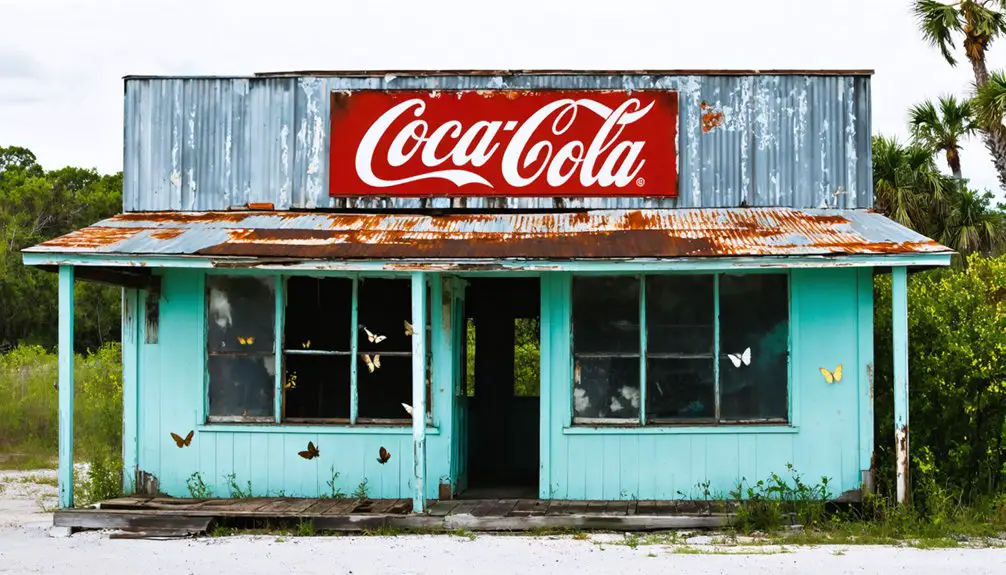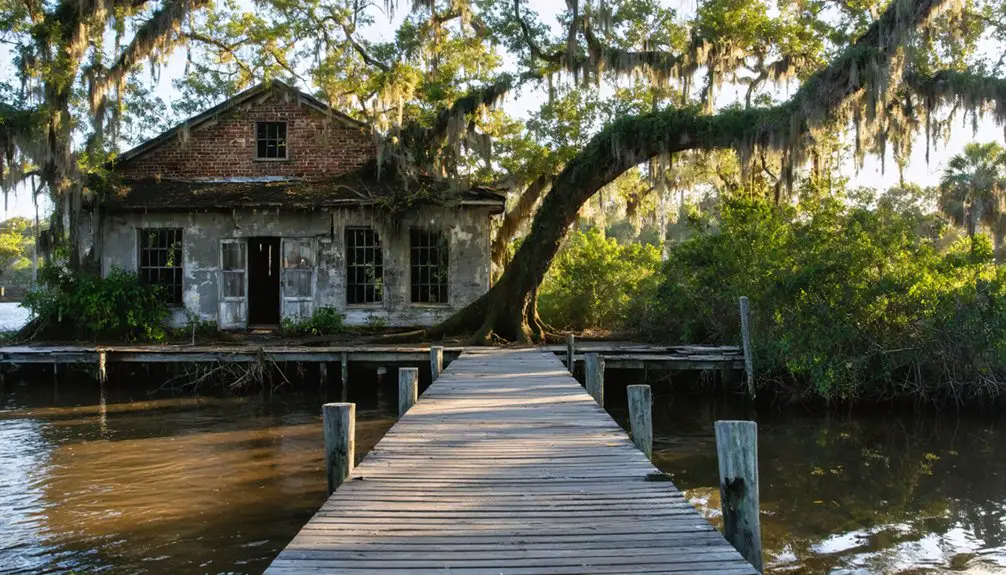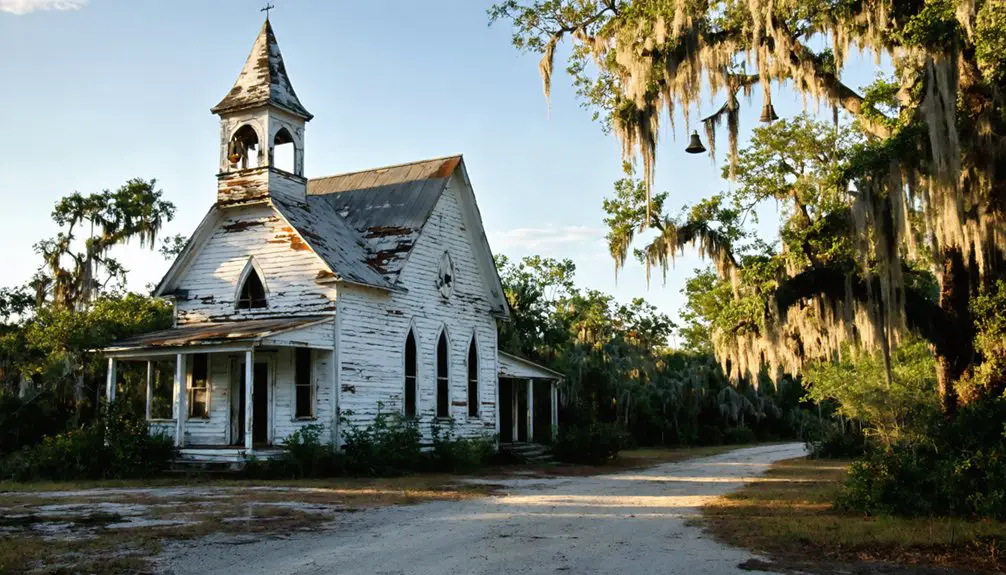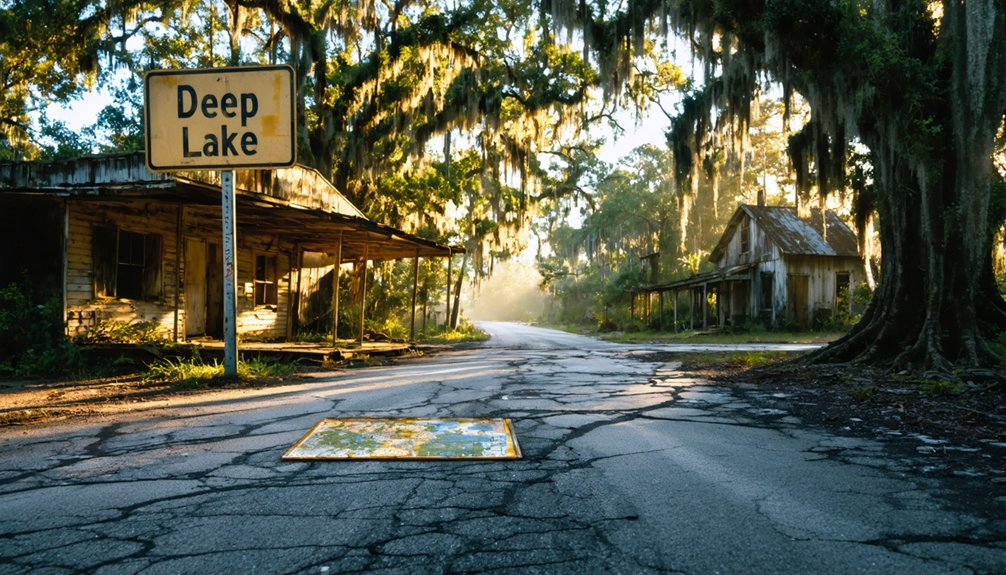
You’ll find Deep Lake seven miles south of I-75 Exit 80, where crumbling 1960s prison buildings and rusted tram rails mark Florida’s vanished grapefruit empire. Plan your visit between January and mid-April when temperatures hover around 50-60°F and park service tours follow the original 1913 railroad route through Fakahatchee Strand Preserve. The best slots fill quickly, so book ahead—and don’t attempt summer trips when impassable roads can trap you in the mosquito-thick wilderness where fortunes froze and civilization surrendered to the swamp.
Key Takeaways
- Take Exit 80 from Interstate 75 onto State Route 29 South and drive seven miles through Big Cypress National Preserve.
- Visit between January and mid-April when temperatures are mild, mosquitoes are minimal, and access roads remain passable.
- Explore the abandoned 1960s prison complex with crumbling buildings and hurricane-damaged structures behind chain-link fencing.
- Follow rusted railroad tram rails from 1913 that once connected grapefruit groves to distant markets through palmetto scrub.
- Book guided tours through Fakahatchee Strand Preserve early, as slots fill quickly for the original railroad route.
The Fascinating History of Deep Lake’s Grapefruit Empire
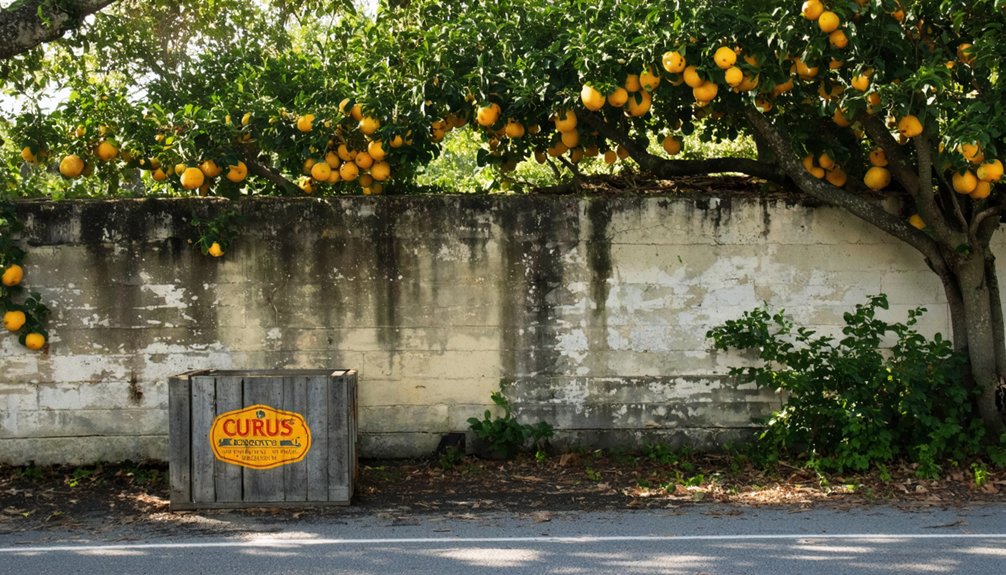
Long before Deep Lake became a whisper on abandoned maps, Spanish explorers were tucking orange seedlings into Florida’s sandy soil near St. Augustine in the early 1500s.
By the 1890s, northeastern Florida was exploding with groves, former citrus processing facilities, and packinghouses churning out five million boxes annually. Then came the stories of boom and bust—the devastating 1894-95 freezes that dropped temperatures 62°F in a single night, obliterating 99% of Lake County’s trees.
Production plummeted from five million boxes to nearly zero. The survivors pushed south, but Deep Lake’s packinghouses fell silent. You can still trace the remnants of this grapefruit empire, where fortunes once grew on branches before winter’s cruel hand wiped the slate clean.
How to Get to Deep Lake From Interstate 75
You’ll find the turnoff to Deep Lake by taking Exit 80 onto State Route 29 South from Interstate 75, where the landscape quickly shifts from highway sprawl to the wild, untamed cypress forests of Big Cypress National Preserve.
The journey stretches about seven miles along this lonely two-lane road, where I’ve counted fewer than a dozen cars on weekend afternoons and watched the pavement narrow as civilization falls away behind you.
Watch for the subtle landmarks—a weathered ranger station, a break in the tree line revealing dark water, and finally the remnants of old grapefruit groves marking your arrival at what remains of Deep Lake.
Exit SR 29 South
Where Interstate 75 intersects with State Road 29, you’ll find your gateway to one of South Florida’s most remote natural wonders. Finding Interstate 75 exit requires GPS navigation since no specific exit number marks this junction, but it’s your portal into authentic wilderness territory.
As you venture deeper, you’ll discover a landscape dotted with intriguing ghost towns to explore in Florida, each with its own story and charm. From forgotten railroads to abandoned homesteads, these sites offer a glimpse into the rich history that once thrived in this region. Embrace the sense of adventure and uncover the secrets hidden in the remnants of the past.
Head south on SR 29, leaving civilization behind as you cross into Big Cypress National Preserve’s domain. The highway narrows to two lanes, cutting through agricultural flatlands where Florida panthers still roam free. You’ll pass the wildlife refuge’s western boundary before the landscape opens into endless sawgrass and cypress stands.
After approximately fifteen miles of straight southbound driving, checking the fire station access becomes indispensable. Deep Lake Fire Station at 20202 SR 29 appears suddenly—your unmarked trailhead destination where adventure truly begins.
Seven Miles Distance Markers
After exiting I-75 at the SR 29 junction around mile marker 80, your odometer becomes your most reliable navigation tool through this roadless wilderness. You’ll head east for approximately eight miles, watching those tenths click by like breadcrumbs through unmarked territory.
There’s no fanfare here—just grassland parking along the highway when you’ve traveled far enough. I’ve learned to reset my trip meter at the exit; it’s the difference between finding Deep Lake and wandering aimlessly.
Nearby elevation changes are subtle but noticeable, ranging from 215 to 454 feet as you traverse this backcountry. Check road construction updates before departing, as project delays between markers can affect timing.
This stretch demands attention to detail, but that precision delivers freedom—the kind only accessible to those willing to navigate beyond conventional signage.
Identifying Deep Lake Landmarks
Spotting the Deep Lake Fire Station at 20202 State Road 29 signals you’ve arrived at one of South Florida’s most remarkable geological oddities—a 90-foot-deep sinkhole that plunges deeper than any other lake south of Lake Okeechobee. You’re standing where Seminole Chief Billie Bowlegs once roamed, and where botanist Charles Torrey Simpson explored in 1921.
The trailhead sits just left of the fire station entrance—park across the street and carefully cross to begin your half-mile journey through diversified habitats. You’ll pass through canopies of ferns and palms, cyprussy wetlands, and chest-high vegetation before reaching the lake’s stratified waters—freshwater floating above saltwater. This was Barron Gift Collier’s land, once cultivated with grapefruit orchards on its high, fertile ground.
What Remains of the Abandoned Prison Complex
From the shoulder of Florida Highway 29, the skeletal remains of Deep Lake’s prison complex stretch across the swampland like a forgotten monument to institutional failure. Dozens of mid-century modern buildings from the 1960s stand behind chain-link fencing, their hurricane-damaged roofs exposing interiors to Florida’s merciless elements.
You’ll spot the main administration building at the drive’s end, surrounded by former halfway houses where inmates once shifted, moved, or returned to freedom. The residential structures feature small kitchens and living rooms, back doors hanging open like invitations to explore.
The ghost town atmosphere intensifies as you notice the severe deterioration conditions—walls crumbling, vegetation reclaiming foundations. FDOT abandoned this maintenance facility in 2002, leaving behind a maze of forgotten corridors where prisoners once worked the surrounding farmland.
Exploring the Historic Railroad Tram System
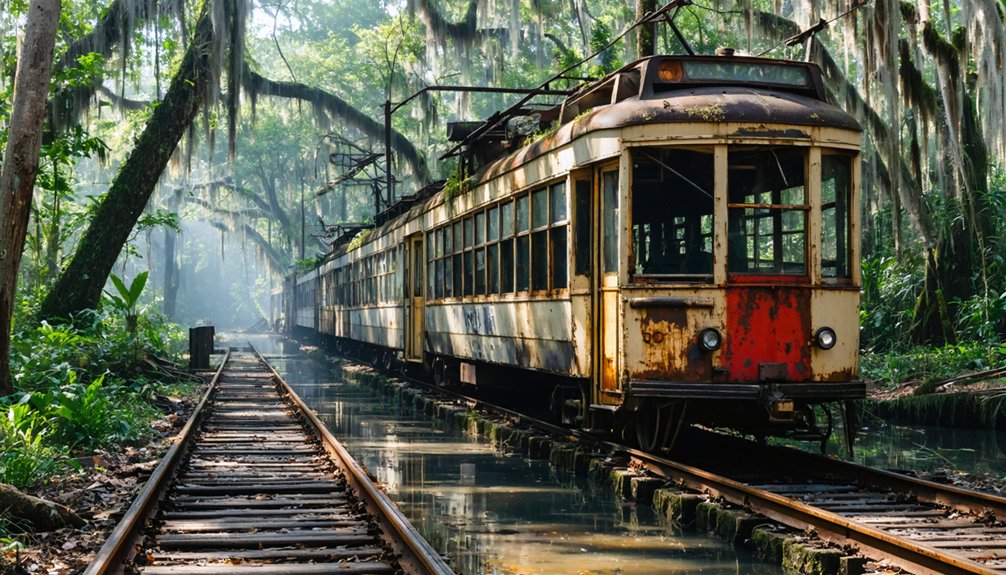
The rusted rails of Deep Lake’s forgotten railroad emerge from palmetto scrub like iron veins threading through Florida’s wilderness, remnants of a transportation network that once connected grapefruit groves to distant markets.
You’ll discover the deteriorating infrastructure along State Road 29, where Walter Langford and John Roach’s entrepreneurial vision materialized in 1913. Their grapefruit-hauling tram eventually caught Barron Collier’s attention, who transformed it into a timber empire before Atlantic Coast Line expanded the network northward.
Walk the abandoned embankments stretching toward Harrisburg—named for the track-laying machine itself—and you’ll find freedom in these overgrown corridors where daily trains once rolled until the 1980s. The wilderness has reclaimed most structures, but the path remains, inviting exploration beyond civilization’s boundaries.
Best Time to Visit and Guided Tour Options
Planning your expedition to Deep Lake demands careful attention to South Florida’s unforgiving seasonal rhythms. You’ll find the sweet spot between January and mid-April when the park service operates tours—precisely when winter’s dry embrace pulls water from the swamp’s chokehold. Tour season logistics favor this window: temperatures hover around 50-60°F, roads stay passable on SR 29, and mosquitoes retreat enough to let you breathe.
The guided tour experience follows the original railroad tram route from that yellow gate east of the abandoned prison. You’ll walk where cypress loggers once hauled their spoils, discovering partial building walls emerging from palmetto scrub. Book ahead through Fakahatchee Strand Preserve—slots fill fast. Come summer’s wet season, forget it. Thunderstorms transform access roads into impassable quagmires, trapping the unwary.
The Natural Wonder of Florida’s Deepest Southern Sinkhole
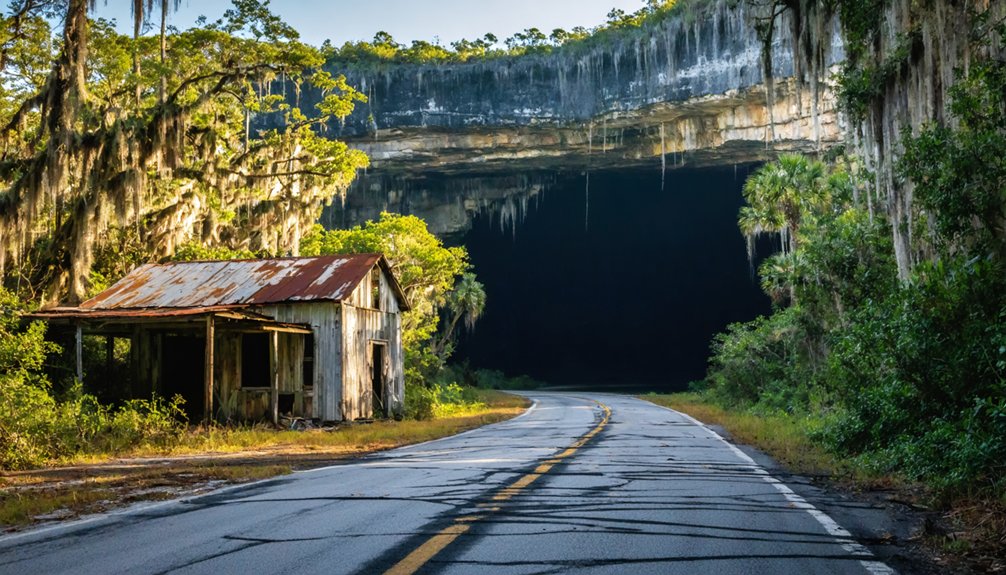
Standing at the edge of Deep Lake, you’ll peer down into Florida’s deepest southern sinkhole—a 310-foot plunge through layers of geological history that dwarfs most other sinkholes in the state.
The water column reveals a fascinating stratification where freshwater meets saltwater, creating distinct zones that shift and shimmer in the filtered sunlight.
Below, centuries of accumulated sediment have built a debris pile so nutrient-rich that scientists measure dramatic chemical changes as they descend, with ammonium levels spiking near the bottom where ancient limestone continues its slow dissolution.
Unmatched Depth and Dimensions
Plunging 90 feet beneath Florida’s surface—deeper than any other lake south of Lake Okeechobee—Deep Lake lives up to its name with an almost unsettling literalness. You’ll find yourself peering into a nearly perfect circular void spanning 295 feet across, where the underwater geology tells a dramatic story of collapse and dissolution.
The striking collapse features become evident as you circle the rim—broken limestone shelves descending into darkness, creating an irregular bowl that measures over 150 feet at its bottom. During dry season, you can trace the entire perimeter clearly, but when summer rains arrive, water levels rise two meters and blur the boundaries. Survey teams have sampled depths from 3 to 105 feet, confirming this isn’t just Florida’s deepest southern lake—it’s a geological marvel.
Unique Saltwater-Freshwater Layers
Beneath the surface of Deep Lake lies one of Florida’s most remarkable natural phenomena—a liquid sandwich where freshwater floats atop a dense saltwater layer, separated by an invisible boundary that’s remained stable for millennia. This halocline creates unique ecosystem characteristics you won’t find anywhere else in South Florida.
The freshwater originates from rainfall and surface infiltration, while saltwater wells up from the ancient Floridan aquifer below—a geological marriage formed when the sinkhole collapsed 6,000 years ago.
You’ll discover vertical habitat zonation throughout the 90-foot depth, where specialized organisms occupy distinct layers based on salinity tolerance. National Park Service studies confirm minimal mixing occurs between these worlds, creating fundamentally two ecosystems stacked within one lake—nature’s own experiment in stratification that’s been running independently for six thousand years.
Rich Soil Formation
When Deep Lake’s ancient sinkhole punched through Florida’s limestone foundation 6,000 years ago, it triggered a soil-building process that’s still enriching the surrounding landscape today. As acidic rainwater dissolved the carbonate bedrock, it released calcium and magnesium that transformed ordinary sand into nutrient rich organic matter. You’ll find the area’s soil composition tells a 6,000-year story of continuous enrichment.
The sinkhole’s unique formation created exceptional growing conditions:
- Dissolved limestone releases mineral nutrients that fertilize surrounding soils naturally
- Carbonic acid erosion produces calcium-enriched sediments supporting diverse microbial communities
- Water table fluctuations cycle nutrients between aquifer and surface layers
- Clay deposits trap organic materials, preventing nutrient loss
- Fractured bedrock channels groundwater to plant roots efficiently
This geological alchemy created soils that sustained indigenous populations and later attracted settlers seeking agricultural freedom.
Spotting Wildlife and Alligators at Deep Lake
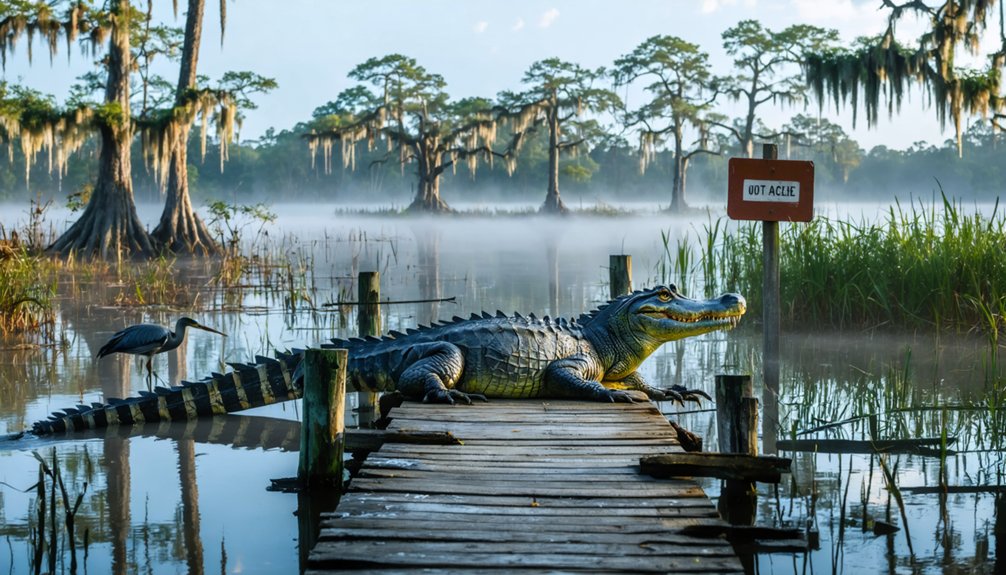
The shallow waters of Deep Lake shimmer with more than just sunlight—they’re home to hundreds of alligators drawn by the same conditions that make nearby Lake Okeechobee a reptilian haven. You’ll spot these prehistoric creatures basking on shores at dawn and dusk, with males stretching up to 14 feet. Bring binoculars for safe observation from at least 30 feet away.
Understanding alligator feeding behaviors reveals why they float motionlessly in shallows—they’re ambush predators waiting for fish and wading birds. Spotting alligator breeding patterns intensifies from April through June when protective females guard nests near water’s edge.
Come late summer, you’ll notice juvenile clusters where hatchlings emerged. Keep your distance, never feed them, and you’ll witness nature’s raw power without constraint.
What to Look For: Ruins and Landmarks Along State Road 29
Crumbling brick structures emerge from tangled palmetto thickets along State Road 29, silent witnesses to Deep Lake’s ambitious agricultural past. You’ll discover fascinating remnants if you know where to look.
Deep Lake’s forgotten agricultural empire hides beneath subtropical wilderness, waiting for curious explorers to uncover its brick-and-mortar secrets.
The one-mile Deep Lake Trail reveals an old brick chimney hidden beneath palm fronds and a hand-built rock wall from the Barron Collier era. Across from the historic groves, abandoned prison buildings stand fenced since 2008, while reclaimed vegetation along trail sections slowly erases decades of human ambition.
Key landmarks to spot:
- Barron Collier’s 1922 cottage home
- Original railroad tram foundations near former State Road 29 alignment
- Ruins of nearby cottages from the 1900s grapefruit operation
- Deep Lake Cannery site markers
- Gas-powered rail car remnants from the 1913 Ford-engine transport system
Frequently Asked Questions
Is Camping Allowed Near Deep Lake in Fakahatchee Strand Preserve State Forest?
Camping isn’t permitted within Fakahatchee Strand’s boundaries—you’ll need to venture beyond its wild heart. However, nearby sites offer camping amenities where you can swap stories about wildlife sightings under star-filled skies, truly embracing freedom.
What Happened to the Grapefruit Groves After Barron Collier Purchased Deep Lake?
After Collier’s purchase, you’d witness revitalization efforts transform the groves into a thriving enterprise shipping 17,000 boxes to New York’s finest hotels. However, agricultural decline came by 1940 when rising costs forced operations to close permanently.
Are There Any Fees to Access Deep Lake or Join Guided Tours?
Like a padlocked gate on an abandoned road, Deep Lake’s now private property with no seasonal access fees or guided tour availability. You can’t enter since Altair fenced it in 2008—freedom to explore this ghost town vanished completely.
Can Visitors Swim or Kayak in the Deep Lake Sinkhole?
You shouldn’t swim or kayak in Deep Lake Sinkhole due to safety hazards and access restrictions. Without water quality testing or proper wildlife observation protocols, you’d risk contamination exposure and unknown depths—freedoms best exercised at safer, authorized locations.
What Safety Precautions Should Visitors Take When Exploring the Abandoned Ruins?
When venturing into these “historically challenged” structures, you’ll want to bring proper lighting for shadowy corners and maintain situational awareness of crumbling walls. I’ve learned unstable floors demand respect—test each step, travel with companions, and keep emergency contacts ready.