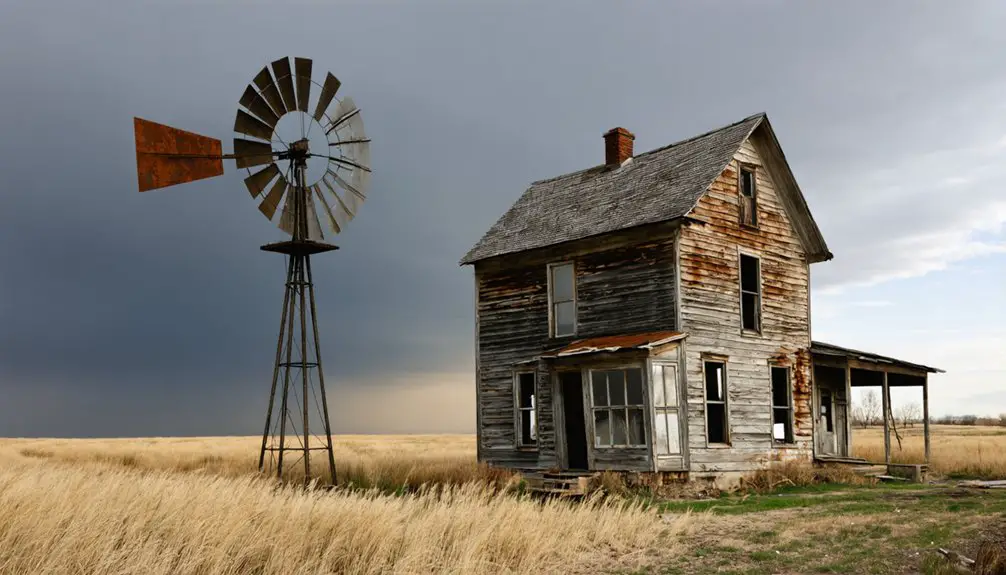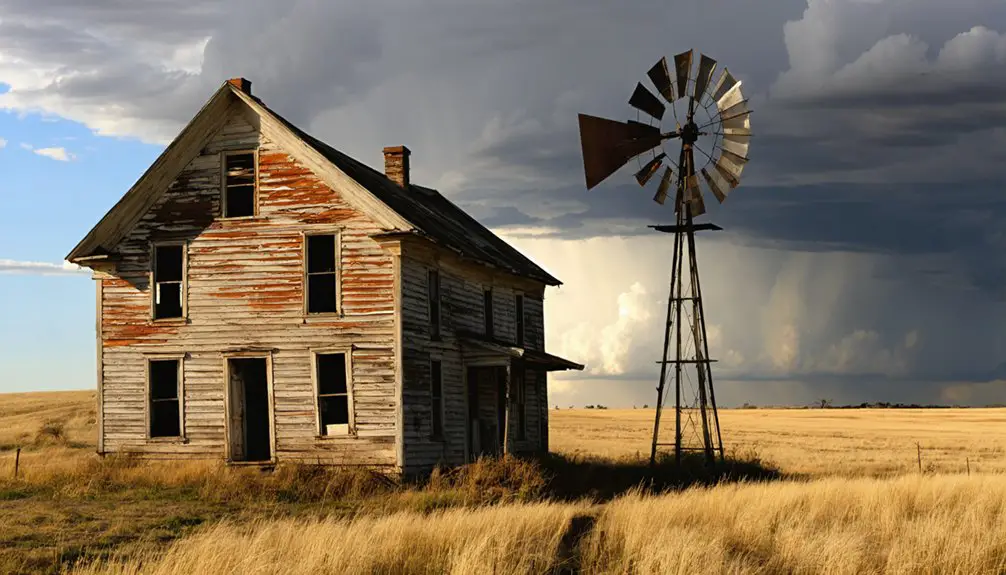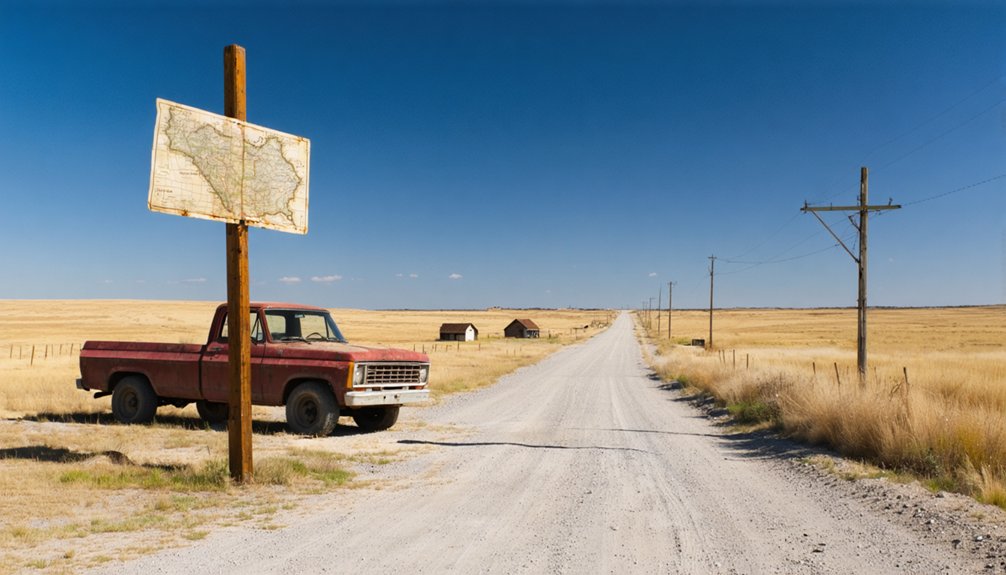
You’ll find the DeWitty historic marker along U.S. Highway 83 at milepost 198 in Cherry County’s Sandhills, accessible from Valentine via U.S. 20 west. While no original structures remain from this remarkable African American homesteading community—where 58 Black pioneers once claimed nearly 30,000 acres between 1907 and the 1930s—a Nebraska State Historical Marker installed in 2016 commemorates their legacy. Plan your visit between late spring and early fall when mild temperatures and clear roads make navigation safer, and you’ll discover the full story behind this forgotten settlement.
Key Takeaways
- DeWitty is located on U.S. 20 west of Valentine at Highway 83 junction, milepost 198 in Cherry County’s Sandhills.
- Visit late spring through early fall for mild weather, accessible roads, and vibrant landscapes while avoiding harsh winter conditions.
- Only a Nebraska State Historical Marker remains at the site; no original sod structures or physical traces of settlement exist.
- Valentine offers nearby amenities for travelers, with Brownlee and Wood Lake as additional communities along the route.
- DeWitty was established by 58 Black homesteaders who claimed nearly 30,000 acres and built a church, schools, and businesses.
Getting to the DeWitty Historic Marker in Cherry County
When you’re heading west on U.S. 20 from Valentine, you’ll find the DeWitty historic marker three miles past the Highway 83 junction at milepost 198. The marker sits on your left side as you traverse Nebraska’s expansive Sandhills region, where cattle ranches stretch across semi-arid grasslands.
Valentine, founded in 1882 and your staging point, offers local amenities before you venture into Cherry County’s remote terrain. The nearby communities of Brownlee, with just fifteen residents, and Wood Lake provide glimpses into the area’s frontier character.
Installed in 2016 by the Nebraska State Historical Society, this roadside monument marks where DeWitty’s black homesteaders claimed their 640-acre parcels along the North Loup River between 1904-1908, establishing Nebraska’s longest-lasting African American settlement.
What Remains at the DeWitty Ghost Town Site Today
When you arrive at the DeWitty site along Highway 83, you’ll find the Nebraska State Historical Marker installed in 2016 through crowdfunding efforts—the primary physical record/documentation/account to this once-thriving community of 150 Black homesteaders.
Unlike other ghost towns that retain skeletal buildings or foundations, DeWitty’s original sod structures have completely deteriorated in the decades since settlers abandoned their 29,402 acres to adjoining ranchers in 1936.
The marker’s coordinates now serve as the sole official reference point for visitors seeking to understand where African-American families built homes, farmed semi-arid Sandhills land, and created Nebraska’s longest-lasting Black rural settlement from the 1900s through the Great Depression.
Historic Marker and Coordinates
Unlike most ghost towns where crumbling foundations hint at former lives, DeWitty’s landscape offers no physical structures to mark where Nebraska’s largest African American homesteading community once thrived. The Nebraska State Historical Society’s roadside marker, dedicated April 11, 2016, stands as the sole memorial to this vanished settlement. Descendants crowdfunded $5,100 for this marker history preservation, ensuring their ancestors’ legacy wouldn’t disappear entirely.
Key marker placement details for your visit:
- Located on U.S. Highway 20, three miles west of Highway 83 intersection
- GPS coordinates: 42.284600, -100.536268
- Positioned 10 miles northwest of Brownlee in Cherry County
- Situated near the North Loup River where 82 Black residents once homesteaded 640-acre parcels
You’ll find this commemoration where semi-arid Sandhills reclaimed what perseverance briefly conquered.
No Standing Structures Remain
Standing at the historical marker on Highway 20, you’ll scan the horizon for weathered boards or crumbling foundations—but the Sandhills grassland stretches unbroken in every direction. DeWitty’s lack of preserved structures stems from its original sod construction and the region’s unforgiving semi-arid conditions. When the last African American resident departed in 1936, nature reclaimed everything—no church steeple, no store facade, no schoolhouse walls survived the decades.
The 56 homesteads that once covered 29,402 acres vanished completely as ranchers absorbed the parcels. You’re standing where 150 people built their dreams, yet zero archaeological traces mark their presence. The enduring settlement impact exists only in historical records and descendant memories, not in physical evidence. The land’s reverted to its pre-homestead state, supporting cattle rather than crops.
Best Time of Year to Visit the Nebraska Sandhills
You’ll want to plan your DeWitty ghost town road trip between late spring and early fall when the Nebraska Sandhills reveal their full character. The mild temperatures from May through October—ranging from 61°F to 82°F—make exploring the remote prairie landscape comfortable, while winter’s harsh conditions and unpredictable snowfall can render the rural roads nearly impassable.
Time your visit during these warmer months to safely navigate the backcountry routes and fully appreciate the windswept grasslands that once sustained this historic African American homesteading community.
Spring Through Early Fall
When planning your visit to DeWitty, timing matters as much as the journey itself. Spring through early fall offers ideal conditions for exploring this historic African American settlement in Nebraska’s Sandhills. The favorable growing seasons that once drew settlers between 1900-1915 still provide the best window for your road trip adventure.
Why These Months Work Best:
- Accessible Terrain – Improved road conditions let you navigate Brownlee Road and Highway 83 without spring mud or winter hazards
- Vibrant Landscapes – Sandhills grasses green-up showcases the semi-arid region’s surprising beauty
- Wildlife Activity – Migratory birds and ranch life unfold across the North Loup River valley
- Site Visibility – The 2016 historical marker and settlement remnants stand clear without snow obstruction
You’ll experience DeWitty as its pioneering families did during their most prosperous years.
Avoiding Harsh Winter Conditions
The same Sandhills isolation that offered African American homesteaders freedom from discrimination in the early 1900s transforms into a formidable adversary during Nebraska winters. You’ll face harsh winter driving conditions including black ice on bridges, crosswinds on north-south highways, and temperatures hovering near 32 degrees that create treacherous surfaces. Communities spread 20+ miles apart limit your access to help during emergencies.
If you’re determined to visit between November and March, pack emergency preparedness supplies: blankets, flashlight, first-aid kit, sand, shovel, and booster cables. Keep your fuel tank half-full minimum. Roads like US 281 experience complete snow coverage, while strong westerly winds pummel I-80’s exposed plains.
Your safest choice? Visit spring through early fall when Dewitty’s story unfolds without winter’s isolation threatening your journey.
The Remarkable Story of DeWitty’s African American Pioneers
Between 1902 and 1904, Leroy Gields and his sister Matilda Robinson staked the first claims in what would become DeWitty, establishing an African American homesteading presence in Nebraska’s vast Sandhills. The 1904 Kinkaid Act‘s promise of 640 free acres drew former slaves and their descendants seeking land ownership denied them in the South.
The remarkable achievements of DeWitty’s founders included:
- 58 Black homesteaders proving up claims on nearly 30,000 acres
- Building St. James AME Church as their spiritual center in 1910
- Establishing three school districts where Black and white children learned together
- Creating thriving businesses including a post office, store, and barber shop
Despite these accomplishments, the hardships faced by DeWitty’s homesteaders—insufficient acreage for ranching and marginal farming conditions—ultimately forced most residents away by 1936.
Exploring Nearby Brownlee and the North Loup River Area
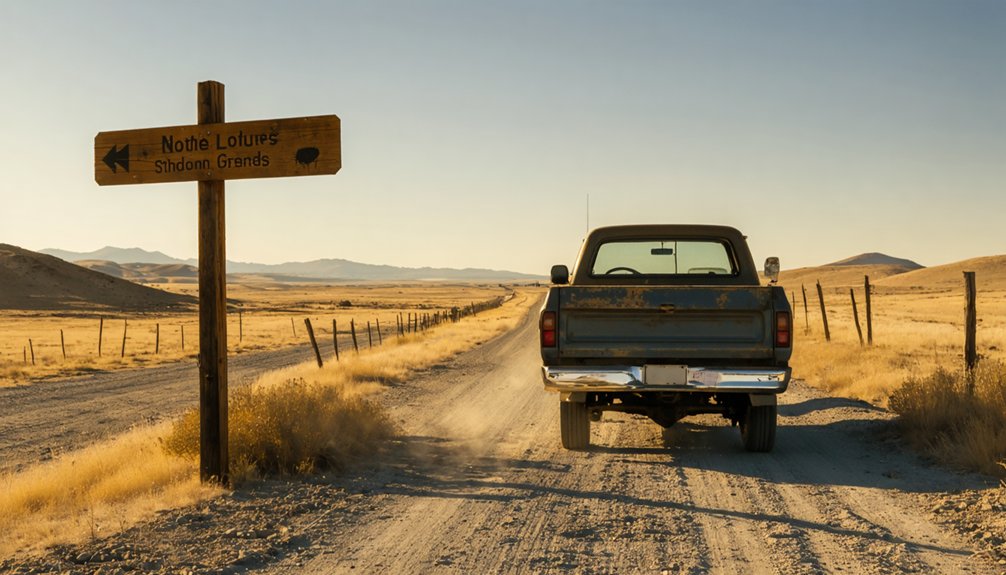
Just a few miles from DeWitty’s historical marker on Highway 83, you’ll find the Brownlee turnoff leading to what remains of another vanished Nebraska community. The town site sits along the North Loup River, where John R. Lee built the first frame store in 1886, transforming isolated ranchland into a bustling trade center that once boasted three general stores, a bank, and a hotel.
Today, you can access the North Loup River near historic crossings like Twin Bridge and the 1903 Bell Bridge, one of four Pratt through truss structures that survived the catastrophic 1916 ice flood.
Historic Brownlee Town Site
Nestled along the North Loup River in Nebraska’s Sandhills region, Brownlee represents one of the Great Plains’ quieter chapters in frontier history. Founded in 1886 by Irish immigrants John R. and William B. Lee, this unincorporated settlement tells a remarkable story of coexistence. You’ll find remnants of what once thrived alongside the chiefly Black settlement of DeWitty.
When you visit the historic town site, you’ll discover:
- Community hall where integrated Fourth of July celebrations united neighboring settlements
- Brownlee church standing as symbol to shared frontier values
- Evidence of interracial couples who defied social conventions
- Integrated schoolhouses that educated children from both communities together
Today’s population of thirteen preserves this unique legacy where freedom meant choosing cooperation over division.
North Loup River Access
The North Loup River flows past Brownlee’s historic grounds, offering modern adventurers a waterway that connects you to the same landscape DeWitty’s homesteaders once inhabited. You’ll find public access at Ord Veteran’s Grounds, where a floating dock welcomes kayakers and canoeists to this designated water trail.
The spring-fed, sand-bottomed river maintains exceptional water quality, perfect for paddling the 18.5-mile stretch from Burwell to Ord. Anderson Island serves as your downstream exit point after a full day’s journey.
Wildlife viewing opportunities abound along these banks—watch for waterfowl, quail, and rabbits across the riparian corridor. At North Loup State Recreation Area, you can fish for bluegill, channel catfish, and largemouth bass before camping at primitive sites that mirror the self-sufficient spirit of Nebraska’s pioneering communities.
Essential Supplies for Your Remote Sandhills Adventure
Before you venture into the isolated prairie surrounding DeWitty, you’ll need to pack with the understanding that help isn’t coming quickly if something goes wrong. Your emergency communication plans should include a satellite communicator like Garmin inReach, since cell coverage disappears miles before you reach the ghost town.
Follow these durable packing recommendations:
- Navigation trio: GPS device, compass, and printed Cherry County topographic maps
- Vehicle essentials: Full spare tire, 10+ gallons extra fuel, recovery straps, and reinforced undercarriage protection
- Water reserves: Minimum 1 gallon per person daily, plus purification tablets and 5-gallon jerry cans
- Survival kit: First aid supplies with snake bite treatment, emergency blanket, fire starter, and weather radio
Pack non-perishable foods for 3-5 days and rodent-proof storage containers for this genuine wilderness experience.
Combining Your Trip With the Stuhr Museum Exhibit
While driving Highway 2 westward from Grand Island toward the Sandhills, you’ll pass within blocks of the Stuhr Museum—a detour that transforms your ghost town expedition from simple exploration into profound historical understanding.
The “Descendants of DeWitty” exhibit chronicles the twelve pioneering families who carved out Nebraska’s longest-lasting Black settlement on 640 Cherry County acres. Museum programming runs Monday-Saturday 9am-5pm, Sunday 10am-5pm, offering context you’ll carry to the actual site.
Exhibit events like descendant receptions connect visitors with living family histories—Artes Johnson, whose ancestors founded DeWitty, directs the narrative personally. Before traversing those remote Sandhills roads, ground yourself in authentic stories of homesteaders who defied discrimination to build Audacious. Check their website for current display dates and related programming that deepens your independent journey.
Photography Tips for Capturing the Sandhills Landscape
Arriving at DeWitty’s remnant landscape, you’ll immediately confront the Sandhills’ deceptive simplicity—miles of undulating prairie that appear monochromatic until proper light reveals layered textures invisible to hurried observation. Capture this ecosystem’s essence through patient methodology:
- Golden hour skimming light transforms grass-stabilized dunes into dimensional waves, emphasizing topographic subtleties
- Layered foreground-to-background compositions establish scale across seemingly flat terrain
- Moody atmospheric conditions during seasonal color variations add dramatic context to conservation storytelling
- Wildlife photography opportunities emerge during patient observation sessions
Pack telephoto lenses (400-600mm), sturdy tripods for low-light work, and protective gear for Nebraska’s variable weather. This landscape rewards those who slow down—revealing North America’s largest grass-stabilized dune system through deliberate visual exploration rather than casual snapshots.
Understanding the Kinkaid Act and Homesteading History
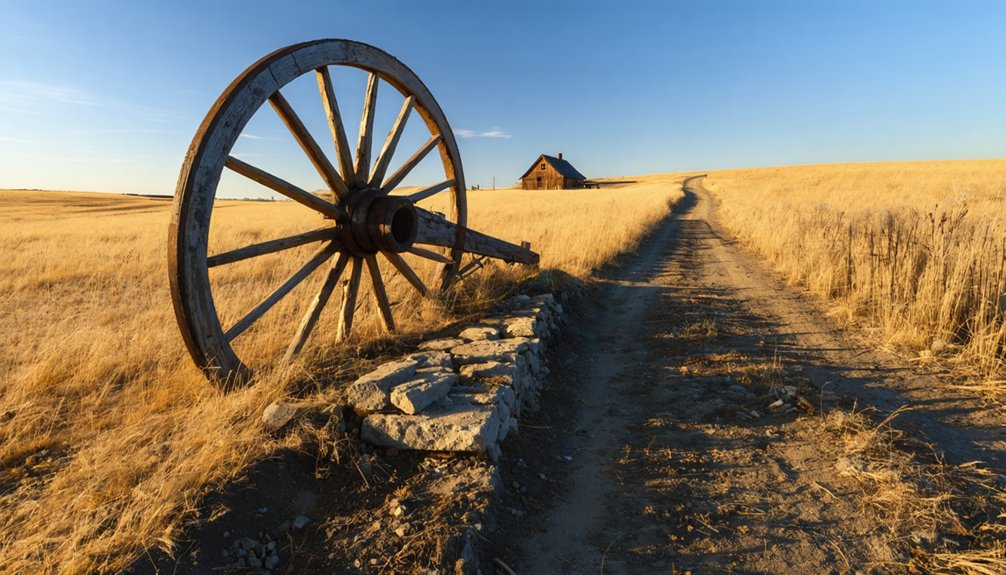
Standing among DeWitty’s weathered foundations, you’re witnessing the physical aftermath of America’s most ambitious—and ultimately tragic—experiment in dry-land homesteading. The Kinkaid Act of 1904 promised 640 acres to anyone brave enough to challenge the Sandhills’ unforgiving terrain.
Before this legislation, the role of large ranchers dominated these grasslands through fraudulent claims and illegal fencing of public domain. Congressman Moses Kinkaid’s bill aimed to break their stranglehold by opening nine million acres to settlers like DeWitty’s African American pioneers.
But homestead land use challenges proved insurmountable—640 acres couldn’t sustain farming in these mobile dunes, and ranching required far more acreage. Most homesteaders abandoned their claims within years, ironically selling back to the very ranchers they’d displaced, cementing cattle culture’s ultimate victory.
Other Historic Sites to Visit Along Highway 83
Beyond DeWitty’s silent foundations, Highway 83 threads through a corridor of American expansion where monuments and museums preserve stories of westward migration. You’ll find authentic experiences far removed from typical roadside attractions, with historic route signage guiding you to:
- Old Highway 83 Alignment – Navigate gravel curves mimicking early motoring four miles south of North Platte, where Grain Bin Antique Town sits alongside this preserved stretch
- Fort Cody Trading Post – Explore frontier artifacts in North Platte (308-532-8081)
- Harold Warp Pioneer Village – Discover 350 vintage vehicles and America’s oldest steam merry-go-round in Minden ($14 admission)
- Chimney Rock – Stand where trail pioneers marked their westward progress at this National Historic Site near Bayard
Each stop reveals layers of settlement patterns that shaped Nebraska’s identity.
Frequently Asked Questions
Were Dewitty Residents Allowed to Vote During the Settlement’s Existence?
Yes, you’ll find DeWitty residents exercised voting rights and political representation throughout the settlement’s existence. Nebraska laws granted African American homesteaders full citizenship privileges after meeting residency requirements, with no documented disenfranchisement barriers in the Sandhills region.
What Crops Did Dewitty Farmers Primarily Grow in the Sandhills?
While cattle ranching dominated the Sandhills, DeWitty farmers courageously grew corn, potatoes, oats, and sorghum instead. They processed molasses on-site and diversified grain harvests, though sandy soil and semi-arid conditions ultimately proved these alfalfa crops unsustainable for their independent dreams.
Did Dewitty Children Attend School With White Children From Brownlee?
Yes, DeWitty children attended integrated one-room schoolhouses with white Brownlee students. You’ll find this interracial school attendance remarkable, reflecting progressive community social dynamics where mutual dependence in Nebraska’s remote Sandhills fostered cooperation despite nationwide racial tensions during that era.
What Happened to the Church Building After Residents Left?
The church building’s fate remains undocumented, though you’ll find only its foundation today at DeWitty’s site. No records detail the building’s current condition or preserve descriptions of the church’s architectural features after settlers departed by 1936.
Are Any Descendants Still Living in Cherry County Today?
No descendants currently maintain livelihoods in Cherry County, though they’ve preserved strong local community connections through the Descendants of DeWitty organization. The last African American resident departed in 1936, ending the settlement’s physical presence in the region.