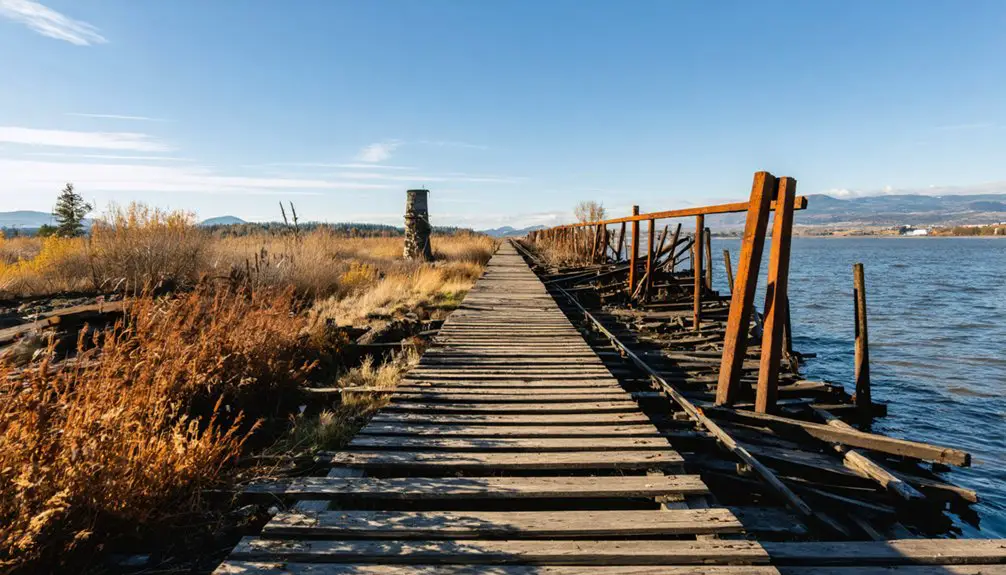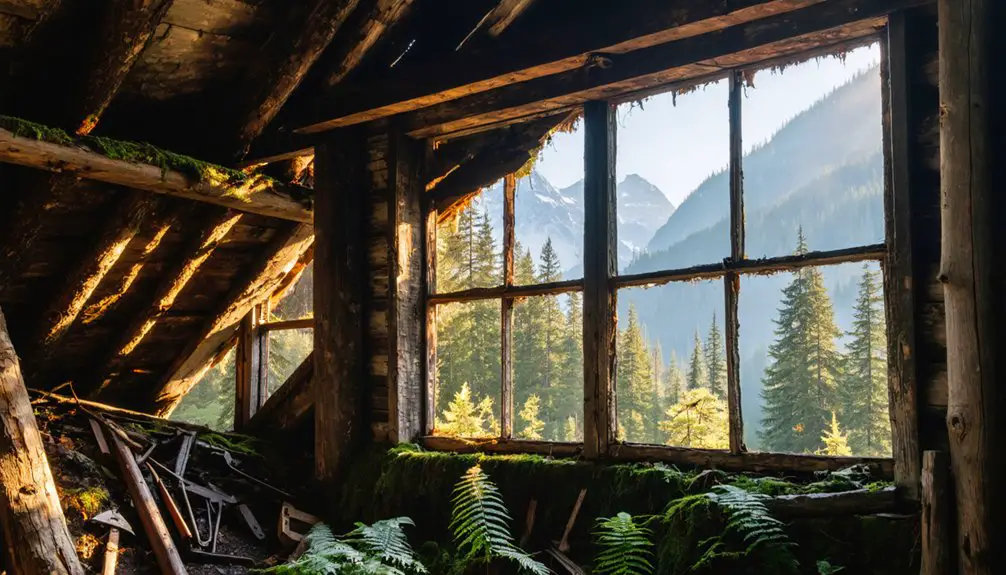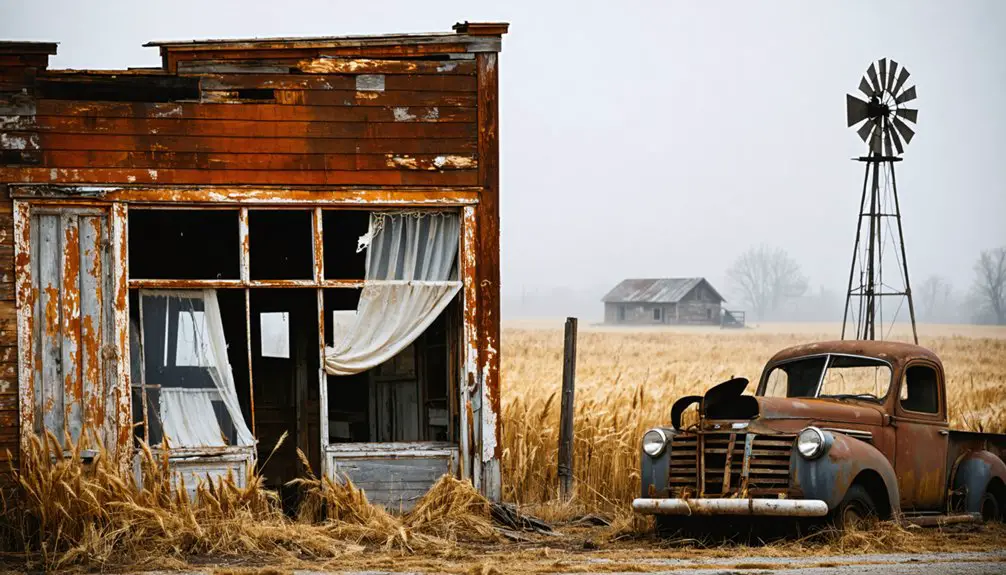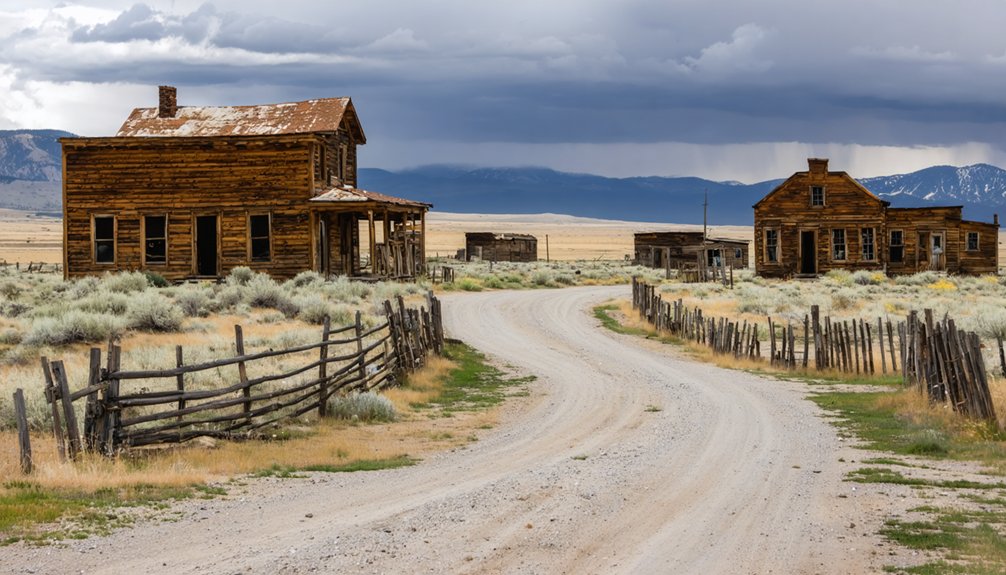
Your ghost town road trip begins with a 25-minute drive from Omak along winding two-lane roads where cell service vanishes and a towering Sasquatch sentinel marks Disautel Pass. You’ll discover weathered schoolhouses, crumbling foundations, and gravestones beneath ancient firs—remnants of a logging boomtown that thrived until the Great Depression delivered its final blow. Visit between April and June for ideal weather, fuel up before departing, and prepare for exploration where independence means self-sufficiency in these isolated Cascade foothills.
Key Takeaways
- Drive 15 miles from Omak on a two-lane mountain road; fuel up beforehand as no services exist en route.
- Visit April-June or September for moderate temperatures and solitude; avoid July-August heat and winter road hazards.
- Explore the standing schoolhouse, church, Pioneer Cemetery, and foundation ruins scattered throughout the accessible ghost town site.
- Look for the 18-foot Sasquatch sentinel marking Disautel Pass and remnants of Biles-Coleman Logging Company equipment.
- Bring supplies for self-sufficiency as cell signals fade and the area remains remote year-round.
The Rise and Fall of a Logging Boomtown

Before the shriek of steam donkeys echoed through Washington’s ancient forests, logging was a humble affair—men with axes and crosscut saws working within shouting distance of the shoreline. You’d have found oxen dragging timber through tidelands, their hooves churning mud as they hauled Douglas fir to waiting mills.
Then everything changed. Steam-powered equipment in the 1880s liberated logging operations from their waterbound shackles, pushing deep into previously untouched wilderness. Railroads revolutionized timber transportation—narrow gauge trains snaking through mountain passes, hauling 100-car loads during peak seasons.
Between 1912 and 1927, boomtowns erupted wherever tracks met timber. Camps sprawled into company towns, complete with bunkhouses and cookstores.
Then silence. When the trees fell, so did the towns.
What Remains of Disautel Today
Today, Disautel sleeps beneath a blanket of encroaching wilderness. You’ll find the schoolhouse and church still standing—leaning slightly, defiant against time’s pull. Low rock walls emerge from brush, outlining where six general stores and saloons once thrived.
The Pioneer Cemetery guards its secrets beneath ancient fir trees, where gravestones date to the late 1800s. Gravesite preservation efforts removed historic markers to protect them, leaving only stone bases visible among mining disaster victims and early settlers.
Erosion effects haven’t been kind—weathered structures crumble into Cascade foothill terrain, half-swallowed by forest reclamation. Creek beds replace human voices with rushing water. You’re free to explore via Washington Trails Association routes, wandering these accessible ruins that’ve known no inhabitants since 1942.
Getting There: Directions From Omak
From Omak’s weathered storefronts, you’ll trace Highway 155 eastward into terrain that swallows civilization incrementally. This fifteen-mile passage demands twenty-five minutes of attention—no alternative travel options exist beyond your own wheels.
The two-lane ribbon curves through mountain passages where cell signals fade and wildlife crosses without warning. Route descriptions seem almost unnecessary; simply follow SR 155 through increasingly wild country until you reach Disautel Pass, marked by Smoker Marchard’s eighteen-foot Sasquatch sentinel. Its rotating arm catches wind like a compass pointing toward forgotten places.
The ghost town’s ruins appear roadside, accessible year-round to those with standard vehicles and winter nerve. Fuel up in Omak—independence here means self-sufficiency. No permits required, no schedules binding your departure.
Best Time to Visit This Okanogan County Ghost Town
Timing your pilgrimage to Disautel’s skeletal remains shapes everything—the crunch beneath your boots, the clarity of light on collapsed timbers, the solitude you’ll claim among the ruins.
April through June delivers ideal weather without seasonal crowds suffocating your exploration. Temperatures hover between 10–24°C, perfect for wandering decayed structures without summer’s scorching heat.
September offers equal magic—golden light bathing weathered wood, harvest-season stillness replacing Memorial Day madness.
Avoid July and August unless you’re chasing peak warmth; you’ll sacrifice solitude for sweltering conditions. Winter transforms Disautel into frozen isolation, though snow-packed roads might strand you midway. The road demands respect year-round—check Okanogan County conditions before departing.
Shoulder seasons grant you what ghost towns deserve: emptiness, moderate temperatures, and freedom to linger undisturbed among forgotten histories.
Notable Structures and Remnants to Explore
Disautel guards its secrets beneath Okanogan’s relentless sun—what remains stands as fragments rather than monuments, whispers of settlement where certainty once thrived. You’ll find no reliable information about Disautel‘s specific structures documented in conventional archives, which makes your exploration genuinely untamed territory.
The historical significance of remnants here lies not in preservation but in absence—foundations swallowed by sagebrush, weathered wood surrendering to elements, scattered evidence of lives lived beyond bureaucratic record-keeping.
What you’ll discover depends entirely on your willingness to read landscape as text. Foundation stones might mark homesteads. Depressions suggest root cellars. Rusted fragments tell stories official histories overlooked. This isn’t curated heritage—it’s raw archaeology of self-determination, where people carved existence from harsh country then vanished, leaving only questions for those bold enough to seek answers in dust.
The Biles-Coleman Logging Company Legacy
While ghosts haunt Disautel’s sagebrush slopes, the most substantial specter belongs to the Biles-Coleman Lumber Company—an operation that didn’t just extract timber but rewrote logging’s possibilities across Washington’s unforgiving terrain.
You’ll find traces of their innovation in logging equipment everywhere: solid-tired Moreland trucks that conquered Moses Mountain in 1927, Knox trucks with iron-wheeled trailers that pioneered motor hauling in 1914, and Washington’s last narrow gauge logging railroad threading through Omak Mountain until 1948.
What sets this ghost apart? The conservation efforts by Biles Coleman outlasted the sawdust. Superintendent Emmit Aston transformed Camp Progress into a forest education center, hosting University of Washington students while covering their costs—proving extraction and preservation could coexist on these wild slopes.
How the Great Depression Sealed Disautel’s Fate
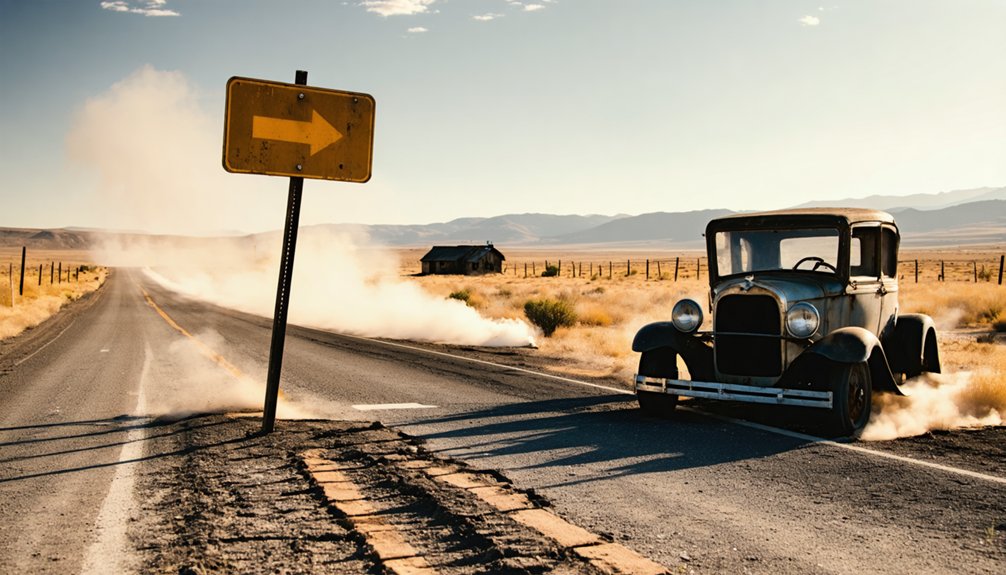
The sawmill’s rhythmic hum had already begun fading from Disautel’s valley when October 1929’s stock market collapse delivered its final blow. You’ll discover how economic isolation transforms thriving communities into dust when workers had already abandoned their homes for Omak’s promise, leaving Disautel vulnerable.
The Depression didn’t just close the sawmill—it erased the town’s reason for existing. By the mid-1930s, only empty buildings remained, repurposed briefly as highway department warehouses before complete abandonment.
Standing here today, you’re witnessing lessons for modern communities: towns dependent on single industries face extinction when economic winds shift. Disautel’s ghost town status serves as your reminder that freedom requires diversification—no community survives on borrowed time and singular purpose.
Combining Your Trip With Nearby Ghost Towns
Your understanding of economic collapse won’t end at Disautel’s weathered foundations—Okanogan County harbors dozens of abandoned settlements within an hour’s drive, each whispering different stories of boom and bust.
Nighthawk’s crumbling hotel and mill remnants stand registered with the Historical Society, while Molson preserves full-scale buildings and mining equipment in the Okanogan Highlands.
You’ll find Chesaw’s ghostly remnants 30 minutes east of Oroville, where Chinese miners once sparked a placer gold rush. Bodie’s cookhouse ruins hide 15 miles north of Wauconda along Toroda Creek.
Loomis transformed from eight-saloon rowdiness to quiet country road lined with century-old homes. These nearby historic markers illuminate local pioneer history through weathered wood and rusted iron—tangible evidence of humanity’s restless pursuit of fortune across unforgiving landscapes.
Safety Tips for Rural Exploration

When you’re exploring ghost towns like Disautel in Washington’s remote backcountry, proper preparation separates an adventure from a crisis. Rural roads here stretch through areas where cell service vanishes, emergency help sits hours away, and weather conditions can shift dramatically within minutes.
Pack essential survival gear, maintain constant awareness of your surroundings, and understand that the isolation that makes these abandoned settlements so hauntingly beautiful also demands your complete self-reliance.
Essential Gear and Supplies
Before you venture into Disautel’s crumbling structures and overgrown pathways, equipping yourself with proper safety gear transforms a reckless gamble into a calculated adventure. Your footwear preparation starts with thick-soled boots that’ll shield you from rusty nails lurking beneath rotted floorboards.
Equipment maintenance before departure guarantees your gear won’t fail when you need it most.
Critical gear for exploring Disautel:
- Head protection – A sturdy helmet guards against collapsing beams and low ceilings in decaying buildings
- Illumination kit – LED headlamp with backup batteries reveals hidden hazards in windowless structures
- Hand protection – Cut-resistant gloves prevent lacerations while climbing through debris
- Emergency supplies – Compact first-aid kit, whistle, and fire starter for unexpected situations in this isolated location
Long sleeves and weather-appropriate layers complete your armor against this ghost town’s unforgiving elements.
Remote corners of Okanogan County swallow cell signals whole, leaving adventurers who venture toward Disautel in a communications blackout that can stretch for miles. You’ll need alternatives when cellular connectivity vanishes into wilderness.
Pack a satellite communicator or handheld GPS with offline maps—these devices become lifelines when traditional communication channels fail. Download topographic maps before departure, marking logging roads and landmarks that’ll guide you back. A detailed paper map serves as backup when batteries die.
Inform someone of your route and expected return time. Consider a two-way radio if traveling with companions in multiple vehicles. This isn’t paranoia—it’s respecting the isolation that defines ghost town territory.
Out here, self-reliance isn’t optional; it’s the admission price to places civilization forgot.
Wildlife and Weather Awareness
The wilderness around Disautel doesn’t care about your schedule—it operates on rhythms shaped by predators, prey, and atmospheric pressure systems that swing between extremes. You’ll navigate wildlife migration patterns that bring deer and elk across State Route 155 during dawn and dusk, while black bears emerge from spring hibernation hungry and unpredictable.
Unexpected animal encounters happen when you’re least prepared—a coyote materializing near abandoned structures, raptors circling overhead at Disautel Pass.
Essential awareness protocols:
- Maintain 100-yard bear distance and carry deterrent spray through forested corridors
- Pack layers for 40°F temperature swings between scorching afternoons and frigid evenings
- Monitor July-September thunderstorm forecasts that transform dusty trails into flash flood channels
- Secure all food in vehicles—scent carries miles in Okanogan’s thin air
Photography Opportunities in the Abandoned Landscape
You’ll find Disautel’s weathered logging structures offering raw, textural subjects that tell decades of abandonment through splintered wood and peeling paint. The empty warehouses frame compositions where nature reclaims industry—rusted equipment emerging from wild grasses, barn skeletons standing against Okanogan’s rugged highlands.
Your lens captures isolation here, where each crumbling edifice becomes a monument to the sawmill workers who left these buildings to the elements.
Historic Logging Structures Remain
Although decades have passed since the Biles-Coleman Logging Company shuttered its operations, Disautel’s landscape still whispers stories through weathered remnants. You’ll discover traces of historic log transport systems where narrow gauge rails once carved paths through wilderness. The remnant camp infrastructure reveals itself to those willing to venture off-trail.
Key discoveries await your exploration:
- Foundation outlines from remodeled classrooms at Camp Progress, where education replaced extraction across 105 acres
- Exposed water piping systems snaking through undergrowth, serving communities long scattered
- Ballast loading spur locations documented in 1979 photographs, marking where Heisler No. 102 once labored
- Surface artifact scatters—glass shards, rusted tin cans, ceramic fragments—mapping invisible boundaries of vanished settlements
Each element composes a tangible connection to forest industry heritage.
Abandoned Warehouse Compositions
Where light fractures through collapsed rooflines and nature reclaims industrial bones, Disautel’s abandoned structures become living canvases for photographers. You’ll find architectural decay telling stories that bureaucrats never could—weathered timber against wild grass, rust bleeding through corrugated metal, shadows dancing across forgotten spaces.
These industrial ruins don’t offer polished Instagram moments. They demand you crawl through brambles, risk splinters, and embrace the raw beauty of entropy. Frame your shots through broken windows where forest light pierces darkness. Capture the tension between human ambition and nature’s patient reclamation.
Early morning brings fog that transforms decay into something ethereal. Golden hour paints everything with defiant warmth. You’re not just photographing buildings—you’re documenting freedom’s architecture, where nothing’s manicured and everything’s authentically, beautifully uncontrolled.
Rural Okanogan County Vistas
Beyond Disautel’s skeletal buildings, Okanogan County unfolds in sweeping panoramas that photographers dream about—boundless terrain where abandoned logging roads carve through sagebrush hills and the Columbia Plateau stretches toward mountains that bruise purple at dusk. You’ll discover compositions impossible in regulated landscapes, where decay meets wilderness without interference.
Prime Vista Locations:
- State Route 155 pullouts – Roadside access to dramatic cliff overlooks where the abandoned townscape merges with canyon geography
- Derelict logging trails – Overgrown paths leading to elevated vantage points across remote outdoor settings
- Dawn silhouettes – Empty structures backlit against Okanogan’s vast eastern horizons
- Storm light sequences – Rapidly changing weather transforms ghost town ruins into theatrical studies of abandonment
You’re photographing freedom itself—unmanaged spaces where history crumbles undisturbed.
Frequently Asked Questions
Are There Any Facilities or Services Available in Disautel for Visitors?
No facilities await you at Disautel—you’re truly on your own. There’s no public transportation, water sources, or services whatsoever. Pack everything you’ll need, embrace complete self-reliance, and prepare for raw, unfiltered wilderness adventure at this remote pass.
Is Permission Required to Explore the Abandoned Structures in Disautel?
You’ll need to seek landowner permission before exploring Disautel’s structures, as they’re on private property. Respect the site’s cultural significance to the Okanogan people—this isn’t just adventure territory, it’s sacred ground deserving your thoughtful approach.
What Wildlife Might I Encounter While Visiting the Ghost Town?
You’ll encounter deer sightings dancing through deserted buildings, diverse bird species soaring overhead—from majestic eagles to great horned owls. Black bears roam freely here, while trout shimmer in nearby lakes. Nature’s reclaimed this forgotten place completely.
Can I Camp Overnight Near Disautel or in the Surrounding Area?
You’ll find nearby camping options on surrounding BLM lands offering dispersed sites with rugged freedom. Seasonal accessibility considerations matter here—winter snows close mountain passes, while summer opens endless possibilities for your untethered ghost town adventure.
Are Any Guided Tours Available for Disautel and Nearby Ghost Towns?
No guided tours exist here—you’ll explore independently, discovering historical significance at your own pace. You’ll capture photography opportunities freely, wandering abandoned buildings and weathered landscapes without schedules, embracing the untamed spirit of these forgotten places alone.