Exit I-10 at Desert Center and drive 12 miles north on Kaiser Road toward Eagle Mountain, where 400 abandoned homes and a massive 1.5-mile open pit await your exploration. You’ll need a high-clearance vehicle for the bone-jarring final stretch through genuine middle-of-nowhere territory. The ghostly remnants of Kaiser Steel’s former mining town—complete with rusted railroad tracks and crumbling refineries—sit near Joshua Tree National Park‘s southeastern boundary. Pack plenty of water for summer temperatures exceeding 115°F, and prepare your camera for this post-apocalyptic landscape that’s captivated Hollywood film crews and urban explorers alike.
Key Takeaways
- Exit Interstate 10 at Desert Center and drive 12 miles north on Kaiser Road; high-clearance vehicles required for final dirt tracks.
- Eagle Mountain sits 80 miles from Palm Springs near Joshua Tree National Park’s southeastern boundary in remote mining country.
- Explore 400 abandoned homes, three massive open-pit mines, rusted refineries, and remnants of the 52-mile Eagle Mountain Railroad.
- Bring adequate fuel, water, and supplies as nearest services are miles away in genuine middle-of-nowhere desert conditions.
- Territory has been restricted and patrolled since 2007; respect boundaries while viewing the post-apocalyptic mining landscape.
The Rise and Fall of a Desert Mining Community
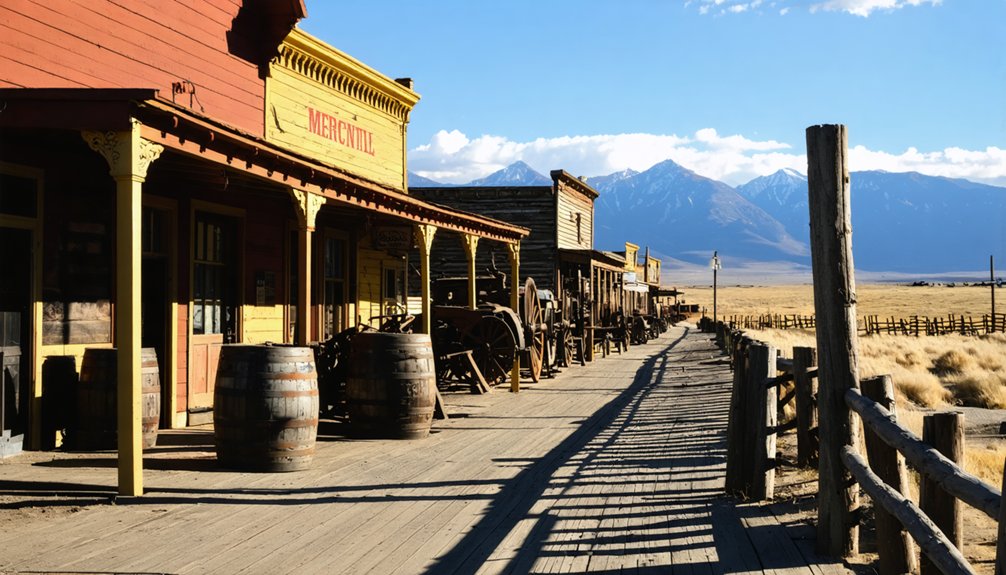
Deep in the Colorado Desert, where summer temperatures regularly soar past 115°F and the nearest civilization sits an hour’s drive away, Kaiser Steel Corporation saw opportunity in the rust-colored mountains. In 1948, they built a 52-mile railroad and extracted 120 million tons of iron ore over three decades.
What started as America’s largest western iron mine grew into a thriving town of 1,500 workers, complete with a high school, post office, and grocery store.
Then foreign competition and environmental devastation concerns crushed the operation. By 1983, the mine closed permanently. Community displacement followed swiftly—the grocery store shuttered in October 1982, the post office vanished, and families scattered across California’s desert highways, leaving behind empty homes and abandoned dreams in the unforgiving heat.
Getting to Eagle Mountain: Routes and Access Points
Your journey to Eagle Mountain begins on Interstate 10, where you’ll exit at Desert Center—a dusty outpost roughly midway between Indio and the Arizona border.
From there, Kaiser Road (County Route R2) stretches twelve miles north through creosote flats and desert silence, leading you straight to the abandoned mining town at the foot of the Eagle Mountains.
You’re trading urban convenience for isolation here; the nearest gas station fades in your rearview mirror as you head toward a ghost town that once thrived on iron ore and railroad dreams.
Primary Highway Access Routes
Reaching Eagle Mountain requires traversing a network of highways that gradually narrows from interstate corridors to dusty desert tracks. You’ll navigate CA-177 as your primary artery from Joshua Tree National Park areas, cutting through the Eagle Mountains Zone toward the southern Coxcombs. This State Route appears prominently on US Topo maps, guiding you past Desert Center where secondary highways branch toward local connectors.
From Cottonwood Spring’s 3,100-foot trailhead, paved certainty surrenders to dirt uncertainty. Black Eagle Mine Road beckons directly to the ghost town, though corporate fences now guard what was once open territory. Since July 2007, public safety concerns and restricted recreational use have transformed these approaches.
The bone-jarring final miles demand high-clearance vehicles, testing your commitment to freedom’s furthest edges where asphalt memories fade into sand.
Distance From Major Cities
From Los Angeles, the 250-mile journey eastward dissolves urban sprawl into increasingly raw desert terrain, typically consuming four to five hours as you trace the I-10 corridor past Riverside’s suburban outposts and Indio’s date palm groves.
Distance benchmarks from major departure points:
- Palm Springs: 80-100 miles via State Route 177, approximately 90 minutes through Joshua Tree’s southern flank
- San Diego: 723-mile commitment requiring 12+ hours, though railway distance proves comparable for budget-conscious travelers
- Pomona: 159 miles crossing inland valleys, 2.5-3 hours through shifting landscapes
- Blythe: Nearest civilization at 54-70 miles westward along Eagle Mountain Road
- Regional travel costs: Factor fuel expenses heavily; nearest services exist miles from your destination
You’re chasing isolation here—plan accordingly for genuine middle-of-nowhere conditions.
Nearby Landmarks and Waypoints
The ghost town materializes where Joshua Tree National Park‘s southeastern boundary fractures into mining country—a landscape of twisted Joshua trees yielding to scarred bedrock and industrial ruins.
You’ll navigate from Interstate 10, where desert highway meets forgotten dreams, roughly three hours from Los Angeles’s gridlock. Watch for the 1.5-mile open pit carved into mountainside—your unmissable landmark.
The Eagle Mountain Railroad cuts through this territory, its rusted rails threading past 400 abandoned homes and decrepit refineries. Scenic vistas here blend natural rock formations with apocalyptic decay, while indigenous wildlife—bighorn sheep, roadrunners, kit foxes—reclaim what miners left behind.
That chain-link fence and “no trespassing” sign? They’re your final waypoint. Beyond them lies completely restricted territory, patrolled and off-limits since 2007.
What to See: Abandoned Structures and Mining Remnants
The heart of Eagle Mountain reveals itself in layers—first the scarred mountain looming at the entrance, then the 1.5-mile-long open pit that swallowed the earth in pursuit of iron ore.
You’ll navigate streets lined with over 400 identical house foundations, some still standing empty, others reduced to concrete skeletons and debris. Rusted machinery dots the landscape between crumbling refineries and the abandoned railroad line, creating a post-apocalyptic tableau that convinced Christopher Nolan to film Tenet’s climax here.
The Massive Open-Pit Mine
Stretching eight miles across the northern Eagle Mountains, three colossal open-pit mines—Eastern, Central, and Black Eagle—dominate the landscape like massive amphitheaters carved into the earth. These engineered canyons tell the story of 120 million tons extracted over 35 years.
What You’ll Encounter:
- Pit walls where 3:00 p.m. blasts once echoed daily through canyons
- Ore transport infrastructure including remnants of the 52-mile railroad to Southern Pacific
- Scars from 150-ton trucks that hauled material to conveyor systems
- The environmental impact of operations visible in stripped geological layers
- Stockpile zones depleted during the three-year cleanup after 1981
You’re standing where 9 million tons moved yearly at peak production. The sheer scale dwarfs you—testament to industrial ambition in America’s desert frontier.
Empty Homes and Streets
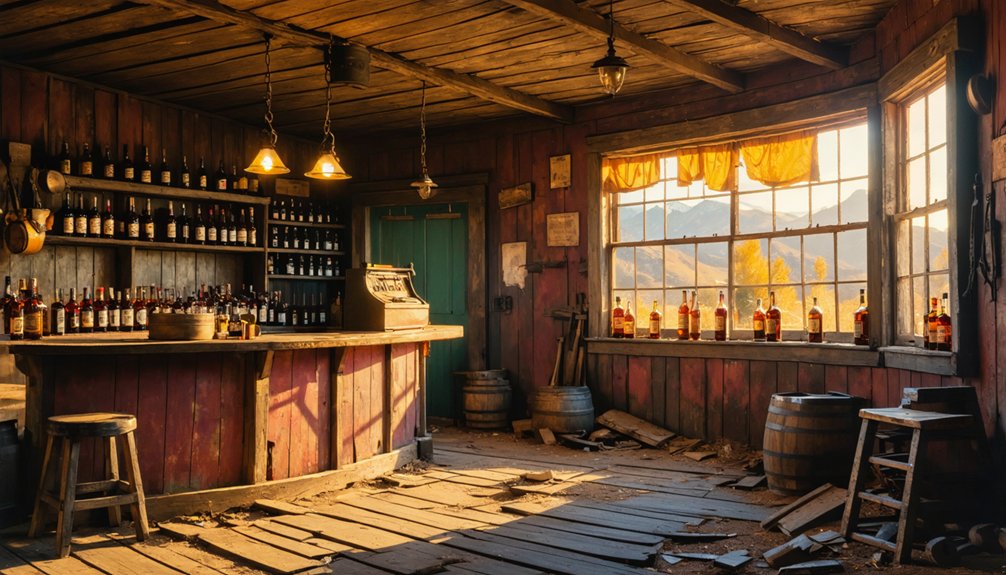
When Kaiser pulled out in 1981, over 400 houses sat frozen in time—a scene so surreal that film crews now use it as a ready-made apocalypse set. You’ll find entire neighborhoods where deterioration of residential areas tells stories of families who vanished overnight.
Streets that once buzzed with 4,000 residents now stretch empty, flanked by unsecured vacant buildings slowly surrendering to the Mojave’s harsh elements.
The fenced-off zones preserve this eerie abandonment, though you can still peer through and imagine Friday night barbecues and kids riding bikes. There’s something brutally honest about seeing a boomtown’s collapse laid bare—no sanitized history lesson, just raw evidence of what happens when the ore runs out and everyone scatters.
Railroad and Industrial Ruins
Beyond those silent residential streets, rusted steel arteries snake across the desert floor—51 miles of railroad track that once carried the lifeblood of America’s only West Coast steel mill. This abandoned rail infrastructure tells Kaiser Steel’s story through weathered monuments to industrial ambition.
You’ll discover:
- 500-foot steel bridge at Salt Creek Wash—spans intact despite forty years of neglect
- Five-track staging yard at Ferrum—where 100-car ore trains once assembled daily
- Maintenance shed built from salvaged ties—standing sentinel since 1986
- Storm-damaged ten-mile section—monsoon-carved washouts revealing nature’s reclamation
- Desert-preserved locomotives and jennies—rusting quietly while creating shelter with minimal impact on local wildlife
Walk the rail bed where Baldwin switchers once thundered. These forgotten rails offer unfiltered access to post-war industrial history.
Exploring Nearby Desert Center and Joshua Tree National Park
The windswept settlement of Desert Center sits like a time capsule along Highway 60, its story intertwined with Eagle Mountain’s boom-and-bust cycle. Founded by Desert Steve Ragsdale in 1921, this former travelers’ oasis shrank to just 19 souls after the Colorado River Aqueduct’s completion. You’ll find antique gas pumps frozen at 36 cents per gallon—perfect photo spots capturing desert nostalgia.
Minutes away, the General Patton Memorial Museum (4.2 stars, 147 reviews) showcases WWII North Africa training history. Extend your adventure to adjacent Joshua Tree National Park (4.8 stars, 891 reviews) for world-class climbing and wildlife viewing opportunities.
Chuckwalla Valley Raceway offers adrenaline rushes, while Carey’s Castle’s mysterious caverns (4.8 stars) beckon exploration. Desert Stewards’ highly-rated UTV tours connect these scattered desert treasures into one unforgettable journey.
Best Times to Visit and What to Bring
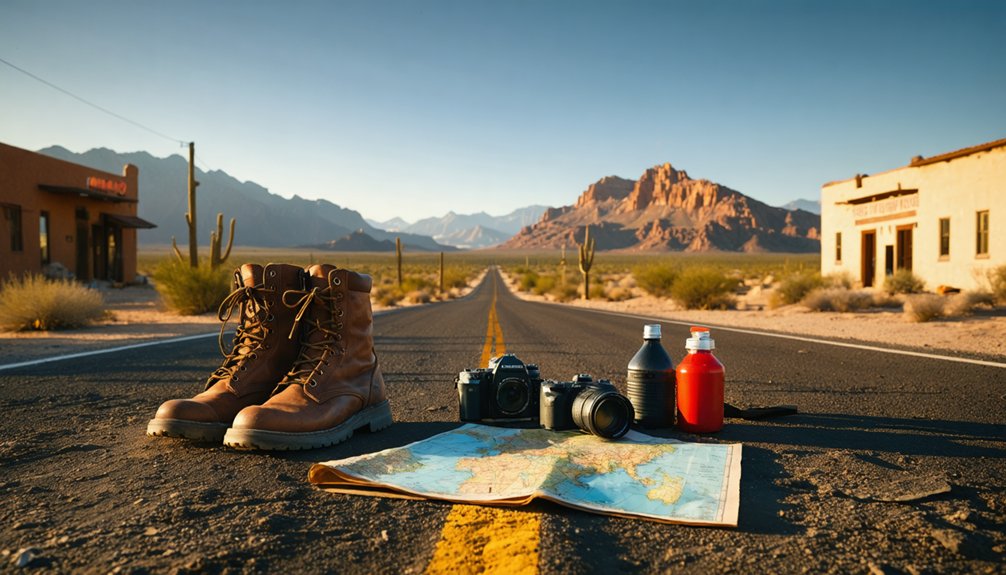
Timing your Eagle Mountain expedition means dodging the desert’s punishing extremes—those scorching summer days when temperatures soar past 110°F will transform your ghost town adventure into a survival ordeal.
Target spring (March-May) or fall (September-November) when temperatures hover between 70-90°F, perfect for unrestricted exploration.
Your essential gear checklist:
- Water: Two gallons minimum per person daily
- Clothing tips: Lightweight long sleeves, wide-brim hat, sturdy boots for 30-40°F temperature swings
- Off road vehicle requirements: Full tank plus spare fuel; Kaiser Road demands high clearance
- Sun protection: SPF 50+ sunscreen against relentless UV
- Navigation tools: GPS, flashlight for abandoned structures
Photography and Filming Opportunities in a Hollywood Favorite
Since Christopher Nolan chose this desolate outpost for *Tenet*’s explosive climax, Eagle Mountain has cemented its status as Hollywood’s go-to apocalypse backdrop—and you’ll understand why the moment your camera captures those skeletal mining structures against the Mojave’s brutal sky.
The dramatic lighting effects here change hourly, transforming rusted metal and crumbling concrete into something otherworldly. I’ve watched golden hour turn abandoned buildings into cathedral-like silhouettes, while midday sun creates harsh shadows perfect for gritty compositions.
*Constantine*, *The Island*, and countless disaster films exploited these unique architectural compositions—the same decaying geometry you’ll frame in your viewfinder. Contact Greater Palm Springs Film Office at (760) 861-1182 for access, though casual photographers often explore freely. Bring wide-angle lenses for the expansive industrial ruins and telephoto glass for isolating abstract details against endless desert.
Frequently Asked Questions
Is It Legal to Enter and Explore the Abandoned Buildings in Eagle Mountain?
No, it’s illegal to explore Eagle Mountain’s abandoned buildings without permission. You’d be trespassing on private property patrolled by armed guards. Before any adventure, you’ll need to check building conditions and secure explicit owner consent first.
Are There Any Guided Tours Available for Eagle Mountain Ghost Town?
Guided tours are unavailable at Eagle Mountain due to private ownership restrictions. You’ll find self-guided explorations are your only option, though you’re risking trespassing charges. The three remaining residents actively patrol, making unauthorized visits genuinely risky for freedom-seekers.
What Safety Precautions Should Visitors Take When Exploring the Abandoned Mine Area?
You’ll want to watch for hazardous materials like unstable dynamite and toxic metals. Avoid deteriorating structures, especially vertical shafts hidden by vegetation. Stay alert for wildlife, oxygen-depleted pockets, and never enter dark tunnels alone—your freedom depends on staying alive.
Can You Camp Overnight Near Eagle Mountain or Within the Ghost Town?
You can’t camp within Eagle Mountain’s gated boundaries—no primitive camping opportunities exist inside. However, you’ll find freedom at nearby Calico Ghost Town campgrounds, where abandoned infrastructure exploration awaits from legal sites just miles away.
Are There Any Facilities Like Restrooms or Water Available at Eagle Mountain?
No facilities exist at abandoned Eagle Mountain—no restrooms, water, or services. You’re truly on your own in this remote desert location. Bring everything you’ll need, including plans for disabled vehicle services and medical emergency assistance before venturing out.