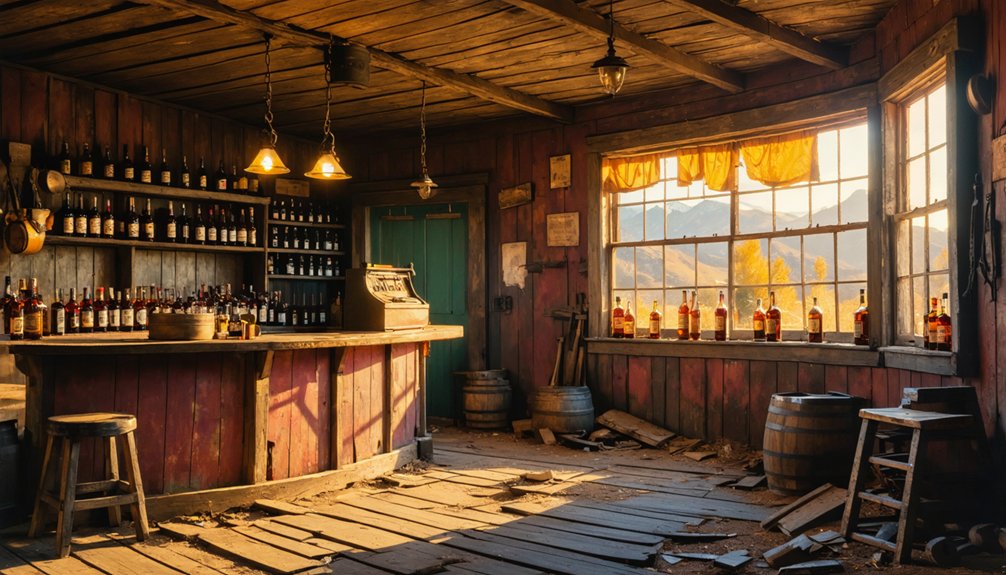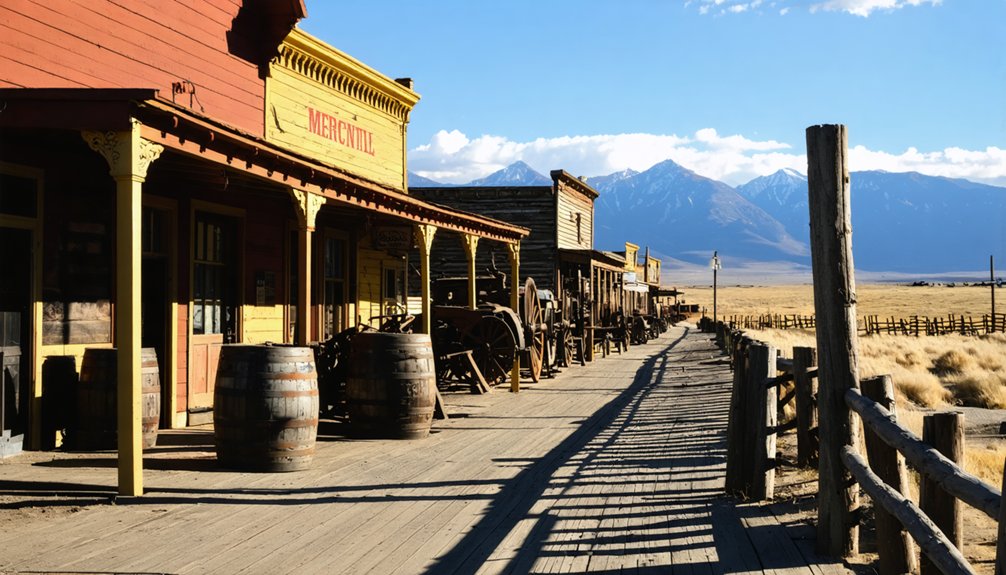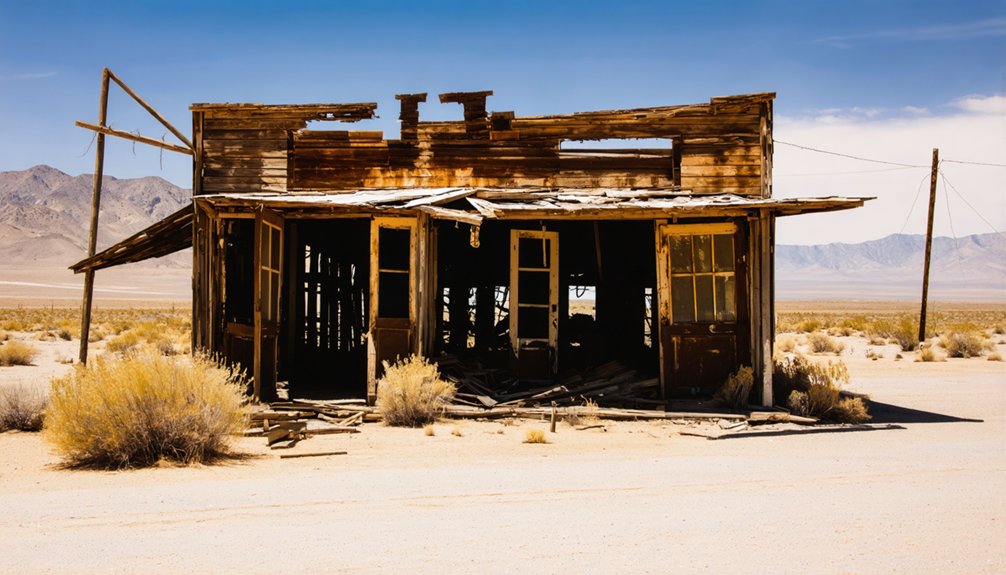
Planning a ghost town road trip to Eagle Mountain, California means heading three hours east of Los Angeles via Interstate 10 and Highway 62 into the Mojave Desert. Kaiser Steel built this once-thriving company town in 1948, housing nearly 4,000 residents before abandoning it virtually overnight in 1983. The dry desert climate has preserved it remarkably well, with homes and businesses still frozen in time. Everything you need to plan your perfect desert escape is just ahead.
Key Takeaways
- Eagle Mountain, a preserved ghost town in Riverside County’s Mojave Desert, is accessible via Interstate 10 and Highway 62, approximately three hours from Los Angeles.
- Depart early morning during summer to avoid extreme desert heat, and stock up on essentials in Twentynine Palms, located 30 miles away.
- Eagle Mountain became private property in May 2023; trespassing is illegal despite its abandoned appearance, so admire rusted structures from the perimeter.
- Explore nearby ghost towns like Dale, California, and the Twentynine Palms Historic District to enrich your road trip experience.
- Joshua Tree National Park, adjacent to Eagle Mountain, offers legal exploration opportunities and stunning desert landscapes worth including in your itinerary.
What Is Eagle Mountain, California’s Forgotten Ghost Town?
Tucked away in Riverside County’s desert, Eagle Mountain is a forgotten ghost town that once thrived as a bustling company town built by Kaiser Steel Corporation in 1948. Henry J. Kaiser constructed it specifically to house workers at the Eagle Mountain iron mine, Southern California’s largest.
At its peak, nearly 4,000 residents called it home, enjoying wide landscaped streets, schools, stores, and even a police department — all carved out of the remote desert.
Eagle Mountain’s forgotten history runs deeper than abandoned buildings. The healthcare system developed here eventually became Kaiser Permanente.
But when the mine became unviable in 1983, residents departed almost overnight, leaving behind rusted machinery and empty homes.
Today, it stands as one of California’s largest modern ghost towns, waiting for curious explorers like you to discover it.
How Kaiser Steel Built and Abandoned Eagle Mountain
When Henry J. Kaiser founded Kaiser Steel Corporation in 1948, he didn’t just build a mine — he carved an entire town out of the Riverside County desert, complete with landscaped streets, schools, stores, and a police department.
At its peak, Eagle Mountain’s iron mine became the largest in Southern California, shipping 350,000 tons of ore in 1975 alone via a 51-mile railroad to connect with Southern Pacific.
But when the mine turned unviable in 1983, Kaiser Steel pulled the plug almost overnight, sending nearly 4,000 residents packing and leaving behind a rusted shell of what was once a thriving desert community.
Kaiser Steel’s Desert Vision
Rising from the Mojave Desert in 1948, Eagle Mountain was Henry J. Kaiser‘s bold desert community carved from nothing. His Kaiser Vision transformed barren land into a fully functioning town, complete with:
- Over 400 homes featuring up to four bedrooms each
- Schools, stores, and a dedicated police department
- 200 trailer spaces and boarding houses for the growing workforce
You’d have found wide, landscaped streets mimicking suburban life despite the remote desert surroundings.
Kaiser even launched what became Kaiser Permanente here, revolutionizing employee healthcare forever.
At its peak, nearly 4,000 residents called Eagle Mountain home.
Then, when the iron mine became unviable in 1983, Kaiser pulled support overnight. Residents vanished, leaving behind rusted machinery and empty buildings — a snapshot of ambition frozen in desert time.
Eagle Mountain’s Mining Peak
At its peak, Eagle Mountain’s iron mine wasn’t just digging ore — it was fueling Southern California’s industrial backbone. The operation shipped raw iron along a 51-mile private railroad to Southern Pacific, delivering material to Fontana’s iron works for processing.
In 1975, miners pulled a record 350,000 tons from the earth, cementing Eagle Mountain’s iron production as a regional powerhouse.
That mining legacy stretched back to WWII, when wartime demand transformed a remote desert discovery into Southern California’s largest iron mine. Kaiser Steel owned the operation previously held by Southern Pacific Railroad, building an entire community around it.
But when production became economically unviable in 1983, Kaiser walked away — shutting down operations and abandoning nearly 4,000 residents virtually overnight, leaving an entire town frozen in time.
Overnight Town Abandonment
Kaiser Steel didn’t just mine iron at Eagle Mountain — they built an entire world around it. Schools, stores, a police department, and hundreds of homes gave nearly 4,000 residents a real community carved into the California desert.
Then, in 1983, the mine became unviable, and Kaiser Steel walked away.
The overnight exodus left behind:
- Homes still furnished, as if residents simply vanished
- Rusted machinery frozen mid-operation across the sprawling site
- Streets once filled with families swallowed by desert silence
What you’ll find today is one of California’s most striking ghost towns — a place where an entire civilization evaporated almost instantly.
Kaiser built it, Kaiser abandoned it, and the desert quietly reclaimed it. That’s the haunting reality waiting for you at Eagle Mountain.
From Company Town to Ghost Town: Eagle Mountain’s Overnight Collapse
When Kaiser Steel pulled out in 1983, nearly 4,000 residents left almost overnight, transforming a thriving desert community into a ghost town in a matter of days.
You’d find it hard to imagine the speed of that collapse — one day families filled those wide, landscaped streets, and the next, rusted machinery and empty buildings stood silent under the desert sun.
Ironically, Eagle Mountain’s remote location near Joshua Tree National Park became its own kind of preservation, keeping the abandoned remnants largely intact for decades.
Kaiser Steel’s Sudden Withdrawal
Once a thriving desert community of nearly 4,000 residents, Eagle Mountain collapsed almost overnight when Kaiser Steel pulled its support in 1983.
Kaiser Steel’s impact was total — when the mine became economically unviable, the corporation simply walked away, triggering devastating economic consequences for everyone living there.
You can still see what they left behind:
- Rusted machinery frozen mid-operation, as if workers vanished mid-shift
- Hundreds of homes, schools, and stores completely abandoned
- Streets once bustling with families now claimed by desert silence
Kaiser didn’t phase out operations gradually — they cut ties swiftly, forcing nearly 4,000 residents to pack up and leave almost simultaneously.
What remained became one of California’s largest modern ghost towns, a raw reminder of corporate towns’ inherent fragility.
Nearly 4,000 Residents Displaced
Nearly 4,000 people lost their homes, their jobs, and their entire way of life the moment Kaiser Steel walked away in 1983. The displacement impacts hit fast and hard — families packed overnight, leaving behind furniture, memories, and routines built over decades.
Schools emptied. Stores locked their doors. Streets that once buzzed with neighborhood life went silent beneath the desert sun.
What makes Eagle Mountain’s collapse so striking is its totality. Community memories didn’t fade gradually — they got cut off like a switch flipping.
You can still feel that abruptness walking through the abandoned streets today. Personal items remain frozen in place, as if residents expected to return. They never did.
One corporation’s financial decision erased an entire living community almost instantaneously, turning a thriving town into a desert relic overnight.
Desert Preserves Abandoned Remnants
What kept Eagle Mountain from vanishing entirely isn’t human preservation efforts — it’s the desert itself. The arid climate surrounding Joshua Tree National Park slows decay dramatically, leaving structures eerily intact for ghost town exploration.
You’ll find remnants frozen in time:
- Rusted machinery sitting exactly where workers left it in 1983
- Weathered homes still standing along those once-landscaped streets
- Abandoned storefronts preserving the skeleton of a self-contained community
Desert preservation works differently than a museum — no curator, no restoration, just dry heat and isolation doing the work.
The remoteness that once made Eagle Mountain inconvenient for residents now protects it from vandals and developers alike. Nature became the unlikely guardian of Kaiser’s forgotten company town.
From Ghost Town to Prison: Eagle Mountain’s Stranger Second Act
After Kaiser Steel pulled out in 1983, Eagle Mountain didn’t just quietly fade into the desert — it got a second life stranger than anything a screenwriter could dream up. By 1988, the abandoned shopping center had transformed into the Eagle Mountain Community Correctional Facility, a privately operated prison housing low-risk inmates.
The prison history here runs deep and turbulent. What began as a practical solution for California’s overcrowded corrections system ultimately shaped the town’s community impact in unexpected ways.
Operations continued until December 2003, when state budget cuts and a massive, fatal riot forced its closure. Talks to reopen the facility surfaced in 2005, but nothing materialized.
Today, the ghosts of both the mining era and the prison years haunt every crumbling wall you’ll encounter.
Inside Eagle Mountain: What Survives After 40 Years of Abandonment
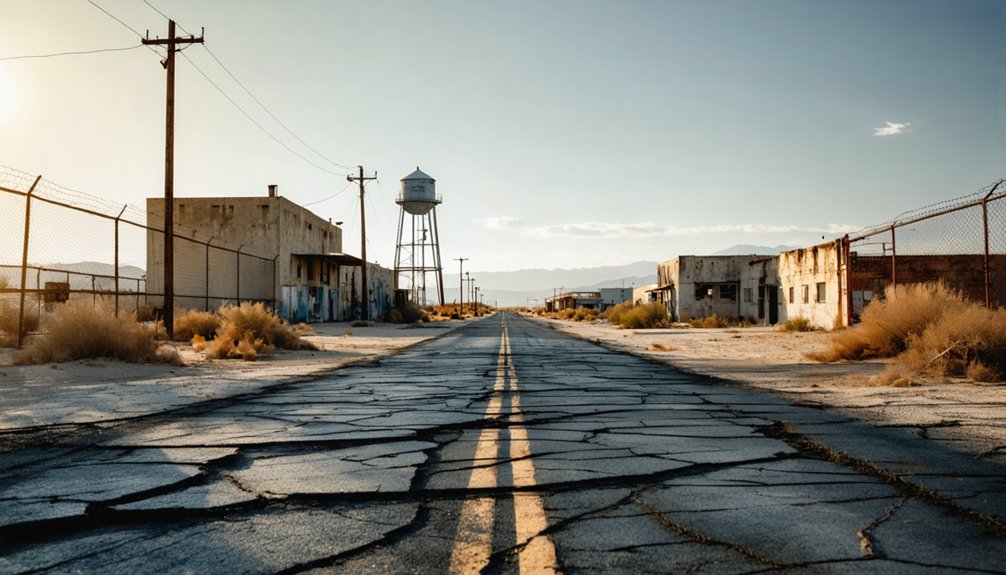
When you walk through Eagle Mountain today, you’ll find the desert has acted as an unlikely preservationist, slowing decay in ways that wetter climates never could.
Rows of homes, the old shopping center, rusted mining machinery, and scattered infrastructure still stand across the sprawling 10,000-acre site, frozen in a moment somewhere between 1983 and 2003.
The dry Mojave air has kept these remnants remarkably intact, giving you the eerie sense that residents simply vanished mid-routine.
Structures Still Standing Today
Decades of desert sun, wind, and silence have done surprisingly little to erase Eagle Mountain’s physical footprint.
You’ll find ghostly remnants of an entire civilization frozen in time, where abandoned architecture tells a story no museum could replicate.
Still standing across the 10,000-acre site:
- Residential streets lined with intact homes, some retaining original fixtures and furniture
- Commercial buildings, including the converted shopping center that once housed the prison facility
- Industrial infrastructure, featuring rusted machinery and railroad-related structures connecting to the historic 51-mile ore line
The desert’s dry climate acted as an unlikely preservative, keeping walls upright and details visible.
Walking these streets, you’re fundamentally stepping through a complete mid-century American company town that time simply forgot to demolish.
Desert’s Preservation Of Ruins
Few environments preserve ruins quite like the Mojave Desert, and Eagle Mountain proves that theory dramatically. Extreme heat, minimal rainfall, and low humidity slow decay considerably, leaving structures surprisingly intact after four decades of abandonment.
When you walk through Eagle Mountain, you’re stepping into a time capsule that nature has carefully maintained.
Desert preservation works in your favor here. Rust creeps slowly, wood dries rather than rots, and concrete holds firm against the arid air. Your ruins exploration reveals homes still showing wallpaper patterns, streets remaining paved, and signage clinging stubbornly to weathered walls.
The isolation amplifies everything. No urban development encroaches, no vandalism wave has erased history completely, and Joshua Tree National Park’s proximity keeps the surrounding landscape untouched.
Eagle Mountain stands remarkably preserved, waiting for curious travelers like you.
Why Eagle Mountain Is Private Property: and What That Means for Visitors
After sitting dormant for decades, Eagle Mountain’s 10,000-acre expanse sold in May 2023 for $22.58 million to Ecology Mountain Holdings LLC, making it firmly off-limits to curious visitors.
As private property, visitor access isn’t permitted, so you’ll need to respect those boundaries. Future development plans remain unknown, leaving the site’s fate wide open.
Before you head out, keep these realities in mind:
Before you head out, keep these desert realities firmly in mind — knowledge protects both you and this storied landscape.
- Trespassing carries legal consequences, regardless of how abandoned the site appears
- The desert perimeter offers glimpses of rusted structures without crossing restricted boundaries
- Joshua Tree National Park sits nearby, giving you legal, breathtaking desert exploration
You can still feel the weight of Eagle Mountain’s history from a respectful distance while honoring both the law and the land.
How to Reach Eagle Mountain From Los Angeles

Three hours of open highway separate Los Angeles from Eagle Mountain, making this ghost town one of Southern California’s most accessible yet genuinely remote road trip destinations.
Head east on Interstate 10 toward Palm Springs, then take the Highway 62 exit north into the Coachella Valley. Road conditions along this stretch are generally reliable year-round, though desert heat makes early morning departures smart between June and September.
Continue past the town of Desert Center, where Eagle Mountain Road leads you directly toward the site. Scenic routes reward the observant traveler here — Joshua Tree‘s boulder-studded landscape frames your approach, shifting from palm-lined valley into raw Mojave terrain.
GPS helps, but printed directions serve as solid backup once cell signals fade deep into Riverside County’s desert corridor.
Why Eagle Mountain Makes a Perfect Base for Joshua Tree
Eagle Mountain sits just outside Joshua Tree National Park‘s southeastern boundary, putting you within striking distance of the park’s most dramatic landscapes without the crowded entrances near Twentynine Palms.
This positioning makes it an ideal launching point for desert exploration into some of California’s most eerie landscapes.
From Eagle Mountain, you’ll find yourself close to:
- Cholla Cactus Garden – a surreal field of jumping cholla that rewards careful wandering
- Cottonwood Spring – a hidden desert oasis attracting migratory birds and solitude seekers
- Mastodon Peak Trail – short but rewarding climbs offering sweeping Salton Sea views
You’re trading tourist congestion for raw, unfiltered desert access.
The freedom to roam these ancient rock formations and windswept trails starts practically at your doorstep.
Where to Stay, Eat, and Fuel Up Near Eagle Mountain and Joshua Tree
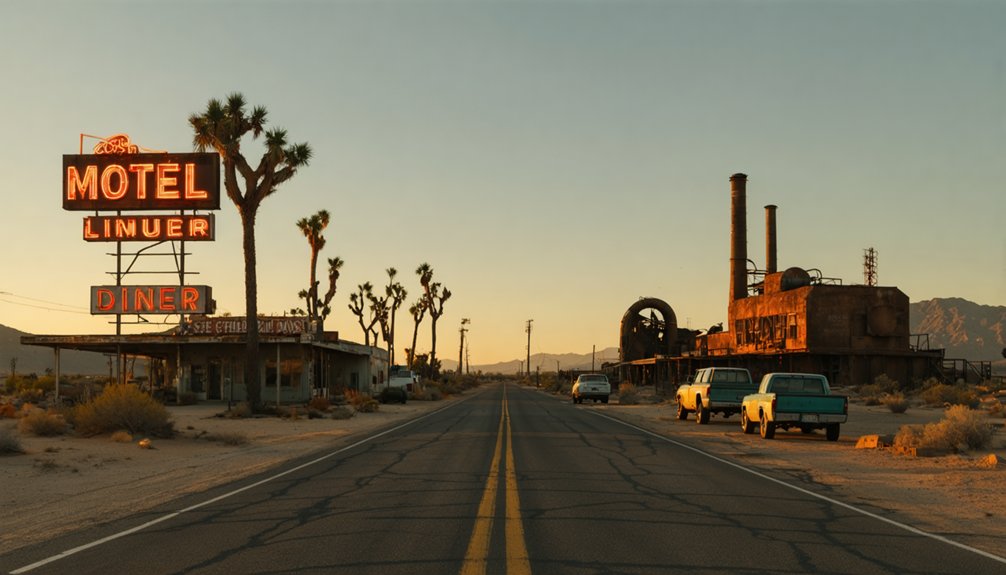
Because Eagle Mountain sits deep in Riverside County’s desert, you’ll want to plan your creature comforts before arriving—the ghost town itself offers nothing in the way of beds, burgers, or gas pumps.
Twentynine Palms, roughly 30 miles northwest, delivers your best options: motels, diners, and reliable fuel stations. Joshua Tree village offers boutique lodging and cafés worth exploring after a day chasing ghost town legends through abandoned corridors.
Palm Springs, about an hour southwest, provides premium accommodations if you prefer comfort after hunting mining myths across sun-baked ruins.
Always top off your gas tank before heading toward Eagle Mountain—desert highways punish unprepared travelers. Stock water, snacks, and a paper map, because cell service thins considerably once you leave the main highway behind.
Ghost Towns Near Eagle Mountain Worth a Detour
While Eagle Mountain delivers a compelling ghost town experience on its own, the surrounding Mojave Desert and Coachella Valley scatter several abandoned settlements worth adding to your itinerary.
These ghost town attractions extend your adventure and deepen your appreciation of the region’s rich mining history.
Consider these worthy detours:
- Dale, California – A crumbling gold mining camp northeast of Joshua Tree with scattered stone ruins and desert solitude
- Twentynine Palms Historic District – Preserved homestead cabins revealing early settler struggles against brutal desert conditions
- Salton City – An eerily abandoned planned resort community offering a surreal contrast to traditional mining ghost towns
Each site adds a distinct chapter to your road trip, connecting you to California’s layered frontier past.
Frequently Asked Questions
Who Bought Eagle Mountain in 2023 and for How Much?
In 2023, you’ll find that Ecology Mountain Holdings LLC snagged Eagle Mountain history’s iconic site for $22.58 million! They purchased the 10,000-acre property in May, leaving future plans tantalizingly unknown for freedom-seeking explorers like you.
What Movies Were Filmed at Eagle Mountain Ghost Town?
You’ll love Eagle Mountain’s cinematic history! Three ghost town films were shot here: *Tough Guys*, *Constantine*, and *The Professionals*. Its eerie, abandoned desert landscape makes it an irresistible backdrop for filmmakers seeking raw, untamed freedom.
Did the Eagle Mountain Prison Riot Result in Fatalities?
The prison riot’s fury shook Eagle Mountain’s very foundations! You’ll find that the riot aftermath left fatalities in its wake, making this chilling chapter of prison history one of the darkest moments before the facility’s 2003 closure.
What Healthcare System Originated From Kaiser Steel’s Eagle Mountain Operations?
You’ll find Kaiser Permanente’s roots tied directly to Kaiser’s Steel Operations at Eagle Mountain! Henry Kaiser’s vision of employee healthcare birthed this revolutionary system, transforming how Americans access medical care and championing personal health freedom nationwide.
How Many Tons of Iron Ore Did Eagle Mountain Produce in 1975?
Sure, the numbers matter! In 1975, Eagle Mountain’s iron ore production hit a record 350,000 tons, making it a standout moment in mining history. You’ll appreciate how this milestone shaped Southern California’s industrial freedom and growth.
References
- https://www.youtube.com/watch?v=4abnhupnLac
- https://www.youtube.com/watch?v=5DOGtWL8pWM
- https://www.islands.com/1878743/one-lagest-ghost-towns-eerily-modern-abandoned-california-mining-town-eagle-mountain/
- https://en.wikipedia.org/wiki/Eagle_Mountain
- https://californialocal.com/localnews/statewide/ca/article/show/51711-10-california-ghost-towns-to-see/