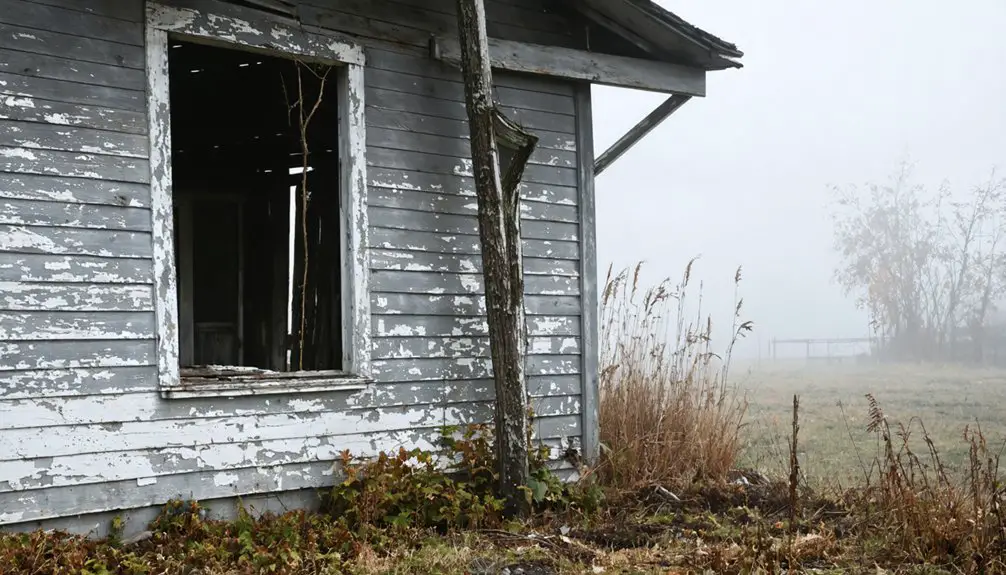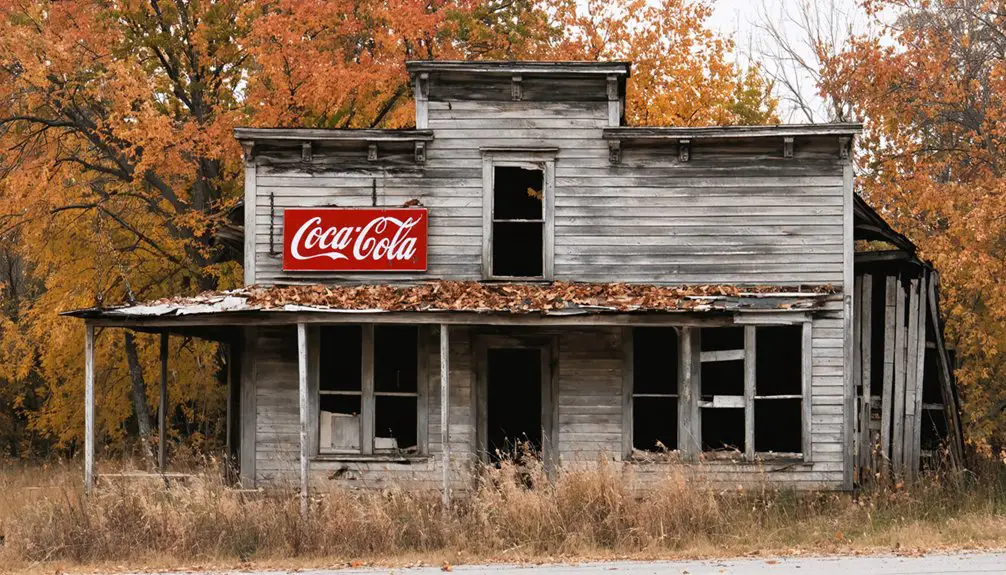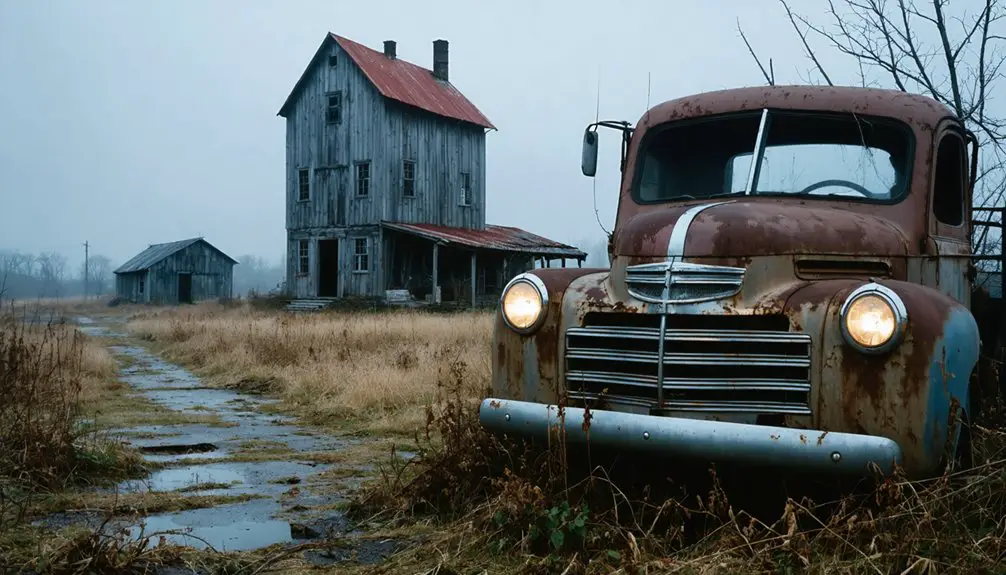
You’ll find Eckford along M-99 between Marshall and Albion, a 12-mile stretch where railroad prosperity turned to abandonment after 1930. Drive through to see converted commercial buildings, an antique store housing artifacts from defunct businesses, and the community center at 99 Maple St. Park free anywhere to explore the former railroad corridor where tracks vanished in 1932 and the post office closed in 1934. The architectural evidence reveals how Eckford earned its ghost town designation through municipal records and dramatic population decline.
Key Takeaways
- Drive 12 miles along M-99 north from Marshall to Albion, with fuel costs around $3-5 and free parking available throughout.
- Visit the antique store and museum documenting Eckford’s transformation from thriving railroad community to ghost town after 1930.
- Explore converted commercial buildings along Maple Street, including the former Maccabbees Hall and George W. Butler’s general store site.
- Tour the Community Center at 99 Maple St. and active church buildings that survived Eckford’s economic collapse.
- View architectural remnants from the pre-1930s era, including repurposed gas stations and the 1978-closed schoolhouse building.
The Rise and Fall of Eckford: From Railroad Boom to Quiet Hamlet
The story of Eckford begins with an act of commemoration that would outlast the village itself. In 1831, first settler Oshea Wilder named this Calhoun County township after Henry Eckford.
By 1883, the Cincinnati, Jackson and Mackinaw Railroad‘s arrival transformed intersecting rural roads into a platted village. John Taylor laid out the original village layout with seven streets, while George W. Butler’s general store at 217 Maple St. became a commercial anchor around 1898.
The railroad connected farmers to Jackson and beyond, delivering mail and moving freight through the modest station. Yet freedom from rail dependency came at a cost. Service ended in 1930, tracks vanished by 1932, and the post office closed in 1934. Today, you’ll find only remnants of early businesses marking where commerce once thrived.
What Makes Eckford Officially a Michigan Ghost Town
Eckford’s classification as a ghost town rests on documented evidence preserved in municipal records and census data. You’ll find its historical significance lies in the transformation from thriving railroad community to near-abandonment. The town’s current condition reflects dramatic population decline that distinguishes authentic ghost towns from simply small villages. While specific population figures require deeper archival research, the pattern mirrors countless Michigan settlements that couldn’t sustain themselves after economic shifts.
To verify Eckford’s ghost town status, you’ll need access to county historical societies and Michigan’s territorial records. These sources document when businesses closed, families departed, and infrastructure deteriorated. Understanding what officially defines this classification empowers you to distinguish between living rural communities and genuinely abandoned settlements. The evidence tells Eckford’s story through concrete data rather than folklore.
Exploring What Remains: Antique Stores, Museums, and Historic Buildings
You’ll find Eckford’s remnants concentrated along the main road, where former auto sales facilities, farm implement shops, and the general store building now serve as private residences while retaining their commercial architecture.
The village maintains an antique store stocked with period items from defunct businesses, alongside a museum documenting the settlement’s rise during the railroad era and its collapse after 1932.
The community center and active church buildings represent the institutional structures that survived economic depletion, offering you accessible entry points to examine what persists of this once-thriving settlement.
Former Business Buildings Today
When you drive through Eckford today, converted residences line the streets where commerce once thrived, their original purposes erased by necessity during the Great Depression‘s grip on rural Michigan. Home conversions transformed the auto sales lot, farm implement shop, general store, grain dealer, and gas station into private dwellings. The railroad depot stands residential after tracks disappeared in 1932. Even the post office—shuttered June 1934—succumbed to this transformation.
The schoolhouse held out longest, closing in 1978 before conversion.
These resident experiences occupy spaces where transactions once echoed. You’ll recognize former business structures by their commercial architecture—wide storefronts, loading docks, strategic corner placements. No operational stores, restaurants, or gas stations remain. Only the antique store and museum resist complete residential conversion, preserving fragments of Eckford’s 1883 railroad-era prosperity for independent explorers seeking authentic Michigan ghost town documentation.
Community Center and Church
Among the converted storefronts and former depots, two structures maintained their communal purposes through Eckford’s decline: the community center and the township’s churches. You’ll find the Eckford Community Center at 99 Maple St., available for public rental and hosting charitable activities like the FFA Fundraiser and Ag Day of Caring.
The original Maccabbees Hall at 300 Maple St., erected before this facility, now serves as a residence—though its 1914 cement sidewalk, funded through community involvement, remains intact.
Four churches continue serving the township: West Eckford, East Eckford, Cooks Prairie Baptist, and Maple Grove Church. These structures represent continuity amid transformation, sustaining gatherings and worship where businesses couldn’t survive. They’re tangible evidence that even ghost towns preserve spaces for collective identity.
Antique Store and Museum
Since the railroad’s departure in 1930, Eckford’s commercial core hasn’t vanished entirely—it’s transformed into a repository of material history. The original main store structure still stands, offering tangible evidence of Luther Rogers’ farm implement enterprise and subsequent proprietors’ operations through 1934.
Key Historical Assets Worth Investigating:
- Original Store Building – The primary commercial structure survives, predating the 1910 fire that consumed W.C. Willits’ operation
- Former Schoolhouse – Converted to residential use after 1978 closure, demonstrating adaptive reuse strategies
- Cement Sidewalk – 1914 Maccabbees fundraiser installation along Maple Street remains intact
While no formal antique dealer inventory or local restoration projects currently operate on-site, these standing structures preserve Eckford’s 1883-1934 commercial trajectory. You’ll find authentic architectural remnants without interpretive barriers or admission fees.
Getting There: Directions and Route Planning Between Marshall and Albion
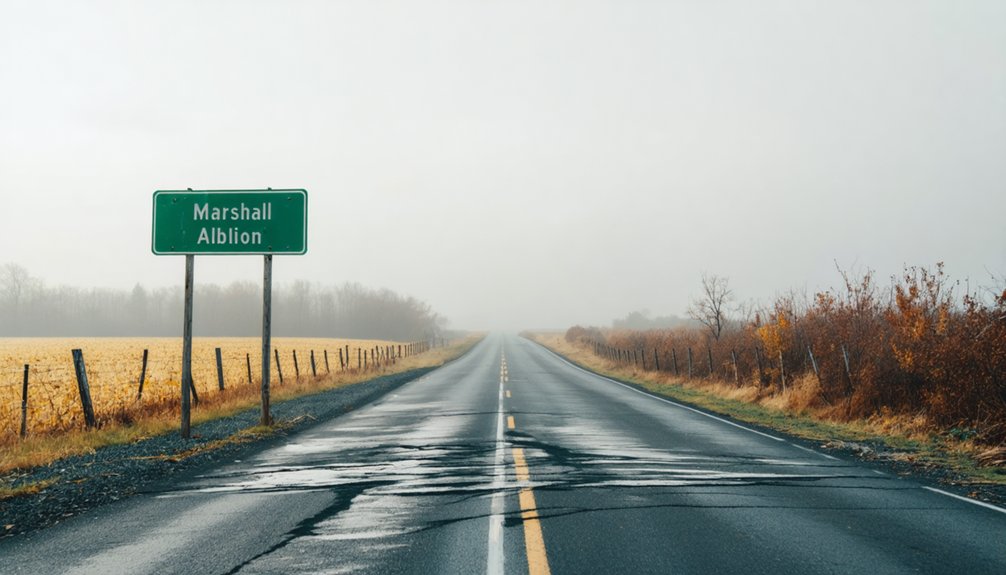
The journey from Marshall to Albion spans a modest 12 miles along M-99 north, preserving the historic corridor that once connected these nineteenth-century railroad towns. You’ll complete this drive in approximately 18 minutes, following the original pathway that linked these settlements during Michigan’s industrial expansion.
Route comparison options include Michigan Avenue’s local segments, though M-99 remains the most direct choice for accessing Eckford’s remnants beyond Albion.
Your fuel costs won’t exceed $3-5, making fuel efficient vehicle recommendations less critical for this brief expedition. No toll barriers obstruct your passage, and you’ll find free parking throughout both communities.
Check real-time conditions through mapping services before departure, particularly when traversing Marshall’s preserved historic district. The Kalamazoo River parallels portions of this route, offering glimpses into the waterways that shaped these frontier communities.
Best Things to See During Your Drive Through Eckford
Once you arrive in Eckford’s quiet core, architectural remnants of its pre-1930s commercial heyday reveal themselves along both sides of the roadway. You’ll navigate this unregulated landscape at your own pace, identifying former shop facades that once housed grain dealers, general stores, and farm implement operations.
The faded commercial past speaks through converted auto sales buildings and repurposed gas stations now serving as private residences.
Essential Stops:
- Antique Store and Museum – Explore documented artifacts from the village’s prosperity period before the Great Depression halted growth
- Historic Church – Photograph this enduring community landmark positioned along the main route
- Community Hall – Observe the operational gathering space that survived economic decline
Pull over freely to document these structures—no parking restrictions limit your exploration.
The Story of the Eckford Post Office and Railroad Era
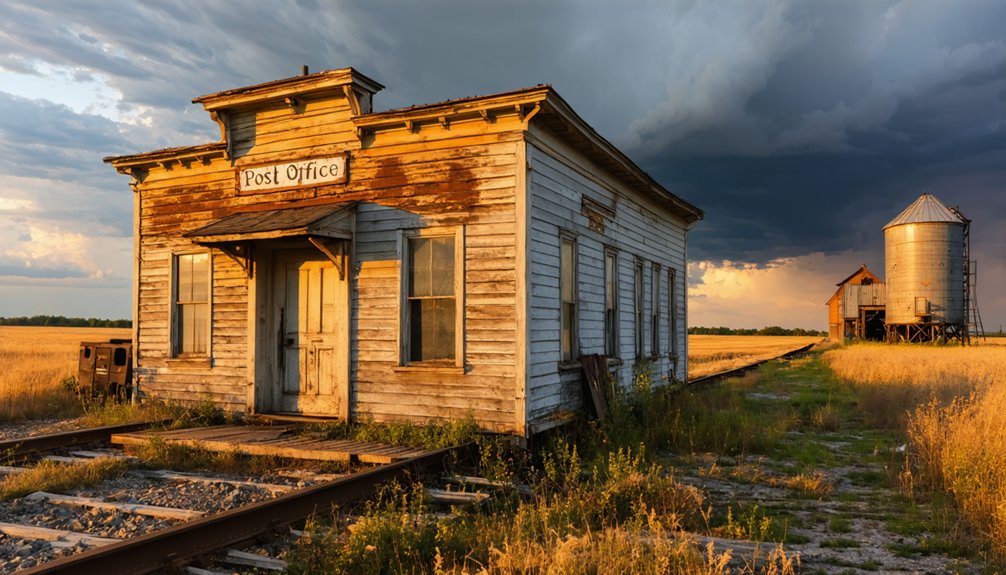
You’ll find Eckford’s documented history centers on its post office, established southwest of Albion before 1883, which became a catalyst for the community’s development.
The Cincinnati, Jackson and Mackinaw Railroad‘s arrival in 1883 transformed the settlement, bringing the depot, businesses, and travelers who relied on rail-dependent mail service.
This prosperity ended abruptly during the Great Depression when tracks were removed in 1932 and the post office closed in June 1934, erasing over fifty years of operations.
Post Office Establishment Era
Established around 1835, Eckford’s first post office emerged at Lower Eckford under the stewardship of Oshea Wilder, who’d serve as inaugural postmaster for approximately ten years. Before formal routes existed, mail delivery methods relied on semi-occasional horseback riders traversing the frontier landscape.
The postmaster appointments that followed Wilder’s tenure documented the settlement’s administrative evolution:
- J. B. Snyder – Pioneer postmaster who established operational precedents
- C. I. Courtwright – Succeeded Snyder, maintaining service continuity
- J. M. Gifford – Followed Courtwright before the Hill family era
This location, named Eckford in 1831 by surveyor Wilder himself to honor Henry Eckford, maintained postal operations that’d eventually pioneer rural free delivery. The creek bearing Wilder’s name still marks where Michigan’s postal heritage took root in Calhoun County’s southwestern reaches.
Railroad Brings Economic Growth
The Cincinnati, Jackson and Mackinaw Railroad transformed Eckford’s frontier postal settlement into a platted village when tracks reached the township in 1883. John Taylor platted streets—Maple, Dayton, Liberty, Lincoln, Harper, Ogden, and Vine—following this transportation enhancement.
The line, later renamed Detroit, Toledo and Milwaukee, positioned Eckford as a regional stop between Marshall and Homer. The station provided freight handling, mail delivery, and passenger services at the rural crossroads. Michigan Central Railroad maintained an operator-agent on day shift by 1917, supporting commercial development throughout the township. This infrastructure attracted trade and established Eckford as a transportation hub.
The Great Depression ended rail prosperity. Service curtailed in 1930, tracks abandoned in 1931, removed in 1932. The post office closed June 15, 1934.
Depression Ends Service
When economic catastrophe struck in 1929, Eckford’s railroad-dependent postal operations couldn’t withstand the financial collapse. The community’s essential infrastructure crumbled through a cascading series of failures that sealed its fate.
The postal operations shutdown unfolded methodically:
- 1932: Railroad tracks removed following complete cessation of rail service
- Mail rerouted: Service redirected to Homer and Marshall, eliminating Eckford’s distribution role
- June 1934: Post office officially closed after nearly four decades of operation
This community economic decline accelerated rapidly once businesses lost reliable mail access. Without the railroad-post office connection that had attracted settlers and commerce since 1883, Eckford transformed from Michigan’s second Rural Free Delivery pioneer into an abandoned settlement. The infrastructure that had made it critically important simply vanished.
Other Michigan Ghost Towns to Add to Your Road Trip Itinerary

Michigan’s northern reaches harbor nearly 100 ghost towns from the 1800s copper mining era, with the Keweenaw Peninsula alone preserving dozens of abandoned settlements worth documenting. You’ll find Central Mine, which declined from 1,200 residents in 1887 to just 100 by 1903, alongside Freda, Cliff, and Delaware. Gay and Eagle River offer additional copper-era exploration.
Fayette provides self-guided tours through preserved lumber-era structures, while Singapore lies buried beneath sand dunes near Saugatuck—a memorial to boom-and-bust cycles. Deward’s abandoned lumber mills and former industrial sites dot the Lower Peninsula landscape.
Each location presents distinct archival opportunities: Central’s company town layout, Amik’s 1902 industrial infrastructure, or Summitville’s railroad remnants. You’re free to chart your route through these documented sites.
Frequently Asked Questions
Are There Any Restaurants or Gas Stations Open in Eckford Today?
No restaurants or gas stations operate in Eckford today. You’ll find grocery store offerings and fuel in nearby Coldwater, 10 miles south. Check the community event schedule locally, as preserved historical records show limited commercial infrastructure here.
Can Visitors Enter the Former Schoolhouse That’s Now a Private Residence?
No, you can’t enter—that ship has sailed into private ownership. Respectful privacy considerations and potential legal restrictions protect the residents’ property rights. The converted schoolhouse remains off-limits, preserving both the structure and owners’ freedom from intrusion.
What Are the Operating Hours for Eckford’s Antique Store and Museum?
Eckford doesn’t have documented antique stores or museums with business hours. You’ll find the nearest option at Museum Gallery in Coldwater, operating Monday-Saturday with seasonal operation on Sundays. Always call ahead to verify current schedules before visiting.
Is There an Admission Fee to Visit Eckford’s Historic Sites?
You’ll find no admission fees for Eckford’s historic sites, allowing free exploration of preservation efforts. This accessibility supports adaptive reuse opportunities while maintaining archival integrity, letting you independently document and experience the town’s authentic architectural heritage without financial barriers.
Where Can I Find Parking When Visiting Eckford’s Community Center?
You’ll discover endless parking options near community center at the spacious rural site. The preserved township setting presents minimal potential parking challenges for visitors, offering you unrestricted access to explore Eckford’s historic grounds and open event spaces freely.