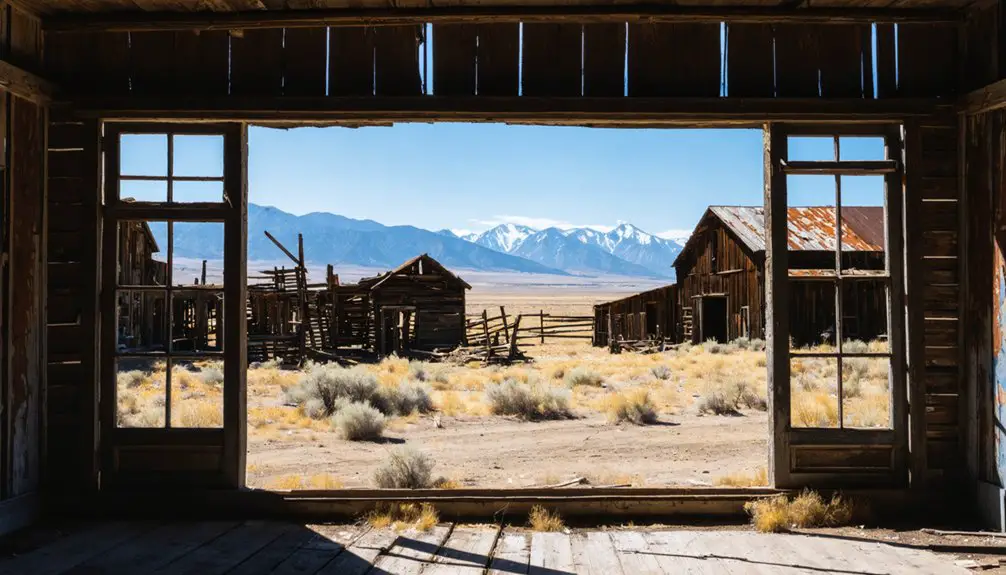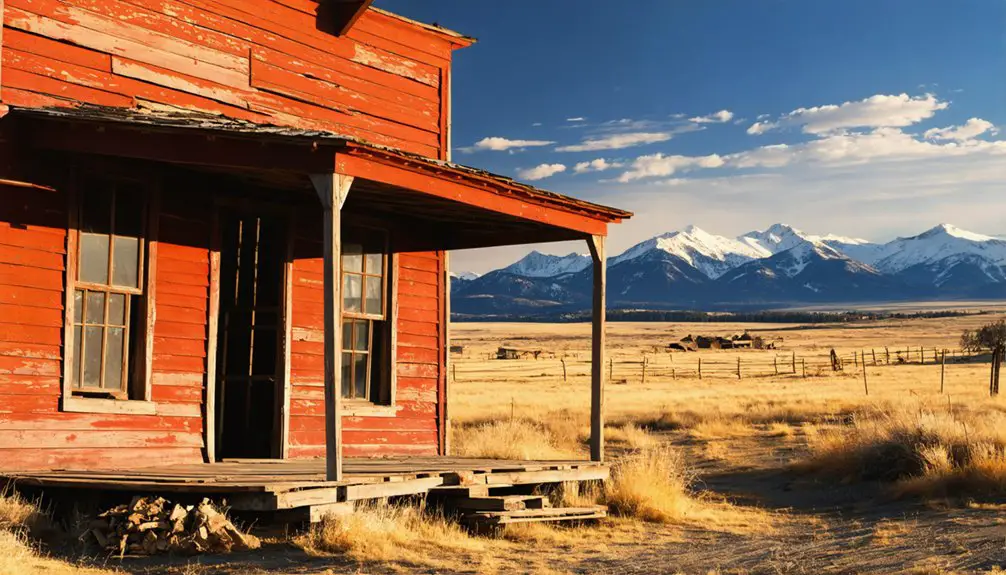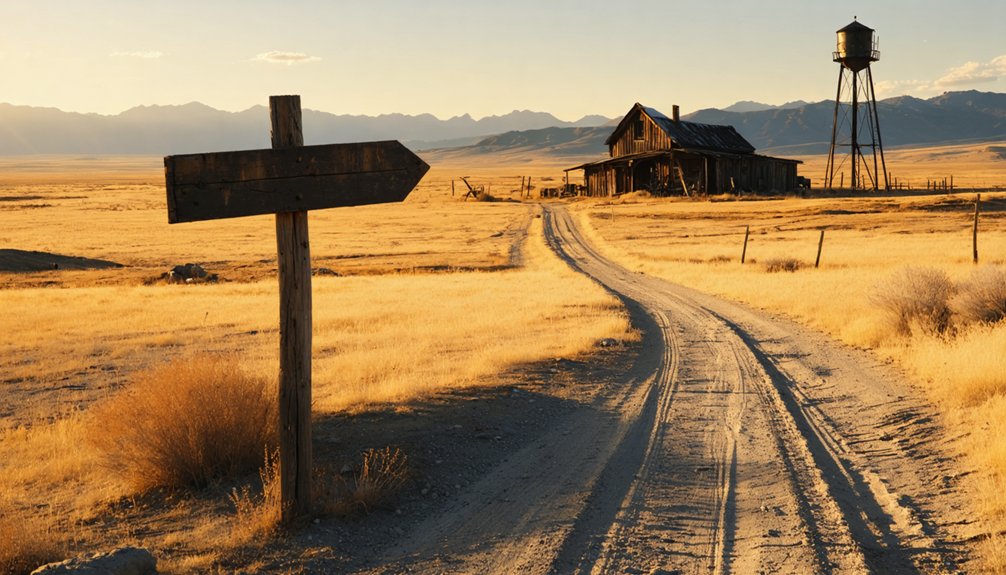
You’ll find Electric’s haunting remains roughly 90 miles west of Bozeman along US Highway 191, where skeletal aerial tram systems still cling to mountainsides above scattered stone foundations. This abandoned coal mining camp once housed 800 residents who powered Western railroads before diesel locomotives destroyed their livelihood in the 1940s. Navigate secondary roads toward coordinates 44° 39′ 32″ N, 111° 6′ 14″ W, where crumbling wooden timbers and rusted tram pulleys await your exploration through Montana’s Gallatin Range wilderness, revealing stories of boom-and-bust cycles that transformed civilization into ghost town legend.
Key Takeaways
- Electric is located 90 miles west of Bozeman via US Highway 191 toward West Yellowstone in the Gallatin Range.
- The ghost town features crumbling foundations, skeletal aerial tram remains, and preserved mining equipment from its coal era.
- Founded as Horr in 1887, the town became Electric around 1900 before abandonment following coal industry collapse.
- Access the site using coordinates 44° 39′ 32″ N, 111° 6′ 14″ W with secondary roads from MT-64 available.
- Plan to explore intact tram systems, wire relics, wooden timbers, and foundations documenting the 1940s-1950s mining decline.
The Rise and Fall of Electric: From Horr to Ghost Town
Deep in Montana’s rugged landscape, the town of Horr sprang to life in 1887 when Harry, the younger brother in the Oracle Mining Company, staked his claim on what he believed would be a profitable coal venture.
You’ll discover that prosperity proved fleeting—constant company leadership changes and fraud investigations plagued the Park Coal Company by 1895, forcing the Orr brothers to sell. The town renamed itself Electric around 1900 after building a power plant, but Montana Coke and Coke Company’s fifteen-year financial struggle sealed its fate. By the time the company collapsed, both Electric and neighboring Aldridge stood abandoned, their 800 residents vanished.
Today, ghost town tourism opportunities draw adventurers like you to explore these weathered remnants of ambition gone cold.
How Coal Mining Shaped Electric and Aldridge
As you trace the old wagon roads threading through Electric and Aldridge, you’re following the arteries that once pumped lifeblood into these camps—first crude paths for horse-drawn coal wagons, then steel rails that connected mine tipples to distant smelters and cities.
The railway infrastructure that made fortunes possible also sealed these towns’ fates: when steam locomotives gave way to diesel in the 1940s, the coal market collapsed, and production plummeted to a mere 305,000 tons by 1958.
What you see now are the skeletal remains of that boom-and-bust cycle—weathered head frames, crumbling tipples, and silent rail beds where prosperity once thundered through on iron wheels.
Transport Evolution and Infrastructure
The coal transportation infrastructure expanded rapidly—surface works appeared at Belt Mine around 1895, while Electric’s mining camp became the commercial hub.
These railroad developments eventually enabled coal trains stretching 115 cars long to rumble west toward Oregon and Washington.
When reserves depleted, trucks replaced rails for local trade, but by then the damage was done: Electric and Aldridge had already peaked and faded into Montana’s dusty memory.
Economic Collapse and Abandonment
When Montana’s coal production plummeted from its 1940s peak of 5 million tons to a gutting low of 305,000 tons in 1958, Electric and Aldridge couldn’t escape the mathematics of ruin.
Three forces killed these camps:
- Steam locomotives vanished – Railways switched to diesel, eliminating the lifeblood demand that sustained Great Falls Coal Field operations
- Electric grids spread – Homes abandoned coal stoves for power lines, strangling domestic markets
- Natural gas rose – Cheap alternatives made mining unprofitable, forcing closures across the field
You’ll find their historical significance etched in crumbling foundations and environmental damage still visible in scarred hillsides. The Anaconda Copper Mining Company pulled out. Great Northern Railway subsidiaries shuttered. Miners scattered, seeking freedom elsewhere, leaving these settlements to Montana’s unforgiving winds.
Getting There: Routes and Access Points to Electric
Reaching Electric, Montana requires traversing the rugged spine of southern Montana where US Highway 191 carves through the Gallatin Range toward West Yellowstone. You’ll find this forgotten settlement near the Wyoming border, where the regional geography overview reveals elevation shifts from valley floors to 10,969-foot peaks.
From Bozeman, you’ll cover roughly 90 miles westward, with nearby state highway access connecting through Park and Gallatin Counties. The route delivers you past Electric Peak‘s summit before descending toward West Yellowstone’s outskirts, just 12 miles from Yellowstone’s north entrance.
MT-64 provides alternative passage from Big Sky country, while secondary roads spider toward the Gallatin Range base. Your coordinates—44° 39′ 32″ N, 111° 6′ 14″ W—mark where civilization surrendered to wilderness.
What Remains: Exploring the Ruins and Historic Sites
When you arrive at Electric, you’ll find scattered stone foundations and crumbling wooden timbers marking where the mining camp once thrived. The skeletal remains of the aerial tram system still cling to the mountainside, with rusted cables and weathered towers tracing the ore’s path from mine to mill.
These fragments tell the story of a once-bustling operation that extracted silver and lead from the Little Belt Mountains in the early 1900s.
Visible Structures and Foundations
The physical remnants of Montana’s ghost towns tell stories through weathered wood and crumbling stone, each structure a memorial to boom-and-bust cycles that shaped the frontier. You’ll discover varying degrees of preservation across these abandoned settlements, from Elkhorn’s standing 1890s Fraternity Hall to Coolidge’s collapsed schoolhouse roof perched precariously on a waterfall.
What you’ll encounter on the ground:
- Intact buildings like Garnet’s stabilized cabins and Elkhorn’s Gillian Hall, where reused building materials kept structures functional
- Deteriorating foundations at Aldridge, marking hastily constructed homes that succumbed to Montana’s harsh elements
- Vanishing buildings throughout Coolidge, where tilting saunas and rubble piles represent nature’s reclamation of human ambition
Each site offers unguarded exploration—your freedom to wander through authentic Western history.
Tram System Physical Traces
Beyond Electric’s decaying wooden frameworks, industrial arteries once pulsed with constant motion—aerial tram systems that defied gravity to haul coal across impossible terrain. You’ll discover tram pulley mechanisms still clinging to weathered support poles, their cast-iron wheels frozen mid-revolution.
Wire insulator relics dot the mountainside, ceramic guardians that once channeled electricity through overhead cables powering Edward Bartl’s ambitious transport network.
Search the canyon slopes for bucket attachment points where moving rope systems gripped and released their cargo. Foundation stones mark where battery houses stood after 1908, converting power for all-electric traction.
The preserved aerial tram bucket itself tells the complete story—this wasn’t just transportation; it was engineering rebellion against Montana’s unforgiving geography, threading industrial muscle through peaks that resisted every conventional solution.
Best Time to Visit and What to Bring

Timing your visit to Electric and Montana’s ghost towns can mean the difference between a leisurely drive and a snowmobile expedition into frozen wilderness. Summer seasonal activities dominate from Memorial Day through October 1, when dirt roads stay open daily until 4:30 PM. Your access considerations shift dramatically once snow piles block routes—then you’ll trade four wheels for cross-country skis.
Essential gear for your exploration:
- Summer: High-clearance vehicle for rutted roads, warm layers for 7,800-foot elevations, Benchmark Montana Road Atlas
- Winter: Snowmobile or snowshoes, supplies for rustic cabin stays (food, water, wood), kerosene lamps
- Year-round: No cell service means self-reliance; contact BLM for weather updates before departing
September offers haunting foliage and manageable trails—perfect for the freedom-seeking adventurer.
Nearby Ghost Towns Worth Adding to Your Journey
Once you’ve packed your vehicle and plotted your route to Electric, you’ll discover Montana’s southwestern mountains hide an entire constellation of abandoned mining camps within striking distance.
Bannack State Park and Virginia City showcase the historical significance of regional ghost towns, their preserved streets echoing 1860s gold fever.
Granite and Elkhorn reveal comparative mining settlement patterns—weathered structures perched at similar elevations, each following the boom-and-bust rhythm that defined Montana’s frontier economy.
You’re free to chart your own course through these skeletal remains, where crumbling stamp mills and tilting cabins tell stories of fortunes won and lost.
Each stop deepens your understanding of the desperate optimism that drew thousands to these remote peaks, then abandoned them just as quickly when ore ran dry.
Frequently Asked Questions
Are There Any Camping Facilities or Accommodations Near Electric, Montana?
You’ll find limited options directly in Electric, but nearby campgrounds dot the surrounding Montana landscape. Local bed and breakfasts in neighboring towns offer cozy retreats where you’re free to explore this ghost town’s rugged, untamed wilderness at your own pace.
Is It Safe to Explore Inside the Remaining Structures at Electric?
You shouldn’t enter the structures—they’re unstable and dangerous. Potential structural hazards include collapsing roofs and rotting floors. Risks of trespassing could bring legal consequences. Instead, explore freely from outside, capturing Montana’s haunting remnants while staying safe.
Do I Need Special Permits to Visit the Ghost Town?
Want unfettered exploration? You won’t need special permits for Electric—public access permissions appear unrestricted. However, verify private property concerns beforehand, as ownership boundaries shift over time. You’re free to roam this forgotten Montana outpost responsibly.
Are There Guided Tours Available for Electric and Aldridge Sites?
No guided tours or organized tours operate at Electric or Aldridge—you’ll explore these forgotten places independently. Their remote, undeveloped status means you’re free to wander these atmospheric ruins at your own pace, creating your own adventure.
What Wildlife Might I Encounter While Visiting the Area?
You’ll encounter diverse bird species like ravens, raptors, and grouse soaring above unique geological formations. Watch for deer, elk, and pronghorn roaming freely across Montana’s wild landscape, where untamed nature thrives beyond civilization’s reach.