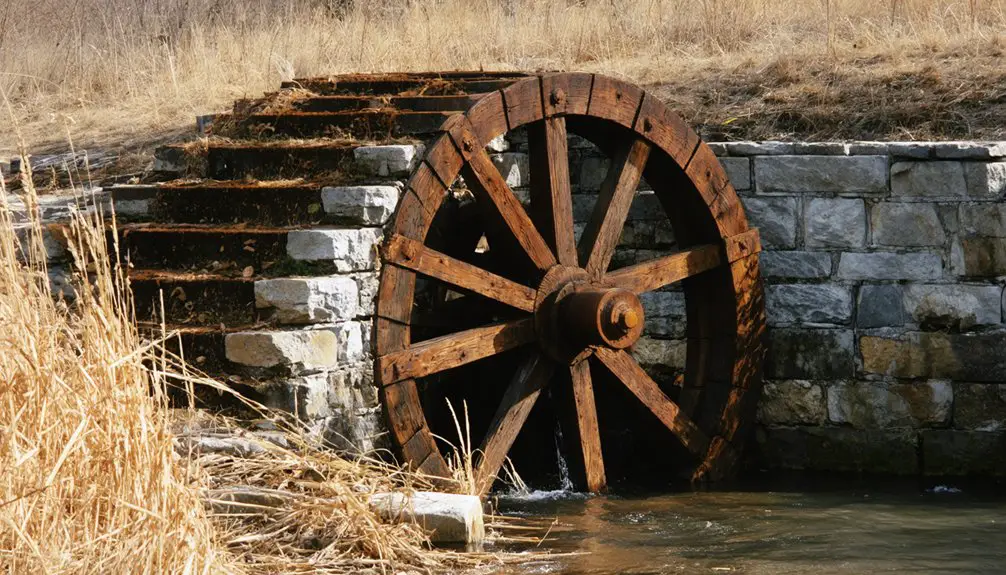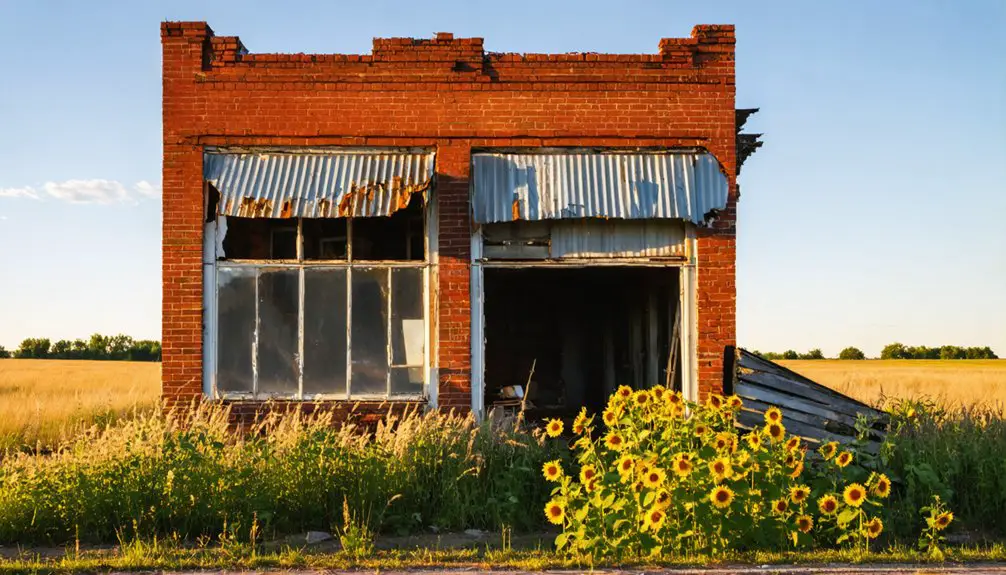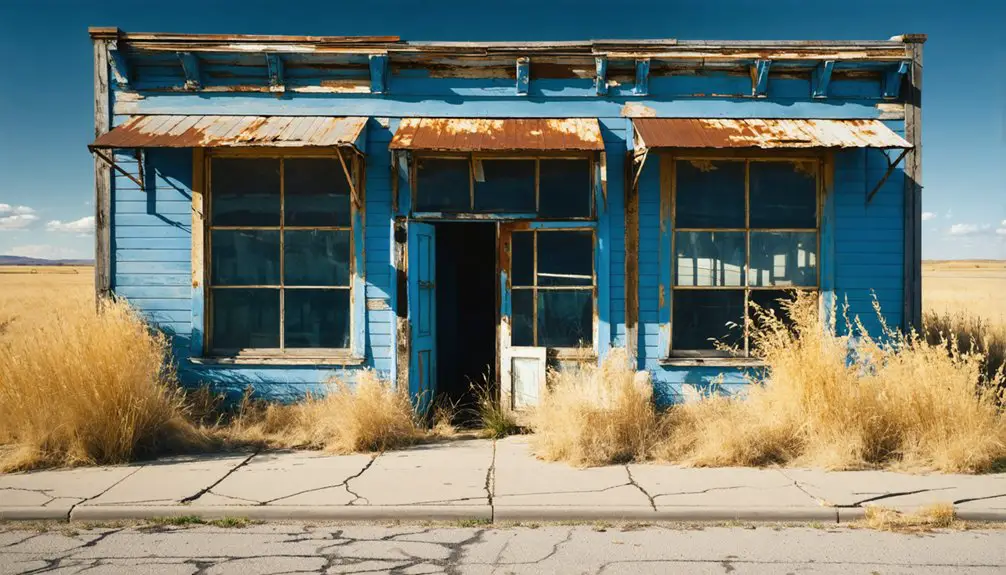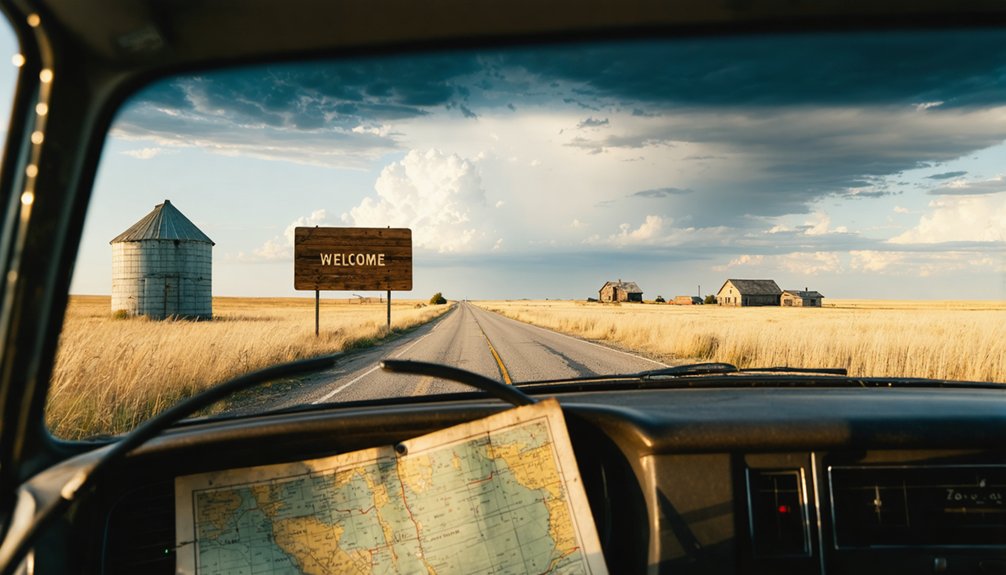
You’ll find Eminence 25 miles southwest of Garden City via US-50, where weathered iron gates open to a pioneer cemetery and scattered courthouse rubble tells the story of ballot-stuffing wars that drew Bat Masterson’s guns. Navigate gravel roads with satellite mapping as pavement fades into prairie grass, and you’ll discover where 1,000 souls fought over an entire county the Kansas Supreme Court later declared illegal. The ruins reveal why this frontier battleground still haunts western Kansas.
Key Takeaways
- Eminence sits in Finney County, Kansas; drive 25 miles southwest from Garden City via US-50 and Eminence Road.
- Use satellite mapping when navigating, as paved roads transition to gravel, especially during spring runoff conditions.
- Explore the historic cemetery through old iron gates, featuring weathered headstones dating back to the 1870s.
- Visit scattered courthouse rubble and deteriorating brick schoolhouse pillars spread across open fields and brush.
- Sites span half a mile, preserving the footprint of a community embroiled in violent 1887 county seat wars.
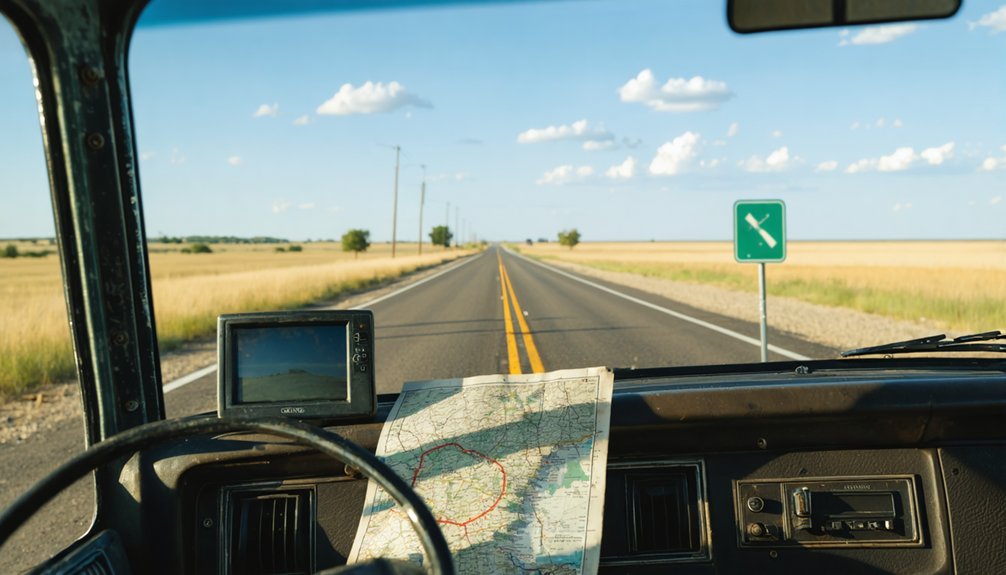
Tucked into the windswept plains of Finney County, Eminence whispers its history from coordinates 38.14640, -100.51750—a set of numbers that’ll guide you to its weathered cemetery rather than Main Street itself. The town’s 1886 relocation rationale centered on Pawnee River flooding, pushing settlers two miles east to higher ground that ultimately couldn’t sustain community life.
From Garden City, you’ll navigate 25 miles southwest via US-50, then branch onto Eminence Road—your primary artery through open rangeland. Wichita travelers face 200 miles westward on I-135 and US-50. Forget alternate transportation options here; this journey demands your own wheels and adventurous spirit. Satellite mapping proves essential when pavement surrenders to gravel, and spring runoff occasionally reclaims low crossings, reminding you why pioneers abandoned their dreams.
The Dramatic County Seat War Between Eminence and Ravanna
You’ll discover one of Kansas’s most violent political conflicts when you explore the bitter rivalry that consumed these prairie towns.
In 1887, Ravanna’s 35-vote victory crumbled after investigators uncovered ballot boxes stuffed with names of dead men and non-citizens—a fraud that cost them 60 votes and sparked a two-year legal battle.
The feud escalated into armed confrontations, with Eminence residents staging midnight raids to steal courthouse records while Bat Masterson and twenty Dodge City lawmen patrolled the streets to prevent bloodshed.
The Stolen Election of 1887
When Garfield County reached 600 occupants in July 1887, the young prairie settlements of Eminence and Ravanna transformed from neighbors into bitter enemies. The November 9th county seat election became a showdown you’d expect in the wildest frontier tales.
Both sides hired gunmen—Bat Masterson and twenty Dodge City deputies kept the peace while ballot box tampering ran rampant. When Ravanna claimed victory with 467 votes against Eminence’s 432, something didn’t add up. Over 1,000 ballots were cast from populations totaling barely 700.
The voter intimidation and fraud were so blatant that Eminence immediately filed suit. By December 1888, Kansas Supreme Court invalidated the stolen election, declaring Eminence the rightful county seat. Ravanna’s whiskey-soaked celebration proved short-lived.
Midnight Courthouse Raid
Despite the Kansas Supreme Court’s definitive ruling on December 11, 1888, Ravanna refused to surrender without a fight.
When commissioners wouldn’t hand over county records, Eminence citizens took matters into their own hands. Under cover of darkness, they forced their way into Ravanna’s courthouse for a brazen records theft that would ignite armed conflict.
The raid unfolded in three dramatic stages:
- Breaking and entering – Men from Eminence smashed through courthouse doors despite court orders
- Safe damage – Raiders targeted the treasurer’s office, battering the safe before Ravanna residents secured it
- Midnight escape – Treasurer W.T. Williams eventually fled with records one night, opening business in Eminence the next morning
You’ll discover how this defiant act sparked militia intervention and transformed two thriving communities into the ghost towns you can explore today.
Bat Masterson’s Armed Intervention
The chaos escalating from courthouse raids demanded professional intervention, and Eminence leaders knew exactly who to call. Bat Masterson arrived from Dodge City with a reputation forged through years of maintaining order across Kansas’s untamed territories. His armed tactics transformed the dispute’s dynamics—recruiting gunmen and positioning them strategically around Eminence sent unmistakable messages to Ravanna’s supporters.
Masterson didn’t rely solely on firepower. His intimidation strategies proved equally effective: wired threats to opposition leaders, warnings about tearing down rival settlements, and displays of overwhelming force that made actual violence unnecessary. His presence alone carried weight—a legendary lawman willing to back words with action.
This professional intervention couldn’t prevent Garfield County’s eventual dissolution, but it demonstrated how desperately these communities fought for survival and prominence.
What Remains: Exploring the Ruins and Cemetery
Arriving at what’s left of Eminence feels like stepping onto a stage after the final curtain call—the actors have long departed, but traces of the performance linger in the Kansas grassland. You’ll discover:
- Cemetery entrance through old iron gates, where weathered headstones mark graves from the 1870s, remembering early residents who built this frontier settlement before its spectacular collapse.
- Courthouse rubble scattered across an open field—remnants of Garfield County’s unfinished seat of power that barely saw use after the 1889 ballot-stuffing scandal.
- Deteriorating brick pillars from the schoolhouse, standing like stubborn sentinels among the brush, helping you piece together the town layout despite nature’s erasure.
The half-mile between cemetery and ruins preserves the footprint of a community that once housed over 1,000 souls chasing opportunity.
The Rise and Fall of Garfield County

Standing among these silent ruins, you might wonder what chain of events could reduce a thriving county government to scattered bricks and fading tombstones. Garfield County‘s story began in 1887 when homesteaders carved twelve townships from surrounding territories, naming it after President Garfield.
Political tensions between communities erupted immediately—Ravanna and Eminence battled fiercely for county seat designation. Ravanna’s settlers built a magnificent three-story stone courthouse with a domed cupola, spending $12,000 on their governmental dreams.
But economic challenges facing small county governance proved insurmountable. In 1893, Kansas Supreme Court declared Garfield County illegal—it contained only 432 square miles, falling short of legal requirements. The entire organization dissolved, absorbed into Finney County. Both rival towns vanished, leaving only weathered stones marking where ambition once flourished.
Notable Figures and Wild West Legends
You’ll find Eminence’s wild past written in the stories of legendary lawmen and frontier characters who shaped its destiny. The dusty streets once echoed with the boot steps of Bat Masterson, summoned from Dodge City to keep the peace during the violent county seat wars, while C.J. “Buffalo” Jones built his vision of a thriving prairie metropolis from raw Kansas grassland.
Later years brought colorful figures like Otto Hund, whose bootlegging escapades added another chapter to this remote outpost’s reputation as a place where the Old West refused to die quietly.
Bat Masterson’s Peacekeeping Role
The dusty streets of Dodge City found their unlikely guardian in Bat Masterson, a man who preferred his gold-headed cane to his Colt revolver when keeping the peace. You’ll discover bat masterson’s law enforcement tactics were revolutionary for the era—he resolved most confrontations without firing a single shot, relying instead on judgment and nerve to control rowdy cowboys during cattle season.
His peacekeeping legacy included:
- Capturing notorious outlaws Dave Rudabaugh and Ed West after their attempted train robbery in 1878
- Serving as Ford County Sheriff across seventeen counties with minimal bloodshed
- Protecting Doc Holliday from extradition while serving as Trinidad marshal in 1882
Later, bat masterson’s gambling partnerships would define his post-lawman career, shifting from marshal to faro dealer and journalist across the frontier’s vanishing landscape.
C.J. “Buffalo” Jones Legacy
From Illinois farmland to the African savanna, Charles Jesse “Buffalo” Jones carved out one of the frontier’s most paradoxical legacies—first as a relentless bison hunter who slaughtered thousands for their hides, then as the conservationist who’d save the species from extinction.
Buffalo Jones conservation efforts began in 1873 when he captured seven calves along the Solomon River, eventually amassing 150 animals—half the world’s remaining population. His transformation came after witnessing frozen cattle following the devastating 1886 blizzard. As Yellowstone’s first game warden under Theodore Roosevelt, he rescued the park’s last 30 wild bison.
His buffalo jones entrepreneurial spirit drove him beyond preservation—crossbreeding bison with cattle to create hardy “cattalo,” roping lions in Africa, and financing Zane Grey’s career-launching expedition.
Otto Hund Bootlegging Tales
Born into Kansas’s rough-and-tumble frontier days, Otto Albert Hund emerged from Leavenworth in 1887—a time when cattle drives still kicked up dust and the ghost of the Wild West hadn’t yet settled into memory.
You’ll discover his legacy intertwined with Crawford County’s shadowy past, where Prohibition era bootlegging operations thrived in the 1920s. His story reflects how family owned smuggling networks operated across Kansas’s “neutral lands”—those unregulated zones perfect for illicit trade.
The Hund legend includes:
- Strategic positioning between Leavenworth and Eminence’s underground corridors
- Confidence schemes that exploited song sheet distribution networks
- Connections to regional rackets that flourished until his 1968 death
Walking Eminence’s abandoned streets today, you’re tracing paths where independent spirits defied federal overreach.
Best Time to Visit and What to Bring
When should you venture into the haunting remnants of Eminence? Early October delivers the perfect convergence of pleasant weather and eerie atmosphere. You’ll escape summer’s scorching heat and winter’s brutal prairie winds while experiencing Kansas’s golden transformation—fiery woodlands meet endless skies. Halloween celebrations intensify the ghostly ambiance across the region.
Pack strategically for maximum freedom: layered clothing handles temperature swings, sturdy boots navigate crumbling ruins, and wind-resistant jackets counter relentless gusts. Your recommended camera equipment should capture dim interiors and distant scattered foundations. Bring flashlights, offline GPS, water, and snacks—no services exist here.
Visitor safety precautions demand first-aid kits for rough terrain and sun protection during exposed prairie exploration. Document buffalo hunting relics, examine schoolhouse remnants, and respect the abandoned landscape’s integrity.
Nearby Attractions in Garden City and Finney County
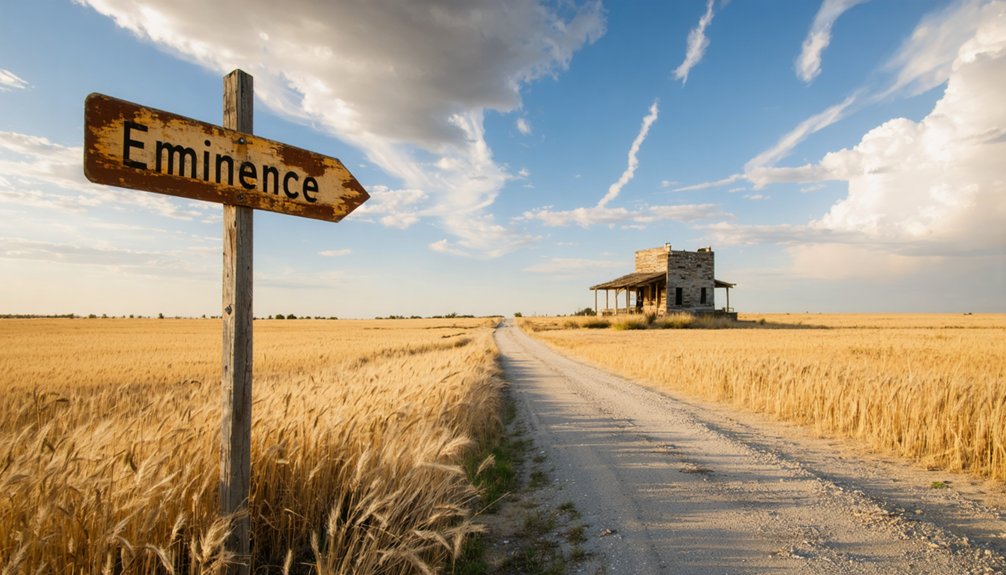
After exploring Eminence’s desolate foundations, you’ll crave civilization’s comforts just thirty miles east in Garden City. This regional hub rewards your prairie wanderlust with compelling museum exhibits and wildlife encounters.
Top Garden City Experiences:
- Finney County Historical Museum – Plunge into notorious True Crime displays featuring the 1959 Clutter murders from Capote’s “In Cold Blood,” plus artifacts from the Fleagle Gang and Baby Face Nelson.
- Lee Richardson Zoo – Southwest Kansas’s largest zoological park highlights over 100 species, from prowling lions to exotic birds, offering educational adventures without admission fees.
- Monument Rocks Day Trip – Venture beyond city limits to photograph these towering limestone formations rising dramatically from endless prairie, geological wonders shaped across millennia.
Garden City Arts provides cultural sustenance through watercolor classes and local artist showcases, while Parrot Cove’s indoor waters refresh sun-scorched explorers.
Frequently Asked Questions
Is It Legal to Access the Ghost Town Sites on Private Property?
You can’t legally access ghost town sites without gaining landowner permission first. Traversing legal considerations protects your freedom to explore—trespassing brings consequences. Respect property rights, seek explicit consent, and you’ll discover Eminence’s forgotten landscapes without legal troubles shadowing your adventure.
Are There Any Guided Tours Available for Eminence and Ravanna?
No guided tours exist for Eminence-Ravanna’s windswept ruins, but you’ll find freedom exploring independently. Nearby ghost towns offer guided tours, while visitor information centers in Garden City provide maps directing you toward these forgotten prairie settlements.
What Photography Restrictions Exist at the Cemetery and Ruins?
No official photography bans exist, but you’ll need private property permission for ruins access. Potential photo angles remain unrestricted at the cemetery. Appropriate camera equipment like tripods requires landowner approval—respect boundaries while capturing these hauntingly beautiful remnants.
Can I Camp Overnight Near the Ghost Town Locations?
You’ll search endlessly for nearby camping options near Eminence, Kansas ghost town—none exist there. The accessibility of ghost town sites remains day-trip only. However, you’ll find excellent campgrounds around Eminence, Missouri’s scenic rivers instead.
Are There Any Admission Fees to Visit the Sites?
Most ghost town sites around Eminence, Missouri offer free access, though you’ll find preservation efforts by local authorities maintaining trails. Accessibility for disabled visitors varies by location, so you’re free to explore these historic ruins without admission fees.