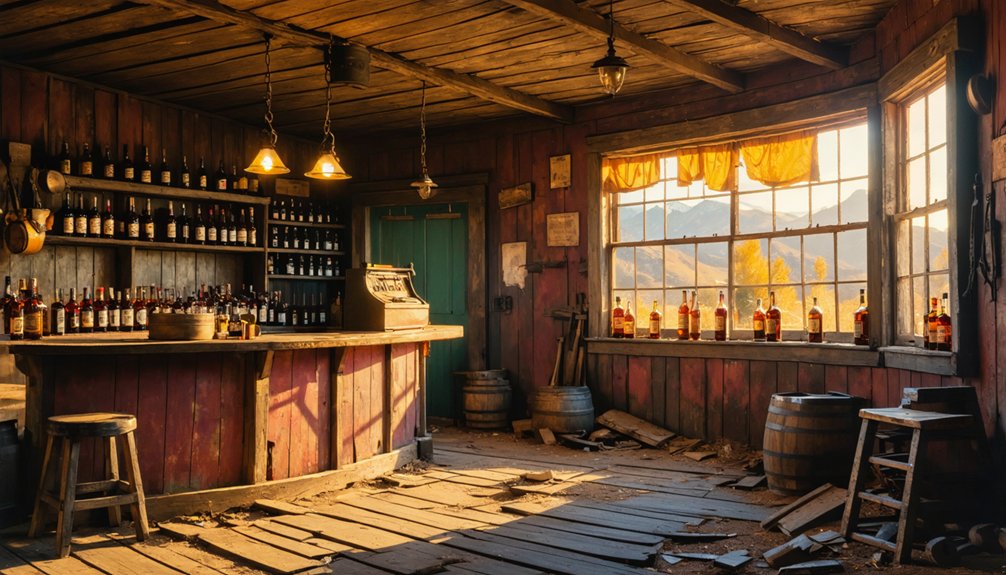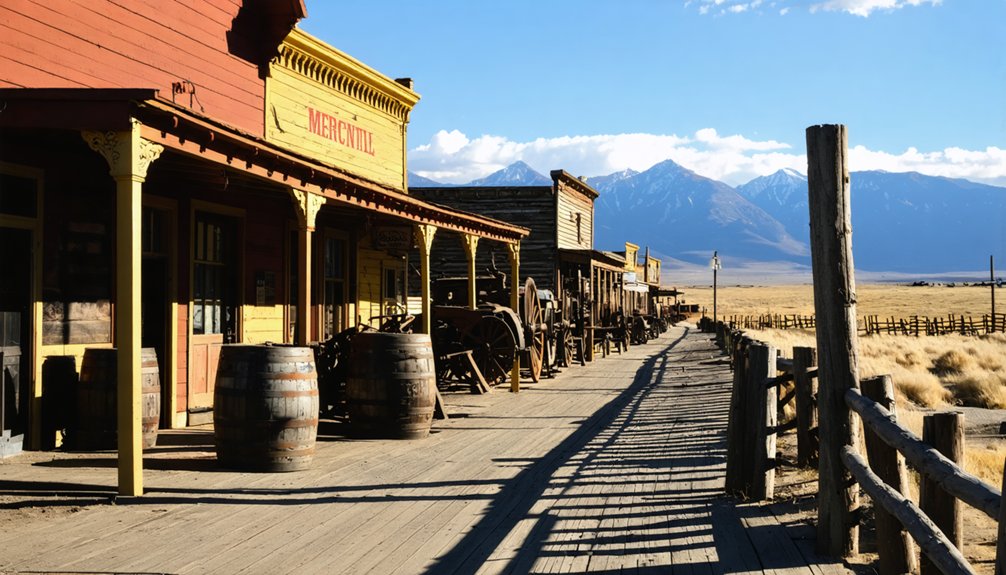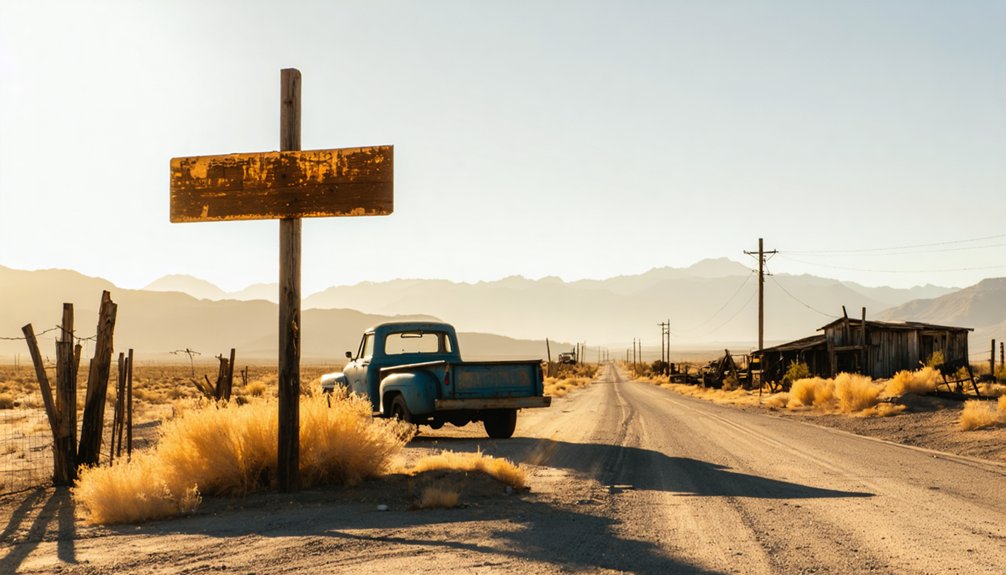
You’ll find Emory along State Highway 49 in Mariposa County’s Cathey Mining District, where Fraser River once carved fortunes from Emory Creek’s gold-rich banks. Rent a four-wheel drive vehicle from San Francisco International Airport, as pavement gives way to rugged trails leading to five collapsed railroad bridges, hillside crusher railways, and mining equipment slowly reclaiming wilderness. The site’s boarding house ramps and storage bunkers tell stories of prospectors who reshaped these hillsides with sluice boxes and hydraulic power, and there’s much more to uncover.
Key Takeaways
- Emory is located in Mariposa County’s Cathey Mining District along State Highway 49, but won’t appear on modern GPS systems.
- Rent a four-wheel drive vehicle from San Francisco International Airport, as pavement ends when approaching the remote ghost town site.
- Explore five ruined railroad bridges, boarding house remains, crusher railways, mining equipment, and a historic storage bunker across the canyon.
- The site showcases Fraser River gold rush history, featuring remnants of sluice boxes and hydraulic mining operations from prosperous deposits.
- Extend your trip to nearby Calico Ghost Town, Maggie Mine, and Emeryville Shellmound for additional historic California mining experiences.
Discovery of Emory’s Gold Mining Heritage
The Fraser River’s turbulent waters carved out fortunes along Emory Creek starting in 1858, where prospectors discovered the region’s second-richest gold deposits after the legendary Hill’s Bar. You’ll find remnants of gold mining operations that transformed this wilderness through successive waves of fortune-seekers wielding sluice boxes, rockers, and eventually hydraulic equipment that reshaped entire hillsides.
The creek’s powerful flow provided endless clean water for separating precious metal from gravel, enabling miners to work independently without corporate oversight. By 1893, operators constructed an impressive mile-long flume moving 3,500 inches of water per second through Prince Albert Flat. Miners formed ditching companies and diverted water to supply their sluice boxes by 1859. Most miners worked in partnerships or small companies of three to six men rather than alone. Today’s landscape bears witness to these extraction efforts, though environmental remediation challenges persist.
Chinese miners continued working the gravel bars late into the nineteenth century, extracting gold from bedrock beneath massive boulders.
Getting to Emory in Mariposa County
Planning your journey to Emory requires accepting a hard truth: this ghost town doesn’t appear on modern GPS systems. You’ll navigate toward Mariposa County’s Cathey Mining District using State Highway 49 as your primary reference point, then venture onto forgotten routes near the Coulterville-Yosemite Road region. Rent a vehicle from San Francisco International Airport, 170 miles west, giving you freedom to explore unmarked turnoffs.
Alternative transportation options prove limited here—four-wheel drive becomes essential when pavement ends. The trails and pathways leading to Emory’s remnants demand attention to historical mining district boundaries, where East Belt’s Clearing House District intersects Whitlock’s territory. Mariposa County Transit provides dial-a-ride service throughout the area, though reaching the remote ghost town site still requires your own vehicle for the final approach. Local knowledge from Mariposa residents often reveals access points that maps won’t show. Consider basing yourself at the Miners Inn for comfortable lodging with complimentary breakfast before your ghost town expedition. You’re pursuing shadows through Sierra foothills, where adventure trumps convenience.
What Remains at the Emory Ghost Town Site
You’ll find Emory scattered across Miller Gulch in layers—five ruined railroad bridges trace the canyon like skeletal fingers, while boarding house ramps and mining equipment emerge from the brush where gold fever once burned hot.
The ghost town reveals itself gradually as you explore: crusher railways clinging to hillsides, a storage bunker beyond a creek crossing, and the rusted shell of a classic car dissolving into wildflowers. Like Bodie, which stands preserved in decay with 110 structures still standing, Emory offers visitors an authentic glimpse into California’s mining past without the interference of modern development. The craggy snow-capped Sierras provide a dramatic backdrop to these abandoned structures, reminding visitors of the diverse wilderness that characterizes California’s landscape.
As you wander through these remnants, you might find yourself captivated by the stories etched into each building and artifact. With so many ghost towns to explore in California, each offers a unique narrative shaped by its history and the rugged environment. From the eerie silence of Virginia City to the sunbleached streets of Calico, adventurers can uncover the remnants of the Gold Rush and the resilient spirit of those who once called these places home.
Between downed trees and poison oak, staircases lead nowhere and cable crossings span empty air, each relic whispering stories of the miners who abandoned this place to time and the Sierra foothills.
Structural Remnants and Artifacts
Beneath the modern landscape of what visitors often mistake for “Emory” lies the Emeryville Shellmound, where only fragments of a 2,800-year story survive. You’ll find the site’s center stripped away—graded flat in the 1800s—leaving only the mound’s margins intact. These edges hold charcoal, animal bones, and organic soil layers that archaeologists have radiocarbon-dated across roughly 100 samples.
The preservation challenges mean you’re glimpsing mere slivers of occupation, particularly from later periods after 0 BC. What archaeological samples remain tell of a smaller, secondary mound used until Spanish contact, while burial sites were disturbed as early as the 1840s. The mound once reached 2.4 meters high during its middle development period between 400 BC and 0 BC. Today’s willow marsh conceals subsurface remnants where indigenous communities once thrived for millennia. While California ghost towns often draw attention to gold rush settlements, this site represents an older chapter of abandonment predating the mining history that created Colorado’s nearly 100 ghost towns.
Landscape Features Today
Where commercial development hasn’t entirely erased the past, Peavine Creek tributaries still trace their original paths along both sides of what’s become a modern strip center. You’ll discover lush riparian vegetation softening the harsh edges where civilization meets wilderness, while the creek continues absorbing storm runoff just as it did when miners walked these grounds.
The landscape reveals itself through:
- South-facing slopes where scattered building foundations cling to hillsides falling toward Peavine Creek
- Sculpted rock formations marking mineral extraction sites along the Highway 140 corridor
- Wildflower fields spreading between the Merced River Trail and forgotten structures
- Remote pools appearing near the fifth railroad bridge ruins, crossed by aging cables
Desert conditions steadily reclaim what prospectors once tamed, creating haunting beauty for those willing to venture beyond maintained paths. Abandoned structures continue deteriorating across the terrain, their weathered remains standing as silent monuments to the community that once thrived here. The relentless desert environment, once described by nineteenth-century travelers as a purgatory to be crossed, has returned to dominate the forgotten settlement.
Nearby Historic Attractions and Mining Towns
You’ll find California’s mining heritage alive just hours from Emory at Calico Ghost Town, where 500 silver mines once carved fortunes from russet hillsides before the 1890s collapse emptied the streets. The restored boomtown now welcomes visitors through creaking saloon doors and into Maggie Mine’s cool darkness, where you can trace ore veins with your fingertips.
For a sobering contrast, consider the Emeryville Shellmound Historical Landmark—a sacred Native American site that predates the mining frenzy by millennia, reminding you that California’s layered past extends far beyond pickaxes and gold dust.
Calico Silver Mining Heritage
Just thirty miles northeast of Barstow, the kaleidoscopic peaks of the Calico Mountains conceal a labyrinth of tunnels where fortune-seekers once blasted through rock in pursuit of silver. This legendary boomtown exploded during the 1880s silver rushes when ore valued at $500 per ton sparked a frenzy that swelled the population to 3,500 souls.
You’ll discover historic mining infrastructure spanning 30 miles of underground passages:
- Silver King Mine – California’s largest silver producer, generating millions in wealth
- 500+ working mines – Including the Oriental and Bismarck operations
- $86 million in silver – Plus $45 million in borax extracted before 1907
- Restored underground tours – Featuring authentic 1800s equipment and techniques
Though silver prices crashed by 1896, Walter Knott’s 1950s restoration preserved this record of unbridled ambition.
Emeryville Shellmound Historical Landmark
While Calico’s silver veins drew prospectors to the Mojave Desert, an even more ancient chronicle to human ambition rises from the San Francisco Bay shoreline, 350 miles northwest. You’ll find the Emeryville Shellmound, where Ohlone Indians built a 60-foot monument from millions of meals spanning 2,300 years. This location significance can’t be overstated—it was the Chochenyan capital, commanding sweeping views of the Golden Gate.
Spanish colonization triggered human population decline and commodification of sacred ground. By 1876, the mound became an amusement park with dance pavilions atop burial sites. Industrial leveling in 1924 exposed 700+ graves, yet eight feet of intact remnants survived beneath paint factories and steel mills. You’re witnessing California’s oldest archaeological site, designated State Landmark #335 in 1939.
Best Time to Visit Emory
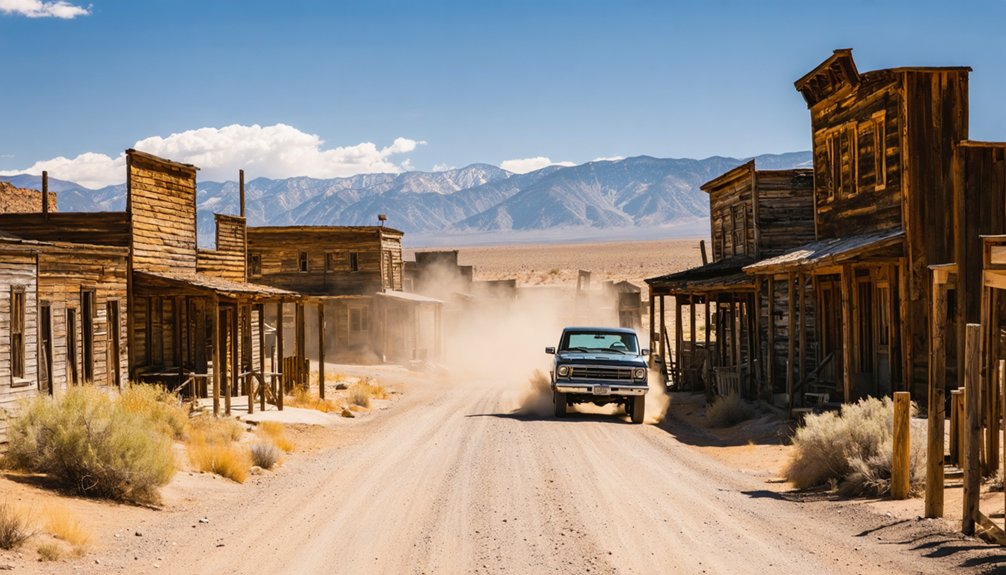
Since Emory sits tucked away in the Sierra Nevada foothills at roughly 3,000 feet elevation, your window for exploration hinges on weather patterns that swing dramatically with the seasons. Understanding seasonal conditions transforms your visitor experience from a muddy slog to an unforgettable adventure through mining history.
Timing your Emory visit around Sierra Nevada weather patterns means the difference between accessible adventure and impassable disappointment.
Optimal visiting periods:
- Late spring (May-June) – Wildflowers blanket surrounding trails while snowmelt clears from access roads, revealing remnants of the Miller Gulch quarry operations
- Early fall (September-October) – Crisp mountain air and golden aspens create photographer’s paradise conditions with minimal crowds
- Avoid winter months – Snow blocks primitive roads and obscures structural remains completely
- Summer mornings – Beat afternoon heat and capture the ghost town in ethereal dawn light before temperatures climb
Pack layers regardless of season—mountain weather shifts without warning.
Essential Supplies for Your Ghost Town Adventure
Before you turn the ignition and point your vehicle toward Emory’s weathered structures, understand that preparation separates memorable exploration from dangerous mishap.
Your packing recommendations should include multiple gallons of bottled water—natural sources near these ruins often carry contamination. Carry offline GPS maps marking railroad bridges and incline roads, plus a compass for backcountry navigation around Miller Gulch. Long pants and boots protect against poison oak bushes near Emory’s shacks, while layered clothing battles freezing nights. Stock your first aid kit with snake bite supplies and bandages for cuts from rusted mining equipment.
Following camping guidelines means packing lightweight shelter, non-perishable rations, and fire starters for warmth. Bring trash bags to preserve these ghost town artifacts—leave no trace amid history’s scattered remnants.
Photography Tips for Capturing Abandoned Landscapes
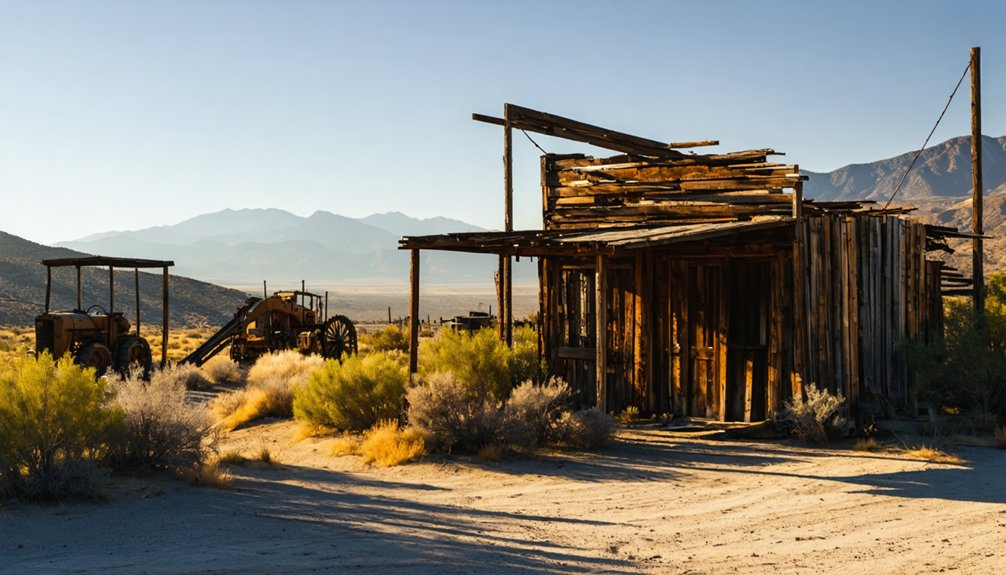
The skeletal silhouettes of Emory’s structures demand more than casual snapshots—they require deliberate framing that honors their fading stories. Master photographic composition techniques by embracing wide-angle lenses that swallow entire rooms, revealing decay’s architecture.
Wide-angle lenses transform Emory’s crumbling rooms into honest narratives, capturing decay’s full architecture through deliberate composition rather than fleeting snapshots.
Strategic lighting management transforms ordinary visits into extraordinary captures—arrive during golden hour when sidelight carves structures from landscape, or chase those dramatic sun rays piercing broken roofs.
Essential Techniques for Emory:
- Lead the Eye – Use crumbling pathways and sagging rooflines as natural guides toward focal points
- Frame Through Decay – Shoot through doorways and shattered windows for layered depth
- Embrace HDR – Bracket three exposures to capture dust-filled shadows and bright desert skies
- Add Context – Position buildings within vast landscapes, giving abandonment room to breathe
Pack your tripod for those moody long exposures that reveal what daylight hides.
Accommodations and Camping Options Near Emory
After hours of photographing Emory’s sun-bleached ruins, you’ll need a solid base camp where dust-covered gear meets comfortable beds. Travelodge by Wyndham Yermo delivers pet friendly accommodations just 3.5 miles out, with rates starting at $89 nightly—perfect for road-trippers hauling furry companions.
Budget friendly lodging stretches from $46 at nearby motels like Super 8 and Route 66 Motel along historic pavement. For ultimate freedom, pitch camp at Calico Ghost Town Campground, mere minutes from abandoned structures, where your RV claims space for around $100 daily (park access included).
Desert Springs and Barstow KOA offer additional camping territory. California Inn and Best Western Desert Villa Inn provide solid mid-range options with reduced mobility rooms, while Motel 6’s seasonal pool washes away desert grit after long exploration days.
Frequently Asked Questions
Is Emory in Mariposa County Connected to Emeryville’s Shellmound History?
No, you’ll find they’re completely separate histories. Emory’s tied to Miwok territories and Gold Rush mining, while Emeryville’s shellmound represents distinct Ohlone local indigenous cultural significance. Their historical settlement patterns evolved independently across 150 miles of California’s diverse landscape.
What Mining Equipment or Artifacts Can Visitors Legally Collect at Emory?
You can’t legally collect any mining artifacts at Emory—like forbidden fruit in Eden, artifact collecting policies protect these historical treasures on public lands. Leave everything untouched; violations risk $10,000 fines that’ll definitely limit your freedom.
Are There Guided Tours Available for Ghost Towns in Mariposa County?
You’ll find guided tours available throughout Mariposa County’s ghost towns, from small-group adventures departing local areas to multi-day explorations. These preservation efforts let you discover authentic mining settlements while respecting their fragile historical integrity and untamed spirit.
How Dangerous Are Abandoned Mine Shafts Near the Emory Ghost Town?
Like Icarus drawn too close, you’ll find deadly peril awaits. Abandoned shafts near Emory feature unstable mine structures and hazardous ventilation systems that’ve claimed lives. Keep your distance—these aren’t attractions but tombs waiting to claim freedom-seekers who venture too close.
What Permits Are Required to Explore or Metal Detect at Emory?
You’ll need to verify Emory’s historical significance and check local regulations with Inyo County authorities before exploring. Since it’s remote BLM land, metal detecting typically requires permits—contact the Bishop Field Office to secure your freedom to roam responsibly.
References
- https://en.wikipedia.org/wiki/Emeryville_Shellmound
- https://californiathroughmylens.com/calico-ghost-town/
- https://en.wikipedia.org/wiki/Emeryville
- https://www.youtube.com/watch?v=1nZFQl4N408
- http://freepages.rootsweb.com/~gtusa/history/usa/ca/mrp-co/r.htm
- https://www.emeryville.org/Government/About-Emeryville/History/Emeryville-is-Born-1890s-to-1930s
- https://kids.kiddle.co/Emory
- https://familypedia.fandom.com/wiki/Emeryville
- https://bcgoldadventures.com/emory-creek/
- https://npshistory.com/publications/usfs/region/5/tahoe/history/chap3.htm