You’ll find Everts six miles from Glenham, accessible via county roads from Mobridge where you can fuel up. Visit between late May and September—September’s ideal for crisp weather and minimal crowds. Bring permission slips since it’s private land, and don’t expect much: the prairie’s reclaimed nearly everything except faint railroad depressions visible at dawn. Pack your wide-angle lens and tripod, then consider extending your journey to nearby Spokane’s two-story caretaker’s house for more substantial remnants of South Dakota’s vanished frontier communities.
Key Takeaways
- Everts is accessible via county roads from Mobridge, with Glenham located 6 miles from the townsite on private land requiring permission.
- Visit between late May and September, with September offering ideal conditions including crisp weather, fall foliage, and fewer visitors.
- The site has almost no visible remains except faint railroad grade depressions, offering a stark prairie landscape experience.
- Bring wide-angle lenses, tripods, and plan for dawn photography to capture the abandoned railroad traces and atmospheric lighting.
- Extend your trip to nearby ghost towns like Spokane and Rockerville for additional photography opportunities and historic sites.
The History Behind Everts: Railroad Terminus and Cattle Shipping Hub
The Milwaukee Road‘s ambitious push westward from Aberdeen reached Everts in the early 1900s, transforming empty prairie into what briefly became the nation’s busiest cattle shipping center. You’d have witnessed dust-caked cowboys driving herds toward loading pens, their Texas longhorns destined for eastern markets. The livestock trade dynamics here mirrored Abilene’s glory days—cattle bawling, locomotive whistles echoing across grasslands, and fortunes changing hands daily.
Early settler experiences centered on this railroad terminus, 65 miles north of Pierre, where the Milwaukee Road’s tracks jutted west toward the Missouri River. Matador representatives and ranchers from Northern Great Plains ranges converged here, making Everts indispensable until 1908. The town’s layout followed the typical T-shape or H-shape pattern that railroad companies imposed on their settlements, with streets running parallel and perpendicular to the tracks. Then LeBeau’s competing line shattered everything, leaving you standing where America’s cattle empire once thundered through.
Getting to Everts: Routes and Access Points
Before your wheels ever reach Everts’ crumbling foundations, you’ll need to orient yourself from Mobridge, that windswept Missouri River town nine miles northeast where gas stations and cafés mark your last chance for supplies. From there, county roads slice through rolling prairie toward coordinates 45.4486025°N, -100.3059646°W, though don’t expect highway signs pointing your way—ghost towns aren’t tourist attractions here.
You’ll navigate by landmarks and intuition, following routes that connect through Glenham six miles out. The townsite sits at roughly 1,624 feet elevation, where the high plains topography becomes your compass across Walworth County’s sweeping grasslands. Everts lies within South Dakota, positioned at 44° 30′ 0.0000″ N latitude in the central reaches of the state. Here’s the catch: access restrictions often apply to abandoned townsite remains on private land. Smart explorers secure local landowner permissions before trespassing across fencelines. Those ranchers hold the keys to history, and respecting their property means you’ll actually get to explore what’s left standing.
What Remains at the Everts Site Today
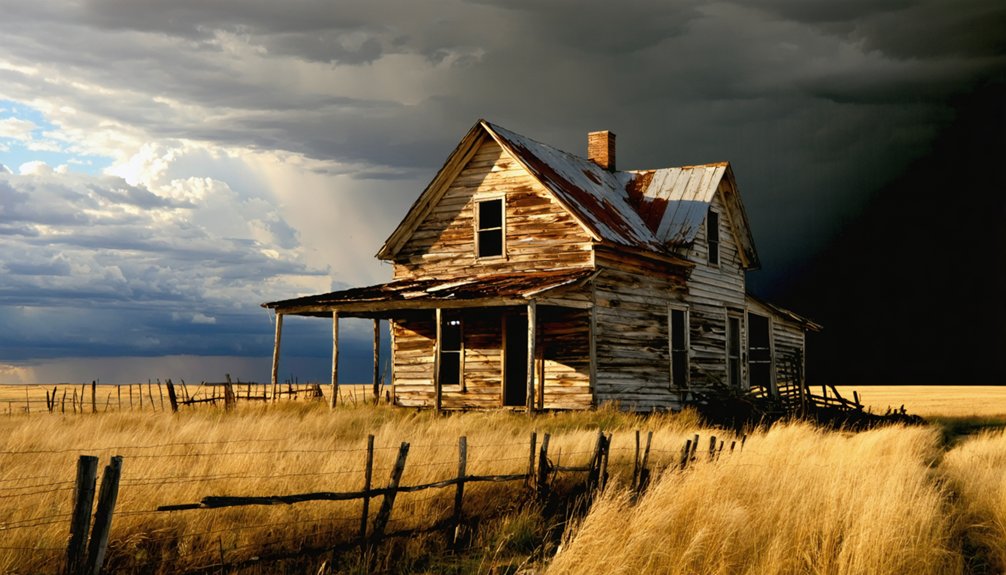
When you arrive at the Everts site, you’ll find nothing but windswept grassland where saloons and shipping corrals once bustled with activity.
If you walk the barren ground carefully, you might trace faint depressions in the earth that hint at the old railroad grade cutting through the prairie. The landscape has erased nearly every mark of human settlement, leaving only subtle contours visible to those who know what they’re searching for. Like many South Dakota ghost towns, Everts demonstrates how land returned to fields can completely erase a once-active settlement.
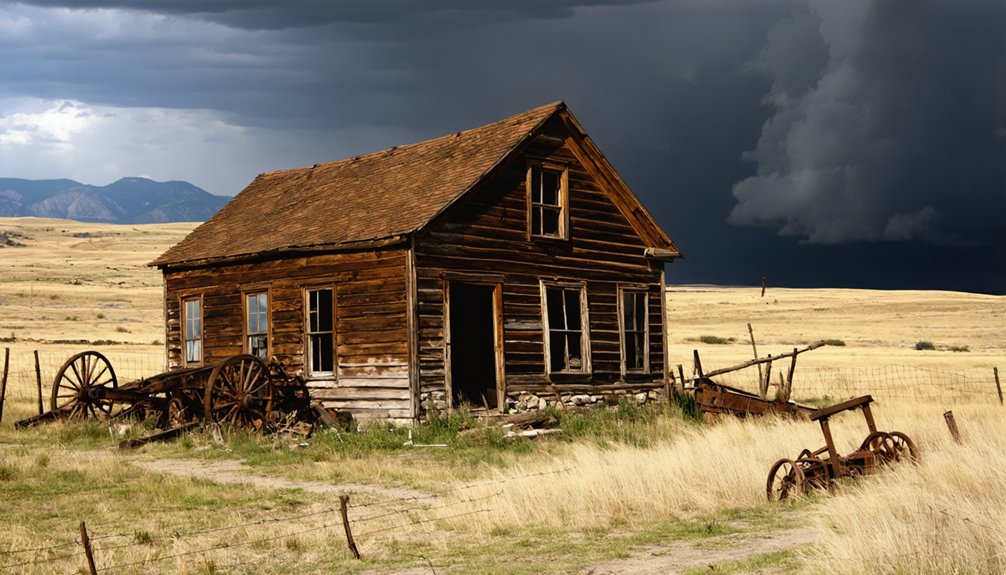
In contrast, the nearby Spokane ghost town features a two-floor caretaker’s house that still sits in a meadow, offering visitors a tangible glimpse into the region’s mining past.
Visible Structural Remnants
Standing at the GPS coordinates that mark Everts’ former location—roughly ten miles southeast of modern-day Mobridge—you’ll find nothing but open South Dakota prairie. The boomtown that once housed saloons, hotels, and gambling halls has vanished completely. No foundations peek through the grass. No weathered lumber marks where brothels and supply stores stood. The land has reclaimed everything.
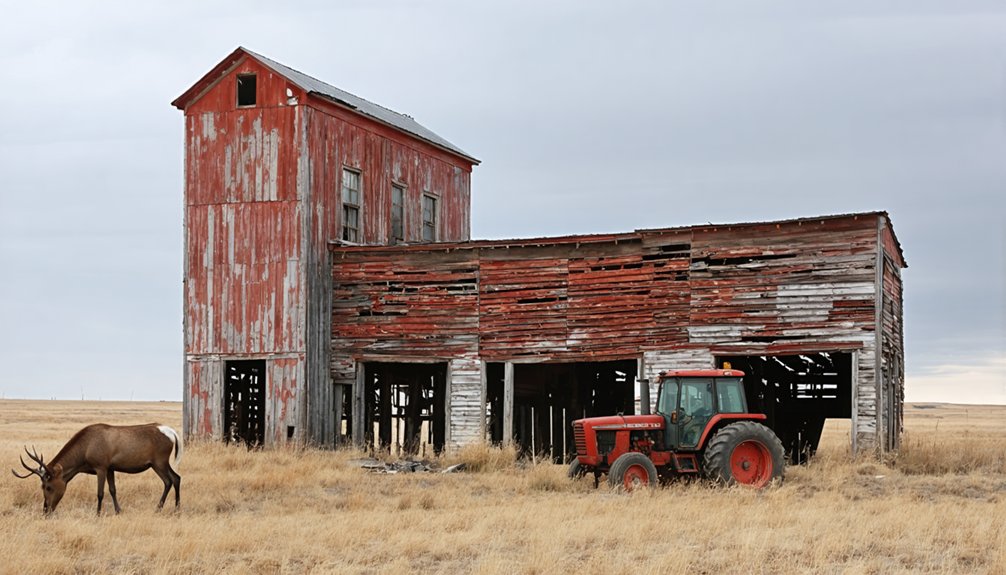
Without interpretive signage to guide you, identifying the exact townsite becomes nearly impossible. No archaeological survey has documented artifact locations or structural footprints. The railroad grade might still cut across the landscape if you know where to look, but even that trace grows fainter each year. Unlike towns such as Awanka where one grain elevator still stands as a landmark, Everts offers no such visible reminders of its past. About thirteen miles south, an abandoned ranch house from Depression-era days slowly deteriorates on a lonely gravel road, representing the region’s forgotten homesteads. What remains is silence—and the freedom to imagine what once thrived here.
Railroad Grade Traces
The most tangible evidence of Everts’ existence lies beneath your boots—if you can find it. The Milwaukee Road’s abandoned railroad grade cuts through prairie grass, a scar that refuses to heal completely. While township supervisors once handled grade maintenance around 1908, decades of grade deterioration have softened these earthworks into subtle ridges.
What you’ll discover:
- Shallow depressions where right-of-way excavation crews dug through higher ground
- Raised embankments crossing wet lowlands, now grass-covered monuments to vanished ambition
- Weathered fragments of ballast stone scattered like breadcrumbs to nowhere
- Faint parallel lines visible at dawn when shadows stretch longest
- Complete silence where steam whistles once announced arrival
These traces whisper of broken promises—infrastructure built for empire, abandoned when LeBeau stole Everts’ destiny.
Best Time to Visit This South Dakota Ghost Town
Timing your journey to Everts requires balancing weather extremes against the reward of exploring crumbling structures beneath wide Dakota skies. Your ideal seasonal timing runs late May through September, when gravel roads dry out and rattlesnakes become your only concern in the ruins.
I’ve found September particularly magical—crisp 50-70°F days, minimal crowds after Labor Day, and fall foliage painting the Black Hills in amber and rust. An appropriate visit length spans two to three hours for wandering foundations and railroad grades at your own pace.
Avoid winter’s subzero fury that buries everything under snow, and skip muddy April when spring thaw turns access routes into quagmires. Summer weekends bring Deadwood’s tourist overflow; dawn visits offer solitude among the ghosts. While exploring the region, consider extending your trip to nearby Spokane, just 16 miles from Custer, where another abandoned mining town offers fragile structures perfect for photography. You might also visit nearby Rockerville, which still has standing buildings despite its ghost town status, offering a compelling contrast to sites that have completely reverted to empty fields.
Essential Gear and Supplies for Your Exploration
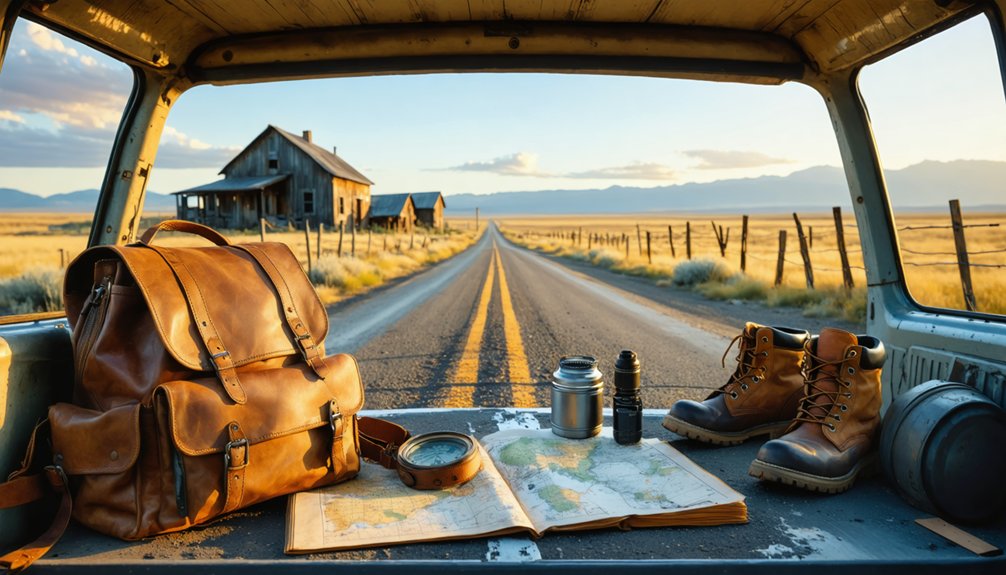
Before you venture into Everts’ weathered ruins, proper gear separates rewarding exploration from genuine peril in South Dakota’s backcountry. Trail hazards like gaping mine shafts and eroded tailings demand your full attention, while wildlife encounters require bear spray and emergency beacons for areas with zero cell coverage.
Pack smart for independence:
- GPS device and detailed topographic maps – cell towers won’t save you near abandoned mining sites
- High-energy rations and 3-day water supply – dehydration ends adventures quickly
- Sturdy hiking boots and layered clothing – sharp debris and elevation changes punish the unprepared
- First aid kit and flashlight – dark mine waste piles hide dangers
- Metal detector and camera – document artifacts legally before they vanish
Your high-clearance vehicle becomes basecamp. Freedom means self-reliance when exploring forgotten places. Watch for abandoned railroad grades throughout the northern Black Hills that once connected these mining communities to the outside world.
Nearby Black Hills Ghost Towns to Add to Your Itinerary
With your vehicle loaded and navigation systems tested, Everts becomes your gateway to a constellation of forsaken settlements scattered across the Black Hills. Start at Spokane, where skeletal stone walls emerge from pine shadows—a true mining camp site established in 1890, now reclaimed by wilderness.
Mystic’s Pioneer Cemetery tells harder truths through weathered headstones marking children who never escaped these mountains. Galena rewards the adventurous with ATV-accessible trails leading to 140-year-old relics and Sarah Campbell’s grave at Vinegar Hill. Near Keystone, Etta’s lithium mine ruins hide in an isolated rural setting beneath Mount Rushmore’s shadow. Harney represents the boom-bust cycle perfectly—gold depleted by 1878, dreams abandoned by 1900. Each site demands self-reliance and respect for the unforgiving terrain that defeated generations before you.
Photography Tips for Capturing Abandoned Sites
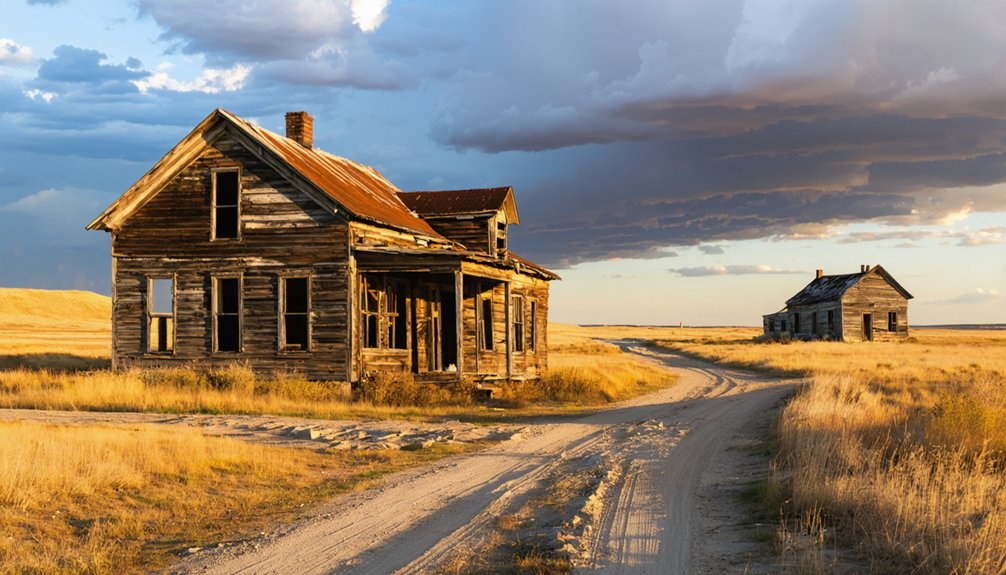
Crumbling walls and rust-streaked metal demand technical precision your smartphone can’t deliver. You’ll need a tripod for those long exposures that transform interior lighting challenges into hauntingly beautiful shots.
Pack your wide-angle lens and embrace creative composition techniques—shoot low to amplify that sense of abandonment, or frame decaying doorways to pull viewers deeper into forgotten spaces.
Essential gear for your ghost town shoot:
- Flashlight for traversing pitch-black corridors where electricity died decades ago
- Bracketed exposures (1/100, 1/50, 1/25) for HDR processing that reveals every texture
- Low-angle perspectives that make empty rooms feel cathedral-vast
- Corner anchors and leading lines guiding eyes toward your focal point
- Discarded objects—chairs, books, phones—becoming powerful storytelling centerpieces
Visit on sunny days when light slices through broken ceilings, creating those dramatic rays you’ll chase from room to room.
Safety Precautions When Exploring Historic Locations
The rotted floorboard that nearly sent my boot through to the basement below taught me what guidebooks can’t—abandoned buildings bite back when you underestimate them. You’ll need three explorers minimum; when someone twists an ankle, one stays while another fetches help.
Pack N95 masks for asbestos, sturdy boots with ankle support, and gloves against rusty metal. Scout the exterior first, identifying exits before entering. Test stairs near wall supports, never the middle.
Personal medical conditions matter—inform your group about allergies or medications before exploring. Establish team communication protocols: stick together, use air horns for emergencies. Tell someone outside your expected return time.
Carry multiple flashlights, first-aid supplies, and proper ID. These precautions aren’t paranoia—they’re freedom insurance.
Where to Stay During Your Ghost Town Adventure
After a full day wandering crumbling foundations and weathered storefronts, you’ll need a comfortable base camp for your ghost town exploration. The Bullock Hotel in nearby Deadwood offers Victorian-era rooms where you can sleep in the same building Seth Bullock constructed in 1895, placing you just minutes from Everts and surrounding abandoned sites.
If you’d rather wake to pine-scented air and campfire smoke, Wild Bill’s Campground provides year-round RV hookups and tent sites at $40-55 per night, keeping you close to the trails while your budget stays intact.
Nearby Historic Hotel Options
Where should you rest your head after a day exploring South Dakota’s abandoned settlements? These nearby historic lodging options capture the untamed spirit you’re chasing:
- Hotel Alex Johnson in Rapid City—that 1928 Tudor landmark with teepee chandeliers beckoning from eight stories of Western authenticity
- Historic Bullock Hotel in Deadwood, where Sheriff Seth Bullock’s ghost still roams the halls you’ll wander
- The Hotel By Gold Dust—Deadwood’s #1 heritage gem offering freedom from overpriced chains
- Historic Iron Horse Inn with its family-run charm and downstairs bar perfect for swapping road stories
- Hotel on Phillips in Sioux Falls, where you’ll sleep inside a transformed 1918 bank vault
These boutique hotel accommodations nearby aren’t just lodging—they’re living history matching your adventurous soul.
Camping Near Everts Site
Your ghost town exploration deserves a basecamp that connects you to these windswept plains, and the Black Hills region delivers camping options ranging from full-service RV resorts to backcountry tent sites where coyotes serenade at dusk.
Nearby RV campgrounds like Fish ‘N Fry and Mystic Hills Hideaway accommodate big rigs with full hookups year-round, while Hart Ranch positions you near Rapid City’s conveniences. I’ve watched dawn break over Horsethief Lake from my tent—that $26 site bought me absolute silence and stars that crowded the sky.
Tent camping sites at Fort Welikit start at $25, or choose Grace Coolidge’s $30 spots with hot showers after dusty trail days. Oreville’s $20 dry camping sites offer maximum freedom with minimal restrictions, letting you disappear into South Dakota’s vast emptiness between ghost town discoveries.
Frequently Asked Questions
Are There Any Documented Hauntings or Paranormal Activities Reported at Everts?
No reported paranormal phenomena exist in documented records for Everts. You won’t find alleged ghostly apparitions or supernatural encounters here—just windswept prairie where cattle once roamed. The town vanished without leaving haunting tales behind, only historical silence.
What Cattle Brands or Railroad Companies Were Originally Associated With Everts?
Like tumbleweeds lost to time, Everts’ specific cattle ranching operations and early railroad infrastructure details have vanished from records. You’ll find the town’s origins remain frustratingly mysterious, with no documented brands or railway companies definitively linked to this abandoned settlement.
Can I Legally Take Artifacts or Souvenirs From the Everts Site?
No, you can’t legally take artifacts from Everts without obtaining necessary permits. Federal and state laws protect these sites, imposing fines up to $100,000. Preserving historical sites safeguards future explorers experience authentic remnants of South Dakota’s frontier past.
Were Any Notable Historical Figures Connected to Everts’ Founding or Operation?
No notable figures founded Everts—the town died by 1908. You’ll find no documented founders, just traces of Native American settlement patterns and early European explorers who passed through before this brief settlement flickered out on Dakota’s wild prairie.
What Caused Everts to Be Abandoned as a Railroad Terminus?
You’ll find Evarts abandoned when the M&StL’s competing line to LeBeau eclipsed it in 1907. The economic decline hit hard as superior livestock facilities and better water supply drew shippers away, leaving Milwaukee Road’s terminus without purpose or profit.
References
- https://www.sdpb.org/rural-life-and-history/2023-08-21/some-black-hills-ghost-towns-and-their-origins
- https://www.blackhillsbadlands.com/blog/post/old-west-legends-mines-ghost-towns-route-reimagined/
- https://en.wikipedia.org/wiki/List_of_ghost_towns_in_South_Dakota
- https://core.ac.uk/download/pdf/345016075.pdf
- https://www.youtube.com/watch?v=vaqndyx5LM4
- https://www.legendsofamerica.com/south-dakota-ghost-towns/
- https://www.youtube.com/watch?v=r-wdmY0FpBs
- https://www.sdhspress.com/journal/south-dakota-history-33-1/a-promise-broken-lebeau-and-the-railroad/vol-33-no-1-a-promise-broken.pdf
- https://www.youtube.com/watch?v=hxgc0GCfdfw
- https://www.sdpb.org/rural-life-and-history/The-Rise-and-Fall-of-the-Railways-in-South-Dakota