Start your ghost town expedition at Farmer City’s scattered foundations, where ambitious settlers bet everything on becoming Wichita County’s seat before vanishing into prairie grass. You’ll find Coronado’s repurposed schoolhouse and restored log cabin nearby, then follow the route through Mertilla, Jasper, Ravana, and Ulisses—each settlement telling stories of rival towns, imported gunfighters, and the violent 1887 shootout that decided their fates. The weathered gravestones and crumbling stone ruins offer photographer’s gold, while preserved late 1800s structures reveal what bureaucratic dreams and railroad promises left behind.
Key Takeaways
- Start at Farmer City’s scattered foundations and gravestones, the neutral territory that collapsed after losing county seat status to Leoti.
- Visit nearby ghost towns Mertilla, Jasper, Ravana, Ulisses, and Summer City to see Kansas settlement remnants and preserved 1800s structures.
- Explore Coronado’s repurposed schoolhouse foundation, restored log cabin, and Coronado Park’s granite monument commemorating the county seat wars.
- Photograph Ulisses’s actual late 1800s structures and Empire City’s weathered cemetery marking the 1877 mining boom with 3,000 residents.
- Include Eminence’s weathered schoolhouse, Lyona School, and Coronado Heights castle for a comprehensive Wichita County ghost town expedition.
The Rise and Fall of Farmer City: A Compromise That Vanished
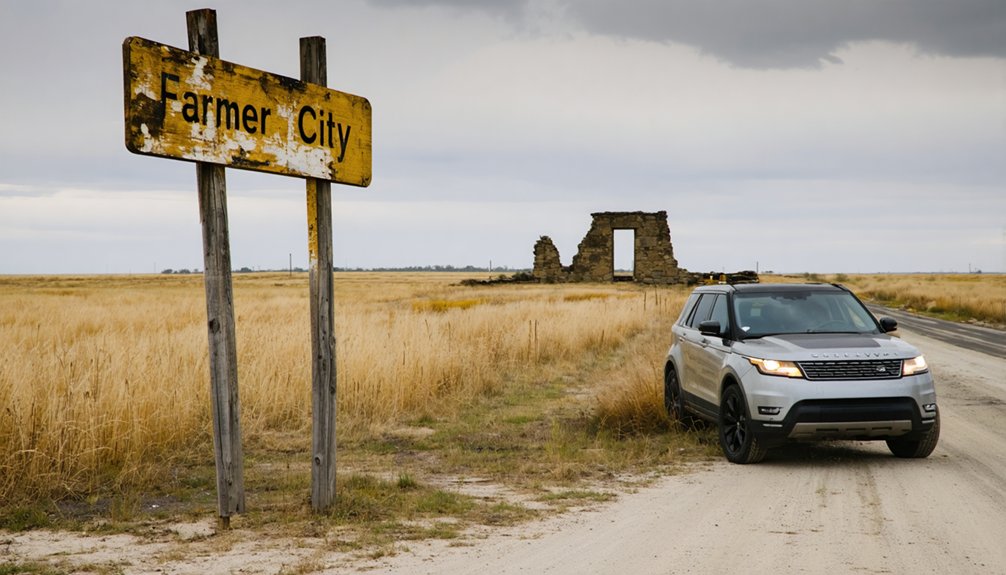
When rival Kansas towns couldn’t agree on where to place their county seat in the 1880s, they did something peculiar—they created an entirely new town from scratch. You’ll find Farmer City‘s story represents the politics of compromise at its most ambitious and tragic.
Leoti and Coronado battled fiercely for Wichita County’s administrative throne, so town founders positioned Farmer City as neutral territory between them.
The plan seemed brilliant until reality struck. This compromise settlement faced the economic challenges of administrative centers—it depended entirely on winning county seat status. When Leoti claimed victory, Farmer City’s reason for existing vanished overnight. Residents packed up and left within years.
Today, you’ll discover only scattered foundations where ambitious settlers once bet everything on bureaucratic compromise.
Understanding the County Seat Wars Between Leoti and Coronado
Two newly-minted Kansas towns stood just miles apart in 1885, each convinced it deserved to rule Wichita County. Leoti claimed geographic superiority as the county’s center, while upstart Coronado rapidly transformed into a thriving rival.
Their county seat status claims sparked one of Kansas’s bloodiest confrontations. The role of lawless tactics escalated quickly:
- Coronado’s petition mysteriously produced 1,700 signatures versus Leoti’s 500
- Both sides imported gunfighters—Leoti from Wallace County, Coronado from Dodge City
- Voters faced intimidation through forced drinking and prairie abandonment
The February 27, 1887 shootout left Coulter riddled with fourteen bullets and bodies lying in Coronado’s streets until midnight. Newspapers hurled accusations of fraud and murder while each town weaponized every available resource to claim victory and the prosperity it promised.
Mapping Your Route Through Wichita County’s Abandoned Settlements
After the gunsmoke cleared and Leoti claimed its hard-won victory, the landscape of Wichita County transformed into a graveyard of abandoned dreams. You’ll find Farmer City‘s skeletal remains perfectly positioned for a multi-stop expedition through forgotten settlements. Start at Farmer City itself, then push northeast to Mertilla, where a grocery store hauled by four oxen once marked civilization’s arrival.
Jasper lies nearby in Mertilla Township—platted May 14, 1888, by the Kansas Town and Land Company.
Continue to Ravana, where settlers fired guns and rang bells celebrating their brief county seat proclamation on July 21, 1887. As economic drivers decline stripped these towns of purpose, settlement demographics evaporated.
Ulisses preserves actual late 1800s structures worth photographing. Summer City, originally Kado Degola Ranch, rounds out your route with its lumber yard foundations.
Empire City and Other Ghost Towns Along the Trail
You’ll find Empire City’s weathered cemetery first, where hundreds of graves mark the town’s explosive 1877 boom when 3,000 miners flooded this Short Creek settlement chasing lead and zinc.
Just twenty miles west, Ransomville’s crumbling foundations reveal another flash-in-the-pan industrial dream, while the twin settlements of Mertilla and Jasper barely left a trace beyond scattered stone ruins in the prairie grass.
These stops aren’t just detours—they’re essential chapters in understanding how railroad promises and mineral deposits carved ghost towns across this stretch of Kansas.
Empire City Mining Legacy
By the late 1890s, the disparity was stark:
- Galena operated 265 producing mines
- Empire City struggled without prime mineral deposits
- Environmental impact devastated the region with pollution and desolation
After years of bitter rivalry and legal battles, Empire City surrendered its charter on July 9, 1907, becoming Galena’s Fifth Ward by 1910.
Ransomville’s Brief Industrial Era
When James H. Ransom purchased land east of Williamsburg in 1879, he sparked an industrial transformation that would define Franklin County’s landscape for three decades. His coal mining operations launched in 1881, carving five 50-foot shafts that eventually produced 1,000 tons monthly for the Santa Fe Railroad.
You’ll find it remarkable how quickly this enterprise grew—by the 1890s, 300 residents occupied 65 houses, with 60 miners working the depths daily.
The Ransom family legacy ended abruptly in 1914 when James died that September. His mines sealed, his workers scattered, and his town vanished almost overnight. Today’s Ransom Farm stands where bustling streets once thrived, a quiet memorial to Kansas’s fleeting industrial dreams and the boom-bust cycle that shaped the American frontier.
Mertilla and Jasper Settlements
You’ll find fascinating evidence of frontier ingenuity in how settlers moved buildings from existing sites:
– Dr. Ostrander relocated his entire drug store from Carthage after Meade Center won the county seat battle
The hotel’s lumber eventually constructed a barn on the Rexford farm.
That drug store building survived as the remodeled Boyer district schoolhouse.
What Remains: Sites and Landmarks to Explore
You’ll find Farmer City’s story written in scattered foundations and crumbling stone markers rather than standing buildings. The cemetery west of town holds the clearest evidence—weathered gravestones from 1887 emerging from farm fields like forgotten teeth, while most markers have disintegrated into the soil.
If you venture to nearby Coronado, you can spot similar ruins: a repurposed schoolhouse foundation beneath mature trees, a restored log cabin with its original shake shingles, and the ghostly outline of what was once Oil Hill’s main square.
Farmer City Ghost Foundations
Scattered across the Kansas prairie like forgotten punctuation marks, the ghost town remnants near Farmer City tell stories through crumbling limestone and weathered gravestones. You’ll find weathered schoolhouse remnants at Eminence, where limestone walls stubbornly resist complete collapse despite the removed roof and second floor. The structure once served cattle before surrendering to time’s patient assault.
West of town, forgotten cemetery headstones mark the 1887 establishment of Eminence Cemetery, surrounded by endless farm fields where nothing else survives.
Each site offers distinctive features:
- Lyona School (1870) stands as one of few intact structures alongside a surviving church
- Prairie City preserves ruins including an abandoned stone house and church remains
- Monument maintains operational grain elevators amid decaying homes and shuttered buildings
These foundations grant you unobstructed access to Kansas’s vanished frontier legacy.
Nearby Coronado Town Remnants
While Farmer City’s foundations crumble into prairie soil, the Coronado sites northwest of here have weathered time through deliberate preservation. You’ll find the polished granite shaft—originally erected in 1902 at Logan Grove—now standing in Coronado Park after its 1974 relocation. The move saved Henderson’s monument from recreational development, showcasing early Coronado monument preservation efforts.
Drive northwest to Lindsborg where Coronado Heights castle significance becomes immediately apparent. The 1936 WPA structure crowns a 300-foot Dakota sandstone butte, offering sweeping valley views Coronado himself might’ve witnessed in 1541. Its fireplace still draws visitors seeking respite after climbing the winding staircase. The surrounding bluffs yield artifacts—Spanish coins, chain mail, arrowheads—proving this landscape holds stories deeper than any ghost town’s brief existence.
Essential Tips for Visiting Kansas Ghost Town Locations

Before you set out to explore Kansas’s abandoned settlements, understand that proper preparation makes the difference between an enriching historical adventure and a frustrating—or dangerous—mishap. You’ll need to respect both the land and its legacy while maintaining your independence on the road.
Proper preparation transforms ghost town exploration from potential disaster into meaningful historical discovery while preserving Kansas’s frontier heritage.
Essential considerations include:
- Research property boundaries beforehand—many ghost towns sit on private land where trespassing laws apply strictly
- Practice digital preservation ethics by documenting sites through photography without disturbing artifacts or structures
- Check community access policies with local historical societies who often maintain these sites and appreciate advance notice
Pack water, first-aid supplies, and offline maps since cell service disappears quickly in rural Kansas. Sturdy boots protect against collapsed floorboards and prairie rattlesnakes. Weather shifts rapidly across these plains, so layer your clothing appropriately.
Frequently Asked Questions
Are There Any Restaurants or Gas Stations Near Farmer City?
You’ll find minimal options directly in Farmer City since it’s a ghost town. Your best bet is stocking up at convenience stores and local diners in nearby Wichita or Manhattan before heading out on your adventure.
What Cell Phone Coverage Can I Expect in Wichita County?
You’ll find virtually seamless connectivity throughout Wichita County, with AT&T delivering exceptional cell phone coverage reliability at 100% and solid network coverage consistency. Verizon matches that dependability in Wichita proper, keeping you connected wherever your adventures lead.
Is It Legal to Take Artifacts From Ghost Town Sites?
No, it’s illegal without permits. You’ll face serious fines and imprisonment for taking artifacts from public lands. Obtaining permission from landowners is essential, and respecting historical preservation protects these irreplaceable sites for future explorers like yourself.
What Weather Conditions Are Best for Visiting Kansas Ghost Towns?
You’ll want to skip the Zoom call and hit these abandoned streets during spring conditions when mild temperatures make exploration comfortable. Aim for April through early June—you’ll avoid scorching summers and frozen winters while maximizing your adventure.
Do I Need Special Vehicle Clearance for Rural Ghost Town Roads?
You don’t need special clearance for most ghost town roads, but check local regulations first. Road conditions vary wildly—some’re narrow with overgrown brush. Standard vehicles handle fine; wider RVs might struggle on abandoned routes.