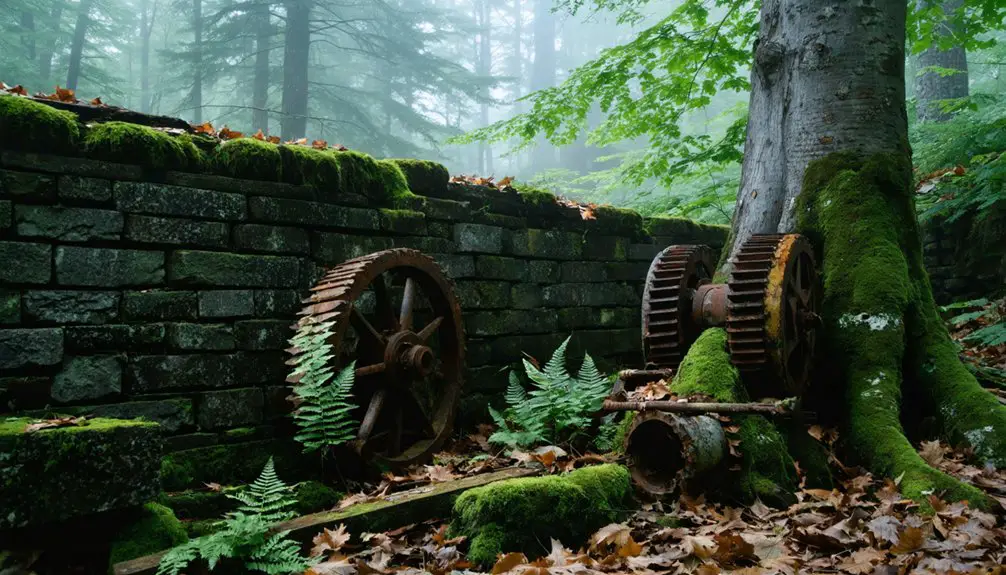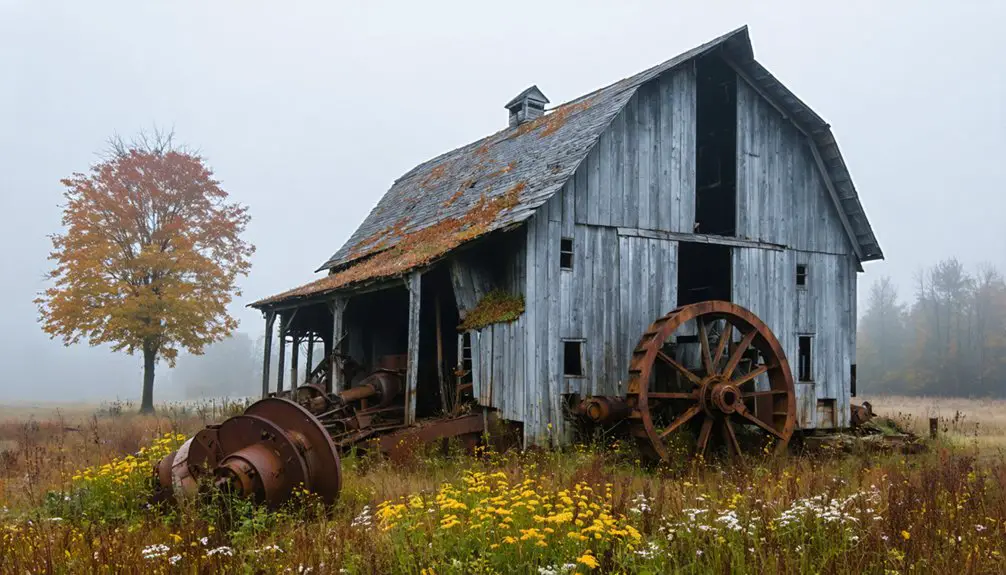
Fisk isn’t actually a ghost town—it’s a beautifully preserved 1820s farm on Isle La Motte with white clapboard buildings and ancient fossils underfoot. You’re probably thinking of Glastenbury, Vermont’s genuine abandoned settlement 150 miles south, where five people mysteriously vanished between 1945 and 1950. Access it via Route 7 to Bennington, then follow treacherous logging roads into the Green Mountain National Forest. The crumbling foundations and overgrown railroad tracks tell haunting stories that await your discovery beyond the trailhead.
Key Takeaways
- Fisk Farm features a restored 1820s Greek Revival farmhouse and 1803 stone house built from local quarry blocks.
- Visit Fisk Quarry to see rare black marble deposits containing ancient Chazy Reef fossils from 480 million years ago.
- Explore nearby Glastenbury ghost town via Long Trail, featuring abandoned workers’ quarters and the mysterious “Bennington Triangle.”
- Access from major cities: Albany 40 minutes, Burlington 2 hours, Boston 3 hours, Montreal 3 hours, NYC 4 hours.
- Bennington serves as the last resupply point before exploring treacherous unpaved logging roads through abandoned settlements.
The Truth About Fisk and Vermont’s Abandoned Places
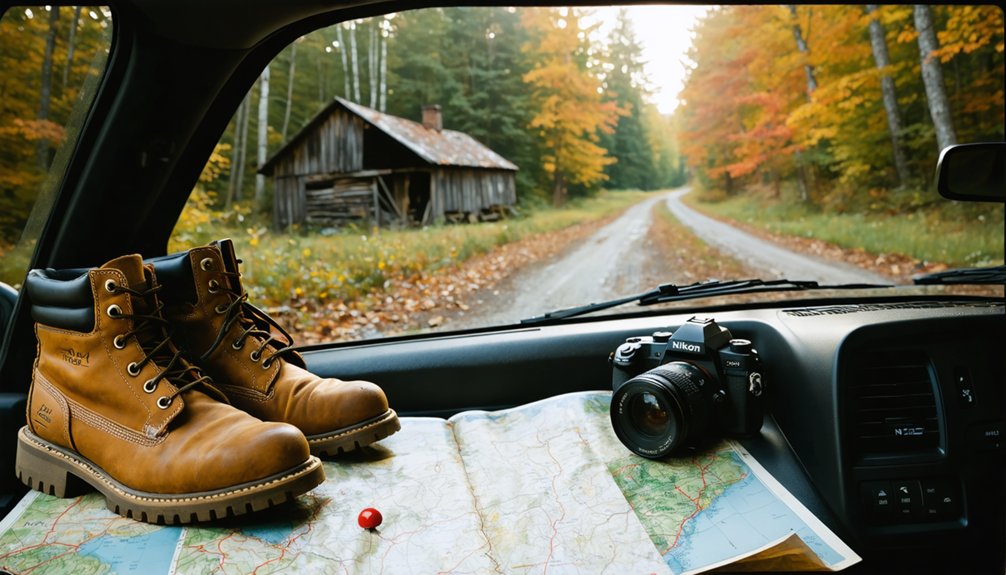
When you first hear the name “Fisk” in Vermont, you’re stepping into a web of intertwined stories—some real, some spectral, all rooted in the remote waters and limestone shores of Isle La Motte. There’s no ghost town here in the traditional sense—no rows of crumbling buildings. Instead, you’ll find layers: the Fisk Farm where Roosevelt learned of McKinley’s assassination, the abandoned quarry where historic quarry operations carved out French gray stone for a century, and the legend of Eleanor’s crimson cloak tangled in island brush.
What makes this place haunting isn’t decay—it’s transformation. The 1998 shift toward ecological preservation initiatives turned industrial ruin into fossil-rich trails. You’re free to walk where miners once worked, touching 450-million-year-old reef beds beneath open sky.
Glastenbury: Vermont’s Most Famous Ghost Town
Unlike Fisk’s limestone quarries that morphed into fossil trails, Glastenbury died completely—and stayed dead. This chartered town peaked at 241 souls in 1880, thriving on charcoal-making and logging until the trees ran out.
After an 1898 flood destroyed the railroad, the population collapsed. By 1937, only seven residents remained, and Vermont disincorporated the entire town.
What makes Glastenbury truly haunting aren’t just the abandoned foundations—it’s the unsolved mysteries. Between 1945 and 1950, five people vanished without trace, earning it the nickname “Bennington Triangle.” Paula Welden disappeared in her red coat. Jim Tetford vanished from a moving bus.
These unexplained phenomena, combined with Bigfoot sightings since 1879, transformed Glastenbury from forgotten logging camp into Vermont’s most notorious ghost town.
Getting to Glastenbury and Surrounding Areas
You’ll find Glastenbury tucked in the heart of Bennington County, accessible via Route 7 through Shaftsbury before winding east toward the Green Mountain National Forest boundary. From Burlington, the two-hour drive south passes through Vermont’s quintessential covered bridges and maple-lined highways, while Albany travelers can reach the area in under an hour heading east on Route 7.
Park at trailheads along Forest Road 10, where the Long Trail cuts through Glastenbury’s abandoned settlement—just remember that Vermont’s unpaved logging roads turn treacherous after spring thaws and autumn rains.
Routes From Major Cities
Reaching the remote wilderness around Glastenbury requires careful planning, since you’ll be traversing toward one of Vermont’s most isolated corners where cell service fades and GPS signals grow unreliable.
From Boston, you’ll cover 140 miles via I-93 N and I-89 N in roughly three hours, though scenic routes along US-7 N reward detours.
NYC adventurers face a 200-mile journey through I-87 N, maneuvering Albany’s congestion before connecting to VT-9 W.
Montreal travelers cross at Highgate Springs, following US-7 S for 160 miles of Champlain Valley vistas.
Burlington offers the straightforward 121-mile southbound run on US-7.
Albany sits closest at just 40 miles via NY-7 W.
All primary transportation methods converge at Bennington, your last resupply point before venturing twelve miles deeper into Glastenbury’s shadowed hollows.
Trail Access and Parking
Once you’ve navigated the winding roads into Bennington, the real adventure begins at scattered trailheads that serve as gateways into Glastenbury’s tangled wilderness. The Long Trail/Appalachian Trail parking sits five miles east on VT-9—cross the highway and you’re bound for Glastenbury Mountain’s fire tower.
For Bald Mountain’s approach, follow North Branch Street to the powerline lot, then push through the tunnel under VT-279 into wilderness territory. Harbour Road offers another entry point, winding 0.8 miles to a concrete water tank where the woods swallow you whole. Park perpendicular in these lots—space fills fast.
Watch for seasonal road closures that’ll strand you until May, and winter hiking challenges multiply when snowdrifts bury trail markers across 22,425 unforgiving acres.
What Remains: Exploring the Abandoned Settlements
You’ll find Fisk Farm’s white clapboard Greek Revival farmhouse still standing on Isle La Motte’s shores, its symmetrical facade and stone cottage offering tangible glimpses into 1820s rural life among the ancient Chazy Reef fossils.
Just across Lake Champlain’s waters, Cloak Island holds darker memories—where Eleanor Fisk’s crimson cloak supposedly tangled in the vegetation after her desperate 1770s ice crossing, though historians find no proof she ever existed.
Meanwhile, Glastenbury’s abandoned settlements scatter across vast uninhabited territory, their empty workers’ quarters and flood-damaged railroad tracks marking where 241 residents once thrived before mysterious disappearances and economic collapse erased entire communities from Vermont’s maps.
Fisk Farm Historic Structures
The stone ruins rising from the west shore of Isle La Motte tell the story of Vermont’s earliest settlement patterns, their weathered walls still defiant against time. You’ll find the original 1803 stone house, built by the Fisk family from adjacent quarry blocks, standing as a skeletal monument after its early 20th-century fire. The fisk house architecture showcases frontier ingenuity—those thick limestone walls sheltered four generations before flames claimed the interior.
Beyond the ruins, you’ll discover the 1820s Greek Revival farmhouse with its pristine white clapboards, where Theodore Roosevelt once visited in 1901. The fisk family history permeates every structure here, from the restored barn hosting modern gatherings to the mysterious square stone water structure with its protruding pipes—likely a well house that kept this frontier homestead thriving.
Lake Champlain Island Folklore
- Buried British Gold – $75,000 in coins allegedly hidden near Cedar Beach in 1773, still unfound
- Stave Island Mysteries – Treasure tales and unexplained phenomena cluster around this isolated outcrop
- Vermont’s Lake Pirate – A rough Malletts Bay tavern keeper verified by founding father Ira Allen himself
- Singing Beaches – Sand that produces dog-like noises when slapped, defying rational explanation
Freedom-seekers discover truth often surpasses fiction here.
Glastenbury’s Documented Abandoned Sites
Deep in Vermont’s Green Mountains, Glastenbury’s vanished settlement of Fayville tells a haunting story through scattered cellar holes and crumbling foundations. You’ll discover remnants of a once-thriving sawmill community that housed 241 residents in 1880—complete with a blacksmith shop, post office, and schoolhouse.
The logging infrastructure that sustained this settlement included railroad lines snaking through the forest, though the catastrophic 1898 flood destroyed most tracks and bridges.
Population decline began when deforestation-driven erosion devastated the area’s economic foundation. By 1937, so few remained that Vermont disincorporated the entire town. Today, nature’s reclaiming what humans abandoned. You can explore Fayville’s accessible ruins on your own terms, walking among empty foundations where families once lived, worked, and mysteriously vanished into Vermont’s wildest territory.
Lake Champlain’s Historic Sites and Folklore Connections
- Fisk Quarry’s rare black marble deposits containing ancient Chazy Reef fossils
- 1820s Greek Revival farmhouse hosting cultural gatherings at Fisk Farm
- Community-led preservation efforts that prevented quarry destruction in 1995
- Folklore clusters throughout Champlain Islands linking natural history with human drama
These sites reveal how communities protect both tangible heritage and intangible stories.
Best Time to Visit Vermont’s Remote Historical Locations
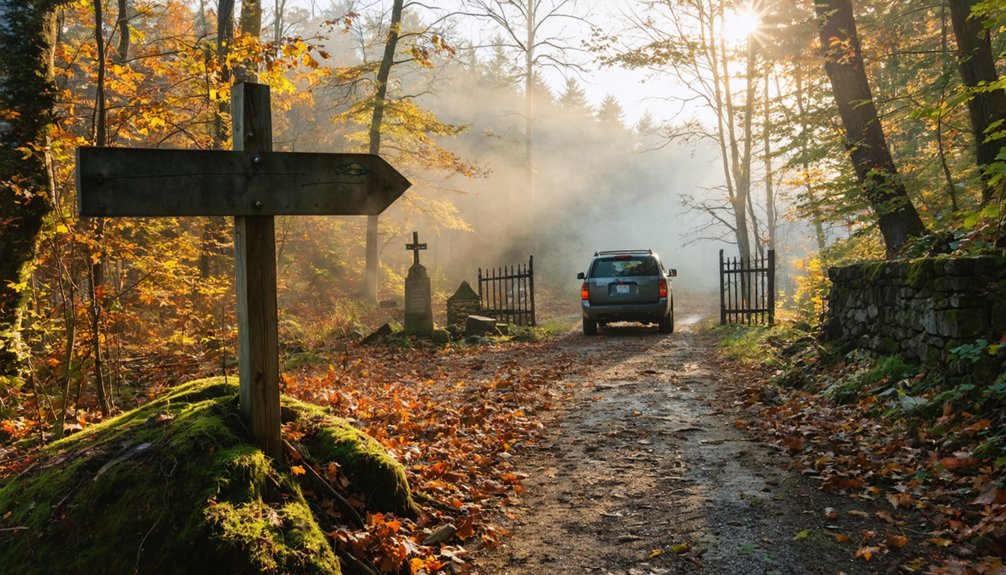
When you’re planning a ghost town road trip to Fisk and Vermont’s other remote historical sites, timing can make the difference between a serene exploration and a crowded disappointment. Pre-peak September offers the sweet spot—you’ll encounter virtually no tourists while discovering remote village histories along quiet dirt roads.
The golden sunlight filtering through early-turning leaves creates perfect photography conditions for abandoned foundations and forgotten cemeteries. Late spring presents excellent seasonal visitation opportunities too, with gushing waterfalls near historic settlements and lush landscapes revealing overgrown homesteads.
Avoid October’s leaf peeper crowds and inflated prices—they’ll clog the back roads leading to your destinations. Mud season’s impassable trails make March and April frustrating for exploration. May through early September delivers accessible roads, reasonable accommodations, and the solitude these forgotten places deserve.
Essential Gear and Safety Considerations
Before you venture down those overgrown logging roads to Vermont’s forgotten settlements, you’ll need gear that won’t fail when you’re miles from cell service. Personal protective equipment isn’t optional—it’s your insurance policy against crumbling structures and unstable terrain.
Miles from help, your equipment becomes your lifeline—choose gear that matches the consequences of failure.
Navigation Strategies and Critical Gear:
- Topographic maps and compass (GPS dies; paper doesn’t)
- Sturdy boots with ankle support for traversing debris-strewn foundations
- Headlamp with backup batteries since abandoned sites hide in dense forest canopy
- First aid kit with Israeli bandages for serious cuts from rusted metal
I’ve watched adventurers underestimate Vermont’s backcountry severity. Those moss-covered cellar holes and rotting timber frames demand respect. Pack water purification tablets, emergency shelter, and tell someone your exact route. Self-reliance means preparation.
Nearby Attractions and Active Historic Sites
After loading your pack with emergency gear, you’ll want destinations worth the preparation. Isle La Motte delivers with quarried marble sites that tell Vermont’s industrial story. Fisk Quarry Preserve showcases grey and black marble extraction from the 1800s, while its interpretive trail reveals fossils in the ancient Chazy Reef—the world’s oldest. Two miles north, Goodsell Ridge expands your fossil hunting with miles of additional trails.
The preserved farmsteads anchor your journey. Fisk Farm’s 1820s Greek Revival architecture hosts seasonal art exhibitions along Lake Champlain’s shores, where Theodore Roosevelt once visited. Down at West Castleton, the Slate History Trail winds through genuine ghost town ruins—water-filled quarries, crumbling worker foundations, and slate rubble piles stretching through forest shadows. The Barlow House Museum completes this circuit of Vermont’s vanished communities.
Respecting Private Property and Preservation Efforts
Vermont’s constitutional quirks create a landscape where your legal right to roam clashes with property owners’ reasonable expectations. While the 1793 constitution grants access to unenclosed lands, respecting local property owner rights means observing posted boundaries—even when a single missing sign technically opens the territory. Around Fisk’s remnants, you’ll find preservation balanced against liberty.
Navigate this freedom responsibly:
- Photograph from public roads rather than testing posting technicalities
- Document crumbling foundations without disturbing artifacts that tell stories
- Report vandalism to selectboards who balance access with protection
- Support preservation groups maintaining structures without restricting exploration
Preserving historical structures requires cooperation between roamers and stewards. Your footsteps trace routes pioneers blazed, but today’s abandoned homesteads depend on collective restraint to survive another generation.
Frequently Asked Questions
Are There Any Guided Tours Available for Vermont’s Abandoned Settlements?
You won’t find guided tours for Vermont’s abandoned settlements like Fisk. Instead, you’ll need self-guided tours using historical research and old maps. Pack sturdy boots, water, and your adventurous spirit—these forgotten places reward independent explorers.
What Permits or Permissions Are Needed to Explore Ghost Town Sites?
Maneuvering Vermont’s bureaucratic maze, you’ll need written permission from private land ownership before detecting. State property requires permits due to historical preservation concerns. Remember: sites over 100 years old on public ground stay untouched—your detecting freedom lives on private land.
Can I Camp Overnight Near Glastenbury or Other Abandoned Areas?
You can’t camp on private lands without explicit permission, and most abandoned areas remain privately owned. Trespassing concerns are serious—you’ll face legal consequences. Stick to designated Green Mountain National Forest sites near Glastenbury, where dispersed camping’s actually permitted.
Are There Any Books or Maps Specifically About Vermont Ghost Towns?
Like scattered puzzle pieces, Vermont ghost town resources exist but aren’t exhaustive. You’ll find *Abandoned Vermont* showcasing photographic exploration, plus YouTube documentaries covering historical significance and local folklore of fifteen sites, though dedicated maps remain elusive for your independent wanderings.
What Photography Restrictions Exist at Vermont’s Abandoned Historical Sites?
You’ll need permission from property owners before shooting, as most abandoned sites are private. Photo release requirements vary by location, and prohibited equipment usage typically includes drones without consent. Always verify restrictions beforehand to avoid trespassing charges.