Planning a ghost town road trip to Flora, South Dakota, requires embracing uncertainty—this 1890s tin mining settlement left no marked coordinates or courthouse records in Custer County. You’ll need to distinguish Flora from similarly-named Floral near Rochford and Florence in Codington County. Expect minimal physical remnants, if any, at this barren site where collapsed structures and overgrown vegetation might hint at past activity. Your journey becomes more rewarding when you expand your route to include nearby Rochford and other documented Black Hills ghost towns that offer clearer destinations and richer historical context.
Key Takeaways
- Flora’s exact location in Custer County remains unknown due to absent historical records, making precise coordinates impossible to determine.
- Expect minimal physical remains at Flora’s site, including collapsed structures, rusted equipment, and overgrown vegetation with limited signage.
- Don’t confuse Flora with Floral (Pennington County near Rochford) or Florence (Codington County) when planning your route.
- Flora’s tin mining history lacks documentation, suggesting it may have been a temporary camp or failed operation.
- Visit nearby Rochford, a well-preserved gold rush town with a 40-stamp mill and extensive mining artifacts.
The Mystery of Flora’s Lost Location in Custer County
Where exactly did Flora once stand in the vastness of Custer County? You’ll find ambiguous historical records offer no clear answer. Unlike Buffalo Gap or Hermosa, Flora left no trace in county documentation—no township listings, no census entries, no preserved markers. The gold rush spawned dozens of transient settlements across this rugged terrain, and Flora apparently vanished among them.
You’re facing the loss of physical evidence that plagues many western boomtowns. Hayward once rivaled Custer City before fading completely. Wooden structures rotted, populations scattered to ranching operations, and the land reclaimed what miners abandoned. Without courthouse records or surviving foundations, Flora’s exact coordinates remain speculation.
You’ll need to embrace the uncertainty—this ghost town keeps its final resting place secret, somewhere in Custer County’s sprawling landscape.
Flora’s Brief Tin Mining Legacy in the 1890s
The scarcity of records about Flora’s location mirrors the obscurity of its economic purpose. You’ll find historical accounts frustratingly silent about this settlement’s tin mining operations during the 1890s.
Flora’s traces vanish into silence—no records, no claims, no proof it ever mattered to South Dakota’s tin rush.
Unlike its better-documented counterpart Tinton, which thrived in Spearfish Canyon after 1903, Flora exists as a phantom in Custer County’s mining narrative. No production records, claim maps, or geological surveys confirm its role in South Dakota’s tin rush.
What remains is tantalizing uncertainty—a name attached to coordinates, whispers of mining activity, and nothing more. Perhaps Flora represented failed claims, a temporary camp that dissolved before census takers arrived, or simply a location misidentified over decades.
This void transforms your search into an archaeological puzzle where absence speaks louder than evidence.
Understanding the Difference Between Flora and Floral/Florence
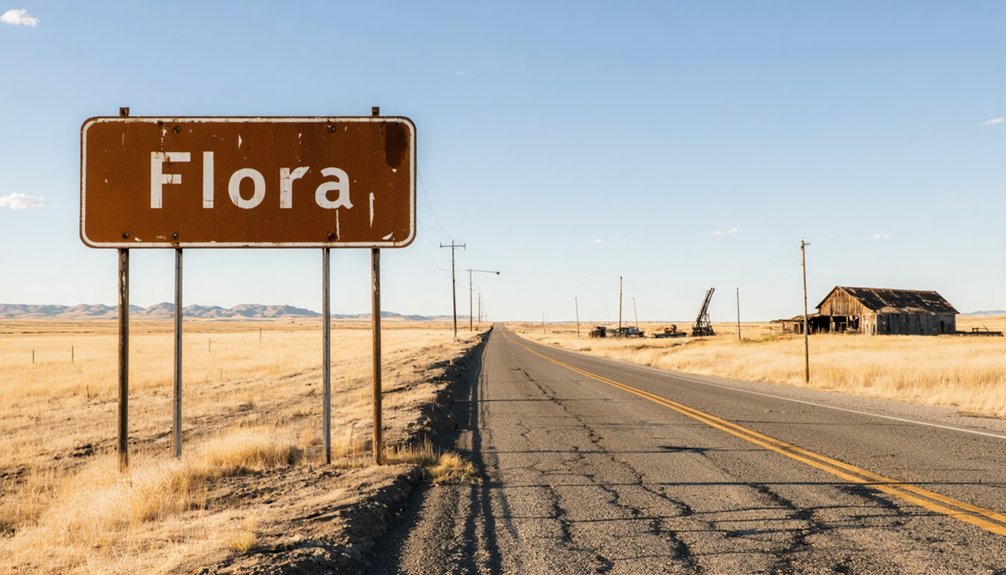
Among South Dakota’s scattered ghost town nomenclature, Flora stands distinct from Floral—a separation that extends beyond a single letter to encompass different counties, industries, and fates. You’ll find Flora rooted in Custer County‘s 1890s tin mining operations, while Floral (sometimes called Florence) emerged in Pennington County near Rochford with unspecified industrial origins. These naming similarities create confusion amplified by historical records gaps that leave Flora’s exact location unknown and its traces completely vanished.
The history of Flora, South Dakota provides a fascinating glimpse into the mining boom that characterized the region during its peak. As a once-thriving hub, Flora’s legacy is intertwined with the stories of the miners who sought fortune amidst the rugged landscapes. Despite its decline, the remnants of Flora’s past offer a silent testament to the resilience of those who shaped the town’s brief existence.
Floral’s neglected status suggests remnants might still exist, contrasting with Flora’s barren designation. Don’t confuse either with Codington County’s Florence—an entirely separate settlement. Understanding these distinctions proves essential when planning your exploration, preventing wasted journeys to wrong coordinates across South Dakota’s southwestern Black Hills region.
What to Expect When Visiting a Barren Ghost Town Site
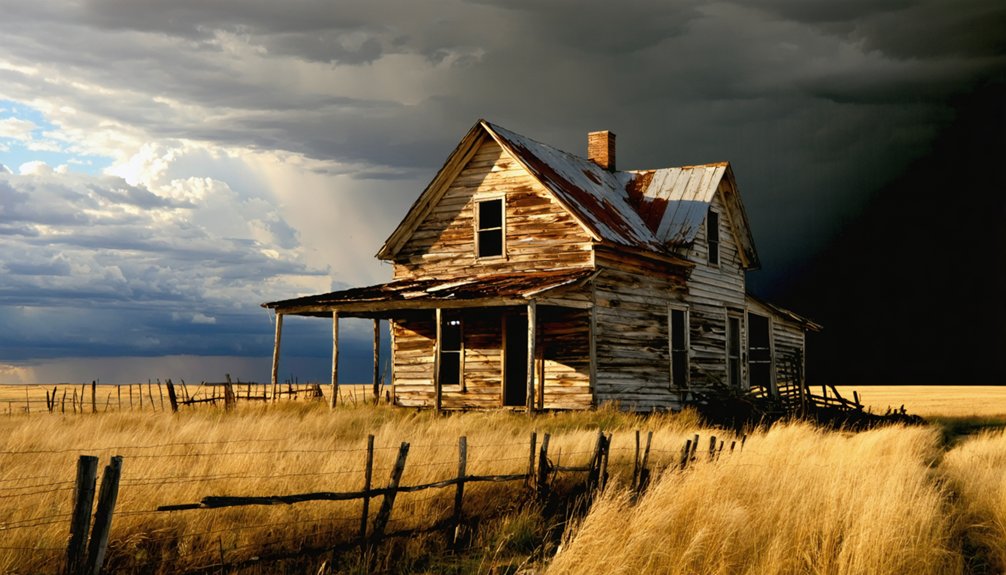
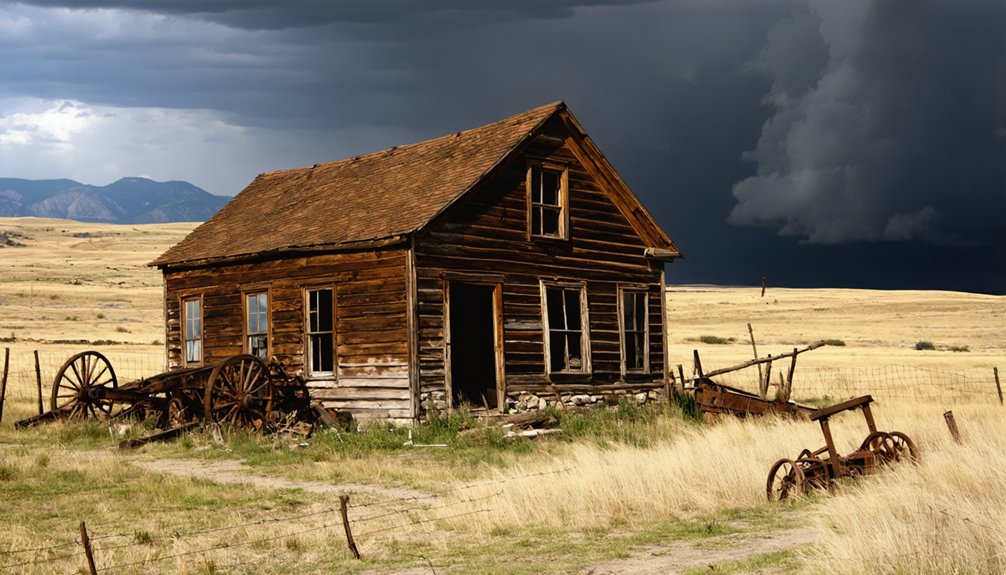
When you arrive at Flora’s barren site, you’ll encounter nothing but windswept prairie where a tin mining community once thrived. Collapsed wooden structures and rusted mining equipment dot the landscape, while overgrown vegetation obscures original foundations. Minimal signage marks building locations, so you’ll need to interpret authenticity through landscape reading rather than structured exhibits.
Expect extreme weather—harsh winters and scorching summers accelerate decay, exposing more remnants each season. Wind-eroded trails lead you through scattered debris, offering photographic opportunities that drive visitor engagement. You’ll likely share the experience with other middle-class families or couples, though the homogeneous crowds mean limited cultural diversity.
Bring your high-clearance vehicle for gravel access roads, and plan brief stays focused on visual exploration rather than deep historical immersion.
Exploring Rochford: Flora’s Neighboring Gold Rush Settlement
Just a stone’s throw from Flora sits Rochford, where prospectors struck gold in March 1877 and transformed a lonely gulch into a bustling settlement of over 1,000 souls within eighteen months.
You’ll find this “friendliest ghost town in South Dakota” preserves remnants of its rapid boom—from the massive Standby Mine with its 40-stamp mill to scattered foundations of the stores, saloons, and homes that once lined its streets.
Today’s Rochford stands as a more accessible window into the Black Hills Gold Rush era, offering tangible connections to the fortune-seekers who flooded these hills after Custer’s 1874 expedition.
Rochford’s 1877 Gold Discovery
While hunting near Deadwood in August 1876, M.D. Rochford and his companions Richard B. Hughes and William Van Fleet stumbled upon gold-bearing rock on Montezuma Hill. This accidental find established the legacy of the Montezuma Gold Mine and sparked a rush that transformed the wilderness.
By March 1877, prospectors from Castle Creek discovered additional deposits, prompting the organization of Rochford Mining District. Detailed accounts of Rochford’s discovery reveal how M.D. Rochford built the area’s first cabin in February 1877, then laid out the town alongside Hughes in May 1878.
Lots sold for $10 to $60 as miners from Lead and Central City staked claims along Little Rapid Creek, creating a thriving mining camp in Pennington County.
Peak Population and Infrastructure
The gold discovery that sparked Rochford’s founding quickly transformed the remote wilderness into a bustling mining center. Within eight months of M.D. Rochford laying out the town in May 1878, you’d have witnessed over 500 inhabitants occupying more than 100 log cabins, with another 500 prospectors camping in the surrounding hills.
This peak population growth timeline reflected the settlement’s remarkable expansion—six mercantile stores, five business houses, three saloons, two restaurants, and two blacksmith shops emerged by December. The residential and commercial infrastructure continued developing with a two-story hotel, Methodist Episcopal Church, and entertainment venues like the Rochford Theatre.
Property lots sold for just $10 to $60, offering affordable stakes in this vibrant frontier community where sawmills produced lumber and sixty stamps crushed ore.
Modern-Day Rochford Remnants
Today, Rochford holds the distinction of being the Black Hills’ friendliest ghost town, where weathered remnants of its 1870s gold rush heritage blend with a small community of modern residents. You’ll discover native gold specimens from the legendary Standby Mine still documented among collectors, evidence of the town’s prolific mining era.
The landscape reveals fascinating anticlinorian geological formations, with the Ellison Formation dominating the area’s structure. As you explore, you’ll notice how Bayley’s identification of Moonshine Gulch Quartzite shaped understanding of Rochford’s mineral wealth. These geological features directly influenced where prospectors dug their claims.
The remaining foundations and mining artifacts scattered throughout the gulches offer tangible connections to the fortune-seekers who built this remarkable settlement from wilderness into a thriving gold camp.
Other Custer County Ghost Towns Worth Adding to Your Route
Beyond Flora and Rochford, Custer County conceals dozens of abandoned settlements where tin speculation and gold fever once drew thousands to remote gulches and creek beds.
You’ll find everything from completely barren sites like Otis—now buried beneath Custer State Game Lodge—to places like Mystic, where weathered headstones and children’s graves tell stories of hardship in the logging camps.
Kiddville, positioned four miles up French Creek from Custer, marks where placer miners first worked the gravels in 1879 before hard rock operations transformed the county’s mining landscape.
Folsom’s Gold Mining Heritage
California’s Folsom district tells a dramatically different gold story than South Dakota’s Black Hills, yet both landscapes bear the indelible marks of fortune-seekers who transformed entire regions in their quest for precious metal.
While Flora’s ruins whisper of hard-rock mining, Folsom’s legacy emerged from water-based extraction. The district stretched ten miles along the American River, where placer mining techniques evolved from simple panning to industrial-scale operations. Chinese miners worked these gravels through the 1890s before mechanization arrived.
By 1898, bucket-line dredging operations revolutionized gold recovery:
- Eleven massive dredges operated simultaneously by 1916
- Annual yields exceeded $2 million in peak years
- Operations continued until 1952, reshaping entire valleys
The Natomas Company‘s floating behemoths carved up seven miles of landscape, leaving behind a transformed terrain that demonstrates how different mining methods create distinct geological signatures.
Expanding Your Custer Exploration
While Flora serves as your primary destination, Custer County harbors at least five additional ghost towns that’ll transform a simple visit into an in-depth exploration of Black Hills mining history. Kiddville, positioned four miles up French Creek, offers remnants of commercial development from its 1870s placer operations near the Penobscot Mine.
Spring-On-The-Hill, twenty miles southwest in Red Canyon, marks a famous trail stop where Captain J. Hunter died during frontier conflict. You’ll find Tin Camp’s barely-visible traces from the 1880s speculative boom, while Otis now hosts Custer State Game Lodge on its former mill site. Yamboya (also called Ivanhoe) rounds out your route, providing insights into transient nature of these ephemeral settlements that vanished as quickly as they appeared.
Essential Tips for Black Hills Ghost Town Road Tripping
Before you venture into the remote corners of the Black Hills, thorough preparation separates a memorable ghost town expedition from a frustrating dead end. Research property ownership status before exploring sites like Awanka’s collapsing church or towns with single remaining families.
Seasonal access considerations determine whether you’ll navigate Highway 16 comfortably or face impassable routes to remote locations.
Pack strategically for these rugged expeditions:
- Navigation tools: Detailed maps and GPS for sites like Flora’s unknown exact location
- Survival essentials: Water, emergency supplies for barren terrain
- Off-road capability: 4WD vehicle for former railroad grades and grassland trails
Respect no-trace principles at historically protected sites. Check road conditions before tracking down submerged Pactola’s lone cabin or Sully Springs’ valley remains. Your freedom to explore depends on responsible preparation.
Frequently Asked Questions
Are Metal Detectors Allowed at Ghost Town Sites in South Dakota?
Traversing South Dakota’s treasure-hunting landscape isn’t straightforward—you’ll need written permits from Game, Fish and Parks for state-managed sites. Metal detector regulations prioritize historical artifact preservation, while private ghost town properties require landowner permission. Recreational treasure hunting on public lands remains prohibited.
What Camping Facilities Exist Near Flora’s Suspected Location in Custer County?
You’ll find limited primitive campsites near Flora’s remote location, but nearby recreational areas like Custer State Park offer developed campgrounds. Big Pine and Fort Welikit provide full-service options, giving you freedom to explore ghost town territory comfortably.
Do I Need Permits to Explore Ghost Town Sites on Public Land?
You’ll need private land access permissions since Flora sits on private property, not public land. Always follow historical preservation guidelines and respect landowners’ rights. Ghost town exploration requires permission—trespassing violations carry serious consequences affecting your freedom.
What Cell Phone Coverage Can I Expect in Remote Custer County Areas?
You’ll find spotty coverage in Custer County’s backcountry—reliable network connectivity fades quickly, adequate cellular reception disappears entirely. AT&T offers your best chance at 93.5% county coverage, but expect dead zones where wilderness reclaims its solitude.
Are There Guided Ghost Town Tours Available in the Black Hills Region?
Yes, you’ll find guided tours offered throughout the Black Hills, from GeoFunTrek’s customizable ghost town adventures to Deadwood’s haunted walking tours. Tour schedule availability varies—some require advance reservations while others accommodate walk-ins daily.