Reach Florence ghost town via Forest Service Road 221 from Riggins, traversing 30 miles of unmaintained mountain roads to 6,000 feet elevation where Idaho’s 1862 gold rush boom town once housed 9,000 residents. You’ll need high-clearance 4WD vehicles, detailed maps, and emergency supplies since cellular service doesn’t exist in this isolated basin. Plan visits between July and September when snowmelt permits access to the historic cemetery, building foundations, and remnants from when this settlement extracted seven million dollars in gold during its single peak year. The journey below reveals why preservation efforts matter for understanding frontier violence and economic collapse.
Key Takeaways
- Florence, once Idaho’s roughest gold rush town with 9,000 residents in 1862, is now a remote ghost town in Idaho County.
- The site peaked as America’s most-discussed gold camp, extracting six to seven million dollars in gold during 1862 alone.
- Chinese miners sustained Florence’s economy from 1865 through the 1890s after initial placer deposits were depleted by late 1862.
- Florence established Idaho’s first county seat, school, and Masonic lodge before its rapid collapse left minimal infrastructure behind.
- Expect a challenging journey to this isolated location, as the boom-and-bust cycle left little sustainable development for modern visitors.
The Wild History of Florence’s Gold Rush Era
When E. D. Pierce’s 1860 prospecting on Orofino Creek sparked Idaho’s gold rush, you’ll discover it set the stage for Florence’s explosive emergence. A 23-member party struck rich placers in August 1861, yielding $20 per pan and $100 daily per miner.
By 1862, this remote basin above 6,000 feet swelled to 9,000 residents, extracting six to seven million dollars in gold that year alone—wealth that helped finance the Northern Civil War effort. You’ll find Florence’s production reached approximately one million troy ounces from the French-Creek district.
However, brutal winters with 16-foot snowpack suspended operations seasonally. Chinese mining interests dominated the district from 1865 through the 1890s, preserving post gold rush Florence’s economic viability long after the initial frenzy subsided.
When Florence Was the Roughest Town in the West
Florence’s designation as “the roughest town in the West” wasn’t hyperbole—the winter of 1862 saw systematic violence that exceeded even California’s mining camps.
You’ll find the most documented evidence at the site of the Boomerang Saloon, where Cherokee Bob’s fatal gunfight in January 1862 epitomized the daily shootings that claimed an average of one life per week.
The lawless winter months proved particularly deadly, as the absence of formal law enforcement combined with brutal conditions at 6,000 feet elevation to create an environment where survival depended on armed self-defense rather than civil order.
Violence at Boomerang Saloon
During the winter of 1862-1863, Florence earned its grim distinction as the roughest town in the American West, where the Boomerang Saloon stood at the epicenter of daily violence and lawlessness. Cherokee Bob‘s saloon takeover established his control after forcibly ejecting the original owner, claiming a deceased partner’s debt as justification.
Red Headed Cynthia’s saloon choice between Bob and rival suitor Billy solidified Bob’s power when Billy departed town the following day.
The establishment’s violent atmosphere exemplified Florence’s chaos:
- Drunken patrons fired revolvers into crowds, triggering fearful stampedes through streets
- Daily killings and woundings occurred without legal consequence or intervention
- Storekeeper Alonzo Brown stacked flour sacks four feet high protecting himself from stray bullets
- P.W. Gillette’s diary documented the constant threat from ruffians’ unpunished gunfire
Cherokee Bob’s Fatal Gunfight
Though Cherokee Bob—whose real name was Henry Talbotte—had terrorized Florence‘s residents for months as the town’s most feared bully and saloon keeper, his reign ended abruptly on January 2, 1863, when a gunfight on Main Street exposed his vulnerability.
The confrontation stemmed from revenge motivation after Bob defended his red-haired companion Cynth‘s right to attend a citizens’ social event. Cynth’s relationships with multiple men, including her legal husband Jakey Williams, created dangerous tensions.
When Bob faced Williams and Rube Robbins in the street standoff, his revolver misfired—possibly sabotaged by Cynth removing percussion caps. Robbins’s second shot mortally wounded the outlaw. Bob lingered three agonizing days before dying January 5th, praising his killers while refusing mention of Cynth. Authorities ruled the shooting self-defense.
Lawless Winter of 1862
Between November 1861 and August 1862, Florence descended into a chaos that earned it recognition as the roughest town in the American West—a designation born from the confluence of extreme weather, failed governance, and desperate men.
Desperate miners’ struggles against winter’s brutality fostered an environment where violence became routine:
- Daily gunfire: Intoxicated miners discharged revolvers into stores and tents nightly, with shootings occurring daily amid crowds
- Unchecked mortality: Over 100 men perished from cold, starvation, and exposure, with no accurate death count maintained
- Lack of effective law enforcement: Crimes went unpunished despite Justice of the Peace Jaspar Rand recording 90 cases between November 1862 and August 1863
- Criminal influx: Thieves and gamblers from the Pacific Coast congregated in this lawless settlement
This period represents frontier governance’s complete collapse.
Understanding the Boom and Bust of Florence Basin
Florence’s trajectory from obscurity to America’s most discussed gold camp within twelve months exemplifies the volatile economics of placer mining—August 1861’s discovery triggered explosive growth to 9,000 residents by 1862, with daily production reaching $50,000 and individual pans yielding $20-$100 in gold.
This meteoric rise occurred alongside severe lawlessness, as the tent city’s rapid expansion outpaced institutional development despite Idaho County’s anticipatory establishment in December 1861 and the first district court’s convening in September 1862.
The basin’s richest deposits were substantially depleted by late 1862, transforming Florence from peak production to economic decline within a single year and leaving 7,000 of 10,000 arriving miners without viable claims by fall.
The 1861 Gold Rush
When prospectors discovered gold in the remote creeks and gulches of Florence Basin in August 1861, they ignited one of the Pacific Northwest’s most dramatic boom-and-bust cycles. The original gold discovery occurred when a prospecting party’s 1861 success on August 19-20 revealed extraordinarily rich placers—claims yielding $20 per pan and $100 daily.
Following E.D. Pierce’s 1860 Orofino Creek strike 65 miles north, this twenty-three-member expedition ventured into the high mountain basin thirty miles south of Grangeville.
The rush’s significance extended beyond individual fortunes:
- Florence transformed from a 50-resident tent encampment to a 9,000-person city by 1862
- 1862 production reached $6-7 million, peaking at $50,000 daily
- Washington Territory created Idaho County in December 1861, anticipating the stampede
- Idaho gold funded Northern Civil War efforts after cotton revenue losses
Violence and Lawlessness Peak
As Florence’s population surged toward 9,000 residents in 1862, the mining camp descended into what historians recognize as one of the most dangerous periods in the Pacific Northwest’s frontier history.
You’ll discover a volatile environment where gunfights punctuated daily life, exemplified by the infamous Main Street standoff between Rube Robbins and Cherokee Bob. The brutal winter of 1861-62 claimed over 100 lives, while lawless conditions peaked during a critical 10-month period in 1863 when Idaho Territory lacked formal government.
During this vacuum of authority, at least two murderers escaped punishment entirely. Yet remarkably, Florence simultaneously established Idaho’s first county seat, school, and Masonic lodge—community-building efforts that reveal your ancestors’ determination to impose order amid chaos that defined this forgotten outpost.
Rapid Resource Depletion
The Florence Basin gold rush exemplifies the extractive brutality that characterized 19th-century mineral exploitation across the American West. You’ll discover a landscape fundamentally transformed by ecological devastation, where miners extracted six to seven million dollars in 1862 alone—then abandoned the basin without reinvesting wealth into sustainable infrastructure.
The collapse unfolded with devastating speed:
- Production concentrated almost entirely within 1861-1862, exhausting accessible deposits within months
- Only $30,000 extracted between 1901-1936 compared to millions during peak year
- Chinese miners arrived by 1865 to rework claims Americans deemed unprofitable
- Steam shovel operations in 1924 obliterated remaining structures while pursuing marginal deposits
This pattern of rapid extraction without stewardship created the wasteland you’ll encounter today—a cautionary monument to unchecked resource exploitation.
What Remains of Florence Today
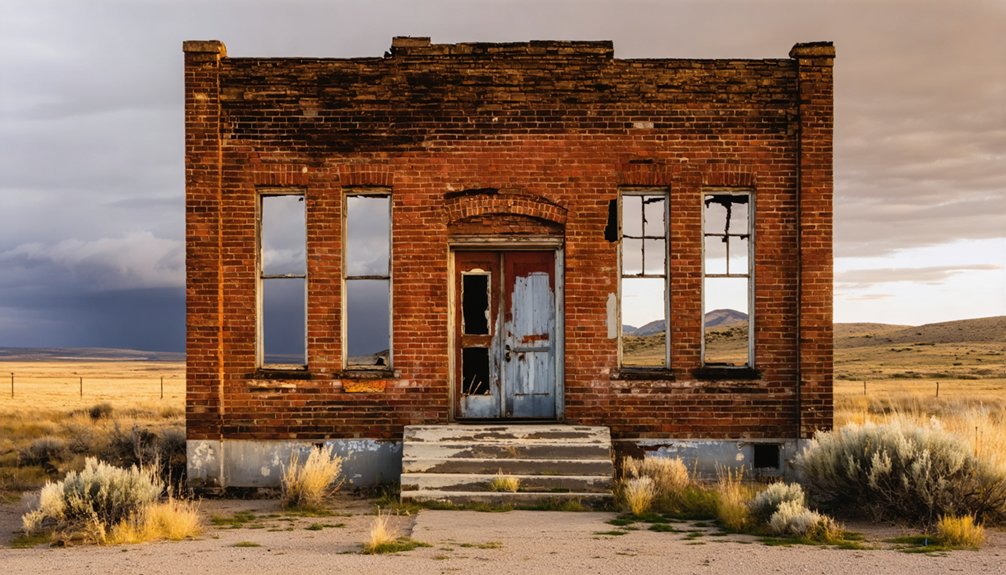
Nestled among thick forests and rolling hills at 6,080 feet elevation in north central Idaho County, Florence’s physical remnants tell a story of systematic erasure rather than gradual decay.
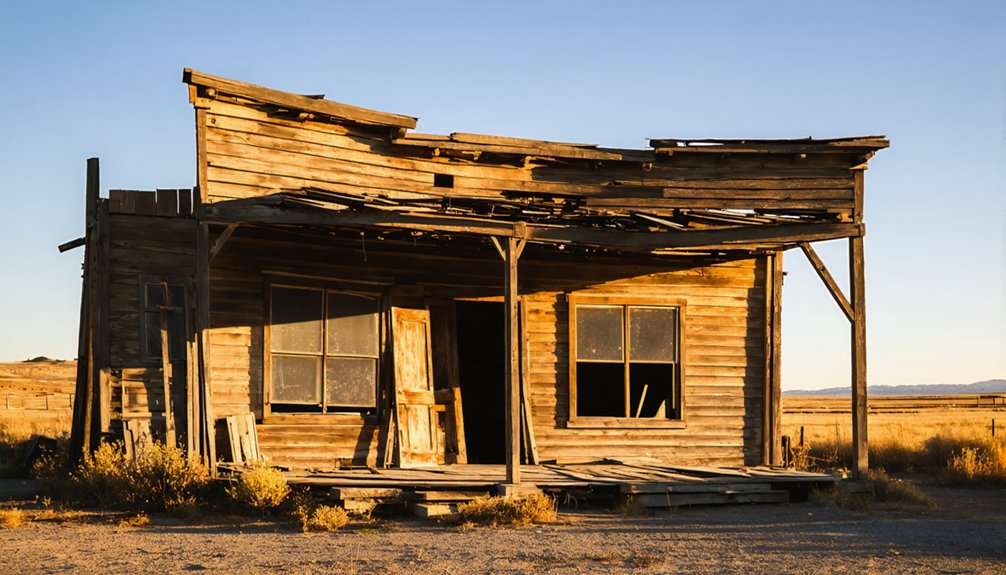
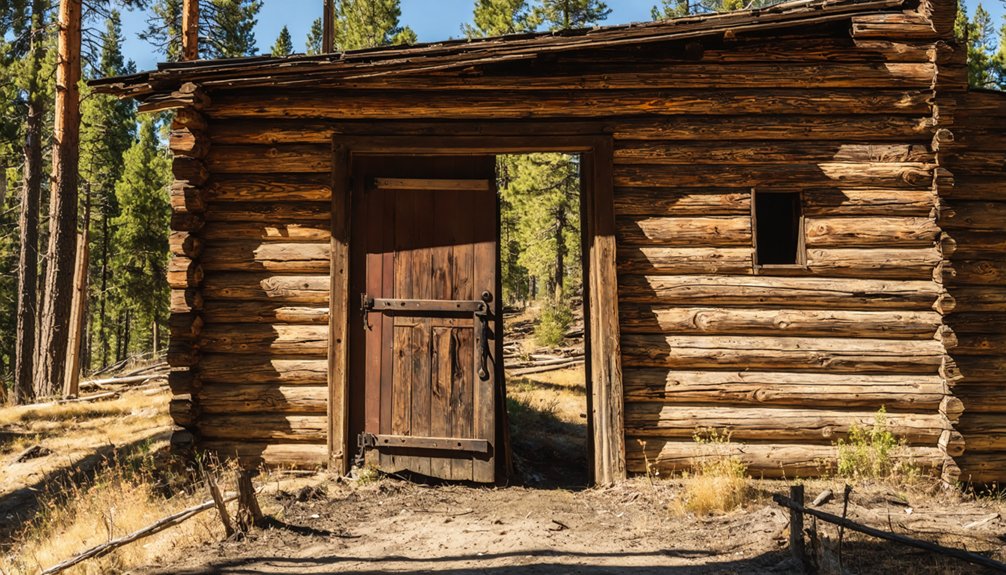
The 1924 steam shovel operations obliterated most original structures while extracting millions in gold, creating a landscape dominated by placer diggings rather than architectural heritage. You’ll find a partially reconstructed jail, decent-condition Canfield place structure, and general store ruins—sparse survivors of industrial-scale destruction.
The overgrown cemetery presents disturbing evidence of exhumations, with empty holes marking where graves once stood from the 1861-1863 violence. These undocumented archaeological sites receive minimal protection, and impacts of restoration efforts remain negligible. What survives exists more as accidental remnants than deliberate preservation, hidden beneath natural overgrowth.
Getting to Florence: Routes and Access Points
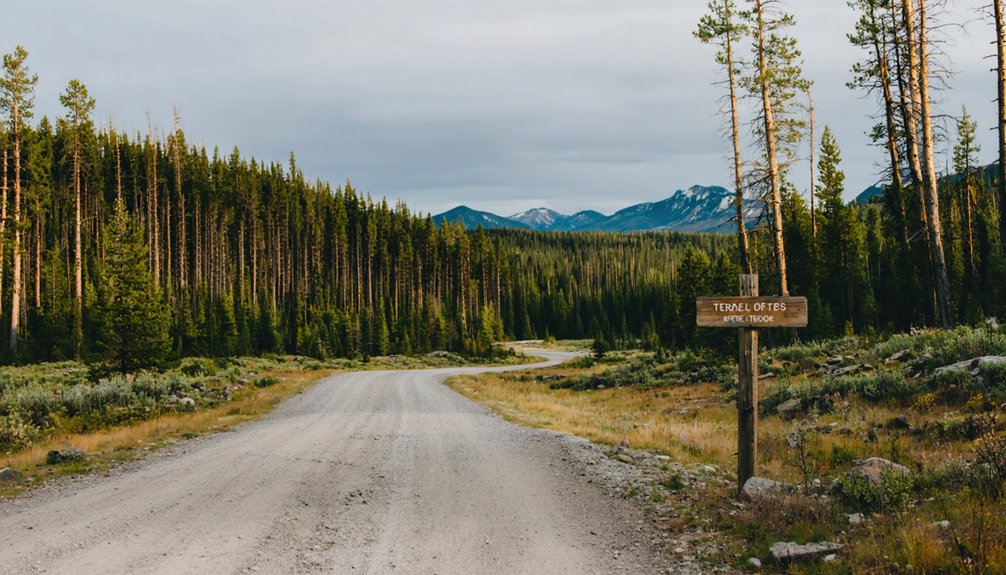
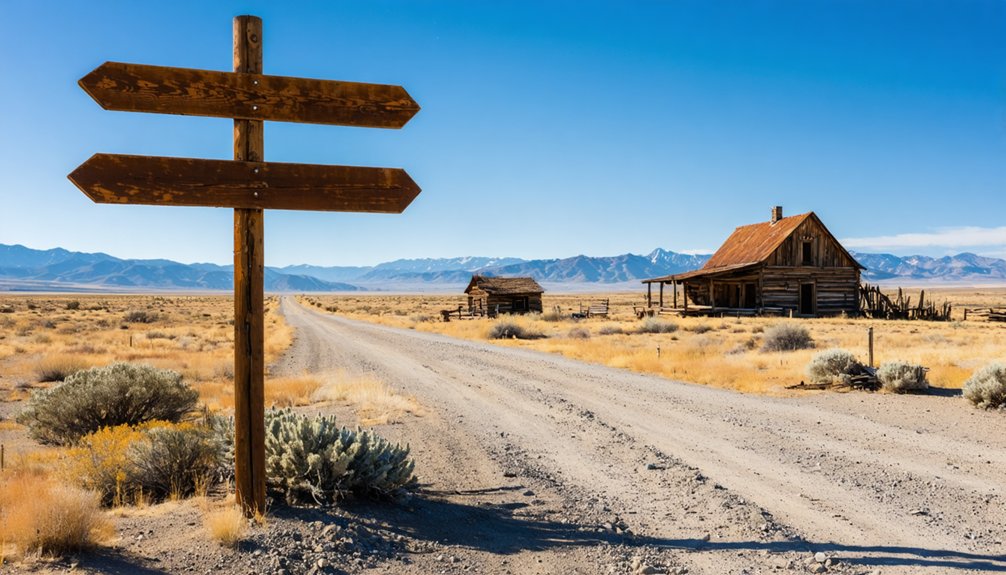
You’ll access Florence by departing Riggins and traveling approximately 25 miles northeast through Idaho’s mountainous backcountry, where elevation gains exceed 4,000 feet from the Salmon River valley floor to the 6,080-foot ghost town site.
The journey requires a four-wheel-drive vehicle capable of maneuvering rough mountain roads that historically formed segments of the 140-mile Florence Trail from Lewiston. These access routes converge near Summit Creek and the Milner Trail, traversing terrain that has remained largely unchanged since the 1860s mining era.
Starting From Riggins
Since Florence lies deep within Idaho’s backcountry wilderness, reaching this abandoned mining settlement from Riggins requires careful route planning through rugged terrain. You’ll navigate approximately 90 miles through mountain pass conditions that demand respect and preparation.
Your route follows this sequence:
- US-95 North to Grangeville — Establish your baseline position along this primary corridor before shifting to backcountry access
- Idaho Highway 14 toward Elk City — This segment introduces elevation changes and reduced services
- Forest Service roads to Florence — Final approach requires high-clearance vehicles and navigation considerations for unmaintained surfaces
- Pacific Daylight Time zone awareness — Coordinate your departure to maximize daylight hours through remote sections
MapQuest’s turn-by-turn directions provide three alternate routes when primary access faces seasonal closures or washouts.
Mountain Road Conditions
Accessing Florence demands intimate familiarity with Forest Service Road 381‘s behavioral patterns across seasons, as this 18-mile gravel corridor from Warren represents your primary lifeline to Idaho’s most isolated ghost town. You’ll navigate narrow passages with steep grades that transform treacherously when moisture compromises traction—check Idaho 511’s real-time weather advisories before departure.
Vehicle requirements escalate beyond nominal recommendations: high-clearance 2WD suffices only during ideal dry conditions, while 4WD provides essential margin against washouts and slickness. The alternative South Fork Salmon River Road (FR 247) from Yellow Pine extends your journey to 40 miles through less-maintained terrain prone to spring rockslides.
Download offline maps now; cellular connectivity vanishes precisely when you’ll need navigational confirmation most urgently in this roadless expanse.
Elevation and Terrain Challenges
Beyond traversing seasonal road conditions, you’ll confront Florence’s most formidable barrier: a 6,089-foot elevation perch that towers more than 4,000 vertical feet above the Salmon River canyon floor. This extreme elevation change creates difficult terrain conditions that demand careful preparation and vehicle capability assessment.
The ascent presents significant challenges:
- Vertical climb gradient: Routes gain 5,800 feet from Whitebird (1,578 ft) to Dead Point summit (7,365 ft) before descending to Florence’s basin
- Faulted basalt formations: Geological instability from Saddle Mountain creates unpredictable road surfaces
- Canyon-to-plateau migration: Steep switchbacks navigate between level bottomlands and gently sloping uplands
- Atmospheric effects: Reduced oxygen density at 6,000+ feet affects both engine performance and physical exertion
Understanding these elevation dynamics guarantees autonomous exploration without compromising safety.
Best Times to Visit This Remote Ghost Town
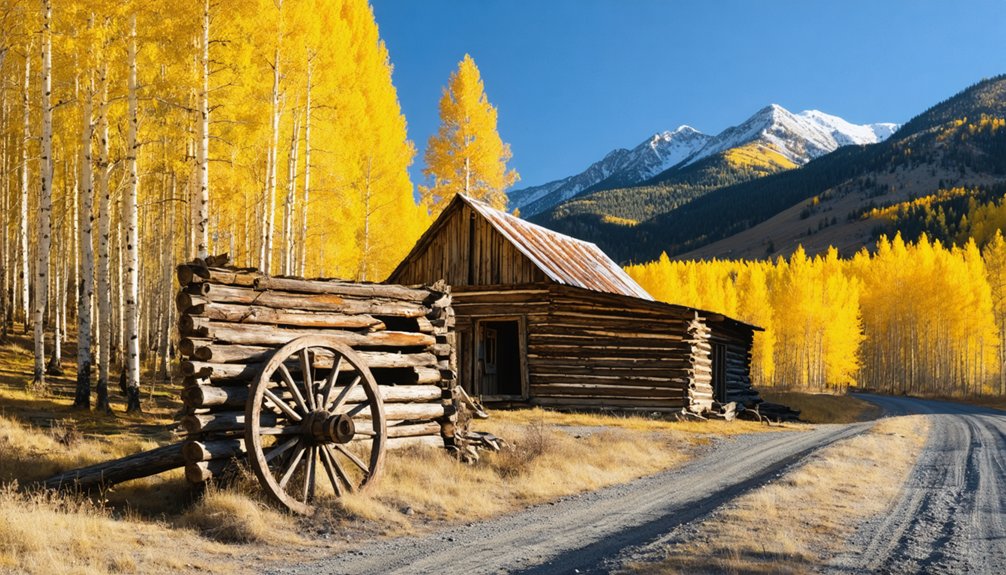
While Florence’s abandoned structures remain accessible throughout the year, seasonal conditions dramatically influence the feasibility and safety of your journey to this isolated mining settlement. Spring and fall represent ideal/favorable/suitable/appropriate season lengths for independent exploration, offering moderate temperatures, reduced mosquito populations, and manageable road conditions without peak-season constraints.
Summer’s intense heat and fire restrictions within Nez-Perce National Forest complicate access, while seasonal tourism impacts may compromise your solitary experience of this historic site. Winter presents significant challenges: snowpack renders the thirty-mile forest route impassable for standard vehicles, and subfreezing temperatures at elevation demand specialized equipment.
Your ideal/perfect/prime/optimal window spans late May through October, when snowmelt subsides but winter storms haven’t commenced, preserving both your autonomy and the authentic isolation that characterizes genuine ghost town exploration.
Exploring the Historic Cemetery and Foundations
The hilltop cemetery at Florence stands as the settlement’s most significant surviving artifact, offering tangible evidence of the mining camp’s violent frontier existence between 1861 and 1863. You’ll discover weathered headstones marking miners and outlaws who shaped Idaho County’s first territorial seat, though original 1860s markers no longer exist.
The cemetery’s elevated position reveals the original town layout sprawling below along the creek, where foundation stones and scattered debris mark building sites obliterated by 1924 steam shovel operations.
Essential Cemetery Features:
- Cherokee Bob Talbotte’s grave commemorates Florence’s most notorious gunfighter, mortally wounded January 2, 1863
- Wayside information panels establish historic marker significance for documented frontier casualties
- Multiple unmarked graves reflect incomplete settlement records
- Archaeological foundations beneath hillside vegetation preserve structural evidence from 9,000-resident boom period
Surviving the Elements: What Made Florence So Deadly
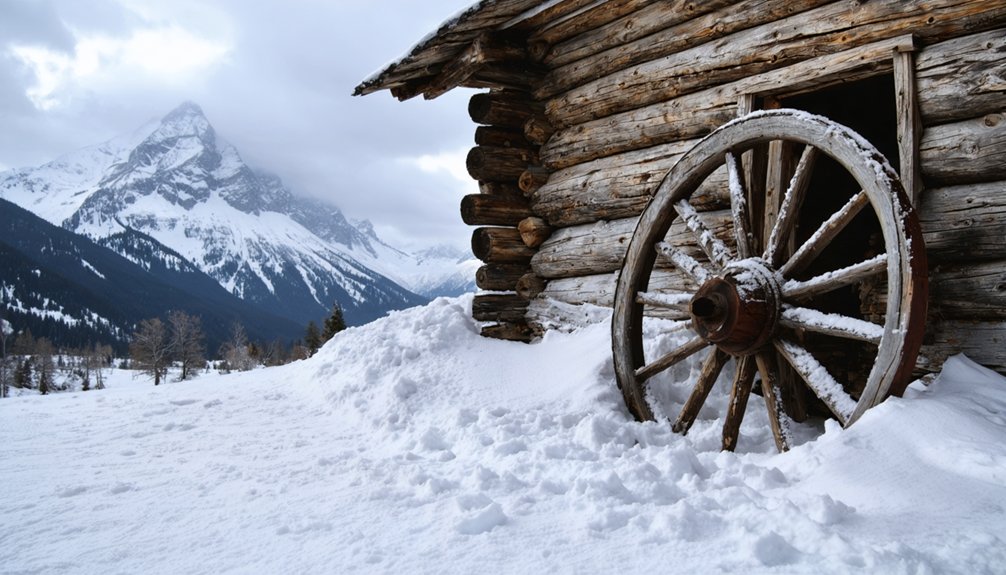
Florence’s reputation as Idaho’s deadliest mining camp stemmed from a catastrophic convergence of environmental extremes, criminal violence, and frontier hubris that transformed gold fever dreams into frozen nightmares. The isolation of the location—25 miles into wilderness at 6,000 feet elevation—created lethal conditions when extreme winter temperatures plunged below zero during 1861-1862, claiming over 100 lives.
Ill-prepared miners who’d rushed to strike it rich faced starvation as deep snow clogged supply routes. Firewood scarcity forced residents to dismantle their own infrastructure board-by-board for heat. Simultaneously, Florence earned designation as the West’s most violent town in 1862, where outlaws ambushed travelers while drunken gunfire riddled stores nightly.
This deadly combination of environmental brutality and lawless chaos explains why 9,000 fortune-seekers rapidly abandoned what became Idaho’s most notorious ghost town.
Essential Gear and Supplies for Your Trip
Before venturing into Florence’s 6,000-foot wilderness, you’ll need specialized equipment that addresses the same environmental extremes that killed over 100 miners during the camp’s deadliest winter.
Critical Supply Checklist:
- Proper footwear essentials: Waterproof hiking boots with ankle support navigate marshy gullies and overgrown trails where miners once perished from exposure
- Outdoor lighting recommendations: High-lumen flashlights illuminate jail ruins, mining shafts, and cemetery headstones like Savester Scott’s 1862 marker
- Weather protection layers: Insulated gear combats gnarly cold at elevation; November mornings demand thermal clothing
- Wilderness safety equipment: Bear spray, first-aid kit, GPS with offline maps, and communication devices for 30-mile cell-dead zones
Pack abundant water, mosquito repellent, and waste bags. Florence’s isolation remains unchanged—no electricity, plumbing, or services exist within this remote Nez-Perce National Forest location.
Nearby Attractions and Camping Along the Salmon River
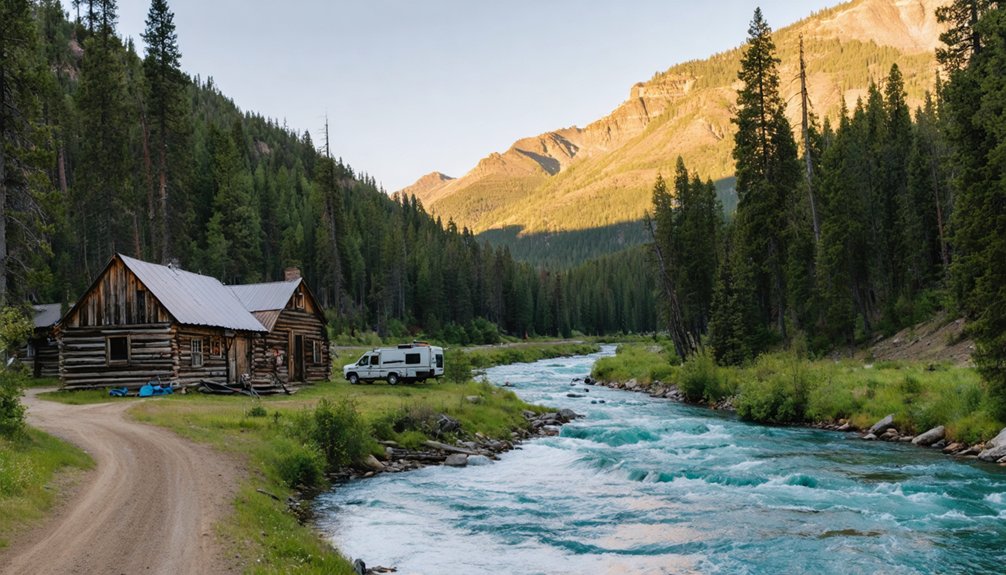
After securing your wilderness equipment, you’ll find Florence’s remoteness balanced by exceptional recreational infrastructure along the 425-mile Salmon River corridor—North America’s longest undammed waterway within a single state.
Riverside campgrounds like Bonneville provide thermal spring access and strategic base camps for multi-day exploration. The River of No Return designation reflects Class II-IV rapids accessible through whitewater adventure tours operated by Middle Fork Wilderness and Silver Cloud Expeditions, offering day floats to week-long expeditions.
You’ll encounter world-class fly fishing near Salmon town, where drift boats facilitate year-round trout casting across converging waterways. Island Park’s whitewater surf wave and the Salmon River Scenic Byway connecting Land of Yankee Fork State Park establish expansive outdoor access while maintaining wilderness character essential to backcountry travelers seeking unregulated landscapes.
Frequently Asked Questions
Are There Any Entrance Fees or Permits Required to Visit Florence?
You won’t pay entrance fees or need permits to explore Florence’s historic sites. However, you’ll find limited parking availability and minimal visitor facilities, so you must prepare adequately for this remote, preservation-focused destination requiring self-sufficient exploration.
Is Cell Phone Service Available in the Florence Ghost Town Area?
You’ll find absolutely zero cell phone service in Florence’s wilderness—limited cellular coverage doesn’t exist here. Rural infrastructure challenges mean complete disconnection from modern networks, freeing you to experience authentic isolation in this preserved historical mining site surrounded by untouched backcountry.
Can You Camp Overnight at the Florence Townsite Itself?
Overnight camping isn’t formally permitted at Florence townsite itself due to absent on-site amenities and lack of designated facilities. You’ll need to seek primitive camping on surrounding endowment lands or utilize the nearby Florence RV Park for availability of overnight accommodations.
Are There Guided Tours Available for Florence Ghost Town?
No guided tours availability exists at Florence Ghost Town—you’ll explore independently. No recommended tour companies operate here due to the site’s remote, undeveloped nature. A 2004 self-guided tour publication helps you navigate this preserved wilderness autonomously.
What Wildlife Should Visitors Be Aware of in the Area?
You’ll need to watch for snakes during warm months, particularly rattlesnakes in sagebrush areas. Potential bear sightings occur in forested backcountry, so you’re advised to carry bear spray and maintain awareness while exploring Florence’s historic landscapes.