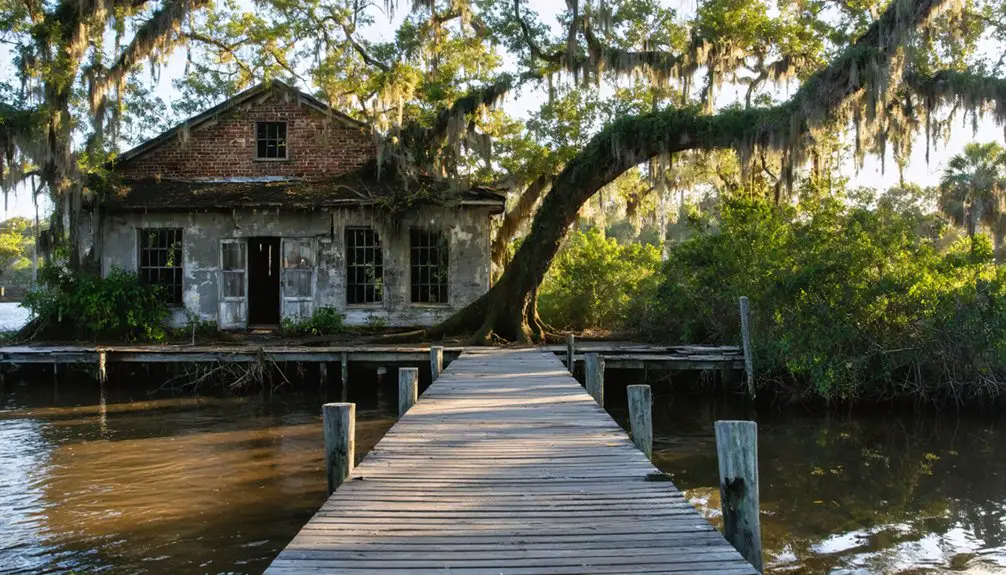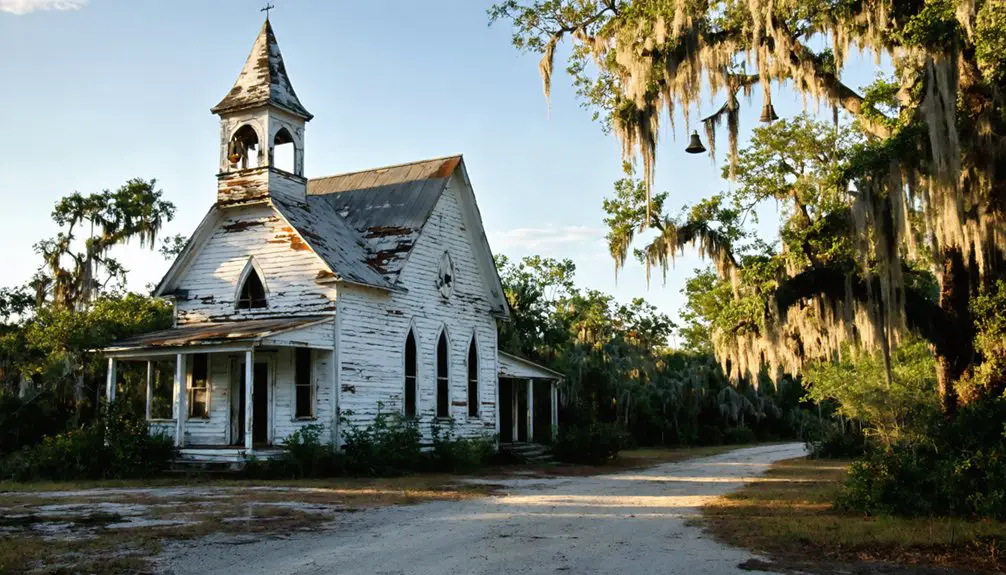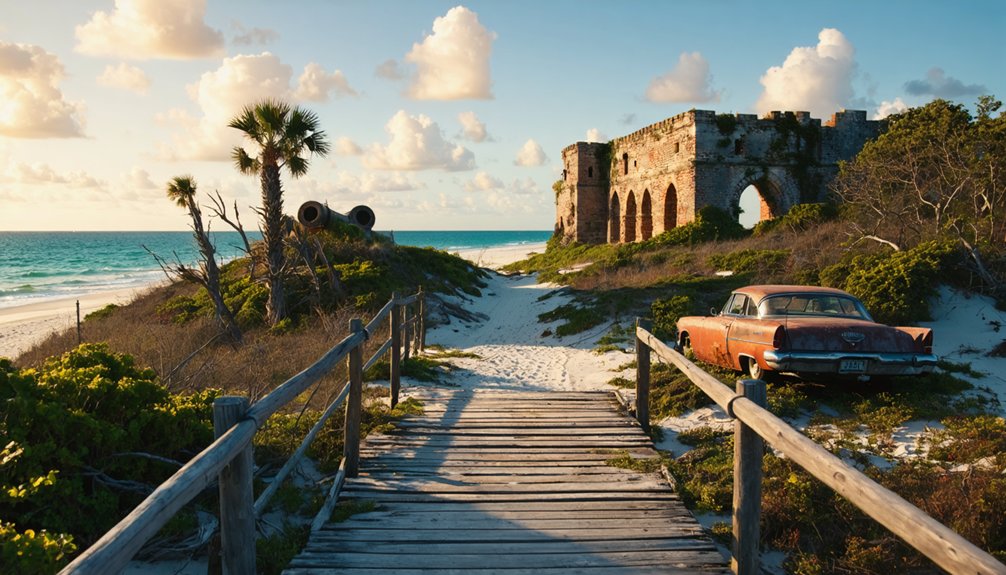
You’ll reach Fort Dade by boarding Hubbard’s Marina ferry from Fort De Soto Park ($45 adults), departing at 9am or 11am for the 25-30 minute crossing to Egmont Key. Once you’ve waded ashore through ankle-deep Gulf water, six miles of century-old brick roads connect artillery batteries, barracks foundations, and the 1848 lighthouse across this 328-acre military ghost town. The exposed terrain demands sun protection and water, while mosquitoes intensify at dusk. The island’s interpretive signs and preserved infrastructure reveal layers of strategic history worth exploring further.
Key Takeaways
- Book the official ferry from Fort De Soto Park departing at 9am, 11am, or 2pm; tickets cost $45 adults, $25 children.
- Explore six miles of historic brick roads connecting Fort Dade’s crumbling barracks, artillery batteries, and military structures from 1901-1906.
- Visit the 1848 Egmont Key Lighthouse, the island’s oldest structure and former Civil War Union watchtower still operating today.
- Wade through shallow Gulf water upon arrival and bring sun protection for the exposed 328-acre island terrain.
- Plan afternoon departure before dusk when mosquitoes intensify; alternative access includes guided tours, private boats, or kayaks.
Getting to Egmont Key: Transportation Options and Logistics
Although Egmont Key sits just three miles off Florida’s Gulf Coast, reaching this isolated barrier island requires careful planning and coordination. Hubbard’s Marina operates the official ferry service from Fort De Soto Park, departing at 9am and 11am daily, with additional 2pm trips on select days.
The 25-30 minute journey costs $45 for adults and $25 for children ages 3-11, with ticket pricing options available through online platforms. You’ll enjoy three hours exploring the island’s ruins before returning. The pontoon vessel includes covered seating and onboard facilities, plus rental equipment offerings like beach umbrellas and snorkel masks.
Alternative access includes guided tours from St. Pete Beach, private boats, or kayaks for experienced paddlers. Arrive 30-45 minutes early for check-in at 3500 Pinellas Bayway South.
What to Expect When You Arrive: The Fort Dade Experience
Your ferry pulls into Egmont Key’s shallow waters, and immediately you’ll notice there’s no traditional dock waiting—just a sandy shoreline where you’ll wade through ankle-deep Gulf water to reach dry land. The 328-acre island greets you with interpretive signs outlining wildlife refuge protocols: no pets, fires, or overnight camping permitted.
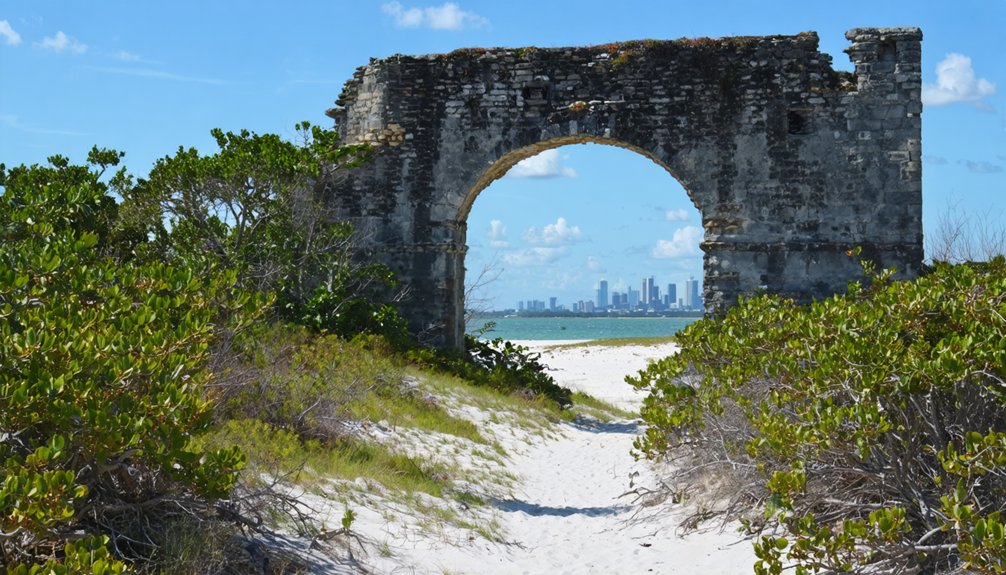
Six miles of crumbling brick pathways snake through vine-strangled barracks and artillery batteries, their deteriorating walls record of a century of tidal erosion. The breezy microclimate offers relief from Florida’s humidity, though exposed terrain demands sunscreen and water you’ve packed yourself—no facilities exist here.
Mosquito conditions intensify at dusk, so plan afternoon departures. Gopher tortoises cross sandy paths while seabirds patrol restricted nesting zones, creating an atmosphere of peaceful abandonment.
Must-See Historic Structures and Military Remnants
You’ll encounter three essential categories of ruins that define Fort Dade’s military heritage. The 1848 Egmont Key Lighthouse stands as the oldest surviving structure, while five concrete artillery batteries from 1901-1906 anchor the northwest shore with their fractured but intact gun positions.
Six miles of brick pathways connect these sites, forming the infrastructure backbone that once supported nearly 600 residents during the fort’s operational peak.
The 1848 Egmont Lighthouse
Standing sentinel at the mouth of Tampa Bay since 1858, the Egmont Key Lighthouse represents the oldest structure in the region still serving its original navigational purpose. You’ll discover that this brick conical tower replaced Francis A. Gibbons’ 1848 structure, which hurricanes destroyed within months of completion. The keeper responsibilities included maintaining the third-order Fresnel lens design that guided ships between St. Marks and Key West.
This resilient beacon has witnessed remarkable history:
- Confederates removed its lens during the Civil War to aid blockade runners
- Served as a U-boat observation post during World War II
- Continues flashing every 15 seconds under Coast Guard automation since 1989
Robert E. Lee himself surveyed this site, recognizing its strategic importance before reconstruction moved the tower 90 feet inland.
Artillery Battery Ruins
Beyond the lighthouse’s beacon, Fort Dade‘s true defensive power manifested in five massive artillery batteries that transformed Egmont Key into an impenetrable fortress guarding Tampa Bay’s entrance. Construction began in 1898, establishing McIntosh, Howard, Burchsted, Page, and Mellon as Endicott-era coastal defense positions.
You’ll discover damaged disappearing gun emplacements at Battery McIntosh, where two 8-inch rifles once rose from protective concrete walls. Battery Burchsted’s remains now rest submerged in surf along the southern shore, creating a unique scuba diving destination. Battery Mellon’s two-story structure stands on the northwest beach, where erosion has exposed concrete foundations alongside military observation tower remnants from World War II.
These fractured fortifications, deactivated between 1919-1923, represent America’s strategic military evolution during the Spanish-American War era.
Historic Brick Road Network
Winding six miles through Fort Dade’s ruins, the historic brick road network preserves an extraordinary example of early 1900s military infrastructure that once connected over 70 buildings across this self-contained island garrison. Built during the fort’s 1898-1923 active period, these durable paths showcase architectural design choices reflecting Florida’s coastal defense priorities and building materials common to the era’s military installations.
You’ll discover roads that once supported 300 residents traversing between facilities:
- Complete town infrastructure – Paved routes linked hospital, jail, movie theater, bowling alley, and tennis courts
- Integrated utility corridors – Brick surfaces accompanied electricity lines, telephone cables, and sewage systems
- Strategic military function – Networks facilitated artillery units, mine crews, and dock operations
Today’s trails let you walk these same paths, exploring building foundations while experiencing authentic early 20th-century military planning.
The 1848 Lighthouse and Civil War History
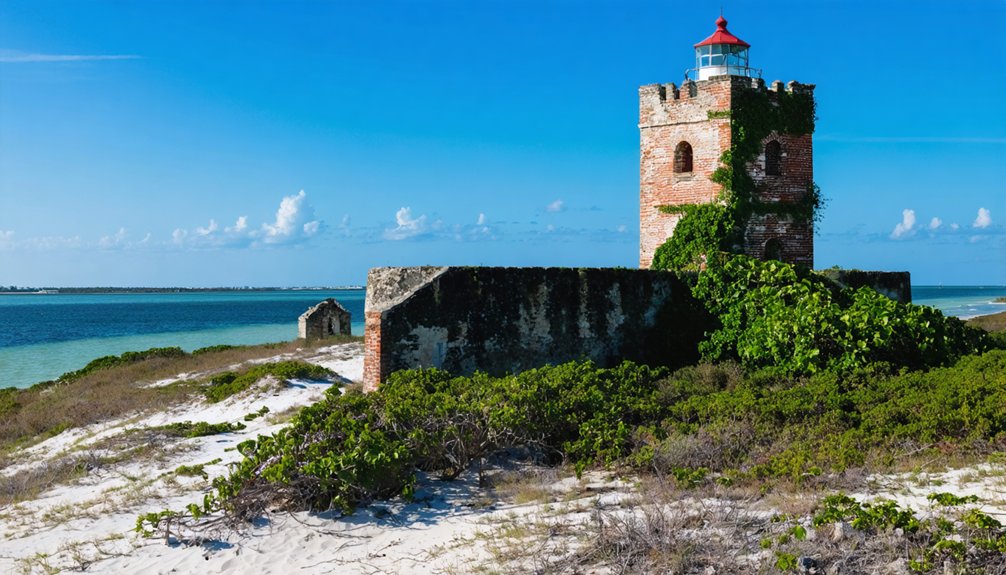
You’ll find the island’s oldest surviving structure still flashing every 15 seconds—the 1848 lighthouse rebuilt in 1857 after devastating hurricanes destroyed the original.
This 40-foot sentinel served as the only navigational aid between St. Marks and Key West until Union forces captured it in July 1861, transforming it into a strategic watchtower for the East Gulf Blockading Squadron. From this vantage point, Union sailors spotted Confederate blockade-runners attempting to smuggle Southern cotton and tobacco to Caribbean markets.
Lighthouse Construction and Purpose
The structure served three essential purposes:
- Preventing ship groundings on the treacherous sandbars surrounding the key
- Guiding increased commercial shipping traffic through Tampa Bay’s approaches
- Establishing federal presence along Florida’s undeveloped coastline
Hurricanes in September 1848 nearly destroyed the tower. By 1857, Congress funded complete reconstruction. The replacement tower—standing twice as tall and positioned 90 feet inland—exemplifies successful lighthouse preservation through adaptive engineering.
When Civil War erupted in 1861, Egmont Key‘s strategic position at Tampa Bay‘s entrance transformed it into a contested military asset. Union naval forces seized the island that July, deploying 30-40 seamen from the steamer R.R. Cuyler who fortified it with three eighteen-pound guns.
Confederate resistance came swiftly—lightkeeper George H. Richards fled to Tampa while pro-Confederate civilians removed the lighthouse lamp and oil, blacking out the bay to frustrate blockade operations. Yet the island became more than a military outpost. By February 1862, you’d have found 200 Union sympathizers living under Navy protection, making Egmont Key a crucial unionist refuge.
The East Gulf Blockading Squadron operated from this base, launching attacks against Tampa while holding Confederate prisoners and maintaining vigilant blockade enforcement.
Watchtower During Wartime
Standing twenty feet above Egmont Key’s sandy shores, the original 1848 lighthouse represented Tampa Bay’s first purpose-built navigational beacon, filling a critical gap between St. Marks and Key West. During the Civil War, this structure became integral to Union naval operations as a strategic watchtower monitoring Confederate blockade runners.
The lighthouse’s elevated position provided critical advantages for coastal defense strategies:
- Surveillance capacity enabled Union forces to spot vessels attempting Tampa Bay access
- Economic warfare disrupted Confederate trade routes through early detection
- Strategic control maintained federal presence despite Confederate resistance
When Confederate forces recognized this threat, they removed the Fresnel lens between 1860-1861, temporarily frustrating Union blockade efforts. The keeper fled with the apparatus, demonstrating the lighthouse’s significance beyond simple navigation.
Wildlife Viewing and Natural Features of the Island
Egmont Key’s ecological significance stems from its designation as a National Wildlife Refuge, protecting one of Florida’s most essential seabird nesting colonies. You’ll witness over 35,000 pairs of colonial beach-nesting birds, including Florida’s largest laughing gull colony and more than 7,000 royal tern pairs.
Sandwich terns dive-bomb for fish while black skimmers skim water surfaces during feeding runs. The island shelters 1,000 to 1,500 gopher tortoise populations, whose 40-foot burrows provide refuge for 350 species, including the eastern indigo snake.
Sea turtles nest along these protected shores, with 30 documented nests producing 17 successful hatchings. Ghost crabs patrol sandy beaches while hermit crabs inhabit tide pools. This sanctuary operates free from artificial lighting and human disturbance, allowing natural cycles to persist.
Planning Your Visit: Best Times, Permits, and Essential Supplies
Planning ahead guarantees successful exploration of this remote barrier island sanctuary, accessible exclusively by watercraft since no bridges or causeways connect it to mainland Florida. You’ll find no entrance fees for Egmont Key State Park, though transportation costs apply—ferry rides run $45 with advance reservations strongly recommended for weekend and holiday departures.
No entrance fee required, but budget $45 per person for essential ferry transportation to this bridge-free island destination.
Ferry schedules typically offer morning through afternoon options, aligning with the park’s 8 a.m. to sunset operating hours.
Essential supplies you must pack:
- Drinking water and food—zero facilities exist on-island
- Sunscreen and protective gear for extended exposure
- Waste disposal bags to preserve this protected ecosystem
Visit during cooler months (November through April) for ideal conditions with lower humidity and minimal crowds. Morning departures provide comfortable temperatures plus spectacular sunrise views across the abandoned military ruins.
Frequently Asked Questions
Why Was Fort Dade Named After Major Francis L. Dade?
Fort Dade honors Major Francis L. Dade’s military service and sacrifice during the Second Seminole War. You’ll find Dade’s role in Seminole wars commemorated here—he commanded troops massacred in 1835, triggering war escalation and earning lasting recognition.
How Many People Lived on Egmont Key During World War I?
You’d think an island would burst with over 600 people! Population estimates during WWI peaked at approximately 600 residents. Military presence on the island expanded dramatically as Egmont Key served as a National Guard Coast Artillery training center.
When Did the Tampa Bay Pilots Association Move to the Island?
The Tampa Bay Pilots Association moved to Egmont Key in 1886, establishing pilot station operations at the lighthouse. You’ll find their maritime navigation procedures evolved from lighthouse monitoring to independent facilities after securing federal lease rights in 1912.
What Happened to Fort Dade Structures That Are Now Missing?
Time’s relentless march claimed Fort Dade’s missing structures through deterioration over time. You’ll find that lack of preservation efforts, combined with the 1921 hurricane, humidity, erosion, and aggressive vegetation, systematically erased wooden buildings and lighter facilities from existence.
Who Currently Lives on Egmont Key Full-Time?
No one lives full-time on Egmont Key anymore. After the last pilot family relocated, caretakers maintain the island periodically while coastguard personnel monitor the area. You’ll find only temporary visitors exploring this preserved wildlife refuge today.