Your ghost town road trip to Fort De Soto begins at Tampa Bay’s haunted shores, where Tocobaga temple mounds once stood and Spanish explorers made first contact in 1528. You’ll explore crumbling seashell concrete fortifications abandoned since 1911, weathered quarantine station structures where yellow fever patients died 700 feet offshore, and drive across the rebuilt Sunshine Skyway Bridge where thirty-five people perished in 1980’s catastrophic collapse. The journey reveals centuries of tragedy, maritime history, and reported paranormal encounters that’ll chill you long after sunset.
Key Takeaways
- Fort De Soto, built in 1898, was abandoned in 1911 and now stands as a decaying coastal artillery stronghold.
- The Mullet Key Quarantine Station operated from 1889 to 1937, with weathered structures remaining as historical memorials.
- Ancient Tocobaga settlement sites reveal eight centuries of maritime civilization that thrived before European contact in 1528.
- Paranormal activity is reported at Fort De Soto and the quarantine station, particularly during twilight hours.
- The nearby Sunshine Skyway Bridge site commemorates the 1980 disaster that claimed thirty-five lives during a storm.
The Ancient Tocobaga Settlement and Spanish Explorers
Long before Spanish galleons carved through the turquoise waters of Tampa Bay, the Tocobaga people had already mastered this coastline for nearly eight centuries. You’ll find their story etched into temple mounds and shell middens scattered across what’s now Fort DeSoto.
Eight centuries before European contact, the Tocobaga civilization thrived along Tampa Bay’s shores, leaving archaeological treasures across Fort DeSoto.
These expert mariners paddled dugout canoes through mangrove channels, harvesting oysters and conchs that sustained their villages from 900 CE onward.
Their Tocobaga cultural practices centered around ceremonial temple mounds—flat-topped earthworks where chiefs lived and governed autonomous chiefdoms like Ucita and Pohoy. When Pánfilo de Narváez‘s crew stumbled ashore in 1528, they encountered a sophisticated maritime civilization.
Hernando de Soto followed in 1539.
Today, Tocobaga legacy preservation efforts protect archaeological sites where intricate pottery and bone tools still surface, connecting you to Florida’s original coastal explorers.
From Military Fort to Abandoned Stronghold
You’ll find the bones of Fort De Soto rising from Mullet Key’s sand, where construction crews mixed seashell concrete in 1898 to build what they hoped would be Tampa Bay’s impenetrable guardian.
The massive 12-inch mortars at Battery Laidley once tracked imaginary Spanish warships across the Gulf, but by 1923, only a single caretaker wandered between 29 slate-roofed buildings that housed ghosts instead of the 125 soldiers who’d drilled here two decades earlier.
What began as coastal artillery stronghold ended as a lonely outpost, its weapons stripped and shipped to California, leaving behind concrete chambers that still echo with the footsteps of an army that never fired a shot in anger.
Fort De Soto Construction
In 1849, a US Army survey team aboard the schooner Phoenix glided through Tampa Bay’s turquoise waters, charting islands for future coastal defenses. Among them rode Brevet Colonel Robert E. Lee, unknowingly surveying what’d become Fort De Soto. Though declared a military reservation that year, construction didn’t break ground until November 1898.
Material sourcing challenged engineers when Northern stone shipments stalled. Their ingenious solution? A seashell concrete formula mixing local shells, sand, and cement—you’ll still see this foundation today.
Workforce management proved efficient as crews completed three major projects simultaneously:
- A 275-foot wharf jutting into Tampa Bay
- A narrow-gauge railroad connecting wharf to battery sites
- Two mortar batteries housing 12-inch coastal defense artillery
Captain Thomas H. Rees delivered the fort on May 10, 1900—fourteen months, $16.73 under budget.
Abandonment and Decay
Just eleven years after Captain Rees handed over the keys, Fort De Soto‘s garrison packed their duffels for Fort Morgan, Alabama. By 1914, you’d find only a solitary ordnance sergeant wandering the empty barracks.
The concrete batteries stood silent through World War I, four mortars shipped to California while caretakers rattled around the decaying compound.
After official abandonment in 1923, exposure and neglect claimed what soldiers once maintained. Tropical hurricanes ripped through undefended walls, scattering slate shingles across the sand.
By 1932, Battery Bigelow surrendered entirely—collapsing into the Gulf like a defeated giant. You can still see where storms and infrastructure damage erased whole structures from existence.
Twenty-six wooden buildings somehow survived that decade, monument to military construction even as nature reclaimed its territory.
The Mullet Key Quarantine Station and Yellow Fever Tragedy
Beyond the crumbling gun batteries, you’ll find remnants of a different kind of battleground—the Mullet Key Quarantine Station, where doctors fought yellow fever instead of foreign armies from 1889 to 1937.
The station’s hospital, built 700 feet offshore on pilings and measuring 37 by 200 feet, became a place where infected travelers died in isolation, their bodies never making it to Tampa’s mainland. Today, nothing remains of those 15 buildings except scattered foundations, but the stories of fumigation attempts, mosquito-borne deaths, and desperate medical procedures haunt this slice of Pinellas County beachfront.
Quarantine Station Operations Overview
Starting December 16, 1889, the Hillsborough County Board of Health transformed the eastern shores of Mullet Key into a quarantine station—a lonely outpost where wooden buildings on stilts stood sentinel against invisible threats arriving by sea.
You’d find the station managing three critical functions:
- Inspecting foreign arrivals – examining aliens aboard ships from distant ports
- Segregating the sick – healthy travelers stayed inland while symptomatic patients occupied the 200-foot hospital built 700 feet offshore
- Fumigating vessels – apparatus introduced by 1892 launched mosquito eradication efforts against disease carriers
Public health protocols evolved as the Marine Hospital Service assumed control in 1901. By 1925, fifteen buildings comprised this waterborne checkpoint. The Quarantine Wharf anchored Tampa Bay’s defenses until operations relocated to Gadsden Point in 1937, ending nearly five decades of maritime vigilance.
Yellow Fever Outbreak Deaths
The summer of 1878 triggered death across America’s river ports with a ferocity that emptied entire city blocks. In Memphis alone, over 5,150 people died as roughly 90 percent of whites who stayed contracted the fever—70 percent never recovered. You’ll find no memorial commemorations adequate for such devastation.
Twenty-five thousand residents fled within two weeks, leaving only 19,000 behind, and 17,000 of them got sick. The social impact on local communities shattered everything—Trinity Lutheran Church watched its congregation collapse from hundreds to 125 members after burying approximately 100.
One Arkansas town saw its population plummet from 1,300 to just 70 souls. These weren’t just statistics; they were neighbors, families, entire communities erased.
Historic Hospital Building Remains
The quarantine wharf, the only building with a concrete basement
A former hospital converted into a fishing lodge
Fifteen buildings that processed immigrants and fumigated ships
These weathered structures stand as memorials to Tampa Bay’s battle against disease, inviting you to walk freely where others once faced mandatory isolation.
Understanding the Sunshine Skyway Bridge Disaster
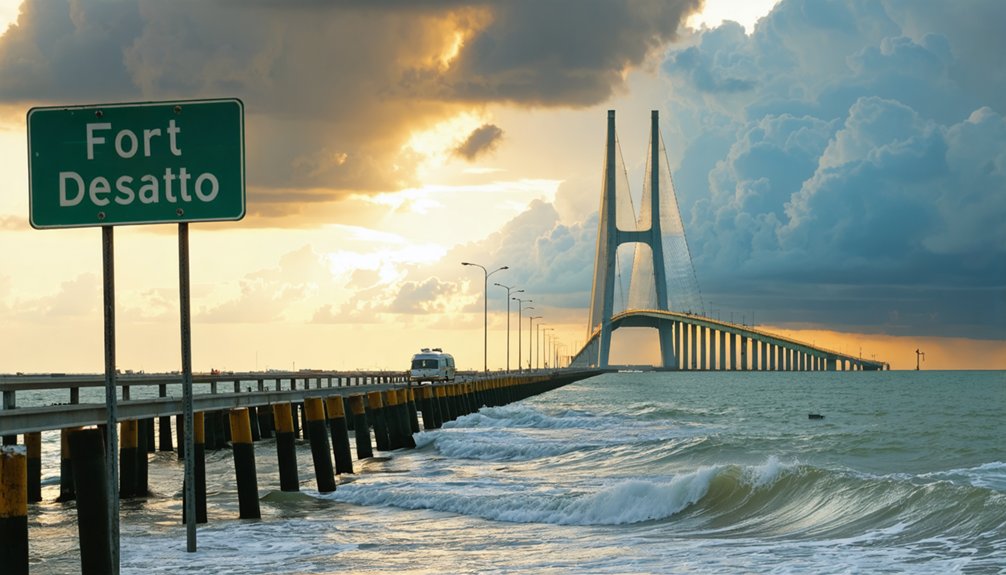
Rain hammered down in sheets that morning of May 9, 1980, transforming Tampa Bay into a wall of gray water and wind. The freighter MV Summit Venture lost all visual references as it approached the Sunshine Skyway Bridge.
Without warning from the National Weather Service, the vessel’s pilot pressed forward through the squall. Steel met concrete at Pier 2S—1,297 feet of roadway plunged 150 feet into the bay. Thirty-five souls went down with it.
The investigation into the incident’s causes revealed a perfect storm of failures: no severe weather warning, no motorist alert system, no protective barriers around the pier. Weather conditions leading up to the disaster had escalated rapidly, catching both mariners and drivers in nature’s deadly grip.
You’ll drive across safer waters now.
Reported Paranormal Activity and Spectral Encounters
Shadows move differently at Fort DeSoto when twilight settles across Mullet Key. You’ll discover layers of spectral activity through investigative methodologies that reveal compelling patterns. Historical record analysis connects modern encounters to documented tragedies—from yellow fever quarantine victims to Skyway Bridge disaster casualties processed at the makeshift morgue.
Watch for these manifestations:
- Military apparitions patrol the battery area where phantom footsteps echo through empty corridors
- Audible mourning from the mother who lost everything to yellow fever, still searching the grounds
- EMF anomalies spike near water’s edge where drowning victims’ spirits allegedly linger
You’re free to explore at your own pace, though investigators report unexplained dizziness and disorientation. The flirty fisherman ghost near the toll plaza vanishes mid-conversation—your experience may vary.
Getting to Fort De Soto Park From Major Florida Cities
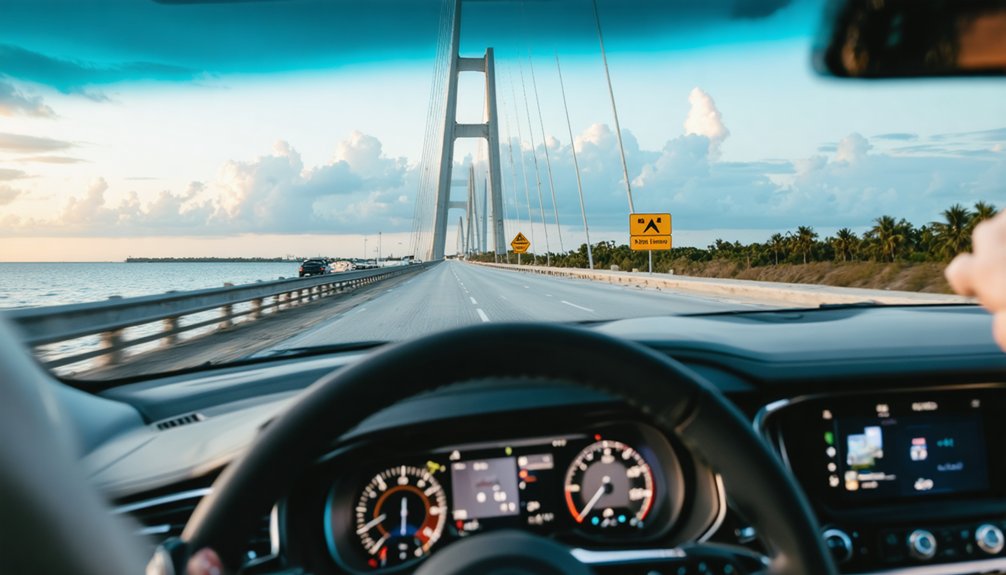
Planning your route to Fort DeSoto Park sets the stage for paranormal exploration beyond the mainland’s familiar grid. From Tampa or St. Petersburg, you’ll take I-275 south to exit 17, merging onto Pinellas Bayway west. After three miles, turn left onto FL 679—this causeway becomes your gateway across shimmering waters. Bridge toll costs apply along this route, though they’re minimal compared to what awaits.
Continue 6.6 miles until you reach the park entrance at 3500 Pinellas Bayway South in Tierra Verde. From Bradenton or Sarasota, you’ll follow I-275 north to the same exit. Park entry fees are just $5 per vehicle. The facility operates from 7am until sunset, giving you ample daylight to investigate five interconnected keys spanning 1,136 acres of documented hauntings.
What to Expect When Visiting the Historic Fortifications
When you first glimpse Battery Laidley rising from the sandy grounds, its weathered seashell concrete walls hold an almost theatrical presence—like stumbling upon ancient ruins that somehow ended up in subtropical Florida. This mortar battery preservation showcases four massive 12-inch M1890-M1 mortars, the last remaining in North America.
Four colossal mortars emerge from seashell concrete walls—the last of their kind standing sentinel over Florida’s subtropical coastline.
You’ll discover the ingenious seashell concrete construction that’s endured since 1898.
Here’s what awaits:
- Four operational-looking mortars positioned in their original pits—breach-loaded rifles that once defended Tampa Bay
- Thick defensive walls built from that distinctive seashell stone mixture, cool to touch even in summer heat
- Open exploration throughout the fortification’s chambers and pathways
You’re free to wander these silent battlements where 125 troops once stood guard, no ropes or barriers restricting your journey through history.
Best Times to Visit for Ghost Hunting and Exploration
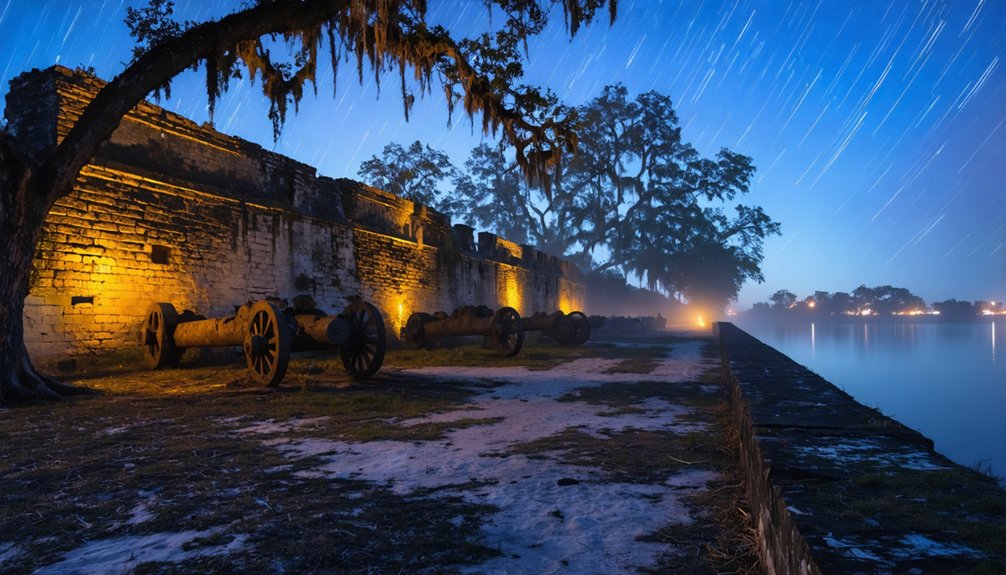
The fort’s paranormal energy shifts dramatically as daylight surrenders to dusk—I’ve found that golden hour between 4:30 and 6:30 PM offers the sweet spot for capturing unexplained phenomena. You’ll hear hushed voices echoing off the southernmost bunker walls as shadows lengthen across weathered brick.
Weekday mornings give you solitude to explore the powder room near the parking area, where your ideal ghost hunting equipment—EMF readers, digital recorders, spirit boxes—picks up strong responses.
The best seasons for visitation run October through March when cooler temperatures activate residual energies from Yellow Fever victims and phantom soldiers. Camp overnight for serious after-dark investigations when tourists vanish and the flirty fisherman ghost emerges near the toll plaza, only to disappear mid-conversation.
Where to Stay Near Fort De Soto Park
Your ghost hunting expedition deserves a base camp that won’t drain your paranormal investigation budget—and I’ve learned the hard way that proximity matters when you’re chasing midnight manifestations.
- Coconut Inn Pass-a-Grille (4.0 miles, 4.8/5 rating) delivers unbeatable value at $151-$300, with proximity to nearby attractions and the historic Pass-a-Grille district.
- Residence Inn Tierra Verde (3.9 miles) offers complimentary breakfast and marina views—perfect for refueling after all-night vigils.
- The Don CeSar provides Gulf views if you’re splurging on convenience amenities and beachfront access.
For families exploring beyond the paranormal, Cedar Cove Resort & Cottages and Sunset Inn & Cottages both rate 4.8/5+. Prices span $151-$708, so you’ll find options matching any adventure budget.
Frequently Asked Questions
Are There Any Guided Ghost Tours Available at Fort De Soto Park?
No guided ghost tours operate at Fort De Soto Park, though you’ll find local haunting stories from rangers and historians. Nearby St. Petersburg offers seasonal ghost tours instead. You’re free to explore the fort’s eerie ruins independently, discovering paranormal legends yourself.
Is Camping Allowed Overnight at Fort De Soto for Paranormal Investigations?
Yes, you can camp overnight at Fort De Soto, though primitive camping isn’t available. You’ll enjoy full amenities including electricity and water. While there’s nighttime security presence, they don’t specifically accommodate paranormal investigations during your stay.
What Paranormal Investigation Equipment Should I Bring to Fort De Soto?
You’ll want electromagnetic field detectors like a K2 meter to catch spirit spikes, plus night vision cameras for darkness. Pack a Spirit Box, EVP recorder, and flashlight—I’ve captured my best evidence using this essential combination.
Are the Historic Fort Structures Accessible to Visitors Year-Round?
The fort stands like an eternal sentinel—you’ll find it open daily, year-round from 7 a.m. to sunset. No seasonal maintenance schedule restricts your exploration, and visitor accessibility policies guarantee everyone can roam these historic grounds freely.
Do I Need Special Permits to Explore the Quarantine Station Ruins?
No special permits needed—you’re free to explore the quarantine station ruins following standard park rules. Unlike private property access restrictions elsewhere, these historic remains welcome visitors while respecting historical preservation concerns through simple viewing guidelines.