Fort Mose isn’t your typical ghost town—it’s a vanished civilization whose story hits harder than any abandoned mining camp. You’re heading to the site of America’s first legally sanctioned free Black community, founded in 1738, where over 100 enslaved Africans walked 300 miles to claim freedom on their own terms. Located two miles north of St. Augustine, it’s accessible from Jacksonville, Orlando, and Miami. Stick around, and you’ll uncover a history that rewrote what freedom could look like.
Key Takeaways
- Fort Mose Historic State Park sits two miles north of St. Augustine, accessible from Jacksonville (40 mins), Orlando (2 hours), and Miami (5 hours).
- Ranger-led tours run Thursday through Sunday at 10 a.m. and 1 p.m., offering guided exploration of this historically significant site.
- A full-scale wooden fort replica and archaeological artifacts, including pottery, buttons, and tools, create an immersive visitor experience.
- Established in 1738, Fort Mose was America’s first legally sanctioned free Black community, predating the Underground Railroad by nearly a century.
- Complement your visit by exploring nearby Castillo de San Marcos and St. Augustine’s historic district, enriching the colonial-era historical context.
What Is Fort Mose and Why It Matters?
Before the Underground Railroad carried freedom seekers north, there was Fort Mose—a sanctuary where runaway slaves fled *south*. Established in 1738 by Spanish Governor Manuel de Montiano, this Florida settlement became the first legally sanctioned free Black community in what would later become the United States.
Its historical significance runs deep. Spain’s 1693 royal decree promised asylum to enslaved Africans who converted to Catholicism and served four years in the militia. Over 100 people accepted that gamble, walking 300 miles through swamps and forests to reach freedom.
Fort Mose’s cultural heritage reshaped American history before America existed. Here, formerly enslaved people built families, defended their freedom with weapons, and proved that liberation wasn’t a distant dream—it was a living, breathing community worth fighting for.
The Remarkable History of America’s First Free Black Settlement
What began as a Spanish political maneuver became something far more extraordinary: a thriving community of formerly enslaved people who built lives, defended freedom, and reshaped the colonial world around them.
Fort Mose’s historical significance stretches far beyond its earthen walls. Established in 1738, it predates the Underground Railroad by nearly a century, yet it served the same revolutionary purpose — sanctuary.
Fort Mose didn’t just predate the Underground Railroad — it *was* the Underground Railroad, a century before anyone named it.
These weren’t passive refugees. Under Captain Francisco Menendez’s leadership, they fought back, most memorably at the Battle of Bloody Mose, where they reclaimed their home with devastating force.
Their cultural heritage was equally remarkable — a deliberate fusion of African, Spanish, and Native American traditions forged into something entirely new.
When you walk this ground, you’re tracing the footsteps of people who refused to accept anyone else’s definition of freedom.
The Battle of Bloody Mose Fort Mose’s Most Violent Hour
In 1740, Georgia Governor James Oglethorpe invaded Florida with a force targeting Fort Mose, pushing its residents to abandon the settlement and seek refuge within the coquina walls of Castillo de San Marcos in St. Augustine.
You’d find that those walls proved impenetrable against British bombardment, buying Captain Francisco Menendez and his free black militia the time they needed to plan their counterstrike.
At dawn, Menendez led his fighters back to Fort Mose, overwhelming the British occupiers in a ferocious assault that survivors would describe in horrifying detail—a battle history now remembers as Bloody Mose.
Oglethorpe’s Florida Invasion
Fort Mose’s most violent hour arrived in 1740, when Georgia Governor James Oglethorpe launched a full-scale invasion of Florida with Fort Mose squarely in his sights.
Understanding Oglethorpe’s Strategy reveals British Motivation clearly: eliminate the sanctuary threatening slavery’s southern foundation.
Fort Mose’s existence destabilized the colonial order by:
- Offering enslaved people a viable freedom corridor southward
- Undermining South Carolina’s and Georgia’s plantation economies
- Challenging British territorial dominance over the Southeast
- Proving that free black communities could successfully defend themselves militarily
Facing overwhelming forces, Fort Mose’s residents made a calculated retreat to Castillo de San Marcos, surrendering the fort temporarily but preserving their lives.
Their freedom wasn’t abandoned — it was strategically protected, setting the stage for a devastating counterattack that would shake British confidence permanently.
Retreat To Castillo
When Oglethorpe’s forces swept into Fort Mose, the community’s leaders faced a brutal calculation: fight and die, or fall back to Castillo de San Marcos and survive to reclaim what was theirs.
Their retreat strategies weren’t cowardice — they were precision. You can’t defend freedom from a grave.
The Castillo’s coquina-shell walls absorbed British bombardment without shattering, giving the Fort Mose refugees critical shelter.
That calculated withdrawal carried profound historical significance: it preserved Captain Francisco Menendez‘s militia intact, positioning them for a devastating counterattack.
Menendez Strikes Back
Dawn broke over Fort Mose on June 26, 1740, and Captain Francisco Menendez released hell. Menendez’s strategy was surgical — strike before British soldiers awoke, reclaiming what freedom had built.
The Fort’s resilience lived not just in coquina walls but in formerly enslaved warriors who refused surrender.
British survivors reported what they witnessed:
- Bludgeoning of sleeping soldiers caught defenseless
- Beheadings signaling reclaimed dignity and rage
- Castrations communicating consequences for enslaving human beings
- Total decimation of occupying forces before sunrise
You must understand this battle’s significance. These weren’t desperate men — they were free men defending their community.
Menendez’s victory demonstrated that Black freedom, once established, would be protected with absolute, unapologetic force.
Captain Menendez and Fort Mose’s Free Black Militia
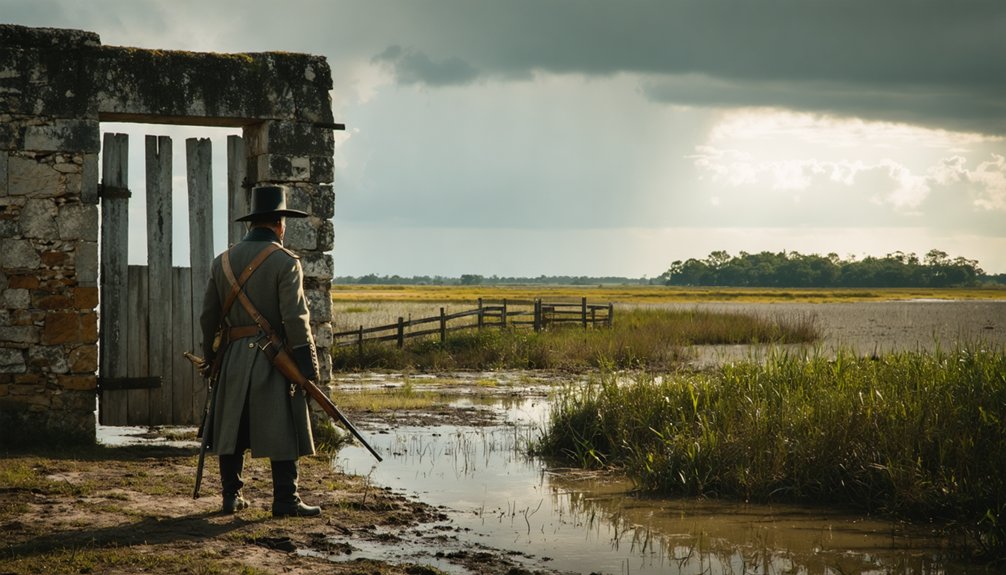
At the heart of Fort Mose’s story stands Captain Francisco Menendez, a man who transformed his own enslavement into a fierce command over Florida’s first free black militia.
You’d find his path to freedom typical of Mose’s founders — escape, conversion, and four years of armed service under Spanish authority — yet his leadership proved anything but ordinary.
When you trace the militia’s role at Mose, you’re following men who understood that defending the settlement meant defending their own freedom, a reality that sharpened every sword and musket they raised.
Menendez’s Path To Freedom
Before the Underground Railroad carried freedom seekers northward, a formerly enslaved man named Francisco Menendez was forging a different kind of liberation—southward, through swamp and Spanish territory.
Menendez’s Journey embodied centuries of Freedom Struggles compressed into one extraordinary life:
- Captured in West Africa, enslaved in Carolina, yet never spiritually broken
- Escaped bondage, maneuvering 300 miles of treacherous wilderness toward Spanish Florida
- Converted to Catholicism, fulfilling Spanish requirements for legal freedom
- Rose from refugee to militia captain, defending the very freedom he’d fought to claim
You’re visiting ground where liberation wasn’t handed down—it was seized, earned, and protected with remarkable ferocity.
Menendez didn’t wait for history to free him. He became the architect of his own emancipation.
Militia’s Defense Of Mose
When Georgia Governor James Oglethorpe invaded Florida in 1740, he expected Fort Mose to fall—and it did, briefly. The residents retreated strategically to Castillo de San Marcos, whose coquina-shell walls absorbed British cannon fire without crumbling. That tactical withdrawal wasn’t surrender—it was calculated.
Captain Francisco Menendez then demonstrated what community resilience truly looks like. At dawn, he led his free Black militia back to Mose in a ferocious counterattack, slaughtering most British occupiers in what survivors called the Battle of Bloody Mose.
Their militia tactics—swift, devastating, purposeful—reflected something deeper than military training. These were formerly enslaved people defending hard-won freedom.
You can’t separate their battlefield ferocity from their humanity. They weren’t just soldiers; they were fathers, husbands, and free men protecting everything they’d risked their lives to build.
Fort Mose’s Legacy as the First Underground Railroad
Though most Americans associate the Underground Railroad with the northward escape routes of the antebellum era, Fort Mose tells a far older and southward story.
Nearly a century earlier, freedom-seekers moved through a dangerous corridor guided by Native American allies toward Spanish Florida. This cultural exchange produced something remarkable — a sovereign Black community that defended its own liberty.
Fort Mose’s legacy reframes what freedom’s pursuit looked like:
- Enslaved people chose Spanish Catholic conversion over permanent bondage
- Native Americans guided refugees southward through treacherous terrain
- Military service became the currency of liberation
- A thriving community proved Black self-governance predated the Revolution
You’re standing at the Underground Railroad’s true origin point when you visit here.
Where Is Fort Mose Historic State Park?
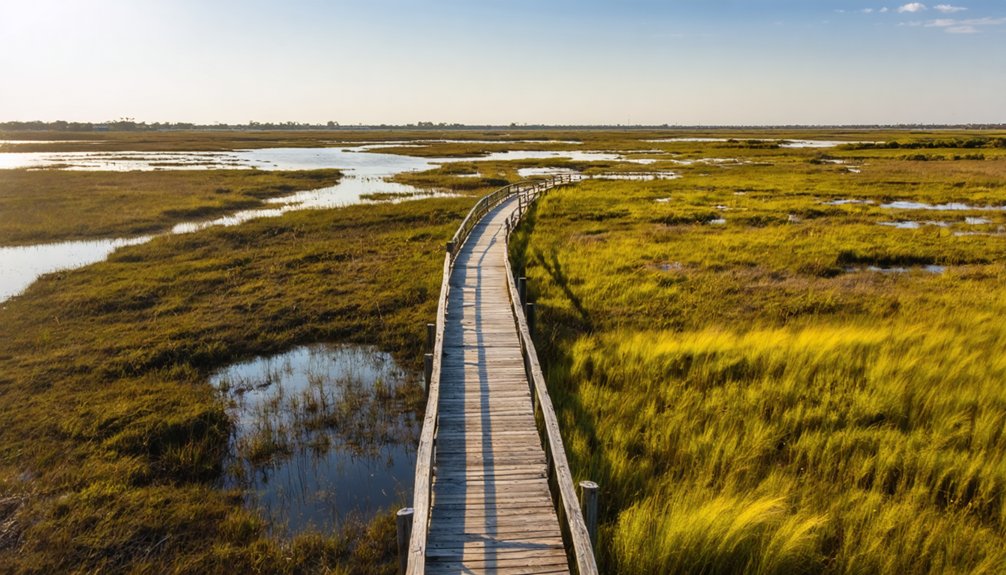
Fort Mose Historic State Park sits just two miles north of St. Augustine, Florida, where Black history, cultural heritage, and community resilience converge on sacred ground.
You’ll find a full-scale replica wooden fort, ranger-led tours Thursday through Sunday at 10 a.m. and 1 p.m., and archaeological discoveries—pottery, buttons, tools—that resurrect lives once erased from memory.
The original site, reclaimed by marsh, reminds you that preservation efforts require active commitment. Educational programs illuminate Fort Mose’s historical significance, connecting military strategy, faith, and survival into one extraordinary narrative.
Preservation isn’t passive—it’s a fight. Fort Mose proves that military strategy, faith, and survival can outlast erasure.
Tourist engagement here isn’t passive; it’s a reckoning. You’re walking where formerly enslaved people built something lasting—family, identity, and freedom—long before America claimed to understand those words.
This ground demands your full attention.
Driving to Fort Mose From Jacksonville, Orlando, and Miami
Getting to Fort Mose is straightforward from Florida’s major corridors, placing this landmark within reach whether you’re traveling from Jacksonville, Orlando, or Miami.
- Jacksonville: Drive 40 minutes south via I-95, exiting toward St. Augustine’s cultural heritage corridor.
- Orlando: Head northeast roughly 2 hours on I-4 East, connecting to I-95 North toward historical preservation sites.
- Miami: Travel approximately 5 hours north on I-95, tracing the same coastal route freedom-seekers once navigated southward.
Once near St. Augustine, head two miles north toward Fort Mose Historic State Park.
Rangers lead tours Thursday through Sunday at 10 a.m. and 1 p.m., guiding you through America’s first legally sanctioned free Black settlement.
Plan your arrival accordingly—this ground demands your full, unhurried attention.
The Fort Replica, Artifacts, and Marsh You’ll Find There Today
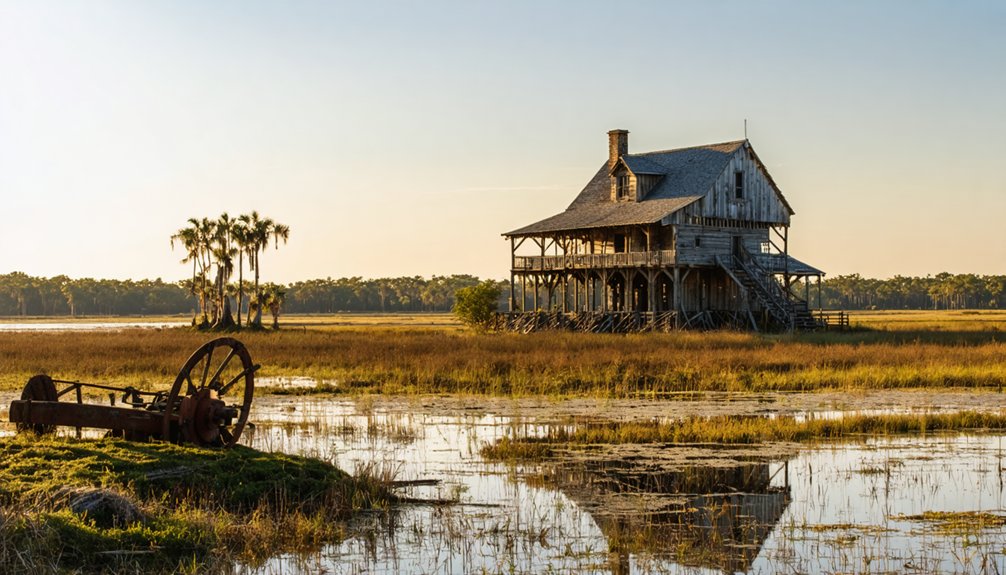
When you arrive at Fort Mose Historic State Park, you’ll find a full-scale wooden fort replica that anchors the site’s interpretive experience, alongside artifacts — pottery shards, buttons, trinkets, and rusted tools — recovered from the original settlement.
The original fort itself, however, is gone, swallowed by the marsh that gradually reclaimed the land over centuries.
You’ll stand on dry uplands looking out over that encroaching wetland, confronting the strange, humbling reality that the first legally sanctioned free Black settlement in what became the United States now lies buried beneath water and sediment.
Fort Replica And Artifacts
Though the original fort was swallowed long ago by the encroaching marsh, you’ll find a full-scale wooden replica standing at Fort Mose Historic State Park, two miles north of St. Augustine. The fort architecture reflects the layered cultural influences that shaped this extraordinary community.
Recovered artifacts deepen that story:
- Pottery fragments revealing African ceramic traditions adapted within Spanish colonial life
- Buttons and trinkets connecting residents to European trade networks
- Rusty tools embodying daily labor and self-determination
- Material remnants anchoring an otherwise erased community to documented history
These objects aren’t curiosities — they’re evidence. They confirm that free Black families built something deliberate here: homes, defense, identity.
Walking among the replica’s walls, you’re standing where autonomy was forged against extraordinary odds.
The Reclaimed Marsh Site
Beyond the replica’s walls, the original Fort Mose site has been fully reclaimed by marsh — and that erasure is itself part of the story. The wetlands that once sheltered freedom seekers now swallow the ground where they built their lives.
Marsh ecology has done what colonial ambition, Henry Flagler’s dredging, and post-1821 American indifference couldn’t fully accomplish — it’s made the site nearly invisible.
Yet you can stand at the park’s edge and understand that invisibility as resistance. Historical preservation here means accepting what’s lost while honoring what survived: the artifacts, the records, the names.
You’re not just visiting a ghost town. You’re standing at the threshold of a freedom struggle that America spent centuries trying to forget.
Fort Mose Hours, Ranger Tour Schedule, and Admission Fees
Fort Mose Historic State Park is open for exploration, with ranger-led tours running Thursday through Sunday at 10 a.m. and 1 p.m., giving you structured access to one of North America’s most consequential yet undervisited historical sites.
Understanding the fort mose hours helps you plan meaningfully around each ranger tour:
- Tours illuminate how formerly enslaved people built legal freedom generations before abolition
- Rangers contextualize artifacts — pottery, buttons, tools — recovered from the original settlement
- The full-scale wooden fort replica anchors the narrative spatially and historically
- Guided interpretation reveals layers that self-guided visits often miss
Walking these grounds, you’re standing where freedom wasn’t abstract — it was defended, legislated, and lived.
Come prepared to listen, reflect, and carry that reckoning forward.
Nearby Historic Sites That Complement Fort Mose’s Story
Just two miles south of Fort Mose, Castillo de San Marcos completes the military and political picture you’ve started building — it’s where Fort Mose’s residents fled during Oglethorpe’s 1740 invasion, sheltering behind coquina-shell walls that absorbed British cannon fire rather than shattering under it.
Walking those fortifications deepens your understanding of why Fort Mose mattered strategically, not just symbolically.
Walking Castillo de San Marcos transforms Fort Mose from symbol to strategy — stone walls making abstract resistance suddenly, powerfully concrete.
St. Augustine’s historic district extends that conversation further. Its Spanish colonial architecture and Florida Black Heritage Trail sites connect Cultural Heritage threads running from 1693 through emancipation and beyond.
Historical Preservation efforts here have kept material evidence of Black autonomy visible and accessible.
Together, these sites form a corridor of resistance — where freedom wasn’t abstract but actively defended, rebuilt, and ultimately remembered against considerable forces working to erase it.
Frequently Asked Questions
Can I Bring My Dog to Fort Mose Historic State Park?
The knowledge base doesn’t specify dog friendly policies or pet friendly amenities at Fort Mose Historic State Park. You’ll want to contact the park directly to confirm their current pet friendly amenities before visiting.
Are There Picnic Areas or Restrooms Available at Fort Mose?
Like Maroons carving refuge in the wild, you’ll find picnic facilities and restroom locations within Fort Mose Historic State Park, letting you pause, reflect, and honor the freedom-seekers who shaped this sacred ground.
Is Fort Mose Accessible for Visitors With Mobility Challenges or Disabilities?
The knowledge doesn’t confirm wheelchair access or mobility aids specifics, but you’ll find Fort Mose Historic State Park’s dry upland grounds and ranger-led tours potentially navigable—contact the park directly to verify your freedom to explore fully.
Does Fort Mose Offer Special Programming for School Groups or Children?
Over 100 freedom seekers once called Fort Mose home. You’ll find ranger-led group tours and educational activities Thursday through Sunday, immersing children in America’s first free Black settlement’s extraordinary legacy of resilience and liberation.
What Should I Wear or Bring for Visiting Fort Mose’s Outdoor Grounds?
Wear comfortable, appropriate footwear for marshy terrain, and consider weather considerations — Florida’s heat and humidity demand light clothing, sunscreen, and water. You’ll walk where freedom’s first defenders once stood, so prepare accordingly.
References
- https://bittersoutherner.com/the-first-floridians-fort-mose-st-augustine
- https://en.wikipedia.org/wiki/Fort_Mose
- https://www.floridashistoriccoast.com/blog/the-story-of-fort-mose/
- https://fortmose.org/about-fort-mose/
- https://www.youtube.com/watch?v=3duWC5Xp-6I
- https://www.nps.gov/foma/learn/historyculture/fort-mose.htm
- https://www.floridastateparks.org/learn/history-fort-mose
- https://www.tclf.org/fort-mose-historic-state-park