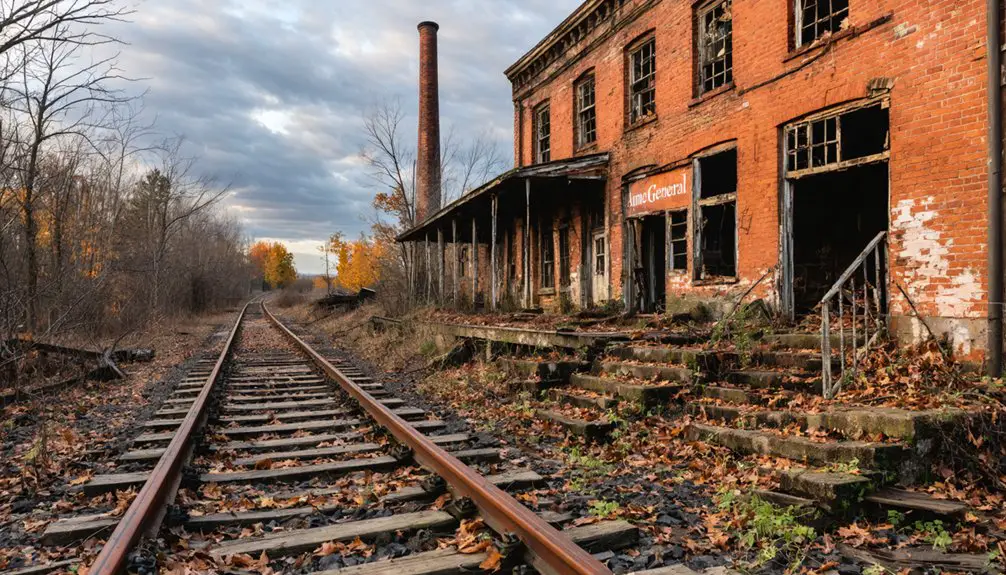
Fort Palmer’s Revolutionary War stockade site sits seven miles northeast of Ligonier along Route 981, though you’ll find only scattered foundation depressions on private property today. You can observe from roadside viewpoints, then expand your trip to include nearby industrial ghost towns like Wehrum along the 46-mile Ghost Town Trail in Indiana County. Plan visits during spring or fall when vegetation thins and terrain conditions prove manageable. The site’s significance extends beyond what remains visible on the surface.
Key Takeaways
- Fort Palmer is located seven miles northeast of Ligonier; access via Route 981 North through Westmoreland County’s rolling terrain.
- Only scattered foundation depressions remain on private property; observation limited to roadside viewpoints along Route 30.
- Visit during late spring or fall for mild temperatures and manageable terrain conditions before seasonal flooding occurs.
- Expand your itinerary with nearby ghost towns: Wehrum, Yellow Dog Village, White Rock, Old Patton, and Salemville.
- Download county topographic maps and trail PDFs beforehand; GPS directions to remote sites often prove unreliable.
Historical Significance of Fort Palmer and the Revolutionary War Frontier
When Robert Nox conveyed his frontier tract to John Palmer on March 11, 1771, neither man could’ve anticipated the stockade built there would become a critical refuge during the Revolution’s bloodiest frontier campaigns.
By November 1777, settlers gathered at Palmer’s Fort—seven miles from Fort Ligonier—as British native alliance strategy unleashed unleashed coordinated raids across sixty miles of Westmoreland County. At least eleven people perished in surrounding attacks that fall, forcing evacuations of homesteads, livestock, and crops.
Westmoreland Rangers and the 8th Pennsylvania Regiment employed frontier militia tactics against warriors penetrating from Fort Detroit, where superintendent Henry Hamilton incentivized defections. The fort’s resistance preserved liberty for families who’d carved settlements from wilderness, embodying the frontier’s stubborn refusal to yield territory or autonomy.
Getting to Fort Palmer: Location and Route Planning in Westmoreland County
Though the historical footprint of Fort Palmer has vanished from modern maps, the site occupied land approximately seven miles northeast of present-day Ligonier in what’s now eastern Westmoreland County.
Reaching this frontier location requires careful planning:
- Route 981 North from Ligonier provides primary access through rolling terrain marked by abandoned mining operations and early settler homesteads
- Township road networks branch eastward toward the approximate fort location, though many remain unpaved
- Topographic maps from county archives prove essential for identifying land features matching 18th-century descriptions
- Private property boundaries now encompass the presumed site, requiring permission before exploration
You’ll navigate landscape largely unchanged since colonial times. The journey itself reveals why this isolated position became strategically crucial—and ultimately vulnerable—during Pennsylvania’s Revolutionary frontier conflicts.
Nearby Ghost Towns to Add to Your Western Pennsylvania Itinerary
Your exploration of Fort Palmer’s remote terrain positions you perfectly for discovering Western Pennsylvania’s network of vanished coal communities. Within Westmoreland County, you’ll find Old Patton in Bell Township and Salemville in Salem Township—both preserving coal mining history through scattered foundations and structural remains.
Venture into Armstrong County to document Yellow Dog Village‘s eerie houses abandoned in the 2010s, where remnants of daily life still occupy rooms. Indiana County’s Wehrum offers extensive ruins along the Ghost Town Trail, including foundations from 250 homes, churches, and commercial buildings.
White Rock in Armstrong County’s Gilpin Township provides accessible exploration sites. Each location demands respectful documentation—you’re preserving stories of communities that industrial forces erased from maps but not from the landscape.
Best Time to Visit and What to Expect at the Site Today
Planning your visit to Fort Palmer requires understanding that almost nothing remains of the 18th-century stockade beyond scattered foundation depressions and historical memory. Site conditions reflect centuries of abandonment—overgrown vegetation conceals structural remnants near Loyalhanna Creek.
Seasonal weather patterns dictate accessibility: late spring and fall offer favorable conditions with mild temperatures and manageable terrain.
What you’ll encounter:
- Collapsed stone foundations hidden beneath tangled brush and mature trees where soldiers once stood guard
- Uneven ground marking where eleven settlers, including Ensign Woods, fell during the 1774 raid
- Creek-side positioning that floods during heavy rains, reshaping the landscape seasonally
- Private property boundaries requiring roadside observation from Route 30 viewpoints
Weekday visits minimize encounters with others. Bring maps—cell service fails here. The site darkens quickly without artificial lighting.
Essential Tips for Exploring Pennsylvania’s Ghost Town Trail Region
Beyond Fort Palmer’s isolated remnants, the Ghost Town Trail delivers 46 miles of documented industrial archaeology across Indiana and Cambria Counties, following abandoned railroad corridors that once hauled coal and iron from vanished settlements.
You’ll find amenities for hikers concentrated at five primary access points: Saylor Park, Heshbon, Dilltown, Wehrum, and Vintondale—each offering parking and seasonal trail closures affect restroom availability outside peak months.
Download PDF section maps before departing, as Google directions to Dilltown prove unreliable. The crushed limestone surface maintains grades under 3%, accessible for most skill levels.
During hunting season, wear blaze orange when crossing state game lands. Interpretive signage marks preserved features including Eliza Furnace and mining slag deposits.
Contact Cambria County (814-472-2110) or Indiana County Parks (724-463-8636) for current conditions.
Frequently Asked Questions
Are There Any Entrance Fees to Visit Fort Palmer?
Like an open door to the past, you’ll find no entrance fees or operating hours restricting your visit to Fort Palmer. This abandoned ghost town remains freely accessible, letting you explore Pennsylvania’s forgotten history at your own pace.
Can I Camp Overnight Near the Fort Palmer Ghost Town Site?
You can’t camp directly at Fort Palmer, but nearest camping facilities include Gordon Glen Woods 1-2 miles away near Ghost Town Trail. Surrounding wilderness areas offer 8,200 acres of state game lands for exploring this historic coal-mining region safely.
Are Guided Tours Available at Fort Palmer or Nearby Ghost Towns?
You’re barking up the wrong tree for guided tours at Fort Palmer—none exist. You’ll need self-guided tours to explore its historical significance. However, nearby Yellow Dog Village offers organized open houses twice monthly for authentic ghost town experiences.
What Safety Precautions Should I Take When Exploring Abandoned Sites?
You’ll need proper personal protective equipment including respirators, sturdy boots, and flashlights. Notify local authorities before exploration, document structural conditions carefully, and never venture alone. Preserve these historical sites by leaving artifacts undisturbed for future researchers.
Are There Restaurants or Gas Stations Near Fort Palmer?
Dining options exist primarily in nearby Palmer and Easton, with Palm Tavern closest for meals. However, fuel availability information wasn’t documented in historical records—you’ll need to scout modern gas stations independently before your expedition begins.