You’ll find Frederick’s weathered remains along M-68 in Crawford County, accessible via I-75 and North Old US-27 through Au Sable State Forest’s truck trails. This former lumber boomtown, devastated when sawmills burned in 1852, now offers abandoned buildings, concrete foundations, and a historic cemetery nestled among regrown forests where 1880s loggers once felled mighty white pines. Plan your visit during summer or fall when seasonal roads stay passable, and you’ll discover why Michigan’s ghost towns reveal compelling stories about the state’s vanished timber empire.
Key Takeaways
- Access Frederick via North Old US-27 and Au Sable State Forest truck trails, with I-75 as the major highway route.
- Plan visits seasonally, as transportation and accessibility change dramatically depending on weather and road conditions.
- Explore weathered buildings along M-68, concrete foundations, a historic cemetery, and scattered relics across the forested site.
- Use modern Frederic, Michigan at 44.7785554 latitude as a reference point for navigation to the historic ghost town.
- Combine your trip with nearby Michigan ghost towns like Central Mine, Port Oneida, and North Manitou Island.
The Rise and Fall of Frederick’s Lumber Industry
When the first settlers arrived in 1877, they found themselves in a wilderness of cork pine so vast it seemed inexhaustible. SettlementAndEarlyGrowth transformed this remote wooding-up stop—first called Forest, then Fredericville—into a thriving lumber hub when the Saginaw-to-Gaylord rail line opened virgin forests to commercial exploitation. David Ward’s massive sawmill five miles northwest made Frederic the logical center for lumberjacks seeking respite between cutting seasons.
PeakLumberProduction reached its zenith in 1888 when Michigan produced 4,292,000,000 board feet statewide. But freedom from restraint proved fatal. By 1860, white pine stands had already dwindled to critical levels. The shift from independent sawyers to industrial titans like Frederick Weyerhaeuser—who controlled over 2 million acres by 1914—only accelerated the devastation. White pine’s light weight and durability made it the preferred wood, driving relentless harvesting across the Northwest. By the 1920s, the forests were gone. When pine logging ended in the late 1800s, hardwood cutting sustained the town for another few decades before that too ceased in the 1920s.
What Caused Frederick to Become a Ghost Town
The sawmills that sustained Frederick burned to the ground in 1852, wiping out the village’s entire economic foundation in a single catastrophic event.
You’ll find Frederick’s collapse mirrors a pattern of vulnerability—it relied solely on lumber production and its position as the eastern terminus of the Clinton-Kalamazoo Canal. When canal dependence issues arose after the broader project’s abandonment, the town lost its backup lifeline.
The site’s instability runs deeper: Frederick rose near New Gnadenhuetten, a Moravian mission abandonment from 1786 when Ojibwe warned settlers to leave. Without diversification into farming or fishing, the 1852 fire left nothing to rebuild upon. Residents simply moved on, leaving Frederick to vanish into Michigan’s frontier memory. This pattern echoed across Michigan’s logging communities from the 1800s, many of which became ghost towns after their resources were depleted. The place name disambiguation reflects how thoroughly the settlement disappeared, with multiple locations now sharing the Frederick designation across different regions.
Getting to Frederick: Routes and Access Points
Finding Frederick today requires traversing a confusing tangle of history and geography, because the ghost town you’re seeking isn’t the Frederic that appears on modern maps. The vanished lumber town of Deward—often conflated with Frederick—sits at 44°50′26″N 84°49′36″W in Frederic Township’s backcountry.
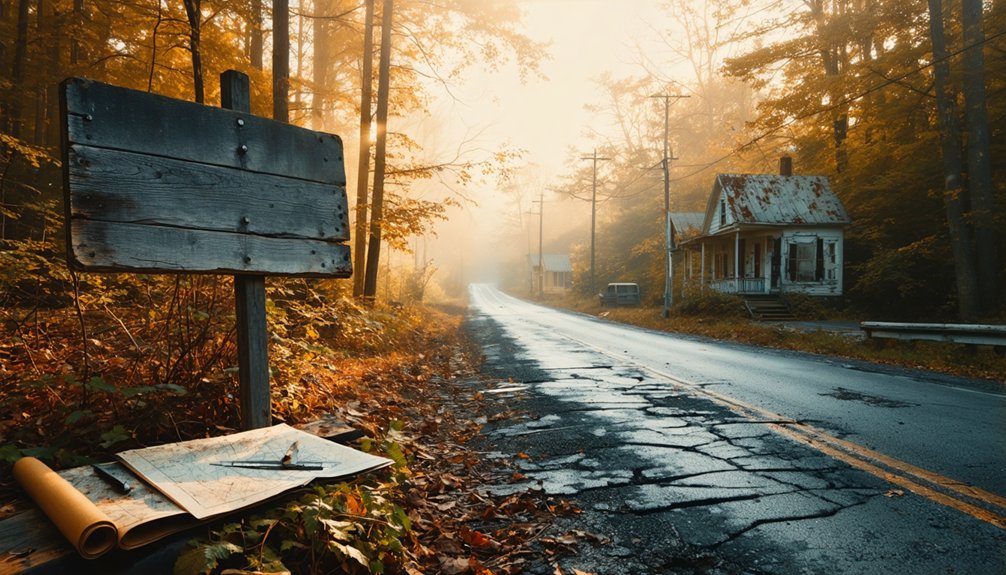
You’ll navigate North Old US-27, then branch onto Au Sable State Forest truck trails where remote logging access points once channeled fortunes in white pine. These winding paths fork unpredictably, demanding careful navigation and proper maps.
Seasonal transportation changes dramatically impact accessibility—spring thaws transform routes to muddy challenges, while winter snows may block passages entirely. The actual town of Frederic, Michigan sits at latitude 44.7785554, serving as a modern reference point northeast of the ghost town location. The middle branch of the Au Sable River guides your approach, whispering stories of vanished railroads and forgotten settlements awaiting your discovery. I-75 passes north-south just east of Frederic Township, providing a major highway access route for travelers beginning their journey into this historic region.
What Remains at the Frederick Site Today
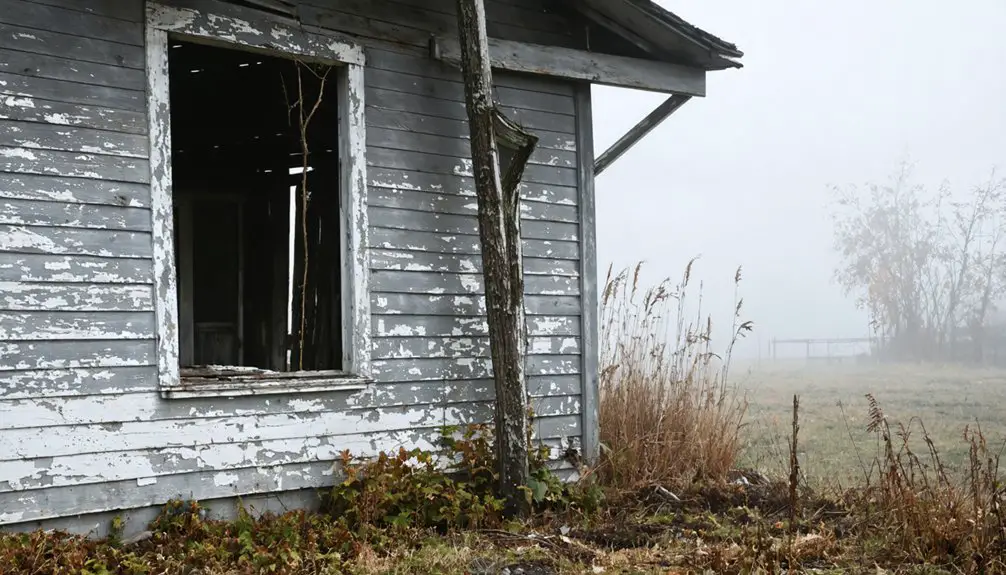
Along the south side of M-68 highway, where pavement cuts through what was once Frederick’s bustling heart, a weathered row of abandoned buildings stands frozen in time like sentries guarding memories of Michigan’s lumber boom. These skeletal structures evoke an old west ghost town, their weathered facades perfect for photography enthusiasts seeking authentic decay.
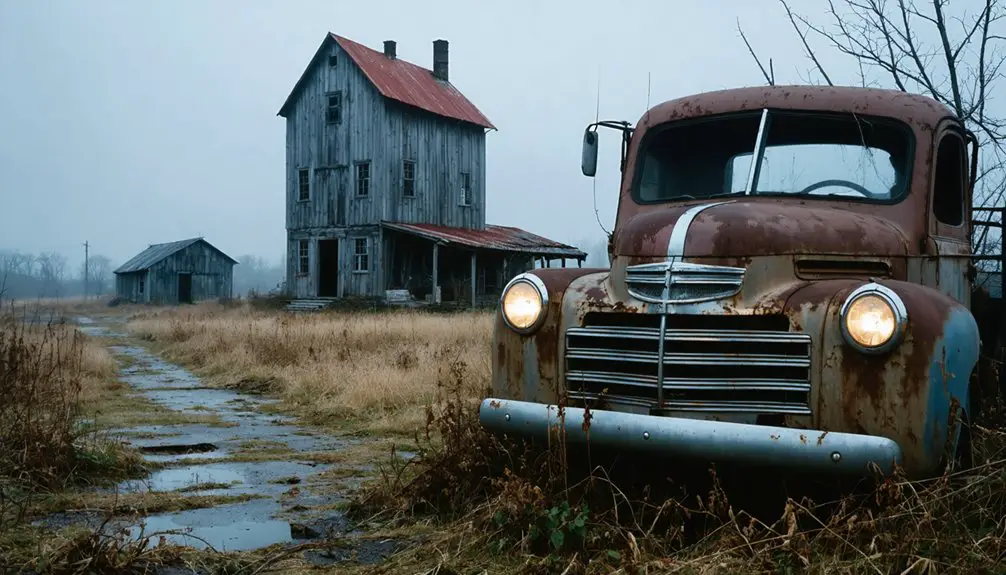
Beyond the highway’s edge, you’ll discover concrete foundations hidden beneath regrown forest, accessible via two-track off County Road 612. Abandoned relics scattered across site include toppled cabins, rusted machinery, and wooden fences with concrete sawmill bases along the river trail. The forests have grown back naturally over the decades, reclaiming the land that was once stripped bare by intensive logging operations.
The cemetery preserves Frederick’s oldest gravestones, while collapsed docks and mysterious underground relics from the former Underground Forest attraction—closed since the 1960s—dot this landscape where nature’s reclaimed what industry once commanded. The town’s population has steadily declined since its lumber camp origins, leaving behind these haunting reminders of a once-thriving community.
Other Michigan Ghost Towns Worth Visiting
Michigan’s ghost town landscape stretches far beyond Frederick’s crumbling foundations, with over seventy documented settlements scattered across the state like forgotten monuments to boom-and-bust dreams. You’ll find copper mining ghost towns clustered throughout the Keweenaw Peninsula, where nearly a hundred communities once thrived during the late 1800s copper rush. Central Mine still stands four miles north of Phoenix, its restored buildings whispering tales of populations that soared past 1,200 before collapsing to mere hundreds.
Meanwhile, logging industry ghost towns dominate the lower regions—fifty-plus settlements abandoned between 1870 and 1930 when timber ran out and railroad tracks disappeared. Most of these forgotten places were former logging or railroad towns, left empty after the trees were harvested or the tracks were removed. As you explore these sites, watch for old apple trees that offer clues about where families once lived and what daily life was like. Port Oneida near Sleeping Bear Dunes offers America’s largest rural historic district, while North Manitou Island’s twin villages beckon ferry-riding adventurers seeking authentic solitude.
Best Time of Year to Explore Frederick
While Frederick’s weathered structures stand sentinel throughout the calendar, your experience transforms dramatically with the seasons—making late September through mid-October the perfect timing for exploration when crimson maples and golden birch frame crumbling foundations like nature’s own memorial wreath. This ideal fall timing delivers peak foliage alongside fewer crowds who’ve abandoned summer’s congestion.
Ideal shoulder seasons—May through early June—offer liberation from tourist hordes, with spring blossoms softening abandoned homesteads under crisp northern air. You’ll navigate empty trails independently, though unpredictable late snow might challenge your plans.
July and August bring warmth but sacrifice solitude to family vacationers. Winter’s harsh closure eliminates structured access entirely, cementing autumn as your window for experiencing Frederick’s ghost town atmosphere when decay and renewal collide most dramatically.
Tips for a Safe and Respectful Ghost Town Visit

Your carefully chosen autumn weekend means nothing if you’re hauling a twisted ankle back through two miles of overgrown logging roads—a lesson learned by countless ghost town enthusiasts who confused Frederick’s abandoned structures with their own invincibility. Pack basic first aid supplies alongside your camera gear, because the nearest medical facility sits forty minutes away on good roads.
Establish backup communication plans since cell towers haven’t followed civilization’s retreat from these Upper Peninsula clearings. Travel with companions who can assist if recovery gear becomes necessary. Respect “no trespassing” markers—landowners who’ve tolerated decades of visitors will close access after a single careless incident.
Leave artifacts untouched; Frederick’s rusted mining equipment and weathered homesteads tell their Depression-era stories best when future explorers find them exactly as you did.
Frequently Asked Questions
Are There Any Guided Tours Available for Frederick Ghost Town?
No guided tours exist for Frederick’s ghost town sites—you’ll need to explore independently. For visitor information and historical significance, you’re free to discover the ruins at your own pace, respecting posted boundaries while uncovering Michigan’s mining heritage.
As you explore ghost towns in Michigan, you might stumble upon remnants of old structures and machinery that tell stories of a bygone era. Each site offers a glimpse into the lives of those who once inhabited these now-deserted places, enriching your understanding of the state’s rich history. Don’t forget to bring a camera to capture the haunting beauty of these locations.
Can I Camp Overnight Near the Frederick Site?
You’ll find several nearby campgrounds offering rustic overnight stays, from Upper Manistee River State Forest to Goose Creek Trail Camp. Local accommodations embrace that frontier spirit—first-come camping under jack pines where Shore-to-Shore riders once gathered freely.
What Photography Equipment Works Best for Ghost Town Exploration?
You’ll want a mirrorless camera with high ISO capability, wide-angle lenses for tight spaces, and a sturdy tripod for long exposures. Don’t forget drone photography for aerial perspectives and telephoto lens usage to capture distant architectural details safely.
Are There Any Local Legends or Ghost Stories About Frederick?
Frederick’s historical buildings whisper tales you’ll want to uncover yourself. While specific documented legends remain scarce, Michigan’s ghost towns harbor rumored supernatural occurrences tied to abandoned homesteads and forgotten settlers—stories waiting for independent explorers like you to discover firsthand.
Do I Need Special Permits to Visit Frederick?
You won’t need special permits for most areas, though you’ll want to respect private property boundaries and public access guidelines. Seasonal accessibility varies with Michigan’s weather, so check conditions before venturing out to explore Frederick’s historic remnants.
References
- https://kids.kiddle.co/Frederick
- https://www.nps.gov/slbe/learn/historyculture/ghosttowns.htm
- https://www.youtube.com/watch?v=yyYu9j1naDA
- https://beaumier.nmu.edu/ghosttowns/towns/Fayette
- https://www.waterwinterwonderland.com/roadsidedetail.aspx?id=2165&type=11
- https://www.upnorthvoice.com/arts-entertainment/2020/02/frederic-with-a-c/
- https://www.immigrantentrepreneurship.org/entries/frederick-weyerhaeuser/
- https://michmemories.org/exhibits/timber-tales-lumbering-and-lumber-camps
- https://en.wikipedia.org/wiki/History_of_the_lumber_industry_in_the_United_States
- https://msaf.forest.mtu.edu/ForestInfo/MSUElibrary/LumberingInMichigan.PDF