Your Fremont ghost town road trip starts 8 miles north of Breese along IL-4, though you’ll find little more than farmland where this settlement once thrived. There’s no GPS coordinates or markers to guide you, so navigate by daylight and bring old-fashioned directions. Consider expanding your journey into a 200-mile loop that includes Tuscumbia’s valley views, Providence’s preserved church, and Buda’s living ghost town atmosphere. The full route reveals Illinois’s forgotten backbone and the stories behind these vanished communities.
Key Takeaways
- Fremont is located 8 miles north of Breese along IL-4, requiring old-school navigation on unmarked county roads.
- Visit during daylight hours as the site lacks GPS coordinates and has minimal physical evidence remaining.
- Combine Fremont with nearby ghost towns like Tuscumbia, Providence, and Buda for a comprehensive 200-mile Illinois loop.
- Breese serves as the nearest town with infrastructure for gas, food, and amenities before exploring the site.
- Expect farmland and fields rather than preserved structures, as no paranormal activity or preservation efforts exist.
What Remains at the Fremont Ghost Town Site in Clinton County
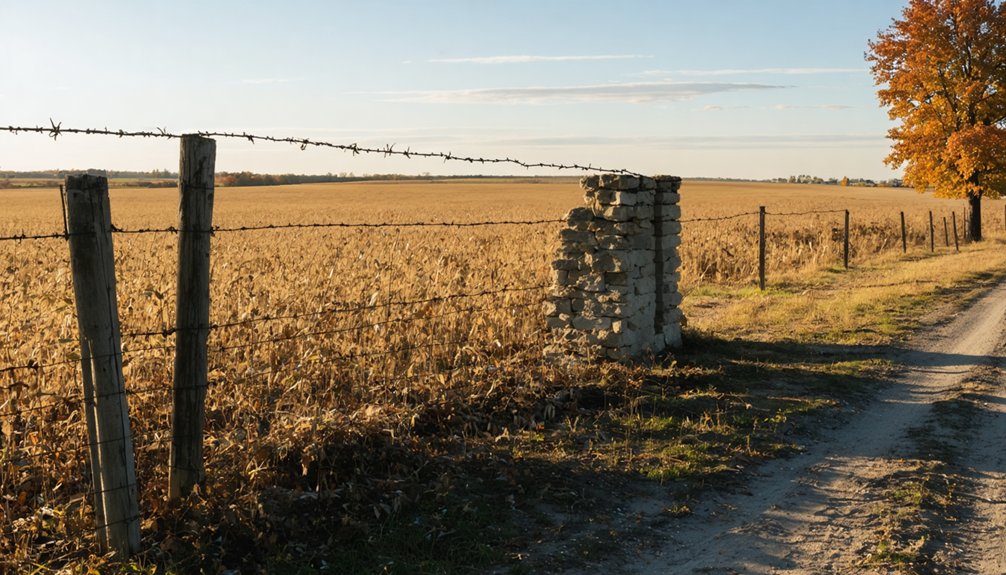
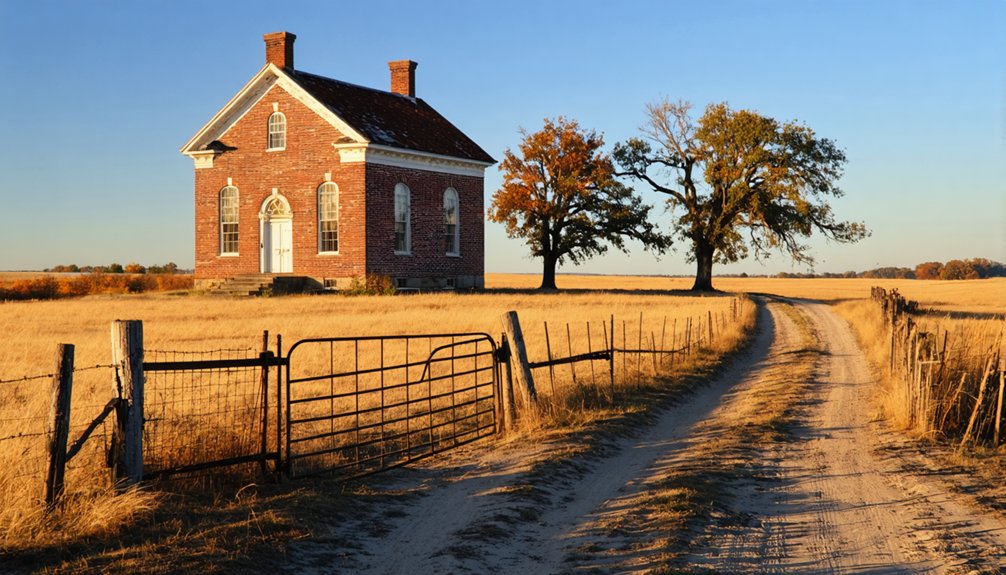
Time has swept away nearly every trace of Fremont, leaving behind only its name on historical records and the rolling farmland of St. Rose Township. You won’t find markers, foundations, or ruins—nothing signals a settlement once existed here. No preservation attempts by locals have emerged, likely because there’s little physical history left to protect.
The site lacks designated access points, so you’ll navigate unmarked county roads through private agricultural land. Respect property boundaries while exploring. Despite its complete vanishing, rumors of paranormal activity haven’t surfaced around Fremont, unlike other Illinois ghost towns. What you’ll discover instead is Illinois prairie reclaiming itself, where wind moves through crops that now occupy spaces where homes and businesses once stood. The absence itself tells the story.
Getting to Fremont: Directions and Coordinates for Your Visit
Since Fremont left no physical footprint behind, pinpointing its exact location requires working backward from Breese, the nearest town with actual infrastructure. You’ll find the historical significance of Fremont location lies eight miles north along IL-4, somewhere in St. Rose Township’s farmland expanse. No GPS coordinates exist, so you’re traversing old-school style.
Fremont exists only in memory now—eight miles north of Breese, hidden somewhere in St. Rose Township’s endless fields.
Your Route to Exploring the Fremont Ruins:
- From St. Louis: I-55 north to IL-4, east through Breese, continue eight miles north
- From Chicago: I-55 south to I-70 west, exit at IL-4 near Breese
- Fill your tank in Breese—last reliable services
- Travel only during daylight hours on unmarked township roads
- Bring county maps as backup navigation
This adventure demands self-reliance. The ghost town won’t announce itself with signs or markers—just open countryside where a community once thrived.
Other Abandoned Towns to Explore Near Fremont
While Fremont vanished without leaving architectural ghosts behind, central Illinois harbors dozens of abandoned settlements where you can actually walk among the ruins.
You’ll find Tuscumbia in Fulton County, marked by roadside signs pointing toward nothing but fields. Providence sits in section 23 of Bernadotte Township, where its preserved church and cemetery stand as evidence/proof/record/documentation to the historical significance of Providence in the region. These abandoned towns near Fremont reward explorers willing to venture off-grid.
Bennington operated its post office from 1823 to 1835 before disappearing completely. Poverty Ridge, built around a schoolhouse, once fed poverty-stricken travelers near Travis and Seville. Over in Macoupin County, Greenridge’s mining operations ceased in 1923, leaving 65 houses to decay along Route 66. Each site offers freedom from tourist crowds.
Why Illinois Ghost Towns Like Fremont Were Abandoned
Five forces conspired to erase towns like Fremont from Illinois maps, each one capable of killing a settlement on its own.
You’ll find these ghost towns scattered across Illinois, victims of circumstances beyond their residents’ control:
- Railroad routes bypassing settlements – When tracks curved away, prosperity followed, leaving entire communities stranded
- Mining industry collapse – Lead and coal deposits played out, forcing miners to abandon their claims and homes
- Natural disasters and floods – River shifts and devastating fires destroyed infrastructure overnight
- Entrepreneurial failures – Columbia died “while aborning” in 1834, unable to compete with better-financed neighbors
- Political squabbles – County seat relocations and administrative changes stripped towns of their government functions
These weren’t gradual declines—they were economic executions. Towns that thrived one decade vanished the next, their populations chasing opportunities elsewhere.
Combining Fremont With Buda and Other Living Ghost Towns

Understanding what killed these settlements helps you appreciate what you’ll actually find when you visit—which isn’t much in Fremont’s case. That’s why you’ll want to pair it with Buda in Henry County, where historic preservation efforts have maintained a living ghost town atmosphere. You’re driving through authentic rural community decline here—population under 500, but structures still standing.
Head southwest to Vishnu Springs in McDonough County, where the Capital Hotel sits on the National Register.
Then swing through Fulton County’s cluster: Tuscumbia offers valley views near Bernadotte, while Otto’s cemetery marks an 1845 settlement. String these together for a 200-mile loop that captures Illinois’s forgotten backbone. You’ll cover real ground where communities fought, failed, and sometimes survived.
Frequently Asked Questions
Are There Any Safety Concerns When Exploring Abandoned Ghost Town Sites?
Yes, you’ll face potential safety hazards including structural instability concerns from collapsing buildings and unstable ground. Stay on marked paths, avoid entering deteriorating structures, and watch for contaminated soil that can affect your health long-term.
What Time of Year Is Best for Visiting Illinois Ghost Towns?
Fall’s your perfect window—coincidentally when nature conspires with history. You’ll experience comfortable seasonal weather conditions while diverse natural landscapes explode in color around crumbling walls. Pack layers, embrace the freedom, and avoid winter’s brutal lockdown on these forgotten places.
Do I Need Permission to Access the Fremont Ghost Town Location?
No documented ghost town exists in Fremont, Illinois, so permission questions don’t apply. If exploring any historical Illinois sites, you’ll need private property access from landowners to avoid liability concerns and trespassing charges.
Are There Any Local Museums With Fremont Historical Artifacts or Photographs?
You’ll find Fremont’s weathered past preserved at Mundelein Heritage Museum, where pioneer photographs and township artifacts tell forgotten stories. The local historical society safeguards memories of abandoned buildings, while Dunn Museum displays broader Lake County treasures from Fremont’s vibrant era.
What Amenities Are Available Near Fremont for Food and Restrooms?
You’ll find diverse dining options within a mile, from Luigi’s Italian to Maya’s Mexican and Jimano’s Pizza. The Fremont Public Library offers public restroom facilities, while most restaurants provide their own for customers during your ghost town exploration.