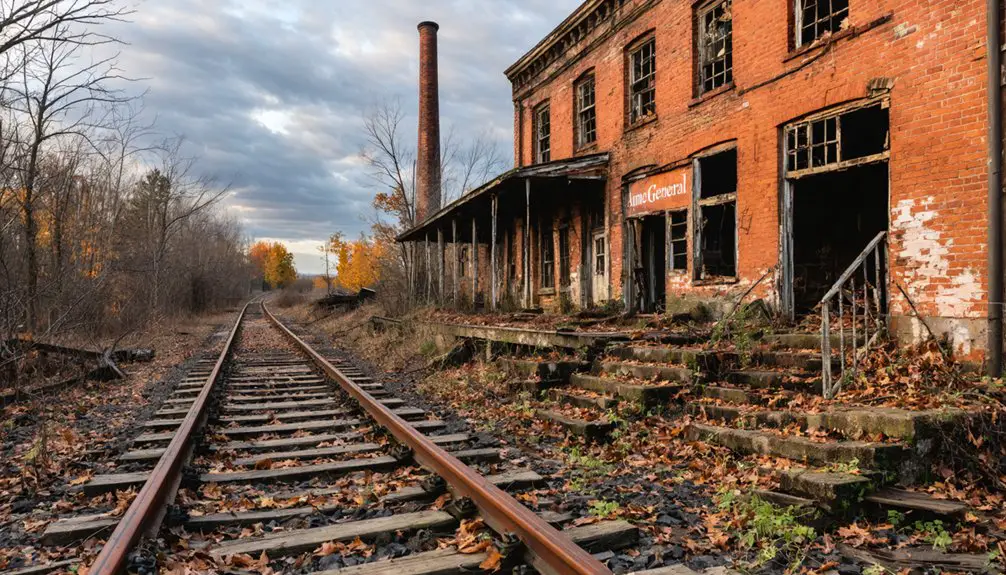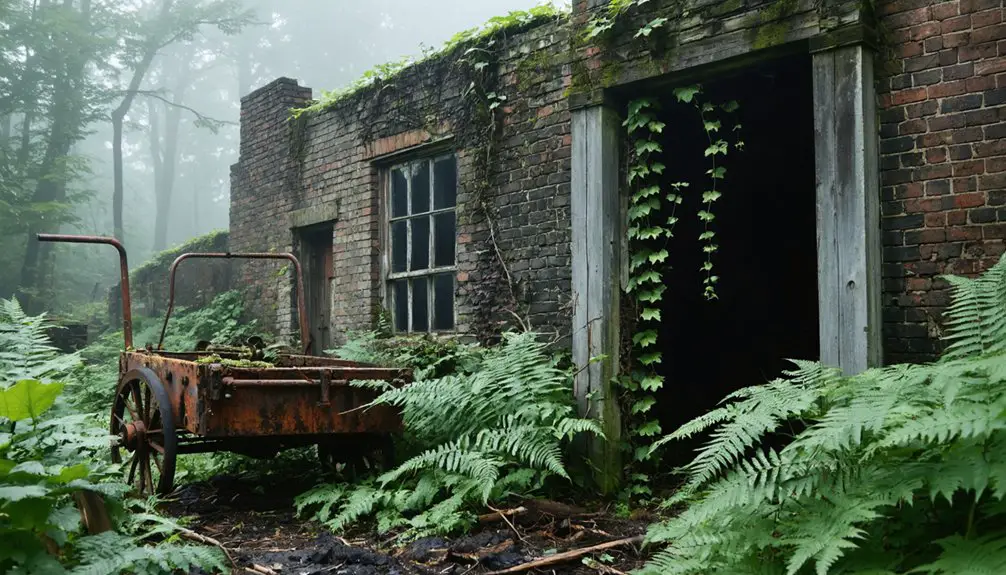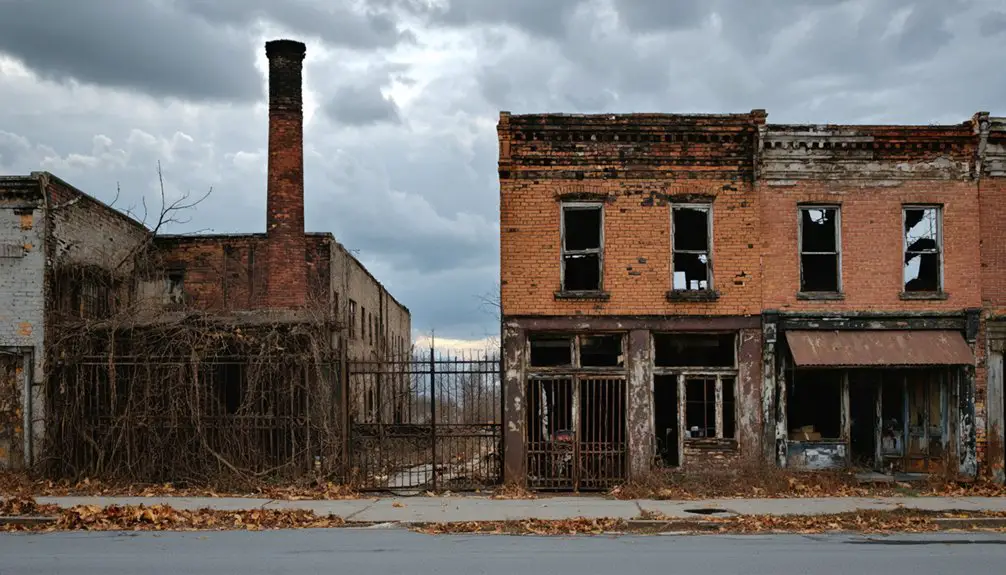
Navigate to coordinates 41.10600, -79.32290 in Salem Township, where nature’s reclaimed Frogtown’s beehive coke ovens and company houses amid rolling Appalachian terrain. You’ll find minimal structures standing—just weathered ruins telling stories of Pennsylvania’s coal heritage. Bring GPS navigation for unmarked trails, watch for uneven ground and mining hazards, and pack photography gear for dawn’s dramatic shadows. Extend your journey to nearby Centralia’s underground fire and Pithole’s oil boomtown remains, where America’s industrial ghosts whisper their cautionary tales across the landscape, revealing secrets buried beneath Pennsylvania’s forgotten coal country.
Key Takeaways
- Navigate to coordinates 41.10600, -79.32290 in Salem Township via Salem Gun Club Road, Bennett Drive, or Newrow Road.
- Use Salem Cemetery as a reliable landmark and GPS navigation for the unmarked, reclaimed terrain.
- Expect minimal structures, uneven ground, and mining hazards requiring self-reliance and appropriate safety gear.
- Visit dawn or dusk with tripod, versatile lenses, and flashlight for optimal ghost town photography.
- Combine with nearby Centralia Mine Fire and Pithole Oil Boomtown ruins for a comprehensive Pennsylvania ghost town experience.
Understanding Frogtown’s Coal Mining Heritage and Abandonment
When you stand along Dunbar Run Creek today, it’s hard to imagine the roar of Union Furnace #1 that once echoed through these hills. Colonel Isaac Meason’s ironworks sparked Frogtown’s transformation into the thriving community of Dunbar, where coke ovens blazed and bluestone quarries carved wealth from the earth.
By 1915, you’d have witnessed peak prosperity—Semet-Solvay ovens glowing orange against night skies, Pennsylvania Wire Glass Company‘s smokestacks piercing the horizon. But freedom from industrial overlords came at a price. The coal industry downturn arrived when seams played out by mid-century.
The decline of mining economy left crumbling oven ruins dotting abandoned patches. Those company-owned towns, once bustling with miners’ families, now stand empty—silent monuments to boom-and-bust cycles that defined Pennsylvania’s coal country.
Getting to Frogtown in Salem Township, Westmoreland County
Though Frogtown itself has faded into Pennsylvania’s ghost town roster, you’ll find its remnants at coordinates 41.10600, -79.32290 in Salem Township, Westmoreland County—about 50 miles northeast of Pittsburgh’s urban sprawl. The regional geography places you in rolling Appalachian terrain where coal once fueled communities that no longer exist.
Your transportation options follow winding backroads through Salem Township’s 47-square-mile landscape. Navigate via Salem Gun Club Road, Bennett Drive, or Newrow Road—these arteries connect forgotten settlements to civilization. MapQuest and GPS will guide you through the township’s network of rural routes like Sportsman Club Road and Walters Road. You’re traveling Eastern Time Zone territory where population density barely reaches 138 people per square mile. The Salem Cemetery marks where Frogtown’s story intersects with accessible ground—a tangible anchor point for your exploration.
What to Expect When Visiting This Western Pennsylvania Ghost Town
Your arrival at Frogtown’s coordinates reveals not a Hollywood-style ghost town with weathered storefronts and swinging saloon doors, but rather nature’s reclamation project. Trees and undergrowth have consumed whatever coal mining infrastructure once existed here. You’ll find minimal visible structures—this abandoned settlement has succumbed to decades of forest regeneration.
The absence of ghost town preservation efforts means conservation challenges have gone unaddressed, leaving Frogtown to disappear beneath Pennsylvania’s woodland canopy.
You’re fundamentally exploring unmarked terrain where a community once thrived. Bring GPS navigation, as trails aren’t maintained and landmarks are nonexistent. Wear sturdy boots for uneven ground and possible mining-related hazards hidden beneath vegetation.
This isn’t a curated attraction—it’s raw exploration requiring self-reliance and respect for private property boundaries.
Combining Your Trip With Nearby Centralia’s Underground Fire
After traversing Frogtown’s overgrown remnants, you’ll find a stark contrast just thirty miles east along Route 61. Centralia’s underground coal fire has transformed this borough into America’s most haunting ghost town since 1962.
You’ll witness the fire’s impact on local infrastructure firsthand—cracked highways, buckled pavement, and the permanently closed section of Route 61 now covered in graffiti. Steam vents pierce the ground, releasing sulfurous smoke that confirms the inferno still raging 300 feet below.
The visual effects of subsidence create an otherworldly landscape where sinkholes punctuate barren earth. Only eight residents remain among scattered buildings. Don’t trespass on private property, but you’re free to explore the abandoned highway. The fire’s expected to burn for centuries—nature reclaiming what civilization abandoned.
Adding Pithole’s Oil Boomtown Ruins to Your Route
At Pithole’s visitors center, you’ll find a detailed diorama and exhibits that bring the 500-day boomtown to life before you step onto the actual grounds where 15,000 people once lived. The mown street grid and interpretive panels guide you through what was Pennsylvania’s third-busiest post office, while hillside trails offer sweeping views perfect for photographing the pastoral landscape that swallowed an entire city.
Position yourself at the overlook points to capture the haunting contrast between the quiet fields and the scale model’s depiction of hundreds of derricks that once crowded these 90 acres.
Historic Museum and Trails
While Frogtown offers ghostly remnants of Appalachian coal country, a 90-minute detour northeast brings you to Pithole City’s vanished oil boomtown—a stark contrast where interpretive panels and grassy fields mark what was once Pennsylvania’s third-busiest post office.
The visitor center, operated since 1975, displays large-scale dioramas reconstructing the 1865-66 boom when 20,000 fortune-seekers crowded wooden streets. You’ll explore trails across 90 acres where the world’s first oil pipeline infrastructure once transported 2,500 barrels daily, transforming local economic impacts overnight.
No original structures survived the devastating fires and subsequent abandonment, but interpretive panels throughout the fields reveal where 54 hotels, theaters, and churches once stood. The Drake Well Museum manages this National Register site, preserving Pennsylvania’s most spectacular rise-and-fall story.
Best Photography Vantage Points
Since Pithole’s landscape today consists entirely of mowed paths through meadows and woodlands—with no standing structures to photograph—you’ll need to embrace a different compositional approach than traditional ruin photography. Available light conditions transform dramatically here throughout the day, with early morning fog creating ethereal atmospheres over the grassy streets.
Your strongest composition techniques will emphasize:
- Golden hour shooting along the forest edges where tree lines frame the former town layout
- Wide-angle perspectives capturing the emptiness where 15,000 residents once lived
- Ground-level shots highlighting interpretive markers against wilderness backdrops
- Overhead angles from elevated trail sections revealing the street grid pattern
- Seasonal shifts when autumn colors or winter snow accentuate the ghost town’s isolation
Let the landscape’s haunting absence tell Pithole’s story through your lens.
Other Abandoned Sites Worth Exploring in the Region
Beyond Frogtown’s forgotten streets, Pennsylvania’s landscape conceals dozens of abandoned communities frozen in time.
You’ll find Centralia’s smoke-shrouded highways where underground coal seams have blazed since 1962, creating an apocalyptic wasteland of buckled pavement and toxic vents.
Further west, Pithole’s oil boomtown stands as a grass-covered monument to America’s first petroleum rush, while Rausch Gap’s crumbling foundations emerge from the forest along a scenic rail trail through St. Anthony’s Wilderness.
Centralia’s Underground Coal Fire
Though Frogtown claims its own abandoned allure, the nearby ghost town of Centralia stands as Pennsylvania’s most notorious example of a community destroyed by forces lurking beneath the surface. Since 1962, an underground coal fire has consumed 3,700 acres of abandoned mine tunnels, creating a landscape where snow melts on winter sidewalks and toxic fumes seep through cracked earth.
What you’ll encounter:
- Buckled Route 61 with graffiti-covered asphalt
- Steam rising from ground fissures
- Sinkholes threatening unstable terrain
- Subsurface temperatures reaching 136°F
- Only 10 residents remaining from 1,500
Despite failed extinguishment attempts and a $42 million buyout, the fire could burn another 250 years. The environmental impact remains severe, with sulfurous gases and carbon monoxide poisoning the air. Potential resolutions never materialized, leaving this cautionary tale smoldering beneath Pennsylvania’s coal country.
Pithole Oil Boomtown Ruins
The skeletal remains of Pithole City pierce through farmland fifty miles north of Frogtown, where America’s first oil boomtown exploded into existence during summer 1865 and vanished just as spectacularly within five years. You’ll find interpretive markers where 15,000 fortune-seekers once crowded into 900 hastily-built wooden structures, creating Pennsylvania’s third-busiest post office behind Philadelphia and Pittsburgh. This population boom attracted Civil War veterans clutching their savings, desperate to strike black gold.
Walk the former street grid where oil derricks stood so close together that wagons couldn’t pass between them. Daily fires consumed wooden tanks and buildings until the devastating August 1866 blaze destroyed twenty-seven wells. When financier Charles Culver’s banks collapsed that March, triggering rapid economic collapse, 13,000 residents fled within months. Today, only foundation depressions remain.
Rausch Gap Mining Trail
Forty miles northeast of Frogtown, stone foundations mark where Rausch Gap’s thousand coal miners once lived and worked along the Schuylkill and Susquehanna Railroad. Founded in 1828 by Dr. Benjamin Kugler, this coal mining legacy thrived until economic decline factors—railroad relocation and exhausted mines—emptied the settlement by 1910.
Access the 21-mile Stoney Valley Rail Trail from Gold Mine Road, hiking 3.5 miles to the ruins:
- Explore crumbling coal breaker structures and named mine openings
- Discover concrete markers that once held spare track for repairs
- Locate hidden Rausch Gap Cemetery deep in the surrounding woods
- Follow acidic mine drainage still trickling down former rail corridors
- Trek two miles beyond to Cold Springs resort foundations
Tree-painted mile markers guide you through this wilderness reclamation, where nature swallows industrial ambition.
Essential Tips for Photographing and Documenting Ghost Town Remains
Before you venture into Frogtown’s crumbling structures with camera in hand, understanding the fundamentals of ghost town photography will transform your documentation from simple snapshots into compelling visual stories. Pennsylvania’s unpredictable weather conditions make dawn and dusk your allies—golden hour light creates dramatic shadows across weathered timber and stone.
Pack light: a sturdy tripod, versatile lenses, and a powerful flashlight for exploring darker corners. Shoot in manual mode with wide apertures (f/4 or lower) and experiment with 13-15 second exposures to capture Frogtown’s haunting atmosphere without star trails. Light painting techniques selectively illuminate architectural details while preserving authentic ambiance.
Careful documentation practices mean bracketing exposures for balanced interior-exterior shots and capturing signage, artifacts, and structural elements that tell Frogtown’s forgotten story.
Frequently Asked Questions
Is It Legal to Visit Frogtown and Explore Abandoned Structures?
You can legally visit Frogtown’s outdoor remnants, but entering abandoned structures requires traversing private property concerns and local trespassing laws. Always seek permission before exploring buildings, as unauthorized entry risks fines despite the town’s ghost-like allure beckoning adventurous souls.
What Supplies Should I Bring for a Full Day Ghost Town Trip?
Pack like you’re treasure hunting through time: portable power sources keep devices charged, a first aid kit handles scrapes, plus water, snacks, sturdy boots, flashlight, and layers. You’ll conquer crumbling corridors prepared for anything adventure throws your way.
Are There Any Guided Tours Available for Western Pennsylvania Ghost Towns?
Guided tours of remote ghost towns aren’t readily available in Western Pennsylvania. You’ll need to arrange private tours of historic mining sites through local historians like Bob Imhof, or venture independently into these forgotten settlements waiting beyond civilization’s reach.
What’s the Best Season to Visit Abandoned Coal Mining Towns?
Fall offers ideal weather conditions for exploring abandoned coal towns, with crisp air perfect for ghost town photography. You’ll capture dramatic autumn colors against crumbling structures, plus most mine tours remain open through October before winter closures.
Can I Camp Overnight Near Frogtown or Other Ghost Town Sites?
You’ll find limited overnight camping options directly at ghost town sites, but nearby public lands accessibility opens possibilities. State forests surrounding Pennsylvania’s abandoned communities offer dispersed camping where you can pitch your tent under starlit skies freely.