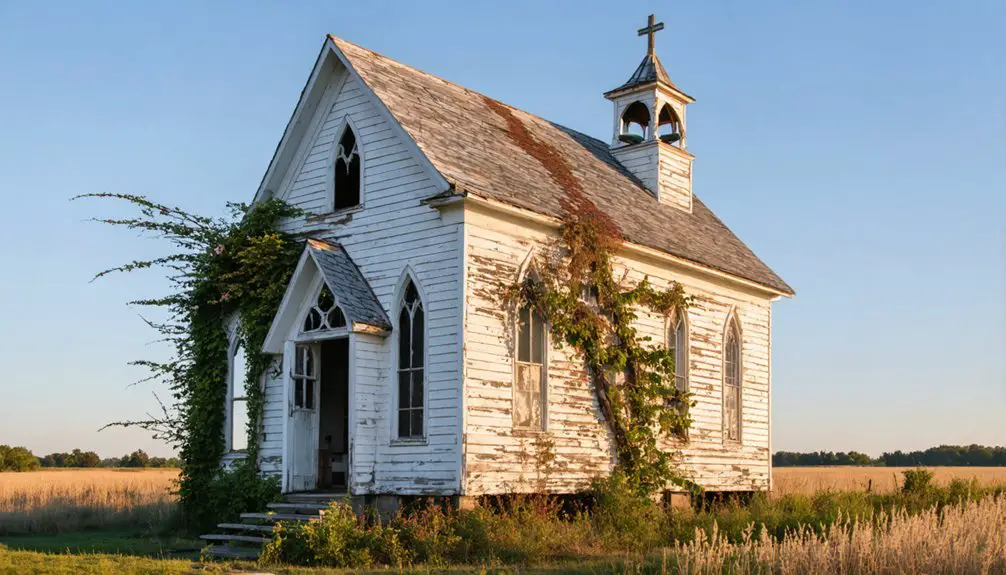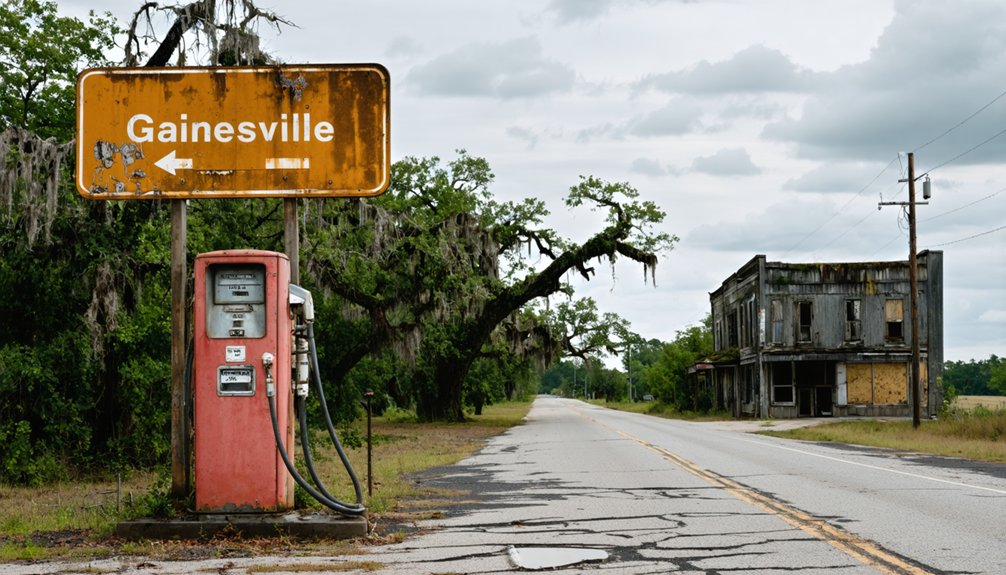
Your ghost town road trip to Gainesville, Mississippi, requires advance planning since NASA’s Stennis Space Center now occupies the site where this once-thriving lumber and river commerce hub stood for 150 years. You’ll need to contact the facility for access permissions to explore where James Copeland’s notorious gang once operated and the Poitevent-Favre lumber empire employed over 150 workers. While visiting, you can also explore nearby ghost towns like Rodney, Logtown, and Napoleon for an extensive journey through Mississippi’s vanished communities and their fascinating histories.
Key Takeaways
- Gainesville is located in Hancock County within the Stennis Space Center buffer zone, requiring advance clearance for access.
- The town was razed in 1961 by NASA; no original structures remain, only wilderness and historical markers.
- Nearby ghost towns include Logtown, Napoleon, and Santa Rosa, offering additional exploration opportunities within the region.
- Gainesville thrived 1810-1961 as a lumber and cotton trade center and headquarters for the notorious James Copeland Gang.
- Plan visits during Stennis Space Center public tour days or contact facility management for special access permissions.
The Rise and Fall of a Pearl River Boomtown
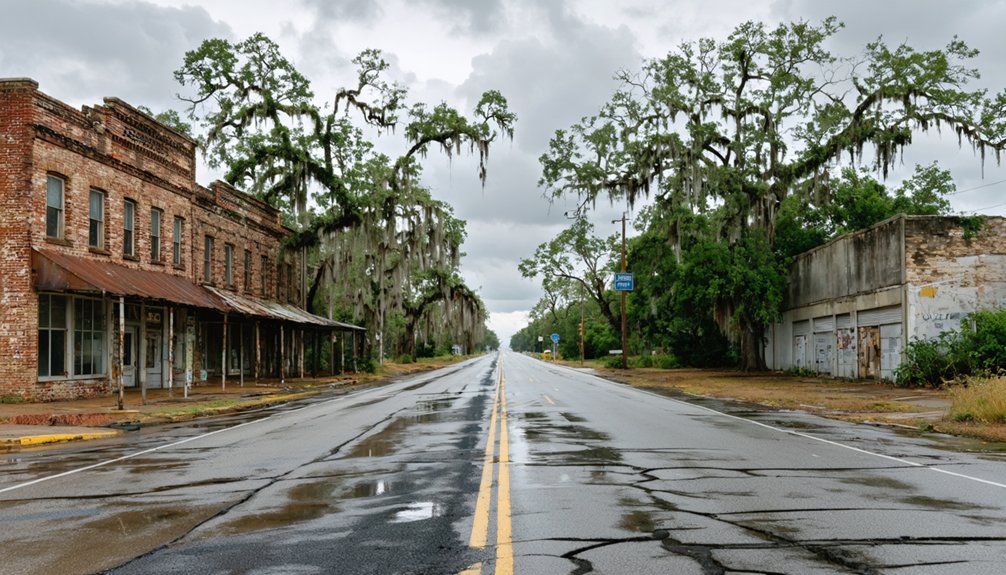
Around 1810, settlers carved a new town from the wilderness atop a commanding bluff overlooking the Pearl River. Gainesville quickly became Hancock County’s seat, drawing families from the Carolinas during the 1820s who navigated treacherous swamps to claim their stake.
The town thrived on lumber and cotton, with the Poitevent-Favre mill dominating Pearl River’s timber trade and producing thousands of board feet. Antebellum economic conditions fueled prosperity through shipbuilding and river commerce, supporting downriver settlements like Logtown and Napoleon.
Yet nothing lasts forever. The 1853 courthouse fire destroyed irreplaceable records, foreshadowing decline. When the county seat shifted to Bay St. Louis, Gainesville’s fate was sealed. In 1961, NASA acquired the land for Stennis Space Center’s buffer zone—environmental impact assessments be damned—and razed every structure, erasing this boomtown from Mississippi’s landscape.
James Copeland’s Pirate Gang and Outlaw Legacy
You’ll find Gainesville’s darkest chapter intertwined with James Copeland, whose notorious gang used this boomtown as a base for terrorizing the region between Mobile and New Orleans throughout the 1830s and 1840s.
From these headquarters, Copeland’s clan orchestrated elaborate crimes—stealing slaves by promising freedom at revivals before selling them at distant auctions, hijacking flatboats laden with goods, and burying vast quantities of stolen gold throughout south Mississippi.
His 1857 hanging on the banks of the Leaf River drew tremendous crowds, and his deathbed confession to Sheriff Pitts became an immediate bestseller that immortalized Mississippi’s most violent outlaw legacy.
Copeland’s Gainesville Headquarters Operations
Between the pine forests of southern Mississippi and the swamps of coastal Alabama, James Copeland and his co-leader Gale H. Wages commanded their notorious clan from Gainesville’s strategic position. You’ll find this area served as their nerve center, where gang member roles were carefully assigned across a criminal empire stretching from the Chattahoochee River to San Antonio.
Wages recruited Copeland after the family sought his counsel on legal troubles, forging a partnership that would terrorize the Gulf South throughout the 1830s and 1840s. The organization’s structure allowed for sophisticated criminal money laundering, with clan members holding prominent positions in Mobile and surrounding communities. Their operations masked livestock theft, slave trafficking, and counterfeiting behind facades of respectability, making Gainesville the perfect headquarters for their illicit enterprise.
Notorious Gang Activities
From this Gainesville headquarters, the Copeland Clan triggered a reign of terror that stretched across three states and transformed common criminality into organized chaos. You’ll discover how their notorious clan tactics included livestock and slave theft, counterfeiting, flatboat hijacking, and cold-blooded murder.
They torched Mobile’s west side, then looted the east during the pandemonium. When lawmen closed in, they vanished through water hideouts and boat slips.
The violent clan incidents reached their peak on July 15, 1848, when James Harvey died in a Red Creek gun battle—revenge for killing Wages’ son. With sixty members operating from the Chattahoochee to San Antonio, they plundered stagecoaches and targeted roadside taverns, accumulating fortunes from travelers who’d learned never to trust banks.
Mississippi Outlaw History Impact
When James Copeland swung from the gallows on October 30, 1857, along the Leaf River banks outside Augusta, a tremendous crowd watched the 34-year-old outlaw’s final moments—but his legend was just beginning. Sheriff Pitts published Copeland’s jailhouse confession in 1858, creating an immediate sensation that detailed decades of violence across the frontier.
The cultural legacy of gang operations stretched from Mobile Bay to Lake Pontchartrain, where Copeland’s name became synonymous with terror throughout the 1830s-1840s. While history books largely ignored their impact, locals preserved the outlaw mystique through Depression-era WPA accounts and persistent rumors of Copeland clan treasure troves—including $30,000 in buried gold and silver hidden somewhere in south Mississippi’s wilderness, awaiting discovery by those daring enough to search.
The Lumber Empire That Built Gainesville
The Poitevent and Favre lumber empire rose from the forests of coastal Mississippi to become an industrial powerhouse that transformed the region. By 1870, their massive operation employed over 150 workers, cutting timber that built railroads stretching to Mobile and New Orleans. You’ll discover they owned 95,000 acres across Hancock County and Louisiana, producing 40 million board feet annually—the South’s largest output.
Their lumber infrastructure investments included schooners, tugboats, and the East Louisiana Railroad, which hauled 1,000 logs daily. The Hancock County lumber trade peaked when their 1890 mill, nicknamed “Big Jim,” cut 200,000 board feet per day. Yet this empire proved fleeting—longleaf pines disappeared rapidly, forcing closure by 1930 after harvesting forests faster than nature could replenish them.
What the 1820s Travel Journals Reveal
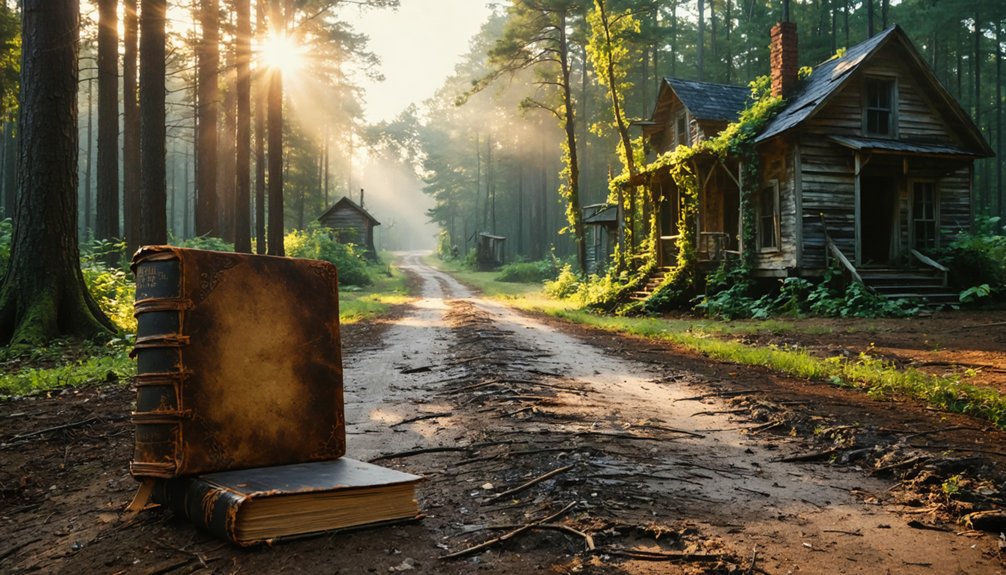
You won’t find Gainesville mentioned in the 1820s travel journals that documented Mississippi’s wilderness—those expeditions focused on major waterways like the Pearl River and Mississippi River corridors. The Russ family and other early settlers left no grand narratives of their migration, only scattered land purchase records and the physical traces of their daily struggle through mosquito-thick swamps and uncharted pine forests.
What survives instead are the practical details: surveyor’s notes, property deeds, and the silence between documented French camps of 1732 and the timber operations that would rise decades later.
Russ Family Migration Route
Departing from Shallotte, Brunswick County, North Carolina, at three o’clock on a February 18th evening, the Russ family began an arduous 55-day trek that would carry them southwest through the remnants of Indian territory and across the swollen rivers of the Deep South. Their route took them through Columbia, Georgia, where they encountered numerous Indians on March 18th, then across the Chattahoochee on a toll bridge.
Family dynamics shifted with brother Samuel’s arrival near Pearlington on April 14th. Pioneer hardships mounted with each river crossing—Doles Ferry over the Alabama, then the Tombigbee—while toll costs drained precious resources. The journey’s 16-mile first day to Little River stretched into weeks of traversing Georgia’s hills and Alabama’s waterways, following ancient traces carved by earlier migrants seeking Mississippi’s promise.
Daily Journey Through Swamps
While the Russ family pushed through overland trails and toll bridges, other 1820s travelers documented a parallel world of aquatic wilderness. John James Audubon’s 1820 Mississippi journey reveals what you’ve lost—an abundance of wildlife so staggering he’d kill thirty partridges before breakfast.
You’d have drifted past miles of bamboo cane habitats tangled with smilax vines, now virtually extinct. Prothonotary warblers flashed gold through cypress swamps where ivory-billed woodpeckers hammered ancient trees. Swans, cranes, and herons crowded every bend.
Audubon’s boat caught sixty-four-pound catfish while sea gulls swarmed the offal he tossed overboard. This wasn’t pristine wilderness—it was Eden before we paved it. The canebrakes disappeared. The birds vanished. Only journals remain.
Early Settlers’ Land Purchases
Land fever gripped the Mississippi Territory after the War of 1812, and by 1820 you’d have watched speculators and settlers alike scramble for deeds along the Pearl River’s navigable waters. Eliza Ripley secured Claim #24 that year, while Joseph Favre locked down Claim #31. Samuel White purchased directly from Nathaniel Hide, bypassing government auctions altogether.
The land surveys followed the 1796 Land Ordinance framework, creating systematic patent descriptions that transformed wilderness into property. Elihu Carver’s 100-acre patent #941 exemplified these precise divisions. You’ll notice earlier claims like Charlo’s 1781 holding predated American control entirely.
How NASA Erased a Mississippi Town

When NASA selected Hancock County for its Mississippi Test Facility, the space agency’s ambitions collided with a reality that couldn’t be bargained away: rocket engines powerful enough to launch men to the moon would produce ungodly noise.
You’ll discover that NASA needed 125,000 acres as an acoustical buffer zone—land that wasn’t empty. Beginning in May 1963, the U.S. Army Corps of Engineers acquired properties through purchases or perpetual easements, initiating the dismantling of a community that had stood for generations.
The social impacts of site selection were profound: homes, schools, churches, and stores vanished to make way for Saturn V testing. By 1966, when the first stage rattled the earth, Gainesville had become Mississippi’s newest ghost town—sacrificed for humanity’s giant leap.
Unlike the vanished town that once welcomed neighbors without question, today’s Stennis Space Center operates as a high-security federal facility where spontaneity meets the full weight of post-9/11 protocols. You’ll need REAL ID-compliant identification just to approach the gates at South Gate or North Gate reception centers. Forget casual exploration—every visitor requires NASA employee sponsorship and advance registration.
The visitor check in procedures demand government-issued photo ID for vehicle occupants, with inspections conducted at entry points. Foreign national clearance requirements prove even more restrictive, requiring Form SSC-776 submission thirty to ninety days before arrival.
The irony cuts deep: where Gainesville residents once moved freely, you’ll now find virtual tours replacing actual access, security checkpoints guarding emptiness, and bureaucracy protecting what federal power claimed.
What Remains at the Historic Site Today
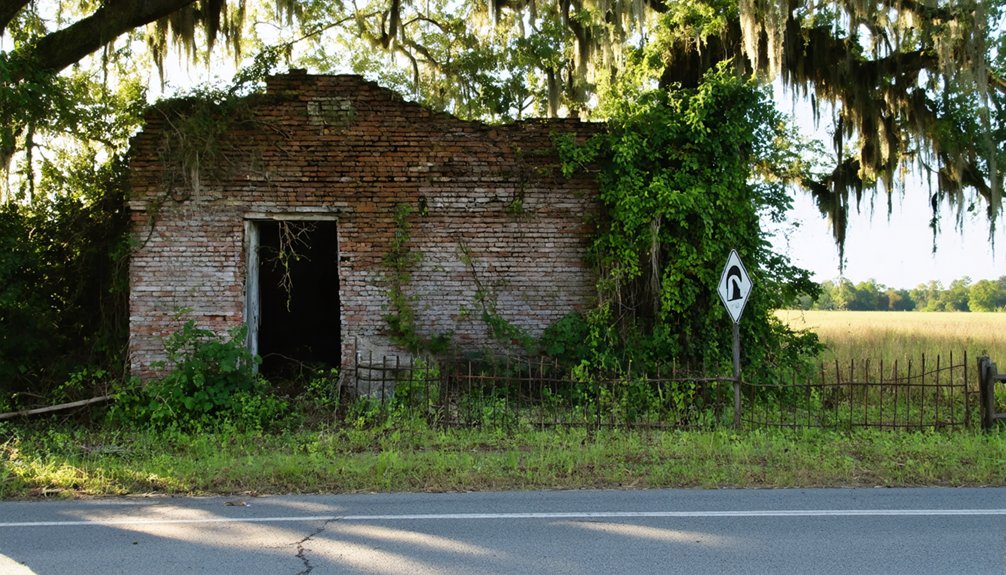
Where Gainesville’s courthouse once anchored a thriving river town of steamboat landings and sawmills, forests now reclaim the land with suffocating silence. You’ll find few graveyard headstones scattered among cleared patches—remnants of 483 graves reinterred when NASA seized this ground. The iconic Gainesville pine tree stands defiant, but no streets, buildings, or wharves survive the government’s bulldozers.
Cemetery monument preservation exists only through Hancock County Historical Society records, not physical markers. You won’t discover interpretive signage explaining what vanished here—no plaques memorializing the 700 displaced families or the vibrant community erased for rocket testing. Behind federal security gates, nature’s conquest feels complete. This isn’t preservation; it’s erasure dressed as progress, accessible only to those willing to navigate bureaucratic barriers for glimpses of America’s forgotten.
Nearby Ghost Towns Worth Exploring
Gainesville’s story echoes across Mississippi’s landscape, where other communities met similar fates through war, economic collapse, and government intervention.
You’ll find Bankston in Choctaw County, where Union forces torched Confederate supply factories in 1864, leaving only a cemetery.
Electric-Mills in Kemper County showcased early settlement patterns with Mississippi’s first electric sawmill, supporting 1,000 residents before shuttering in the 1950s.
Brewton’s courthouse basement still stands after outlaw James Copeland burned the town.
Rodney lost its railroad connection, then its official status under Governor Bilbo—today just thirteen souls remain.
Logtown disappeared for NASA development, though Pawsum Walk Trail connects you to graves dating to 1868.
These ruins reveal economic decline factors that transformed thriving communities into silent monuments.
Essential Tips for Your Mississippi Ghost Town Adventure

Before you venture into Mississippi’s forgotten settlements, you’ll need practical knowledge that separates memorable exploration from dangerous misadventure. Ghost town accessibility challenges demand respect—Commerce Street’s crater-sized potholes can trap vehicles, while alternating blacktop and dirt roads become impassable quagmires after rain.
Winter visits offer your safest window, avoiding summer’s peak snake activity. Cemetery exploration cautions aren’t suggestions—they’re survival essentials. Wear closed shoes and long pants on overgrown trails where annual snake bites occur. The steep path to Rodney’s three-acre graveyard becomes treacherous amid fallen tombstones and dense vegetation.
Travel with companions since cell service doesn’t exist in these remote woodlands. Navigate during daylight hours when you can spot remnant curbs and crumbling structures. Freedom means calculated risk, not recklessness—prepare accordingly for Mississippi’s haunting backroads.
Frequently Asked Questions
Are There Any Hotels or Campgrounds Near the Gainesville Ghost Town Site?
You’ll need to explore nearby towns for pet friendly accommodations and local bed & breakfasts, as Gainesville’s ghost town status means no facilities exist on-site. Your closest options require some driving, but they’re worth the adventure ahead.
Can I Bring Metal Detectors to Search for Artifacts at Gainesville?
No, you can’t bring metal detectors to Gainesville. It’s restricted NASA federal property where artifact removal is prohibited. Use caution and consult local authorities. Instead, join Hancock County Historical Society’s organized digs for legitimate exploration opportunities.
What’s the Best Time of Year to Visit Mississippi Ghost Towns?
Spring season offers ideal weather conditions with temperatures dropping from summer’s 90°F average to comfortable 70s. You’ll explore freely without oppressive humidity, enjoying mild days perfect for wandering abandoned sites and discovering Mississippi’s forgotten histories at your own pace.
Are There Restaurants or Gas Stations Near Stennis Space Center?
You’ll find INFINITY Cafe on-site at Stennis, plus chain restaurants like Applebee’s and Waffle House nearby. While restaurant hours vary, nearby convenience stores aren’t specifically documented—you’ll want to research current fuel options before your ghost town adventure.
Do I Need Special Permits to Photograph at the Historic Site?
Want to capture history freely? You won’t need permits for personal snapshots at Gainesville’s ruins. Permission requirements only apply to professional shoots. Keep photographic considerations simple—just bring your camera and respect the site’s accessibility for fellow explorers.