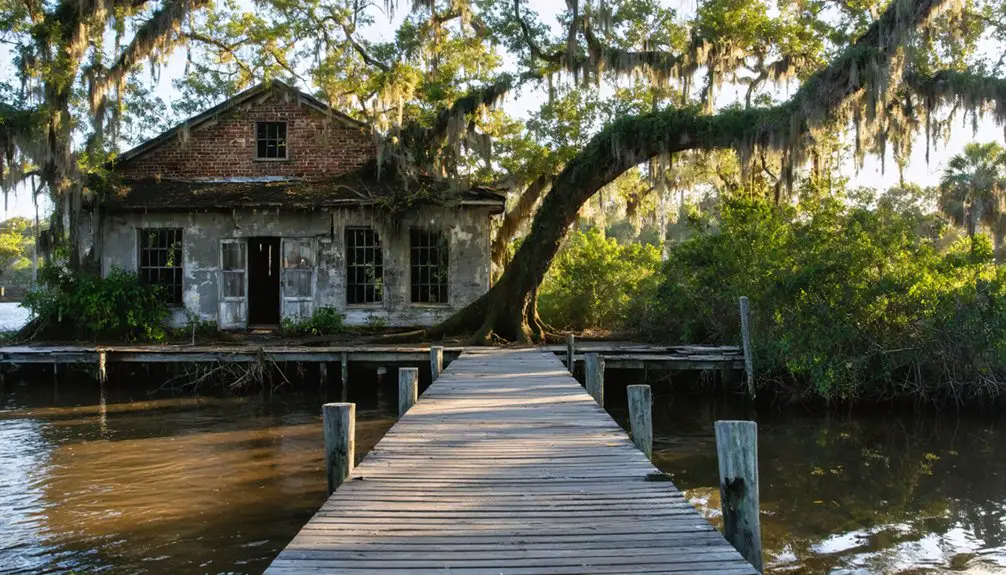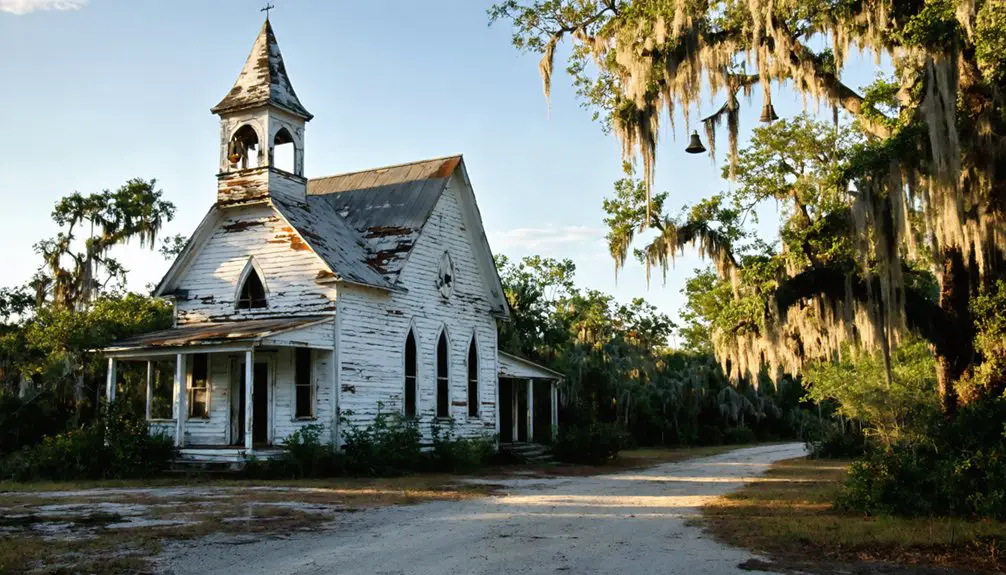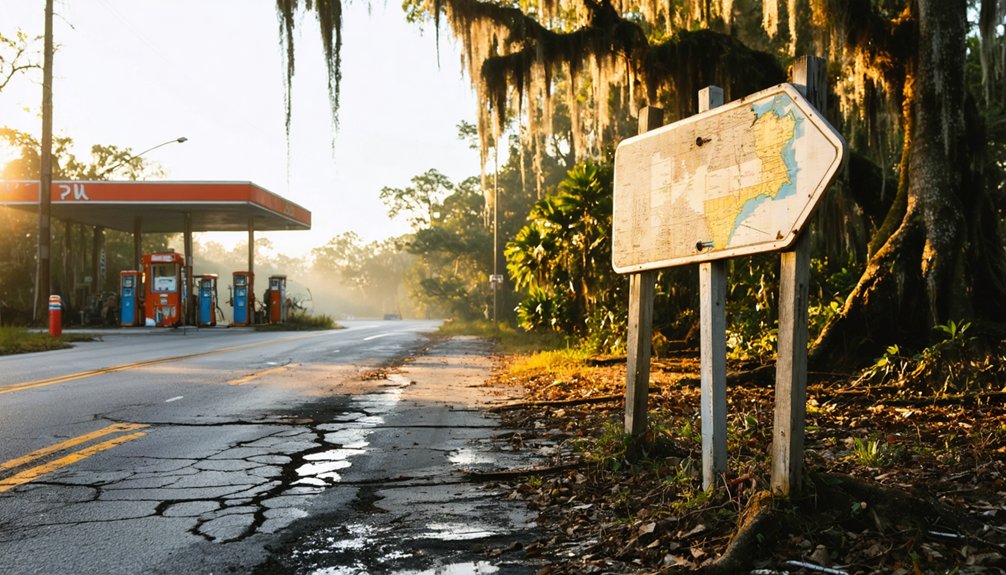
You’ll find Gaiter’s weathered remnants off Route 200 in Marion County, accessible via a narrow dirt entrance into a private hunting preserve near Cedar Grove Methodist Church. The journey requires a capable vehicle, proper permissions, and respect for seasonal restrictions, but rewards you with pioneer cemetery headstones dating to the 1880s, a hand pump well, and the skeletal church rebuilt in 1936. Adjacent Halpata Tastanaki Preserve offers 17 miles of trails connecting you to the Withlacoochee River country that once sustained this vanished turpentine town’s brief existence.
Key Takeaways
- Access Gaiter via Route 200 westbound to a narrow dirt entrance at coordinates 29.008539723476193, -82.34334402883613 requiring a capable vehicle.
- Secure hunting preserve permissions before visiting, as seasonal access restrictions apply to the private land protecting Gaiter’s ruins.
- Explore Cedar Grove Cemetery and rebuilt 1936 church to see pioneer headstones and a hand pump well documenting 1880s settlement.
- Visit the Drake family ranch to view the preserved wooden post office building, which closed in 1928 after 39 years.
- Combine your trip with Halpata Tastanaki Preserve’s 17 miles of trails, Withlacoochee River access, and restored wetlands habitat nearby.
Getting to Gaiter: Routes and Access Points
Finding Gaiter requires traversing a web of dirt roads and hunting preserve gates west of Ocala, where this Marion County ghost town lies hidden at coordinates 29.008539723476193, -82.34334402883613. You’ll navigate Route 200 westbound until reaching the preserve’s narrow dirt entrance—bring a capable vehicle.
The access road winds through dense woods before reaching a gate near Cedar Grove Methodist Church and Cemetery at 13525 SW 147th Lane, Dunnellon. Since the site sits within an active hunting preserve bordering Halpata Tastanaki Preserve, you’ll face seasonal access restrictions. Research prohibited activities beforehand and secure proper permissions.
The Withlacoochee River region’s protected status preserves this tranquil relic, but demands respectful navigation. Your coordinates will prove essential—miss them, and you’ll bypass history entirely.
What Remains: Historic Structures and Landmarks
Few tangible traces of Gaiter survive today, yet those that endure speak volumes about the pioneer spirit that once animated this forgotten settlement. You’ll discover Cedar Grove Methodist Church, rebuilt in 1936 after fire destroyed the original, standing silent alongside its adjoining cemetery where stone markers honor pioneer families.
The hand pump well history reveals self-sufficient infrastructure that sustained daily life, now preserved as a marker of community resilience. Pine level school significance extends beyond education—it merged with Cedar Grove, becoming central to social activities and town identity.
These remnants rest within a hunting preserve off Route 200, where protective boundaries prevent further decay. You’re free to explore this tranquil preserve, walking through gates that open onto forgotten memories.
Cedar Grove Cemetery: A Walk Through Pioneer History
Beyond the wooded gate off Route 200, Cedar Grove Cemetery emerges from the wilderness like a whispered secret of Florida’s pioneer past. This tranquil burial ground within Halpata Tastanaki Preserve tells stories through weathered stone markers, each recording the lives of families who carved civilization from untamed land.
The cemetery’s significance extends beyond memorialization:
- Stone markers document births, deaths, and struggles from the 1880s settlement boom
- Physical connection to Camp Izard, Stokes Ferry, and merged Cedar Grove communities
- Original church site hosted community social gatherings, weddings, and meetings before the 1935 fire
- Hand pump well nearby evokes daily pioneer routines and shared labor
You’ll find this sacred ground remains active despite Gaiter’s ghost town status—a legacy to continuity linking past settlers to today’s wanderers seeking authentic historical connections.
The Rise and Fall of a River Settlement
The natural resource impacts drove everything. Turpentine production and logging sustained businesses while farms flourished.
But when the post office closed in 1928 after thirty-nine years, Gaiter’s pulse stopped. The Drake family’s ranch, passed through four generations since the 1870s, now guards the old wooden post office building.
You’ll find these remnants protected within a hunting preserve off Route 200—silent witnesses to a once-vibrant settlement.
Nearby Attractions and Halpata Tastanaki Preserve
While Gaiter faded into memory, the surrounding wilderness gained new life through conservation. The 8,171-acre Halpata Tastanaki Preserve now protects the lands where settlers once carved out homesteads. Named for Seminole Chief Alligator, this Southwest Florida Water Management District property showcases successful wildlife habitat restoration, with 150 acres of wetlands revitalized in 2010.
You’ll find exceptional river recreational opportunities throughout the preserve’s diverse terrain:
- 17 miles of multiuse trails winding through longleaf pine sandhills
- Five miles of Withlacoochee River frontage for fishing
- Florida National Scenic Trail access at Pruitt Trailhead
- Archaeological sites from the Second Seminole War era
The preserve’s oak scrub supports threatened Florida scrub-jays, while its floodplain swamps remain wild and untamed—nature’s reclamation complete.
Frequently Asked Questions
Is Permission Required to Visit the Drake Ranch Property?
You’ll need permission since property ownership status remains unclear and Florida’s trespassing laws are strict. Don’t risk legal trouble—contact the county assessor’s office first to identify owners and secure access before exploring this ghost town territory.
What Supplies Should I Bring for a Day Trip?
Bring water (ensure adequate hydration), bug spray, sturdy boots, sunscreen, and pack sufficient snacks. You’ll need long sleeves, a first aid kit, charged phone, and camera for documenting this remote preserve’s historic ruins and untamed wilderness.
Are There Guided Tours Available for the Ghost Town?
No guided tours availability exists at Gaiter Ghost Town currently. You’ll find no tour company recommendations for this remote site. Instead, you’re free to explore independently, traversing the hunting preserve and historic landmarks at your own adventurous pace.
Can I Take Photographs Inside the Historic Buildings?
Photography policies aren’t publicly specified for Gaiter’s interiors. You’ll need to obtain local photography guidelines from preserve management first. Respect historical preservation by avoiding tripods and flash that could damage Cedar Grove Church’s 1936 reconstruction and artifacts.
What Is the Best Time of Year to Visit?
Spring offers ideal weather conditions for exploring Gaiter’s ruins, with comfortable temperatures and blooming wildflowers. You’ll avoid popular tourist seasons and hunting restrictions while enjoying accessible trails and perfect photography light before summer’s oppressive heat arrives.