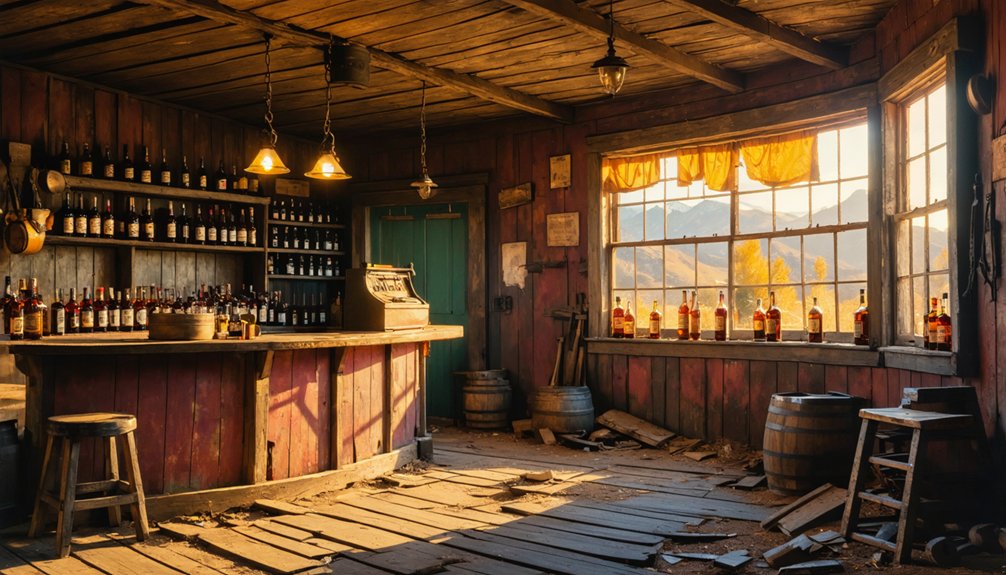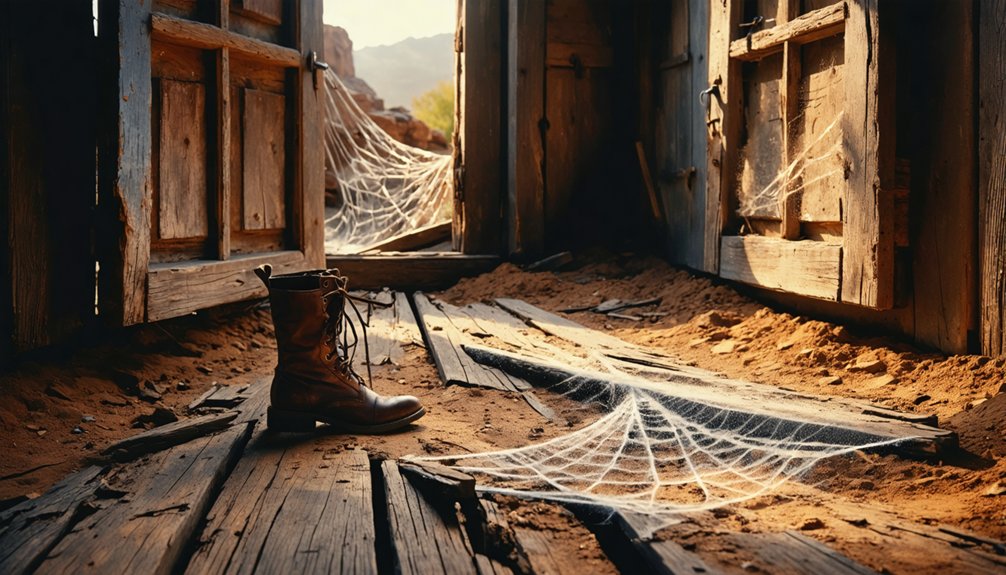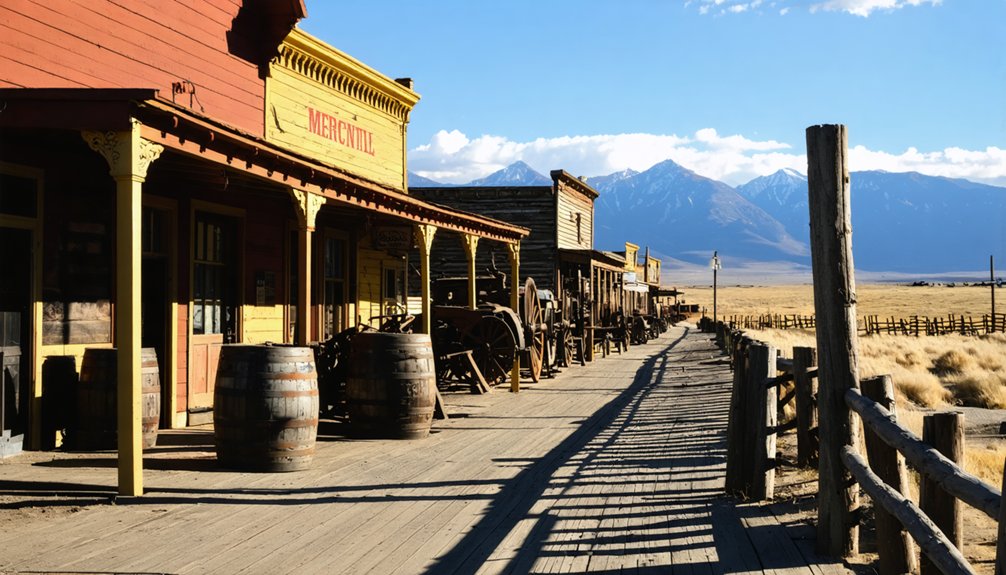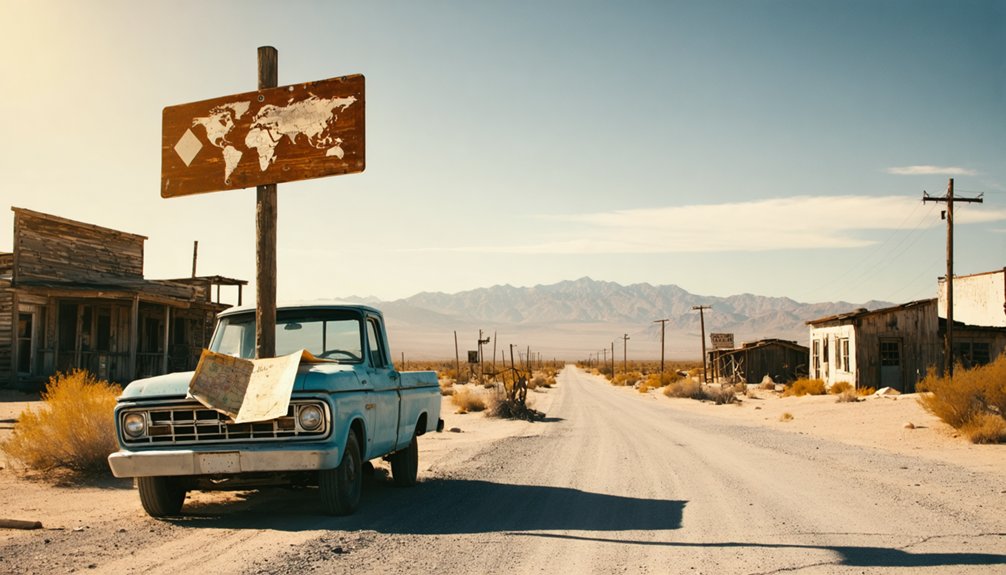
You’ll want to plan your Gamba ghost town adventure for winter months, taking Route 14 north from Los Angeles in a high-clearance vehicle. Pack two gallons of water per person and fuel up in Mojave—your last reliable stop before hitting unmaintained dirt roads. Arrive before 12:30 PM to explore the weathered structures, wild graffiti, and authentic mining relics in solitude. The multicolored Calico mountains create an unforgettable backdrop for this remarkably intact 1880s boomtown, and there’s plenty more to discover about its fascinating past.
Key Takeaways
- Take California State Route 14 north from Los Angeles or Highway 58 east from Bakersfield with a high-clearance vehicle.
- Visit December through February for ideal weather and arrive before 12:30 PM to avoid crowds.
- Fuel up in Mojave and pack two gallons of water per person before traveling unmaintained dirt roads.
- Explore six main houses, mining relics in Maggie Mine’s tunnel, and multicolored Calico mountains.
- Check Caltrans reports before departure and attend October’s Ghost Haunt event for haunted attractions.
What Makes Gamba a Hidden Gem Among California Ghost Towns
The moment you spot Calico’s multicolored mountains rising from the Mojave Desert, you’ll understand why this ghost town earned its name—and why it’s captured imaginations for over 140 years. Unlike the nearly 300 abandoned California mining camps left to crumble, Calico stands restored yet genuine.
You’ll walk past authentic mining relics in the Maggie Mine’s 1,000-foot tunnel, where blacklight reveals hidden minerals. The town’s intriguing historical figures—from Confederate spy Annie Kline Townsend to California governors Robert Whitney Waterman and Henry Harrison Markham—add layers to your exploration. Original schoolhouse visits happen during Saturday night ghost tours.
Five unrestored structures remain untouched, while architecturally faithful restorations let you experience an 1880s boomtown without sacrificing accessibility or authenticity.
Getting to Gamba: Routes and Driving Directions
While most ghost town adventures begin with a simple Google Maps search, reaching Gamba demands old-school navigation skills and a spirit of discovery—this abandoned Kern County settlement doesn’t appear on modern GPS systems. You’ll navigate California State Route 14 north from Los Angeles through Mojave Desert terrain, with alternative routes via Highway 58 east from Bakersfield offering straighter approaches. The final stretch requires high-clearance vehicles on unmaintained dirt roads prone to sand drifts.
Essential driving precautions include fueling up in Mojave—your last reliable stop before venturing 50 miles into isolation. Pack two gallons of water per person for potential breakdowns in triple-digit heat. Check Caltrans reports for sandstorm closures, and travel during daylight hours when desert highways lack lighting and cell service vanishes completely.
Best Time of Year to Visit Gamba
Once you’ve plotted your route through the Mojave’s washboard roads, timing becomes your next consideration—and Gamba’s unforgiving desert climate doesn’t forgive poor planning. The ideal winter visit runs December through February, when 70°F sunshine replaces summer’s blast-furnace heat. You’ll beat the crowds arriving before 12:30PM, experiencing the ghost town’s eerie solitude as it was meant to be felt.
Seasonal event highlights worth planning around:
- October’s Ghost Haunt transforms the town with haunted attractions and Wild West Halloween shows
- Spring’s unpredictable mud after desert rains can strand vehicles on unmaintained roads
- Summer evenings offer extended hours for star walks and ghost stories
- Fall shifts bring changing park hours mid-October, closing at 5PM instead of 6PM
The park closes only Christmas Day, leaving 364 opportunities for your desert escape.
What Remains: Structures and Ruins to Explore
Little prepares you for Gamba’s surreal landscape where art colonizes abandonment—a post-apocalyptic dreamscape 223 feet below sea level that’s morphed into California’s strangest outdoor gallery. You’ll wander through six main houses in various destruction stages, from collapsed wood piles to partial rooms still standing.
Unique art installations transform every crumbling structure—wild graffiti sprawls across weathered walls while quirky sculptures rise from the sand. The old dock extends toward receding brownish waters littered with bones and debris. One house substantially remains, its antique lightboxes still connected.
Wind and weather constantly reshape the ruins, so each visit reveals different configurations. The Community Cafe and Ski Inn represent sustainable community projects where resident artists gather, converting forgotten spaces into thought-provoking canvases that celebrate decay’s strange beauty.
The History Behind Gamba’s Rise and Abandonment
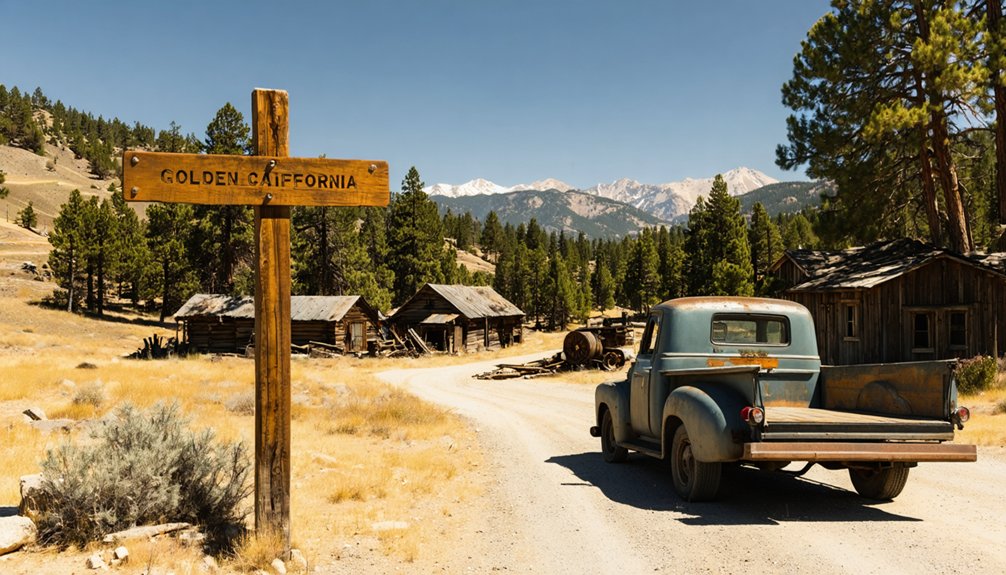
You’ll find Gamba’s story mirrors dozens of California settlements that exploded overnight when prospectors struck pay dirt in the surrounding hills. The town swelled with miners, merchants, and families chasing fortune, only to empty just as quickly when the ore ran out and paychecks stopped coming.
What you’re walking through now are the skeletal remains of that boom-and-bust cycle—weathered wood and rusted metal marking where hope once thrived before economics forced everyone to pack up and leave.
Mining Boom Era Origins
While California’s Gold Rush officially exploded in 1848 when James W. Marshall spotted flakes in Sutter’s Mill tailrace, you’ll discover that gold fever had already touched Southern California six years earlier. Francisco Lopez’s 1842 find in Placerita Canyon proved these southern gold deposits existed, though they couldn’t compete with the north’s legendary riches.
Understanding early mining methods helps you appreciate what drew fortune-seekers to remote camps like Gamba:
- Placer panning separated gold from streambed gravel using simple water techniques
- Quartz vein mining targeted hard-rock deposits once easy pickings vanished
- Deep gravel operations extracted nuggets from ancient river channels
- Ore processing evolved rapidly, crushing rock to extract $12-16 per ton
You’re following trails blazed by desperate prospectors who ventured anywhere promising color.
Economic Collapse and Exodus
The harsh reality of boom-and-bust economics hit Gamba harder than most California mining camps. When the ore veins played out in the early 1900s, you would’ve watched families pack their wagons within weeks. The exodus was swift and unforgiving—miners chasing new strikes, merchants closing shop, children leaving schoolhouses mid-semester.
Walk through Gamba today and you’ll find abandoned businesses still bearing hand-painted signs, their windows like hollow eyes staring at empty streets. Lost economic opportunities weren’t just about depleted gold; the remote location meant no railroad ever arrived, no alternative industries took root.
Essential Gear and Supplies for Your Trip
Preparing for a ghost town adventure in California’s Mojave Desert demands more than just throwing a water bottle in your backpack and hoping for the best. Securing needed supplies starts with understanding this unforgiving landscape.
Desert survival isn’t about luck—it’s about respecting an environment that forgives nothing and rewards only the prepared.
Transportation logistics require a high-clearance, four-wheel drive vehicle for graded dirt roads surrounding abandoned settlements. From Los Angeles, you’ll navigate I-15 North, exiting at Ghost Town Road near Barstow.
Pack smart with these essentials:
- Minimum one gallon of water per person daily plus electrolyte packets
- Headlamp and dust masks for exploring dark mine passages
- Offline GPS maps and physical road atlas for spotty cell coverage
- Closed-toe boots and wide-brim hat for rocky terrain and intense sunlight
Throw in high-energy snacks, a first-aid kit, and portable charger—you’re chasing freedom, not rescue helicopters.
Nearby Attractions and Other Ghost Towns to Visit
Beyond Gamba’s weathered structures, the Mojave Desert conceals a constellation of abandoned settlements worth exploring. Goffs Ghost Town stands as a haunting California landmark where you’ll discover a renovated 1914 schoolhouse and outdoor mining equipment displays—though the historic general store succumbed to fire in 2021.
These nearby ghost town comparisons reveal distinct personalities: Calico beckons with 500 silver mines and Lucy Lane Museum ($8 admission), while Cerro Gordo demands advance email requests to owner Brent for access to its reputedly haunted grounds.
Head north for unique cultural attractions at Shasta State Historic Park‘s 1861 courthouse museum, showcasing Old West guns and gallows along Highway 299. Empire Mine State Historic Park in Grass Valley offers 367 miles of underground tunnels that yielded 5.6 million gold ounces—freedom through fortune’s forgotten passages.
Photography Tips for Capturing Gamba’s Atmosphere
How do you freeze the spectral essence of a ghost town where sunlight carves through broken window frames and dust motes dance like memories?
Your camera becomes a time machine in Gamba. Golden hour transforms weathered structures into subjects worthy of selective lighting experimentation—flashlights reveal hidden corners while natural shadows amplify mystery.
Essential techniques for Gamba:
- Use wide-angle lenses to capture abandoned main street buildings establishing epic scale
- Experiment with unique framing perspectives through latticed windows and doorways
- Stabilize your tripod for long exposures capturing cloud movement over silent structures
- Try light painting to mimic moonlight direction across peeling paint and rusted metal
Black-and-white processing highlights textures over faded colors. Peer cautiously into buildings capturing forgotten tools and furniture. Blend yourself naturally into scenes using wide stances during exposures—you’re documenting freedom‘s forgotten frontier.
Safety Considerations and Precautions
Your adventure to Gamba’s desert ruins demands more than just a camera and curiosity—pack sturdy boots, plenty of water, and a first-aid kit before you leave pavement behind. The abandoned structures harbor rattlesnakes seeking shade in collapsed doorways, while the unforgiving sun can turn a two-hour exploration into a dangerous ordeal without proper hydration.
I learned this the hard way during my first ghost town visit, when a twisted ankle three miles from my truck taught me why a charged phone and someone knowing your location aren’t optional precautions.
Essential Safety Gear
Before you point your vehicle toward the weathered remnants of Gamba, you’ll need to transform your trunk into a mobile command center for desert survival. Your multipurpose emergency tools aren’t just recommended—they’re your lifeline when civilization disappears in your rearview mirror.
Pack these survival preparedness checklists essentials:
- Recovery gear: shovel, traction aids (sand, cat litter), and earth anchors for self-extraction
- Communication backup: downloaded maps, road atlas, solar phone charger, and satellite GPS device
- Emergency visibility: reflective triangles, road flares, headlamp, and high-visibility vest
- Three-day provisions: one gallon water per person, nonperishable food, emergency blankets, and cash
Include jumper cables, tire repair kits, a portable air compressor, and first aid supplies. Remote ghost towns don’t accommodate the unprepared.
Wildlife and Hazards
The California desert doesn’t announce its dangers with warning signs—it whispers them through the rattle of a disturbed sidewinder and broadcasts them in the expanding shadow of a circling turkey vulture overhead.
You’ll share this territory with native wildlife species that demand respect: rattlesnakes coiled beneath shaded boards, scorpions hunting after dark, and black widows threading webs in abandoned structures. I’ve learned to stomp before entering doorways and shake out my boots each morning.
The potential hazardous terrain around Gamba includes unstable mine shafts hidden by rotted timber, collapsing foundations that crumble without warning, and flash flood channels that transform from dust to torrent within minutes. Keep your distance from decaying buildings, watch where you step, and never explore alone.
Where to Stay: Lodging Options Near Gamba
Finding a place to rest after exploring Gamba’s dusty remnants means heading to nearby Calico Ghost Town, where you’ll discover the most convenient option just a tenth of a mile away.
After a day wandering Gamba’s forgotten streets, the closest place to lay your head waits mere steps from Calico’s historic center.
Your lodging choices include:
- Calico Ghost Town Campground – At $100 daily, these local campgrounds put you right beside the action with RV and tent sites
- Travelodge Yermo – Budget accommodations starting at $89 nightly, just 3.5 miles down the road with free cancellation
- Barstow hotels – Best Western Desert Villa Inn and California Inn sit 8-9 miles away, both rated 4.0 stars
- Shady Lane RV Camp – A no-frills option 7.4 miles out with WiFi and cable
Each spot offers freedom to explore without breaking the bank, letting you wake up ready for another day of desert adventures.
Frequently Asked Questions
Are There Any Entrance Fees to Visit Gamba Ghost Town?
I don’t have entrance fee information for Gamba Ghost Town. However, many California ghost towns offer free access thanks to local community preservation efforts, letting you explore their historical significance independently while respecting the land.
Can I Bring My Dog to Gamba?
You can’t bring your dog to Gamba because it doesn’t exist—it’s a phantom town even ghosts abandoned. For real adventures, research actual California ghost towns offering pet friendly accommodations and off leash dog areas where you’ll find freedom-loving exploration.
Is Cell Phone Service Available in the Gamba Area?
Cell phone service isn’t reliable in Gamba’s remote desert location. You’ll likely encounter weak signal strength and spotty network coverage. Download offline maps beforehand and embrace the digital detox—this ghost town adventure means disconnecting from modern distractions completely.
Are Guided Tours of Gamba Available for Visitors?
I don’t have information about guided tours available in Gamba specifically. However, you’ll find self-guided exploration suits freedom-seekers best in authentic ghost towns—wandering abandoned structures at your own pace, discovering hidden stories without schedules constraining your adventure.
What Is the Closest Gas Station to Gamba?
You won’t find historic gas stations or local fuel suppliers in abandoned Gamba—it’s a true ghost town. You’ll need to fuel up in nearby communities before venturing into this remote California desert location for your freedom-seeking adventure.