You’ll find Geuda Springs seven miles from Arkansas City in Kansas’s Flint Hills, where weathered tombstones and crumbling bathhouse foundations tell stories of desperate health seekers who flocked here in the 1880s. The Pioneer Cemetery holds over 450 souls, including victims of Bleeding Kansas and even legendary gunfighter Luke Short. Park near the old spring house site and wander among prairie grass reclaiming what was once Kansas’s finest spa resort. The eight mineral springs that pushed 450 gallons hourly still bubble beneath your feet, their healing promise echoing through time.
As you continue your journey, take a short detour by exploring alcove springs ghost town, where remnants of once-thriving establishments are scattered among the landscape. You’ll discover intriguing artifacts and historical markers that reveal the town’s once-bustling life and its gradual decline. Each corner tells a story, inviting you to imagine the people who once called this place home.
Key Takeaways
- Geuda Springs is located 7 miles from Arkansas City, Kansas, accessible via the historic St. Louis & San Francisco railroad line.
- Visit Pioneer Cemetery to see 450-plus graves dating to 1854, including victims of Bleeding Kansas and Quantrill’s Raid.
- Explore the site of Kansas’s finest 1880 bathhouse, which once attracted 300 weekend visitors seeking mineral water cures.
- The eight mineral springs contained therapeutic bromine, iodine, iron, and magnesium, revered by Native American tribes for centuries.
- Plan your visit during the Cherokee Strip Run anniversary to connect with the area’s 1893 frontier history and notoriety.
The Healing Waters That Built a Town
Before anyone recognized the fortune bubbling beneath the Kansas prairie, locals dismissed the mineral-laden waters as nothing more than oddly-flavored springs with a peculiar taste. Then Robert Mills soaked away his rheumatism. Dr. James Allen, previously unable to walk from severe diabetes, found himself cured within months of drinking from these springs.
These early medical discoveries transformed worthless mineral seeps into liquid gold. You’ll find it fascinating how individual testimonials sparked commercial viability—the springs proved remarkably effective for uterine troubles, liver ailments, kidney disease, and skin conditions. The name itself, Geuda, derives from a Ponca word meaning “healing waters,” a testament to the indigenous recognition of these springs’ therapeutic properties long before settlers arrived. Various tribes, including the Osages, Sac and Fox, Kiowas, Comanches, Cheyennes, and Arapahos, knew of these medicinal waters centuries before Kansas settlement.
Native American Legends and Sacred Springs
You’ll find echoes of their spiritual cleansing rituals in the legends. Grey-Eagle, the renowned marksman, married Mona Lona here after she administered healing draughts that saved his life. Their twenty-day celebration united all tribes.
The springs’ ceremonial healing practices intensified when pilgrims drank water from buffalo horns during hilltop rituals.
This wasn’t just medicine—it was their Fountain of Youth, their Elixir of Life. Five hundred Osages camped here in March 1867 alone, seeking what the earth freely offered. Buffalo hunters discovered the springs that same year, stumbling upon waters the Osage had long known for their medicinal properties. The town’s healing legacy continues today, as the Geuda Springs Museum preserves artifacts and stories from the late 1800s when notable visitors like Wyatt Earp came to experience these legendary waters.
Rise of the Mineral Springs Resort Era
Around 1870, Robert Mills stumbled upon something that would transform this sacred ground into Kansas’s most celebrated health destination. His scrofula and rheumatism vanished after bathing in the springs—accidentally discovering what indigenous peoples knew for generations.
The land purchase transactions came fast. David Bright’s property passed through Hackney and McDonald’s hands (McDonald himself cured of skin disease) before C.R. Mitchell recognized the goldmine potential, ultimately buying out his partner Newman by 1881.
Regional mineral water trends exploded as seven distinct springs flowed up to 450 gallons hourly. Mitchell constructed Kansas’s finest bathhouse in 1880, drawing 300 weekend visitors seeking relief from uterine troubles, kidney ailments, and rheumatism. The two-story spring house with its stone basement became pilgrimage central for freedom-seekers chasing wellness on their own terms. The springs sat 7 miles from Arkansas City, accessible via the St. Louis & San Francisco railroad line that ran between Cowley and Sumner counties.
What Made Geuda Springs Waters So Special
Long before European settlers arrived, Native American tribes recognized these springs as sacred healing grounds, traveling great distances to bathe in waters they believed could cure ailments and restore essential vigor. You’ll find that this wasn’t mere superstition—the mineral-rich waters contained therapeutic concentrations of bromine, iodine, iron, and magnesium that genuinely affected the body. These chlorid waters were widely distributed throughout Kansas, occurring in both shallow and deep-seated formations that made Geuda Springs particularly abundant in mineral content. The springs contained large quantities of sodium chloride, classifying them as brines within the chlorid group of Kansas mineral waters.
Native Healing Traditions
The Ponca people had a word for these waters—*Ge-u-da*—meaning healing springs, and they weren’t the only ones who recognized something remarkable bubbling up from the Kansas prairie. The Osage, Pawnee, and other tribes gathered here long before any surveyor drew property lines, conducting native healing rituals under open skies where spirits were believed to manipulate the waters themselves.
You’ll find eight distinct springs near old Salt City, each with its own taste and flow—some pushing 450 gallons hourly since the earliest records. The spiritual significance of springs ran deep: tribes called them *Pahowa*, *Kitzawitzuk*, places where the Great Spirit touched earth. These waters represented more than physical remedy—they embodied the Native American ideal of walking in beauty, that perfect state where body, spirit, and environment exist in complete harmony.
Every third moon brought big medicines and pow-wows, gatherings lasting weeks where songs, prayer, and communal energy combined with the waters’ curative properties—a different kind of freedom than what settlers would later impose.
Mineral Water Health Benefits
Those spiritual beliefs weren’t superstition—something genuinely extraordinary was happening beneath the surface. Seven springs bubbled within a 25-foot diameter, each chemically distinct. You’d taste everything from rainwater sweetness to vinegar sharpness as you sampled different sources.
The chemistry tells the real story: sodium, calcium, magnesium, iron—all charging through ancient salt deposits and limestone layers. Geuda Springs’ waters packed bromides and iodides, rare compounds that boosted therapeutic efficacy studies even skeptics couldn’t dismiss. The carbonic gas charging enhanced mineral absorption rates, making these natural remedies more potent than anything pharmacists could bottle. While these historical mineral springs drew health seekers, today’s residents should understand contaminants and impurities that can affect modern Geuda Springs water quality.
Doctors classified them as chloride brines, sulfate waters, and special bromine-iodine blends. Each spring offered different healing properties—nature’s pharmacy erupting from Kansas prairie bedrock.
When Health Seekers Flocked to Kansas
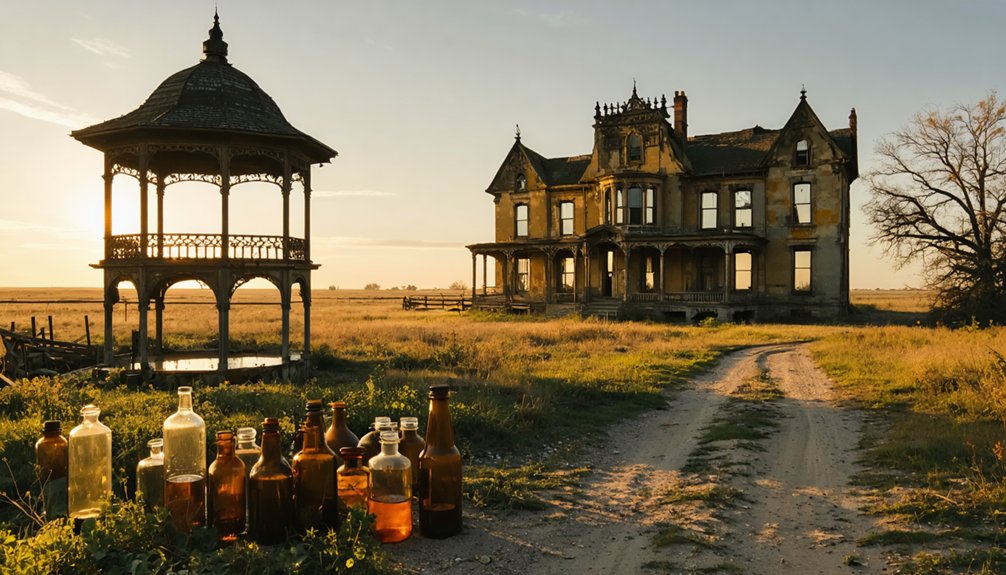
In 1870, Robert Mills stumbled upon springs that would transform a remote Kansas prairie into one of the region’s most sought-after healing destinations. You’d have found camps of invalids dotting the landscape by 1880, with 100-300 weekend visitors seeking cures for rheumatism, scrofula, and skin diseases.
The evolving tourism infrastructure reflected shifting ownership dynamics—from Walpole to Bright to Hackney, eventually landing with Mitchell and Newman, who built the town’s first bath house in 1881. The salt water’s remarkable potency yielded 1-3/4 pounds per gallon, matching the renowned Syracuse salt well in New York.
Historic Sites and Landmarks Worth Visiting
You’ll find the town’s most compelling stories etched in weathered tombstones at the Pioneer Cemetery, where generations of health seekers and frontier settlers rest beneath Kansas prairie grass.
The historic church building stands as a quiet sentinel to the community’s spiritual life during its heyday, its architecture preserving the aspirations of those who believed this place would become a permanent healing destination.
Specifically, gunslinger Luke Short’s grave marks his unexpected final chapter—a Wild West legend who died not in a shootout, but peacefully at the Gilbert Hotel on September 8, 1893.
Pioneer Cemetery and Tombstones
Weathered headstones lean against the Kansas wind at Pioneer Cemetery in Lawrence, where the state’s bloodiest chapters are written in marble and sandstone. You’ll find Bleeding Kansas victims and Quantrill’s Raid casualties among the 450-plus souls resting here since 1854.
What awaits your discovery:
- Thomas K. Barber’s obelisk marks where proslavery forces murdered him in 1855
- Four original gravestones from the 1863 raid that killed 200 Lawrence residents
- Unique tombstone designs like Pamilia Chenoweth’s 1878 marker, possibly crafted by Caton Marble Works
- Historic burial records spanning vitamin pioneer Elmer McCollum’s 1968 interment to current plots
Chancellor Murphy rescued this forgotten ground in 1952, transforming overgrown ruins into hallowed remembrance. The cemetery still accepts burials, though space constraints now limit markers to modest dimensions—freedom’s final resting place preserved.
Historic Church Building
A modest frame church rises from the Kansas prairie at 1801 S Greenwich Road, its two-story silhouette anchoring Geuda Springs’ oldest neighborhood. Hope United Methodist Church has witnessed this town’s complete arc—from bustling health resort to near-ghost town to quiet survivor. Its stone basement and weathered frame construction date to the 1880s, when the Winfield Courier documented grand balls held within these walls.
Walk among the surrounding homes, all exceeding 80 years, and you’ll understand this building’s community significance. It survived the devastating 1908 fire that consumed downtown. Today, it still serves worshippers, still gathers neighbors—a living monument to those who stayed when others left.
You’ll find architectural preservation efforts evident in every board, a witness to residents who refused to let their heritage crumble.
Luke Short’s Final Resting Place
Few gunfighters achieved Luke Short‘s notoriety during their lifetimes, and fewer still met their end in a Kansas ghost town seeking miracle cures. You’ll find the Gilbert House where Short’s personal medical struggles ended on September 8, 1893. The famous gambler came seeking Geuda Springs‘ mineral waters, hoping they’d cure his dropsy—they didn’t.
His tragic final illness played out here:
- Blood-letting treatments failed to control his high blood pressure
- Wife Hattie watched him deteriorate at age 39
- The local paper announced his death that September morning
- He’d purchased his own gravestone before the trip
Though buried in Fort Worth’s Oakwood Cemetery, Geuda Springs marks where the West’s legendary gunfighteraryfinally surrendered—not to bullets, but to fate.
Famous Figures and Local Characters
Though crowds of hopeful settlers flooded Geuda Springs during the Cherokee Strip Run of 1893, one visitor slipped through town unnoticed—legendary gunfighter Luke Short, whose days of operating saloons across the western frontier had come to an end. Short, severely ill with congestive heart failure, sought the healing waters’ redemption after years of frontier saloon antics and legal troubles from selling whiskey to Sioux Indians.
You’ll also discover stories of Jacob Klepper, who at ninety still swore by the springs’ restorative powers after first visiting in 1857 with Grey-Eagle and Mona Lona. Even Dr. James Allen arrived unable to walk, diabetic and desperate after exhausting every other watering place in America. He left cured—testament to why notorious gunslingers and pioneering spirits alike believed in Geuda’s promise.
Getting There and Exploring Nearby Ghost Towns

Tucked between Cowley and Sumner counties at coordinates 37°06’26.40″ N, 97°09’1.80″ W, Geuda Springs sits just seven miles from Arkansas City—close enough that you’ll spot the town’s silhouette before your GPS announces arrival.
Seven miles from Arkansas City, Geuda Springs emerges on the horizon before technology confirms what your instincts already know.
Modern explorers can navigate here using:
- Waze for real-time traffic through rural Kansas backroads
- East 120th Street South leading 0.9 miles to vanished rail infrastructure
- South Oxford Road connecting forgotten settlements
- ViaMichelin’s tourist maps revealing local ghost town lore
At 1,135 feet elevation, you’ll find remnants of St. Louis & San Francisco railroad branches that once carried spa-seekers to those legendary salt springs. The 50-acre lake still marks where pioneers dammed the creek. Zip code 67051 connects you to area code 620’s scattered homesteads and weathered foundations waiting beyond the pavement.
Frequently Asked Questions
Are the Mineral Springs Still Accessible for Bathing Today?
No, you can’t bathe in Geuda Springs’ mineral waters today—they’ve vanished despite their historical significance. Local preservation efforts haven’t restored the flows that once drew freedom-seeking visitors to these healing waters in the 1880s.
What Are the Best Months to Visit Geuda Springs?
Visit September through November or April through June when seasonal weather conditions create perfect exploring temperatures. You’ll find local business hours more reliable during these peaks, plus those spring wildflowers and autumn colors make every abandoned building photograph absolutely sing.
Are There Any Lodging Options Available in or Near Geuda Springs?
You’ll find rustic cabins available and charming Airbnb bungalows nearby, though historic bed and breakfasts are scarce. Wellington and Arkansas City offer hotels within 15 miles, giving you freedom to explore while maintaining your independence on this ghost town adventure.
Is the Town Safe to Explore on Foot?
You’ll find Geuda Springs generally safe for wandering, though you should watch for potential trespassing risks near private properties. The Sumner County Sheriff’s Office provides local law enforcement presence, but services remain limited in this sparse, frontier-like setting.
How Much Time Should I Budget for Visiting Geuda Springs?
Budget 4-6 hours to explore Geuda Springs’ historical significance freely. You’ll discover architectural features of the 50-room hotel, mineral springs, and bathhouse remnants. Add extra time if you’re drawn to nearby ghost towns like Ashton.
References
- https://cchsm.com/resources/misc/wortman_cc/cowley_county_geuda_springs.html
- https://cchsm.com/resources/misc/wortman_cc/salt_city_geuda_springs.html
- https://cchsm.com/resources/misc/wortman_cc/geuda_springs.html
- https://www.youtube.com/watch?v=OyBXD18P_j4
- https://en.wikipedia.org/wiki/Geuda_Springs
- https://www.ksgenweb.org/archives/1912/g/geuda_springs.html
- https://legendsofkansas.com/sumner-county-kansas-extinct-towns/
- https://ausbcomp.com/~bbott/cowley/GeudaSprings/RemantoSaltCityGeudaSprings.htm
- https://www.youtube.com/watch?v=LUjiM_odLJM
- https://www.kgs.ku.edu/Publications/Bulletins/Vol7/12_chlorid.html