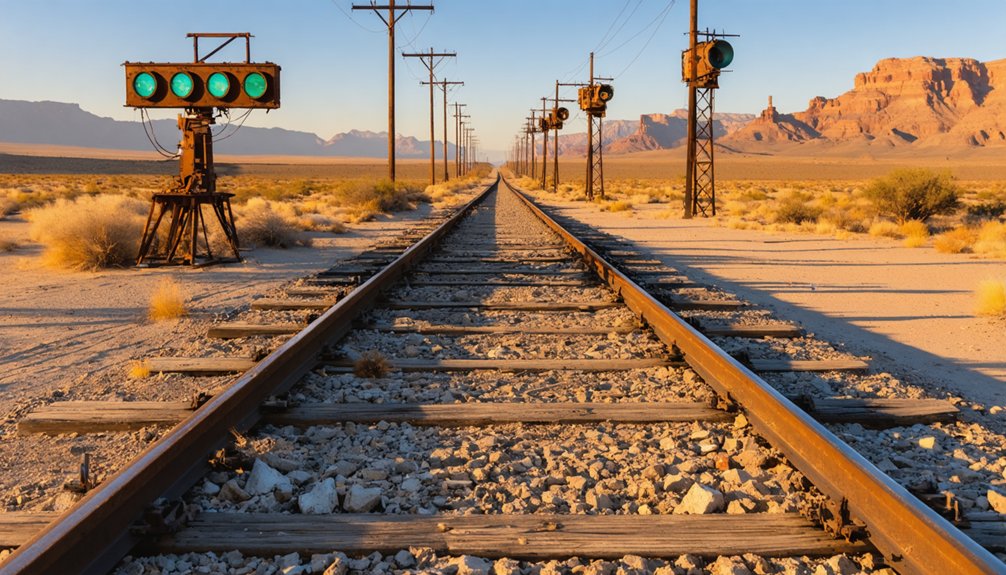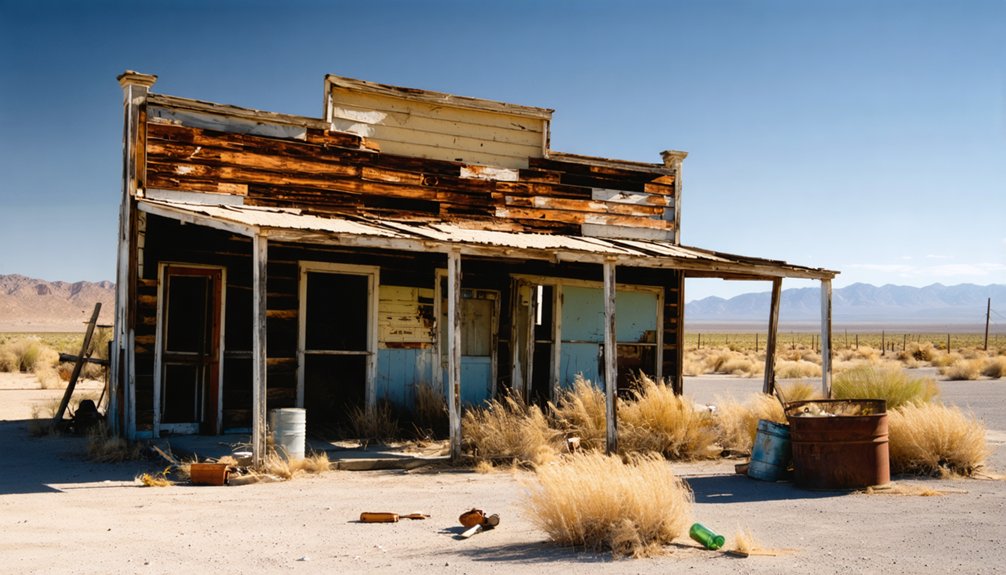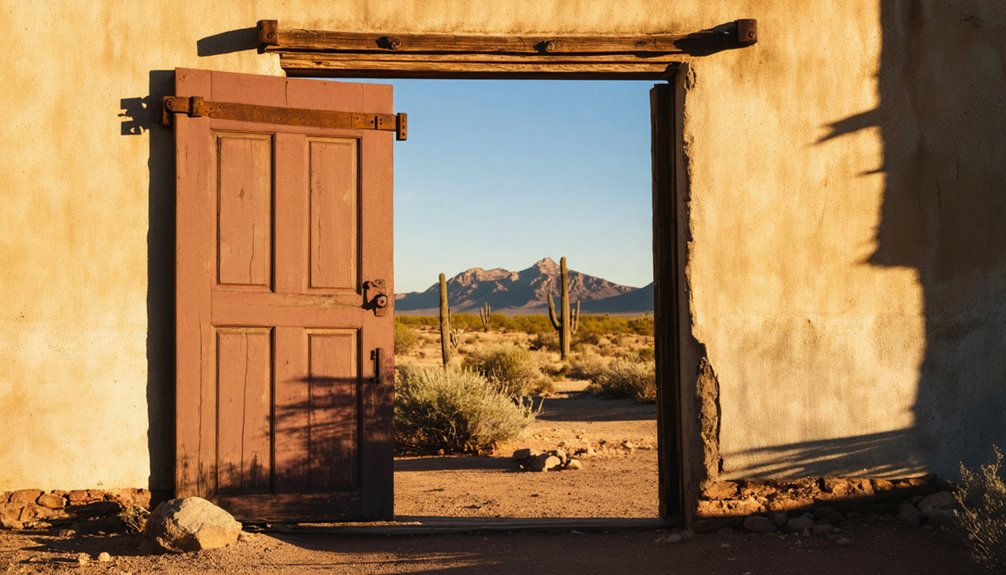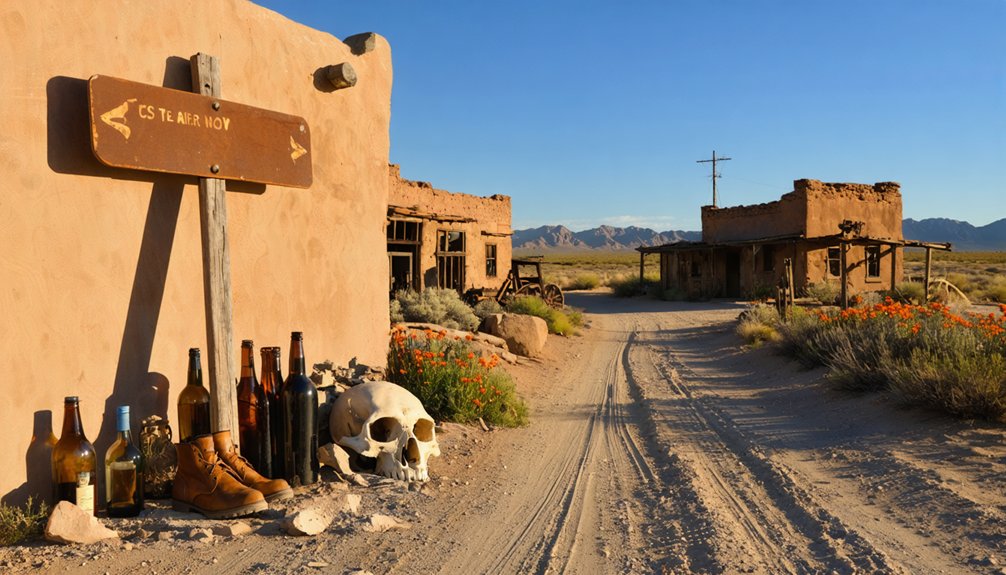
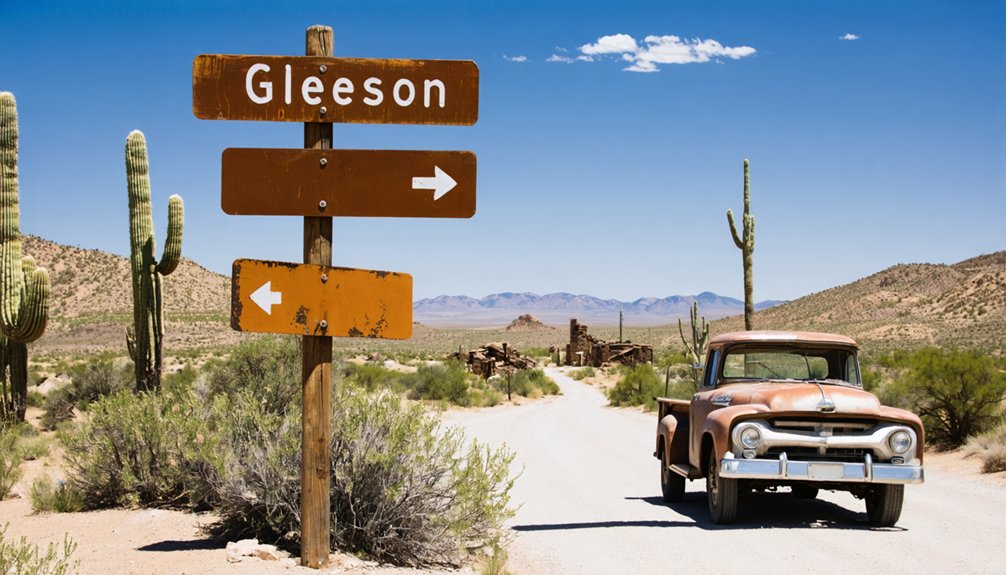
You’ll find Gleeson 16 miles east of Tombstone, where pavement gives way to graded dirt roads suitable for passenger cars. This forgotten copper camp welcomes you with its restored 1910 jail, weathered store ruins, and crumbling hospital foundations scattered across walkable downtown. Time your visit for golden-hour photography at the adobe walls, explore the pioneer cemetery’s stories, and extend your journey along the 34-mile Ghost Town Trail through Courtland and Pearce for a complete southeastern Arizona mining experience.
Key Takeaways
- Travel 16 miles east of Tombstone on graded dirt road suitable for passenger cars to reach Gleeson.
- Explore the restored 1910 jail, weathered store ruins, hospital remnants, and pioneer cemetery within the walkable downtown area.
- Visit the 1910 jail museum on select Saturdays or schedule an appointment for guided tours with five current residents.
- Photograph golden-hour adobe walls, mine tailings, Joe Bono’s Saloon mural, and the concrete jail at dawn.
- Extend your trip along the 34-mile Ghost Town Trail connecting Gleeson with Courtland and Pearce.
From Turquoise Camp to Copper Boom: The Story of Gleeson
Long before copper drew prospectors to these desert hills, Native Americans worked the turquoise deposits south of the Dragoon Mountains, chipping away at veins of the sky-blue stone for decorative purposes. By 1890, a mining camp called Turquoise sprang up here, complete with its own post office. When Tiffany & Co. investigated large-scale turquoise mining operations, they found the deposits unprofitable, and the camp faded by mid-1890s.
The real story began in 1896 when John Gleeson purchased the Leonard mine, renamed it Copper Belle, and developed it into the district’s largest producer. His copper production timeline stretched through 1901, then continued under Shannon Copper Company‘s management. The Copper Belle’s success sparked a boom—Silver Bill, Defiance, and Mystery mines opened nearby, and a new town bearing Gleeson’s name materialized downhill from the abandoned turquoise camp.
What to See in This Southern Arizona Ghost Town
What remains of Gleeson today offers ghost town enthusiasts a compelling mix of accessible ruins and one remarkably intact structure. You’ll find the restored 1910 jail anchoring the walkable downtown ruins, serving as your museum and tour guide hub. Its original wooden door stands as a testament to frontier justice, while inside you’ll grab the map that grants access to the entire settlement.
The 1910 jail stands remarkably intact, offering visitors a tangible connection to frontier justice while serving as gateway to Gleeson’s scattered ruins.
The townscape rewards exploration:
- Weathered store walls where miners once gathered for supplies and gossip
- Crumbling schoolhouse foundation echoing with children’s voices from a century past
- Hospital ruins marking where desperate medical care met copper boom injuries
- Pioneer cemetery holding the stories of those who never left
These picturesque preservation efforts let you wander freely through authentic Western history on dusty streets where high-clearance vehicles earn their keep.
The Mining Legacy: Copper Belle and Beyond
Before John Gleeson’s name graced the town in 1900, prospectors had already spent decades chasing the mountain’s metallic promise through layers of Carboniferous limestone. The Copper Belle Mine—originally Leonard Mine from 1887—evolved into Gleeson’s titan, its 300-foot workings penetrating ore bodies sixty feet wide. You’ll find remnants of an operation that demanded brutal mining labor conditions, where men descended daily into darkness pursuing 1.5% copper grade veins until 1957.
Beyond Copper Belle, the Defiance Mine’s 450-foot adit and the Mystery Mine’s labyrinthine tunnels carved through ridges east of town. Mine equipment maintenance proved relentless—winches, drills, and hoists requiring constant attention in sulfide-rich environments.
Shannon Copper Company leased operations while smaller outfits like Still Bros. kept machinery running, shipping ore to Cochise after local juniper-fueled smelting failed spectacularly.
Getting There and Road Trip Logistics
Reaching Gleeson demands commitment to sixteen miles of eastward travel from Tombstone, where pavement surrenders to graded dirt that billows dust clouds beneath your tires. Road conditions remain surprisingly forgiving—your passenger car handles these historic traces just fine, though you’ll taste Arizona’s mineral-rich earth through your vehicle’s vents.
Sixteen miles of graded dirt separate you from Gleeson’s weathered remnants, where desert dust becomes your traveling companion.
Navigate from Tombstone by heading east on State Route 80, turning left at Camino San Rafael, then right onto Gleeson Road. Your accessibility options expand beyond the ghost town itself:
- Ghost Town Trail extends thirty-four miles through Courtland and Pearce
- The jail museum opens select Saturdays or by appointment
- Five resilient residents still claim this landscape
- No Trespassing barriers block certain historic routes
Park at the Gleeson Road intersection where freedom-seekers have stood for generations, elevation 4,924 feet above conformity.
Best Photo Spots and Photography Tips
You’ll find Gleeson’s crumbling adobe walls and weathered wooden frames offer endless compositions, from the skeletal jail and old hospital ruins to the abandoned saloon with its collapsing roof timbers. Pack a sturdy tripod and wide-angle lens to capture the vast desert landscape framing these structures, plus a prime lens for intimate details like rusted door hinges and peeling paint textures.
The low-lying ruins and exposed interiors demand careful equipment choices—you’re working with harsh Arizona sunlight contrasting against deep shadows within doorways and beneath remaining roof sections.
Historic Ruins Worth Capturing
The skeletal remains of Gleeson’s concrete jail stand as the town’s most photogenic landmark, its weathered walls rising from the desert floor at the main road intersection. During docent hours, you’ll capture interior textures and architectural features that tell stories of frontier justice.
Beyond the jail, explore freely:
- Hospital ruins north of Main Street offer crumbling adobe walls perfect for golden-hour silhouettes against mining-scarred hills
- Joe Bono’s Saloon displays standing walls and a 1982 interior mural depicting lost townsfolk—shoot through fencing with telephoto precision
- Cemetery graves scatter across desert landscape, emphasizing haunting isolation at dusk
- Mine tailings glow with mineral colors in early morning light, their foundations begging wide-angle exploration
Each site rewards those who wander off-schedule, camera ready.
Essential Camera Equipment Tips
Gleeson’s harsh desert light and dusty conditions demand specific gear choices that protect your investment while maximizing image quality. You’ll want a weather-sealed camera body that can handle the grit that permeates everything in this abandoned settlement.
Bring a versatile lens range—wide-angle for capturing complete structures and a telephoto for architectural details.
Master bracketing techniques to combat the extreme contrast between blazing sunlight and shadowed doorways. The handheld vs. tripod debate resolves itself here: you’ll need both. Tripods stabilize long exposures inside dark buildings, while handheld shooting lets you navigate unstable floors and tight spaces quickly.
Pack extra batteries—desert heat drains them fast. A UV filter protects your lens from relentless dust, and microfiber cloths become essential survival gear for constant sensor cleaning.
Exploring the Cemetery and Surrounding Areas
Walking west from Gleeson’s crumbling main street, you’ll spot the weathered cemetery gates marking ground consecrated since 1904, when a stillborn baby became its first recorded burial. The mining boom that built this town also filled these grounds—accidents underground, harsh conditions, and brief lives documented in fading gravestone symbolism that speaks volumes about frontier hardship.
Stone markers and shallow depressions chronicle a mining town’s harsh reality—where frontier dreams ended beneath consecrated desert ground.
You’re free to wander unmarked grave locations and depressions where wooden markers rotted away decades ago. Stone foundations and scattered mining artifacts surround the burial ground, creating an interconnected historical landscape:
- Children’s plots clustered together—silent testimony to frontier mortality rates
- Miners’ graves bearing only dates—anonymous laborers who built the West
- Family sections revealing generational ties severed by economic collapse
- Weathered epitaphs etched in desert-worn limestone
Bring water and explore during cooler morning hours.
Combining Gleeson With Other Ghost Town Trail Stops
You’ll maximize your ghost town adventure by linking Gleeson with nearby Courtland and Pearce, creating a triangle route that captures three distinct mining eras within a compact 10-mile radius. Plan to spend 45 minutes exploring Gleeson’s jail and scattered ruins, then allocate an hour each for Courtland’s crumbling adobe walls and Pearce’s surprisingly intact Old General Store.
Starting from Tombstone—16 miles west of this ghost town cluster—you can complete the entire loop in a half-day, leaving time to photograph weathered headframes against the Dragoon Mountains.
Courtland and Pearce Highlights
While Gleeson offers its own rugged charm, extending your journey just a few miles north transforms a simple ghost town visit into an unforgettable exploration of Arizona’s copper mining legacy.
Courtland delivers authentic experiences you won’t find elsewhere:
- Explore untouched artifacts abandoned for nearly a century—no staging, no commercialization
- Descend into genuine 19th-century mine shafts during guided tours
- Hunt for turquoise under blacklight during nighttime fluorescent rockhounding adventures
- Wander freely among collapsing structures, foundations, and the remarkably intact old jail
Courtland’s preservation efforts by the Arizona Land Project maintain the town’s raw authenticity while offering safe access to its mining heritage. Courtland visitor experiences include pre-Hispanic Hohokam sites and copper processing ruins scattered across the hills. Continue to nearby Pearce for additional historic structures, completing your trinity of southeastern Arizona ghost towns in one remarkable day.
Optimal Route Planning Tips
Planning your route strategically transforms three separate ghost towns into one seamless adventure along the historic 34-mile Ghost Town Trail. Start from Tombstone’s nearby lodging options, following Gleeson Road east for 15 miles to your first stop.
As you continue your exploration, the history of Clark, Vermont ghost town offers a fascinating glimpse into the past, with its remnants whispering tales of a once-thriving community. Make sure to take the time to document your findings, as this rare opportunity to experience Vermont’s forgotten history can enrich your adventure. Each stop along the way reveals unique stories and landscapes that are sure to captivate the imagination.
Continue one mile to Ghost Town Trail Road, turning north for the 3.5-mile journey to Courtland, then proceed to Pearce before looping back. Road condition challenges include dusty, unpaved surfaces suitable for standard vehicles despite rough terrain. Time your visit for the first or fourth Saturday to explore Gleeson’s renovated jail museum.
Allocate full-day exploration, factoring scenic stops at the cemetery, mining ruins, and Rattlesnake Crafts boutique. The northwest route from Pearce reconnects to Interstate 10, completing your historic mining country circuit.
Time Allocation Per Stop
With your route mapped, budget approximately three to four hours exploring all three ghost towns along the Trail. You’ll discover weathered structures standing witness to Arizona’s mining legacy, each stop revealing fragments of frontier life.
Your time breakdown enables spontaneous discovery while maintaining forward momentum:
- Gleeson (60-90 minutes) – Schedule your visit around the jail’s docent led tour experiences, then photograph crumbling saloon walls and walk cemetery grounds
- Courtland (15-20 minutes) – Quick stop recommendations include scanning scattered foundations and the jail twin from your vehicle
- Pearce (25-40 minutes) – Explore school ruins and cemetery at your own pace
Allow flexibility for unexpected photo opportunities among mine tailings and desert landscapes. You’re free to linger where curiosity strikes, adjusting these quick stop recommendations to match your exploration style.
Frequently Asked Questions
Are There Any Restaurants or Places to Buy Food in Gleeson?
You won’t find restaurants in Gleeson itself—it’s fundamentally abandoned. You’ll need to pack supplies before arriving, as there aren’t grocery stores nearby or local cafes and diners. The nearest food options are in Tombstone or Benson, miles away.
Is Overnight Camping Allowed Near the Ghost Town Ruins?
No designated overnight camping exists at Gleeson’s ruins themselves. However, overnight camping policies on surrounding BLM lands permit dispersed camping within 14-day limits. You’ll find nearby camping accommodations offering freedom to explore these haunting desert remnants at your own pace.
Do I Need a Four-Wheel-Drive Vehicle to Reach Gleeson?
You don’t need four-wheel-drive for Gleeson’s main roads. Standard vehicles handle the unpaved road conditions fine during dry weather, though you’ll want caution after storms. Expect limited cell service, so download maps beforehand for navigation freedom.
Are the Buildings and Mine Sites Safe to Enter and Explore?
Most buildings here have stood unrestored for over a century. You’ll find structural integrity concerns throughout—crumbling walls, unstable floors, and collapsing roofs make entering dangerous. Guided tours recommended for safe exploration, though you’re free to photograph from outside.
What Months Have the Best Weather for Visiting Gleeson?
You’ll find October through April offers the best conditions, with ideal temperature ranges from 45°F to 80°F and minimal rainfall. Spring mornings arrive crisp while afternoons warm perfectly for exploring ruins without summer’s scorching heat or monsoon downpours limiting your adventures.