You’ll want to start your Black Hills ghost town adventure in Rapid City, then head 30 miles northwest to Gold Hill at 4,400 feet elevation. Navigate through Black Hills National Forest to coordinates 43.8964, -103.41670, where you’ll discover scattered foundations, abandoned 1940s vehicles, and mining relics from silver and copper operations. Expand your trip to include nearby Galena, Rochford, and Mystic, then finish in historic Deadwood where Wild Bill met his fate—and there’s plenty more to uncover about each haunting destination.
Key Takeaways
- Gold Hill is located at 4,400 feet elevation in Pennington County, 30 miles northwest of Rapid City gateway.
- The ghost town features scattered foundations, abandoned 1940s vehicles, mining shafts, and waste piles from metal operations.
- Access requires navigating Black Hills National Forest; verify private land ownership and secure permission before exploring coordinates 43.8964, -103.41670.
- Nearby ghost towns include Galena’s schoolhouse, Rochford’s general store, Mystic’s railroad frameworks, and Etta’s lithium mill ruins.
- Extend your trip to Deadwood for Wild Bill Hickok’s grave and Homestake Mine’s underground science laboratory tours.
The Rise and Fall of Gold Hill Mining Town
The summer of 1874 marked a turning point for the Black Hills when General George Armstrong Custer‘s expedition stumbled upon placer gold deposits in French Creek near present-day Custer, South Dakota. You’ll discover that this initial find sparked an unstoppable rush, with thousands of prospectors flooding the region by late 1875.
Mining claims acquisition reached fever pitch when Fred and Moses Manuel staked the legendary Homestake claim in April 1876, later selling to George Hearst for $70,000. The Homestake mine operated for 125 years, producing over 40 million ounces of gold. While labor strike impacts occasionally disrupted operations, the mine generated more than $1 billion in wealth, shaping the region’s destiny before closing its shafts forever.
Getting to Gold Hill in the Black Hills
Planning your journey to Gold Hill starts with understanding that this remote Black Hills site sits at 4,400 feet elevation in Pennington County, where rugged terrain and private land ownership shape your access options.
Gold Hill’s 4,400-foot elevation and private ownership create access challenges that demand careful planning before any Black Hills exploration begins.
You’ll base yourself in Rapid City, 30 miles southeast, which serves as your gateway to the region. From there, you’ll navigate through Black Hills National Forest toward coordinates 43.8964, -103.41670.
However, private land access requires verifying ownership and securing permission before exploring the Gold Hill Lode area. Off road vehicle options become valuable here—the Black Hills ATV Trails network provides alternative routes through challenging terrain.
Hill City sits 4 miles from similar mining sites, offering provisions and local knowledge. Remember: respecting property boundaries isn’t just legal necessity—it’s essential for preserving these historic locations.
What You’ll Find at the Gold Hill Ghost Town Site
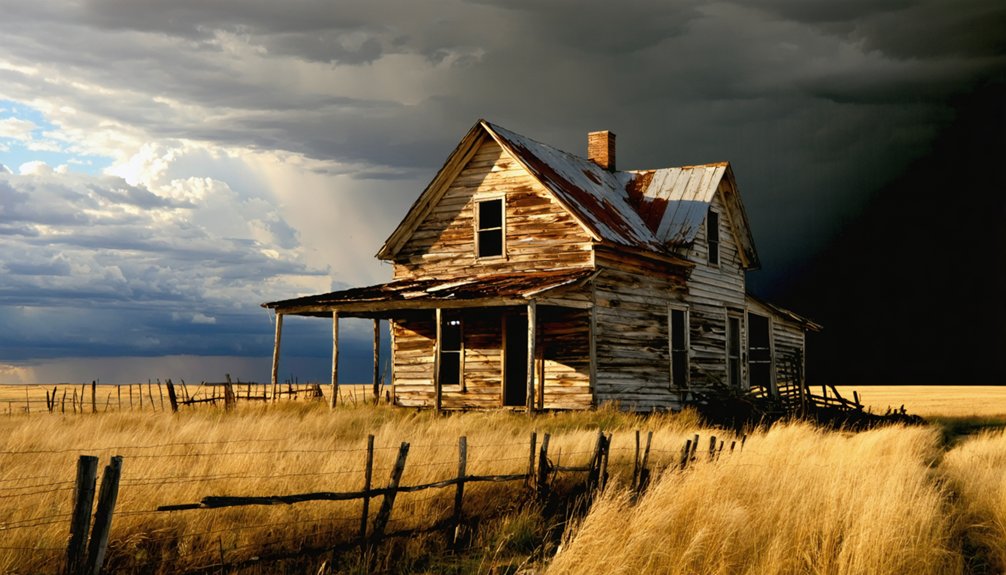
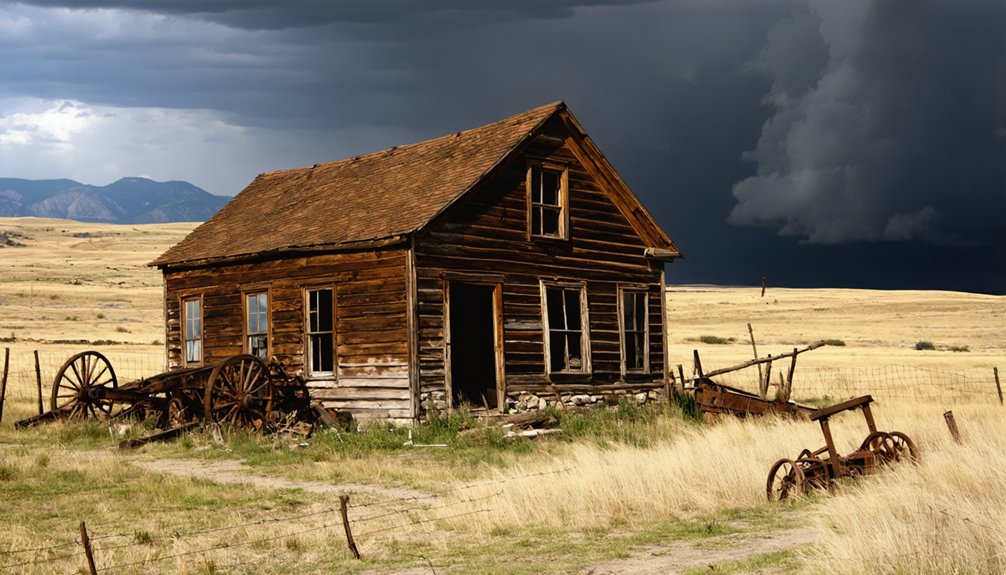
What remains of Gold Hill today tells a story of boom, decline, and preservation through abandonment. You’ll discover scattered foundations where buildings once stood before the Forest Service burned hazardous structures. The site’s authentic character draws photographers and explorers seeking untouched history.
Your exploration will reveal:
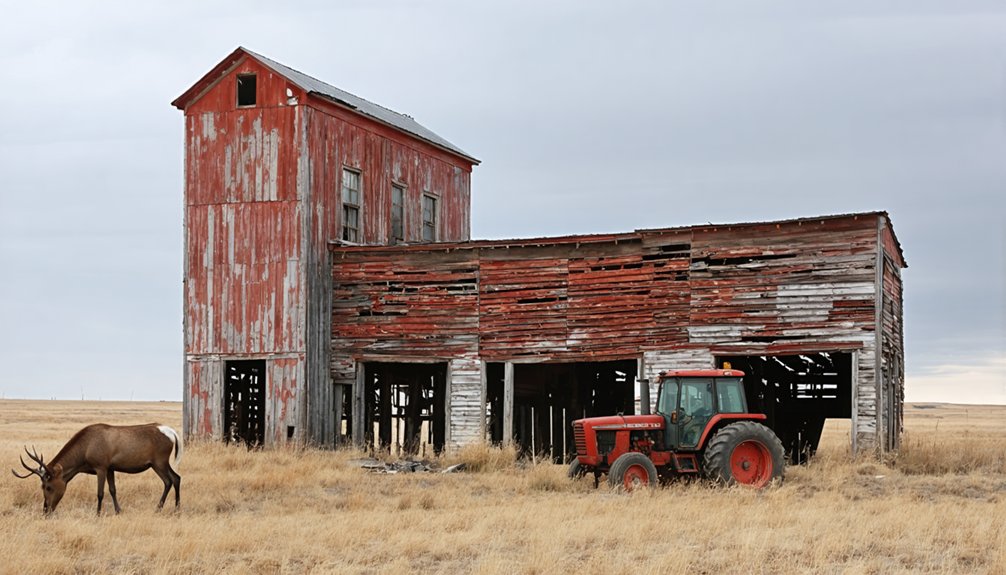
- Abandoned vehicles rusting in place, frozen in time since the 1940s exodus
- Mining relics including gaping shafts and waste piles from silver, copper, and zinc operations
- Standing structures that survived decades of weather and neglect
- Old graves, store remnants, and house foundations telling miners’ stories
Two geocaches add modern treasure hunting to your historical adventure. Whether you’re photographing weathered buildings or tracing foundations through tall grass, Gold Hill offers unrestricted access to authentic ghost town exploration.
Exploring Other Abandoned Mining Towns Nearby
Beyond Gold Hill’s weathered foundations, several equally alluring ghost towns dot the Black Hills landscape within easy driving distance. You’ll discover Galena in Vanocker Canyon, where a schoolhouse stands among remnants of a 1,000-person mining community.
Rochford offers on-site archaeological exploration at its general store, cabins, and hillside cemetery. Mystic’s building frameworks line the old railroad route, though you’ll want to admire these abandoned mining sites from ground level for safety.
Spokane’s mine manager’s house remained occupied until the 1970s, showcasing the area’s lingering appeal. Near Keystone, Etta’s massive spodumene lithium operation left behind mill ruins worth investigating. Rockerville completes the circuit, embodying the classic boom-and-bust cycle that shaped these mountains. Each stop reveals the prospectors’ relentless pursuit of fortune.
Deadwood and Historic Homestake Mine Attractions
Your ghost town adventure leads you to nearby Deadwood, where the legendary Wild Bill Hickok met his fatal end at Saloon #10 in 1876 while holding his famous “dead man’s hand.” You’ll find his grave alongside Calamity Jane’s at Mount Moriah Cemetery, perched on a hillside offering sweeping views of this National Historic Landmark town.
Just minutes away in Lead, the colossal Homestake Mine—once the western hemisphere’s largest gold producer—now operates as a cutting-edge underground science laboratory after 125 years of extracting Black Hills gold.
Wild Bill Hickok Legacy
Few figures embody the Wild West mythos quite like James Butler “Wild Bill” Hickok, whose violent death in Deadwood cemented both his legend and the town’s place in frontier history. You’ll discover gold rush drama everywhere in this lawless boomtown that swelled to 25,000 fortune-seekers after the 1874 Black Hills discovery.
Hickok’s poker game legacy lives on through these compelling sites:
- Saloon No. 10 (near 624 Main Street) – Stand where Jack McCall shot Hickok from behind on August 2, 1876
- Dead Man’s Hand displays – View the infamous aces and eights combination Hickok held when murdered
- Mount Moriah Cemetery – Visit his grave overlooking the town he never left
- World Series of Poker Hall of Fame recognition – His 1979 induction honors gambling’s most legendary figure
Mount Moriah Cemetery Visits
Perched on a hillside overlooking Deadwood, Mount Moriah Cemetery stands as the Black Hills’ most historically significant burial ground, where 3,500 graves tell stories of fortune-seekers, outlaws, and pioneers who shaped the frontier.
You’ll discover the Jewish community legacy on Hebrew Hill, where Sol Star and Harris Franklin rest among headstones bearing Hebrew inscriptions. The Chinese burial traditions come alive in Section Six, where a reconstructed altar and burner honor the 33 immigrants who sought gold-rush fortunes.
Beyond Wild Bill Hickok and Calamity Jane’s famous graves, you’ll find Civil War veterans, murdered preachers, and mill fire victims. The $2 admission grants year-round access to self-guided walking tours through this Victorian-era boot hill, divided into four distinct sections.
Homestake Mine Science Lab
Just eight miles north of Deadwood’s storied cemetery, the Homestake Mine has transformed from North America’s largest gold producer into the nation’s deepest underground science laboratory. Between 1876 and 2001, it yielded over 40 million ounces of gold before beginning its second life as a cutting-edge research facility.
You’ll discover neutrino physics experiments and dark matter research happening 8,000 feet below ground, where cosmic radiation can’t interfere.
Your visit includes:
- Free admission to exhibits featuring mining history and Nobel Prize-winning science
- Underground laboratory tours to the Yates hoist room with 5,000 feet of operational rope
- Viewing the Davis Ring from Ray Davis’s groundbreaking solar neutrino experiment
- Interactive displays explaining how 300 miles of tunnels now shield advanced physics research
Plan 2.5 hours for the complete experience.
Making the Most of Your Black Hills Ghost Town Adventure
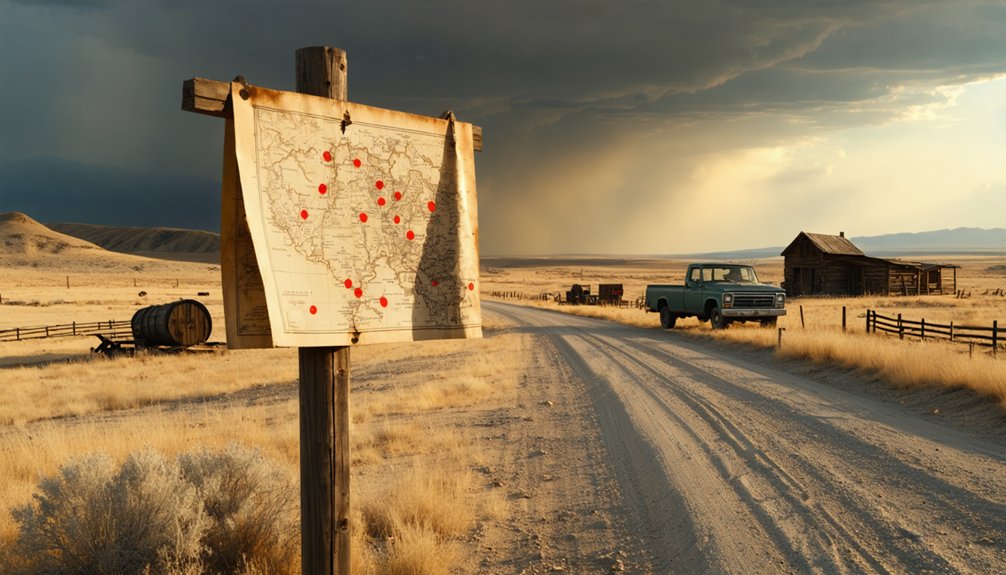
Your Black Hills ghost town adventure requires sturdy hiking boots, a reliable camera, and detailed maps since many sites sit along unpaved Forest Service roads with limited cell service.
Early morning or late afternoon light transforms weathered buildings and rusting machinery into stunning photographs, while cooler temperatures make exploring foundations and mine relics more comfortable.
Pack a GPS device to hunt Spokane’s two geocaches, merging modern treasure hunting with 19th-century prospecting history as you navigate between crumbling structures and scattered mining equipment.
Essential Gear and Preparation
Before you set off to explore Gold Hill and its neighboring ghost towns scattered throughout the Black Hills, proper preparation separates memorable adventures from frustrating—or dangerous—ordeals. Your vehicle needs high clearance for Forest Service Road 330‘s gravel terrain, while appropriate footwear handles uneven ground around abandoned structures.
Pack strategically:
- Navigation essentials: Offline maps, compass, and printed topos cover areas where GPS fails
- Safety equipment: First-aid kit, flashlight, and gloves protect against rusty relics and wildlife encounters
- Remote communication: Inform others of your itinerary since cell service proves spotty
- Weather protection: Layered clothing adapts to Black Hills’ variable conditions, from sudden storms to temperature swings
Water and snacks sustain you through isolated sites lacking services, letting you explore freely without rushing back.
Photography Tips and Timing
Gold Hill’s weathered structures transform into photographer’s gold during the hour before sunset, when warm light rakes across abandoned buildings and highlights every crack in aging wood. You’ll want to master exposure techniques for these challenging shifts between golden hour and darkness, as light intensity alters rapidly in Black Hills terrain.
Watch for atmospheric conditions when cold fronts move through—fog banks rolling across the plains create dramatic backdrops for framing decaying ranch houses. Position structures against these misty layers for compositions that capture the town’s eerie abandonment.
Bring protective gear for your camera. The unpredictable terrain and weather shifts demand weather-resistant housing. Pack backup equipment too—a shattered lens in this remote location means you’re done shooting.
Combining History With Geocaching
Modern treasure hunters merge past and present at Spokane Ghost Town, where two geocaches hide among mining relics that witnessed the site’s 1890 founding and its 1940 abandonment. Your geocaching technology transforms ruins into interactive exploration sites, linking GPS coordinates with historical preservation efforts across the Black Hills.
Strategic Approach for Ghost Town Geocaching:
- Research Spokane’s peak 1927 prosperity ($114,742 revenue) before hunting caches among foundations and remaining structures
- Navigate via Highway 16A to Iron Mountain Road, then Forest Service Road 330 for remote access
- Document mine shafts, scattered equipment, and 19th-century building remnants while pursuing coordinates
- Explore nearby sites like Tinton and Maitland, extending adventures across 400+ abandoned settlements
You’ll discover authentic freedom combining digital hunts with tangible history, respecting structural hazards while experiencing mining-era landscapes.
Frequently Asked Questions
Are There Entrance Fees to Visit Gold Hill Ghost Town?
Gold Hill offers free site accessibility for self-guided exploration, like other Black Hills ghost towns. You’ll find no entrance fees to wander the ruins, though seasonal hours may vary. Nearby paid attractions include mining tours if you’re interested.
What Safety Precautions Should Visitors Take When Exploring Abandoned Structures?
You’ll want to wear proper footwear with ankle support and assess structural stability before entering any building. Never venture inside alone, watch for weak floors and walls, and avoid touching debris that may contain hazardous materials or sharp edges.
Can Visitors Camp Overnight Near the Gold Hill Site?
You’ll find overnight camping facilities at Gold Valley Camp, just 5-10 miles from Gold Hill. This nearby campground option offers full-hookup RV sites and cabins, giving you freedom to explore the ghost town at your own pace.
What’s the Best Season to Visit Black Hills Ghost Towns?
Fall’s your best bet for exploring Black Hills ghost towns. You’ll enjoy ideal weather conditions in the mid-60s, perfect photography lighting during golden hours, vibrant foliage, and fewer crowds—giving you freedom to wander these historic sites at your own pace.
Another intriguing location worth visiting is the history of New Berlin ghost town, where remnants of faded buildings and artifacts tell stories of the past. Walking through its deserted streets, you’ll experience a sense of nostalgia and wonder about the lives that once thrived in this now-silent community. Don’t forget your camera, as the haunting beauty of the landscape provides excellent opportunities for capturing unique photographs.
Are Pets Allowed at Gold Hill and Other Ghost Town Sites?
Your four-legged companions can explore Gold Hill’s weathered ruins alongside you, though hazardous conditions demand caution. Pet policies remain unofficial here, but nearby attractions welcome leashed dogs. Always prioritize safety over adventure in these crumbling, unmanaged spaces.