Park at the Stony Valley Rail Trail where it meets Gold Mine Road in Northern Lebanon County, then hike 15-20 minutes uphill through state game lands to reach the ghost town’s crumbling foundations. You’ll discover stone-lined mine entrances, breaker foundations stretching upslope, and scattered house ruins where coal-mining families once lived during the 1850s boom. Bring the Pennsylvania Mine Maps Atlas to navigate safely around sinkholes, and plan extra time to explore the mysterious ventilation tower standing sentinel on nearby Stoney Mountain—there’s much more waiting among these haunted hollows.
Key Takeaways
- Access Gold Mine via Interstate 81 using high-clearance vehicles, navigating Gold Mine Road or Big Mine Road through state game lands.
- Park at Stony Valley Rail Trail intersections and prepare for a 15-20 minute uphill hike to reach the ghost town ruins.
- Bring Pennsylvania Mine Maps Atlas to navigate safely around unpredictable sinkholes and abandoned mining areas across 44,342 acres.
- Explore breaker foundations, house ruins, stone-lined mine entrances, and tower bases scattered throughout the village area.
- Extend your trip with a two-mile trek to Stoney Mountain’s stone tower via Rattling Run Road’s Water Tank Trail.
Historical Background of Gold Mine’s Mining Era
While the name “Gold Mine, Pennsylvania” conjures images of prospectors panning for nuggets in mountain streams, the reality proves far more modest—and perhaps more intriguing. You’ll discover that Pennsylvania’s gold came primarily as an afterthought to iron extraction, with Cornwall Iron Mine yielding between 37,000 and 60,000 troy ounces starting in 1878.
The region’s true wealth flowed from coal—bituminous deposits that fueled Pittsburgh’s steel empire and powered westward expansion. Early gold extraction techniques remained simple: flakes settled in slow-moving tributaries, carried south by glacial erosion. While mining engineering advancements transformed coal operations from manual room-and-pillar methods to mechanized longwall systems, dedicated gold operations never materialized.
Your journey reveals an industry built on black rock, not golden dreams.
Getting to the Ghost Town: Directions and Access Points
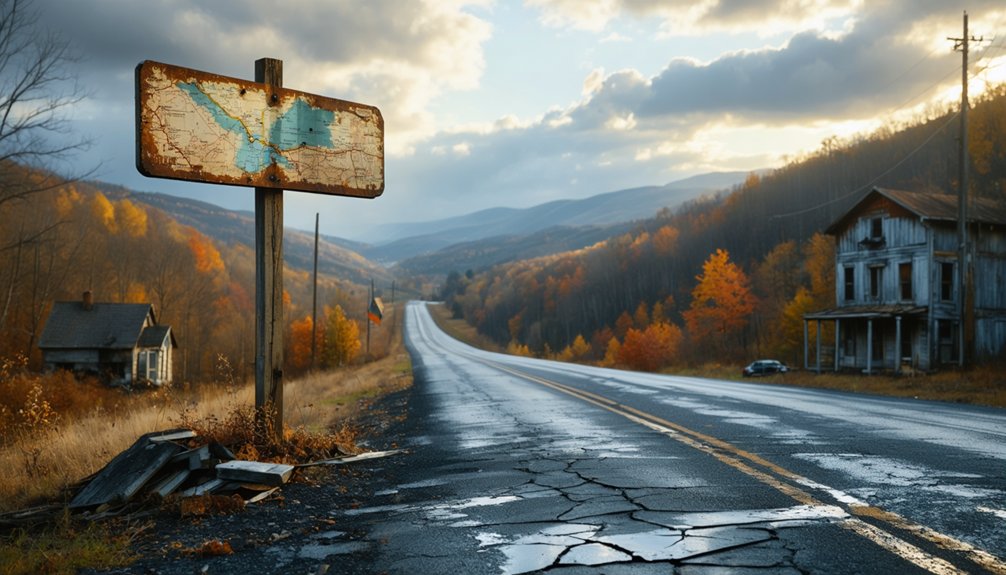
Though Interstate 81 cuts through Columbia County’s northeastern Pennsylvania landscape just miles from Gold Mine‘s abandoned remains, reaching the ghost town demands commitment beyond highway exits. You’ll navigate disheveled abandoned roads requiring high-clearance vehicles, where maintenance concerns have rendered routes structurally questionable. The original north-leading road was diverted during a 1930s CCC project—today’s path follows that leftward deviation through fifteen to twenty minutes of uphill walking to the village site.
From the south, Big Mine Road offers alternative access toward similar mining territory. Above the workings, trails loop around Gold Mine Gap with Sharp Mountain’s silhouette guiding your route. The vertical old mine road provides another option, connecting scattered campsites and co-workings. Pennsylvania’s Mine Maps Atlas and Abandoned Mines map become essential tools—sinkholes form unpredictably where weakened mine supports undermine unmonitored pathways.
Where to Park and Start Your Exploration
Your ghost town adventure begins where Gold Mine Road meets the Stony Valley Rail Trail, a convergence point that serves as the primary staging area for exploring Pennsylvania’s forgotten mining settlement.
Pull onto the shoulder of Gold Mine Road in Northern Lebanon County, where several roadside features accommodate vehicles along this mountain passage. You’ll find the official Stony Valley Rail Trail parking area just down the road, though many explorers prefer parking directly near unmarked trail entrances for quicker access.
From your vehicle, the ghost town lies a 15-20 minute uphill walk through 44,342 acres of state game land. The trail starts past a guard rail—look for a stone wall that marks your return point. Within minutes, you’ll spot the first mine entrance, signaling your arrival into Gold Mine’s haunting remnants.
Notable Ruins and Structures to Discover
What remains of Gold Mine, Pennsylvania reveals itself gradually as you venture deeper into the forest, each crumbling foundation telling fragments of a vanished mining community’s story.
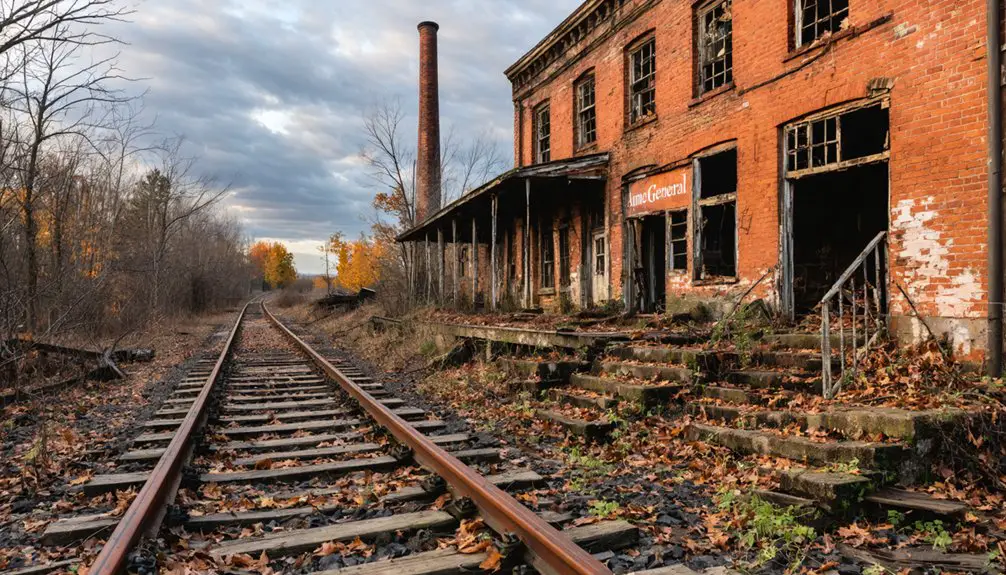
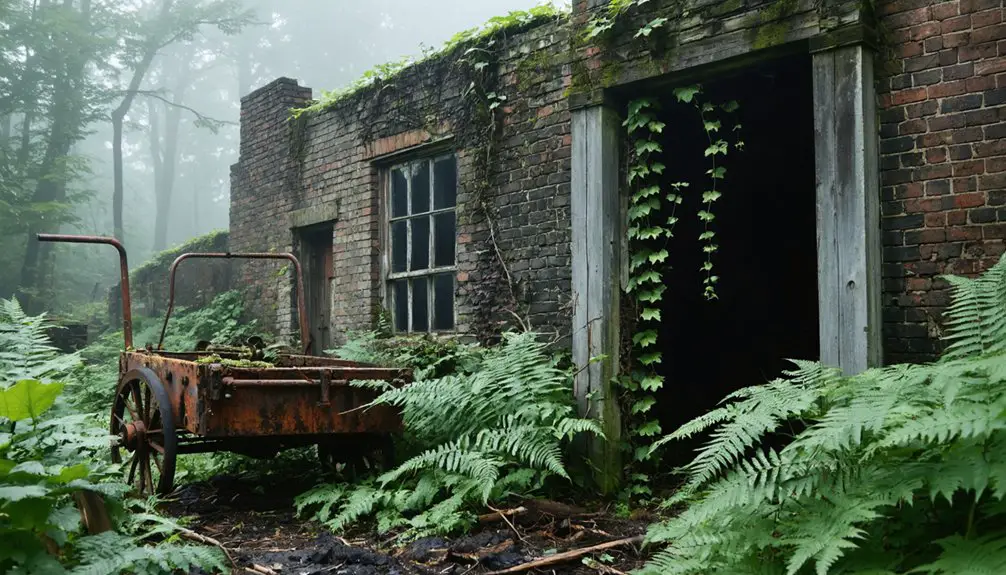
The breaker foundations stretch upslope in parallel rows, their weathered stones once supporting massive wooden platforms where coal was processed. Scattered among them, you’ll discover house foundations spread throughout the village area—stone rubble walls marking where families lived before the mines closed and homes were dismantled for salvageable lumber.
Stone foundations climb the hillside in orderly lines, silent witnesses to the coal breaker’s vanished machinery and the mining families who once called this place home.
Stone-lined mine entrances curve into hillsides, black coal still visible where bootleggers worked after official operations ceased
Tower base remains near the road, tumbled stonework from collapsed steam engine structures
Bridge foundations crossing the creek, separate from railroad remnants
Overgrown basements with intact stonework sides
Metal relics and pottery fragments scattered among foundation clusters
The Mysterious Stone Tower on Stoney Mountain
A few miles northeast of Gold Mine’s scattered foundations, another enigmatic structure rises from the forest floor on Stoney Mountain—a hollow stone tower that’s puzzled hikers and historians for generations. You’ll find this crumbling monument along the blue-blazed Water Tank Trail, accessible via a two-mile trek up Rattling Run Road. Most researchers believe it served as a ventilation shaft for the coal mining operations that fueled Yellow Springs’ brief boom during the 1850s, though its exact purpose remains debated.
The tower’s structural integrity deteriorates with each passing season—fresh rockfalls reveal its declining condition. Despite this decay, its historical significance endures as tangible evidence of the region’s mining heritage, standing sentinel over abandoned pits and waste rock deposits that tell stories of boom-and-bust economics.
Following the Trail System Through the Abandoned Site
The Summit Siding Railroad Trail serves as your primary artery into Gold Mine’s ghost town complex, stretching four miles from its junction with the Stony Valley Rail Trail at the bottom of the valley to Roush Gap’s windswept saddle. You’ll cross creeks near rusting railroad bridges before ascending through Gold Mine Gap, where the trail network condition varies from well-defined paths to barely-traceable routes that become rushing streams each spring.
Four miles of history await between valley floor and mountain saddle, where old rails guide you through Pennsylvania’s forgotten mining past.
Trail landmarks you’ll encounter:
- Stone foundations from 1850s structures emerging through moss and encroaching flora and fauna
- The water tank’s impressive stonework foundation commanding views of scattered remnants below
- Old Mine Road branching vertically toward Sharp Mountain’s scarred ridgeline
- Unnamed connector trails weaving past modern strip mining disruptions
- Creek crossings where iron rails peek through accumulated forest debris
Mining Remnants and Underground Features
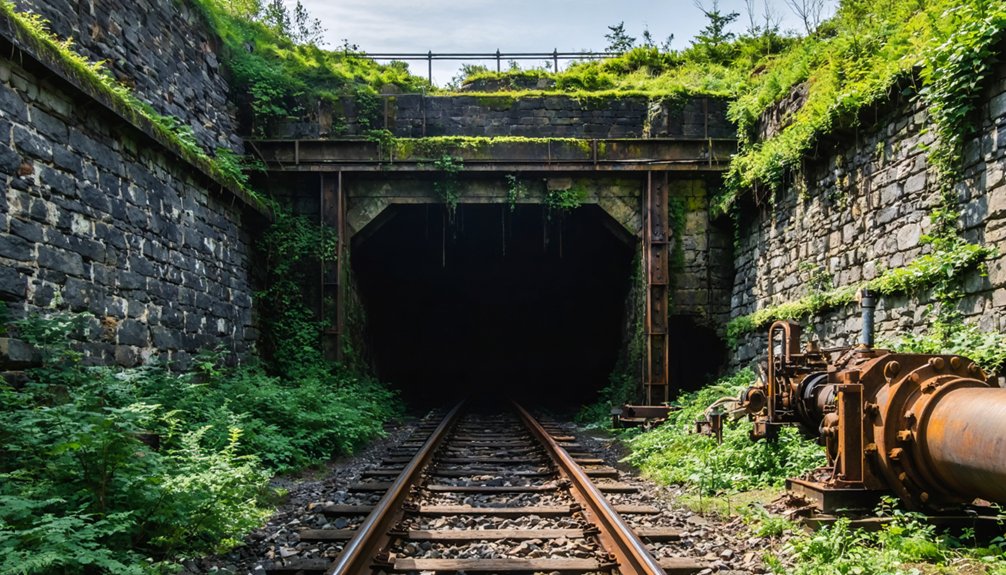
Beyond the trails and railroad grades, Gold Mine’s most compelling evidence lies beneath your feet and carved into the mountainside itself. You’ll discover extensive opencuts crisscrossing both sides of Cool Spring Branch, where 1890s prospectors gouged the earth hunting quartz veins. These manmade trenches form dramatic scars across the landscape, some resembling meteor strikes from above.
The shaft depths tell their own story—from Maryland’s 100-foot vertical drop in 1867 to Ford’s 200-foot workings in 1921. Waste rock piles tower near entrances, stacked high with material deemed uneconomical to process. Foundation ruins scatter the site: hoist houses, assay laboratories, mill remains.
George Kirk’s original opencut discoveries near Cool Spring Branch yielded roughly 5,000 ounces of gold, proving this remote Pennsylvania hollow once held genuine treasure.
Best Times to Visit and Seasonal Considerations
Spring runoff can turn gentle creek crossings into impassable barriers along the approach trails, forcing you to time your visit after the mountain snowmelt subsides but before summer’s biting flies claim the mine entrances.
By July, dense brush conceals both the old pathways and any snakes sheltering from midday heat, making each step through the overgrowth a careful negotiation.
Fall offers the sweet spot—cooler air for the uphill climb, thinning vegetation that reveals stone walls and coal seams, and mountain laurel branches stripped bare enough to frame the valley’s fading history.
Spring Water Flow Challenges
When frozen surfaces seal off Pennsylvania’s anthracite region each winter, the springs and mine discharges that prospectors rely on become encased in ice, transforming once-accessible water sources into crystal-locked barriers. You’ll face seasonal variations that dictate your prospecting success—groundwater fluctuations stabilize beneath the frost line while surface flows vanish. Winter’s grip extends into early spring, delaying your access to gold-bearing creeks.
Abandoned mine portals weeping icicles where discharge once flowed freely
Creek beds glazed in frozen sheets concealing black sand deposits below
Spring sources buried under snowdrifts, their locations obscured until thaw
Sub-zero nights crystallizing groundwater seeps along exposed rock faces
Ice-choked tributaries silencing the rush of mineral-rich water
These conditions persist well past calendar spring, demanding patience before you venture into Gold Mine’s forgotten hollows.
Summer and Fall Accessibility
As summer’s warmth discloses Gold Mine’s frozen corridors, you’ll discover the anthracite ghost town at its most forgiving—trails that winter buried beneath ice now stretch open for exploration, and the same springs that sealed shut in February weep freely down exposed rock faces. You’ll traverse extended hiking trails reaching four miles to Roush Gap, where mountain laurel blooms frame railroad remnants and stone foundations. Early mornings spare you from midday heat on steep grades.
September transforms these corridors. Fall foliage views ignite Sharp Mountain’s gaps, and leaf-drop exposes what summer concealed—bootleg workings, collapsed mine entrances, village ruins behind crumbling walls. You’ll walk three miles of overgrown rail beds with clear sight lines to coal towers and damsite remains, the undergrowth finally retreating.
Nearby Ghost Towns Worth Exploring
The abandoned coal patches and forgotten resorts scattered throughout Pennsylvania’s Stoney Valley create an interconnected web of ghost towns that’ll transport you back to the region’s industrial heyday. You’ll discover Rausch Gap 3.5 miles north along the rail trail, where foundations still mark where railroad workers once lived.
Cold Springs, a couple miles beyond, reveals the pronounced remains of an 1830s resort hotel that once welcomed wealthy travelers. Yellow Springs crowns Stoney Mountain’s peak, accessible via a four-mile hike through the valley’s network.
Trail imagery you’ll encounter:
- Weathered stone foundations emerging from forest floors
- Rusted iron rails disappearing into mountain laurel
- Cemetery headstones marking forgotten communities
- Creek-spanning bridges leading nowhere
- Moss-covered hotel remnants overlooking distant ridges
Each site offers unique lodging opportunities nearby and local artisan shops celebrating mining heritage.
Safety Tips and What to Bring on Your Trip
Before you set foot in Gold Mine or venture toward neighboring ghost towns, you’ll need to understand that these aren’t curated historic sites with handrails and warning signs—they’re wild, abandoned places where nature and decay have erased most traces of civilization’s safety measures.
Proper PPE recommendations include sturdy boots, long pants, gloves, and a bump cap minimum for head protection against low ceilings and falling debris. Pack a flashlight with extra batteries, first-aid kit, water, and whistle for emergencies.
Know that prohibited recreational activities include swimming in abandoned quarries and approaching mine openings—where toxic gases, unstable ground, and unexploded dynamite still lurk. Watch for sinkholes, cracked roads, and subsurface heat anomalies. These ruins demand respect, not recklessness.
Frequently Asked Questions
Are There Any Entrance Fees or Permits Required to Visit Gold Mine?
You won’t need permits or entrance fees at Gold Mine Gate—it’s free to explore. You’ll find parking availability along roadsides, though you should respect local regulations and trespassing warnings near abandoned structures for your safety.
How Long Does a Typical Visit to the Ghost Town Take?
You’ll need just one to two hours for your expected time commitment—enough to wander the scattered foundations, explore the graffiti-marked ruins, and navigate the overgrown trails. Accessibility considerations matter little here; nature’s reclaimed everything.
Is the Site Suitable for Children or Elderly Visitors?
The rugged terrain isn’t ideal for children or elderly visitors. You’ll navigate overgrown paths, stream crossings, and steep climbs without accessibility accommodations. If you’re bringing vulnerable companions, take serious safety precautions or consider alternative destinations.
Can You Camp Overnight Near the Gold Mine Ghost Town Area?
You’ll find endless camping availability surrounding Gold Mine’s haunting landscape. Pitch your tent at Blue Hill Acres or Gold Mine Speedway sites, where crackling campfires illuminate starlit nights. Nearby lodging options include Oil Creek’s primitive shelters for true backcountry freedom seekers.
Are There Any Guided Tours Available for Gold Mine, Pennsylvania?
No guided tour offerings exist for Gold Mine, Pennsylvania—you’ll explore independently through overgrown trails and abandoned ruins. Private tour options aren’t available either, leaving you free to discover the ghost town’s mysteries at your own pace.
As you wander the remnants of this once vibrant community, you can reflect on the broader context of ghost towns in Pennsylvania history, where similar stories of abandonment and resilience can be uncovered. From mining booms to the decline of local industries, each site carries its own unique tale, waiting to be deciphered by curious explorers. Discovering these forgotten places offers a fascinating glimpse into the past and the events that shaped the region.